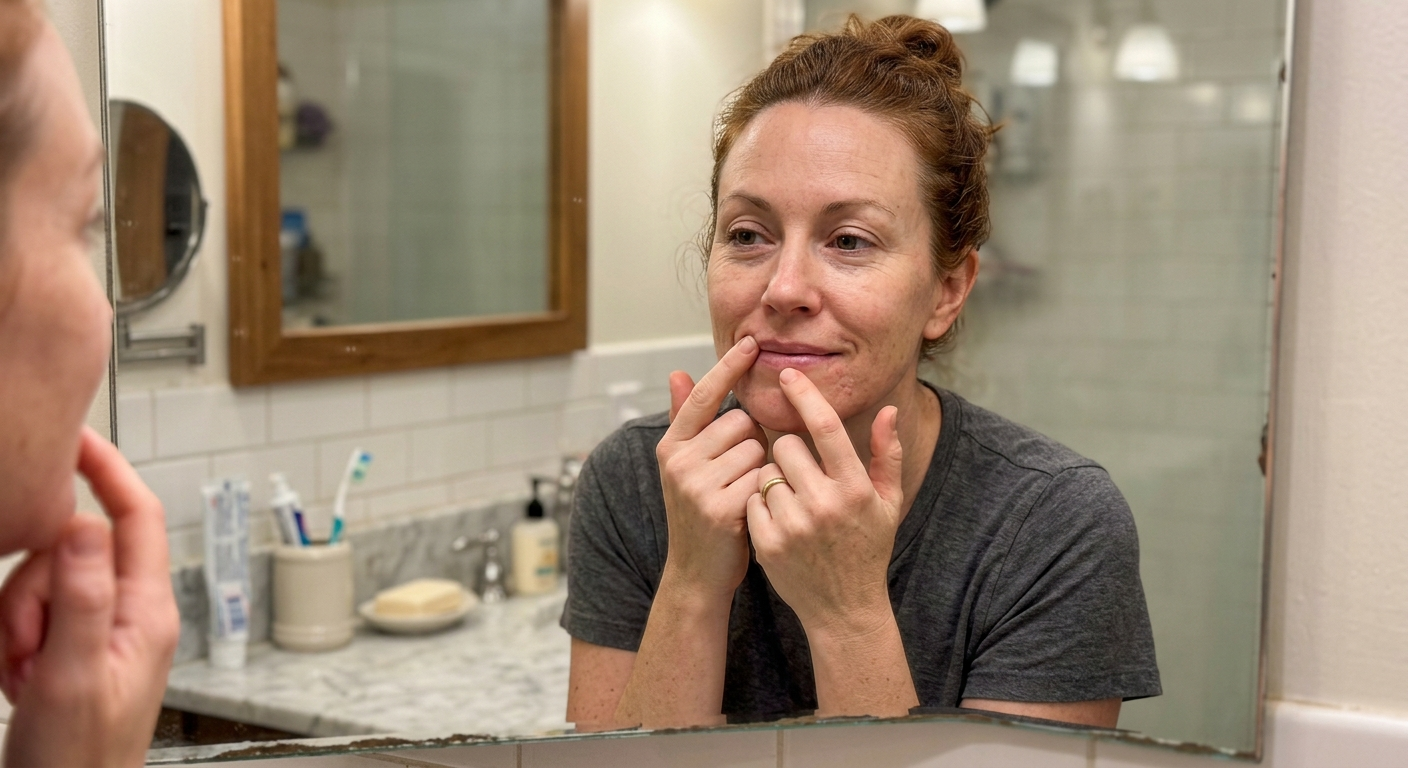
Melasma Mustache: Why Upper-Lip Pigmentation Happens and What Actually Fades It
That shadow above your lip is usually not a hair problem. It is a light-triggered pigment problem that needs a smarter routine.
A melasma mustache is one of the most frustrating forms of facial pigmentation because of where it sits. A faint brown shadow on the upper lip can read like facial hair even when the skin is perfectly smooth. It can also look darker after waxing, heat, sun exposure, pregnancy, birth control changes, or a beach weekend that seemed harmless at the time.
The important thing to understand is that this is usually not a surface stain. Melasma is a chronic pigment pattern in sun-exposed skin, and the upper lip is one of its classic facial locations. Reviews describe melasma as an acquired hypermelanosis that appears most often on the face, especially in women and in people with darker or more easily tanning skin tones [1]. That does not mean you are stuck with it. It means the routine has to treat pigment formation, visible light exposure, inflammation, and cell turnover at the same time.
Why the Upper Lip Is So Prone to Melasma
The upper lip is a perfect storm for pigmentation. It receives daily UV exposure, catches heat, moves constantly, and is often irritated by hair removal. Waxing, threading, depilatories, and aggressive scrubbing can all create low-grade inflammation. In inflammation-prone skin, that can tell melanocytes to produce more pigment.
Hormones are the other major piece. Melasma is strongly associated with pregnancy, oral contraceptives, and hormonal shifts, although not every case is hormonal. The visible pattern is the same: pigment-making cells become overreactive, then deposit excess melanin unevenly across the epidermis and sometimes deeper in the dermis. Once that pigment pathway is switched on, small triggers can make the shadow return.
This is why a melasma mustache often seems to fade in winter and come roaring back in summer. It is not your imagination. Melasma is unusually light-sensitive, and modern research treats it less like a simple dark spot and more like a photoaging disorder involving pigment, blood vessels, inflammation, and barrier stress [2].
The Sunscreen Mistake That Keeps It Coming Back
If you are using sunscreen but your upper lip keeps darkening, the missing piece may be visible light. A double-blind randomized trial found that protection against both UV and near-visible light improved melasma treatment more than UV-only protection [3]. In practice, that usually means a broad-spectrum SPF plus iron oxides, the mineral pigments found in many tinted sunscreens.
If you are using sunscreen but your upper lip keeps darkening, the missing piece may be visible light.
For a melasma mustache, tinted sunscreen is not cosmetic fluff. It is part of the treatment plan. Apply it over the entire upper lip area, not just the cheeks and forehead, and reapply before driving, walking outside, or sitting near bright windows. Heat also matters, so repeated sauna sessions, hot yoga, and prolonged direct sun can keep the pigment pathway active even when you are technically wearing SPF.
If your pigmentation is broader than the upper lip, our guide to sunscreen for hyperpigmentation explains why visible-light protection changes the outcome for stubborn dark spots.
What Actually Fades a Melasma Mustache
The best routine is layered, not harsh. Think of it as turning down several pigment signals at once.
First, reduce stimulation. That means daily tinted SPF, less heat exposure, and gentler hair removal. If waxing always leaves your upper lip red, irritated, or darker, switch to trimming, dermaplaning, or another less inflammatory method. Pigment-prone skin often punishes aggressive treatment.
Second, use pigment-blocking ingredients. Tranexamic acid, azelaic acid, niacinamide, vitamin C, kojic acid, arbutin, and other tyrosinase-targeting ingredients can help slow melanin production. Systematic reviews of melasma treatments find the strongest evidence for prescription options such as hydroquinone and triple-combination therapy, while several nonprescription brighteners have supportive but more variable evidence [4]. If you want a deeper ingredient ranking, start with tyrosinase inhibitors for dark spots and our focused guide to tranexamic acid for dark spots.
If you wear foundation, do not count it as your only visible-light protection unless it is applied generously and layered over sunscreen.
Third, support healthy cell turnover. Tretinoin has been studied directly for melasma; in a vehicle-controlled clinical trial, topical tretinoin improved melasma in Black patients over 40 weeks [5]. Retinoids help because they speed the movement of pigment-loaded cells toward the surface while also supporting collagen and overall photoaging repair. The catch is irritation: if a retinoid makes the upper lip sting, peel, or inflame, it can worsen the very pigment you are trying to fade.
Where Nanoretinol® Fits
This is where delivery matters. Conventional retinol can be valuable for uneven tone, but the upper lip is a sensitive, high-movement area. A formula that forces retinol through the barrier by irritating it is a poor match for pigment-prone skin.
Nanoretinol® was designed around a different premise: deliver stabilized 0.2% retinol inside biomimetic lipid nanoparticles, so the active can reach skin more efficiently without relying on barrier disruption. North Biomedical’s research found Nanoretinol® to be 232% more effective in collagen recovery and 73% more effective in elastin recovery than conventional retinol, with significantly gentler effects on skin cells. That matters for melasma-prone skin because firmness, turnover, and barrier calm all have to work together.
Nanoretinol® is not a prescription melasma drug, and no cosmetic should be framed as a cure. Its role is smarter anti-aging support: helping the skin renew and rebuild without the level of irritation that often derails pigment routines. If your main concern is broader discoloration, our guide to retinol for dark spots explains the turnover side in more detail.
A Practical Upper-Lip Routine
In the morning, cleanse gently, apply a brightening serum if your skin tolerates it, moisturize if needed, then finish with tinted broad-spectrum SPF. Reapply SPF to the upper lip before meaningful light exposure. If you wear foundation, do not count it as your only visible-light protection unless it is applied generously and layered over sunscreen.
At night, use one active lane at a time. On some nights, use a pigment-focused serum such as tranexamic acid, niacinamide, or azelaic acid. On other nights, use a gentle retinoid or Nanoretinol®. Avoid stacking acids, scrubs, retinoids, and waxing trauma on the same small patch of skin. The upper lip does not need punishment. It needs consistency.
If the pigment is rapidly changing, sharply bordered, gray-blue, itchy, scaly, or resistant to a careful routine, see a dermatologist. Melasma is common, but not every dark patch above the lip is the same thing. Prescription hydroquinone, triple-combination therapy, oral tranexamic acid, and procedural options can be appropriate in selected cases under medical supervision; a randomized trial found oral tranexamic acid improved moderate-to-severe melasma, but it is not a casual supplement and requires screening for risk [6].
The Takeaway
A melasma mustache fades when you stop treating it like a stain and start treating it like a reactive pigment system. Daily tinted sunscreen is the anchor. Gentle brighteners help turn down melanin production. Retinoids support turnover, but only if they are delivered without provoking irritation. For mature skin, the winning routine is not the harshest one. It is the one your upper lip can tolerate long enough to change.
References
- Handel AC, Miot LDB, Miot HA. “Melasma: a clinical and epidemiological review.” Anais Brasileiros de Dermatologia. 2014;89(5):771-782. doi:10.1590/abd1806-4841.20143063
- McKesey J, Tovar-Garza A, Pandya AG. “Melasma Treatment: An Evidence-Based Review.” American Journal of Clinical Dermatology. 2020;21(2):173-225. doi:10.1007/s40257-019-00488-w
- Castanedo-Cazares JP, Hernandez-Blanco D, Carlos-Ortega B, Fuentes-Ahumada C, Torres-Alvarez B. “Near-visible light and UV photoprotection in the treatment of melasma: a double-blind randomized trial.” Photodermatology, Photoimmunology & Photomedicine. 2014;30(1):35-42. doi:10.1111/phpp.12086
- Pennitz A, Kinberger M, Avila Valle G, Passeron T, Nast A, Werner RN. “Self-applied topical interventions for melasma: a systematic review and meta-analysis of data from randomized, investigator-blinded clinical trials.” British Journal of Dermatology. 2022;187(3):309-317. doi:10.1111/bjd.21244
- Kimbrough-Green CK, Griffiths CEM, Finkel LJ, Hamilton TA, Bulengo-Ransby SM, Ellis CN, et al. “Topical retinoic acid (tretinoin) for melasma in black patients. A vehicle-controlled clinical trial.” Archives of Dermatology. 1994;130(6):727-733. PubMed: 8002642
- Del Rosario E, Florez-Pollack S, Zapata L Jr, Hernandez K, Tovar-Garza A, Rodrigues M, et al. “Randomized, placebo-controlled, double-blind study of oral tranexamic acid in the treatment of moderate-to-severe melasma.” Journal of the American Academy of Dermatology. 2018;78(2):363-369. PubMed: 28987494