Orange Peel Skin: Why Your Pores Look Pitted and How to Smooth the Texture
The collagen story behind rough, dimpled facial texture — and what genuinely refines it
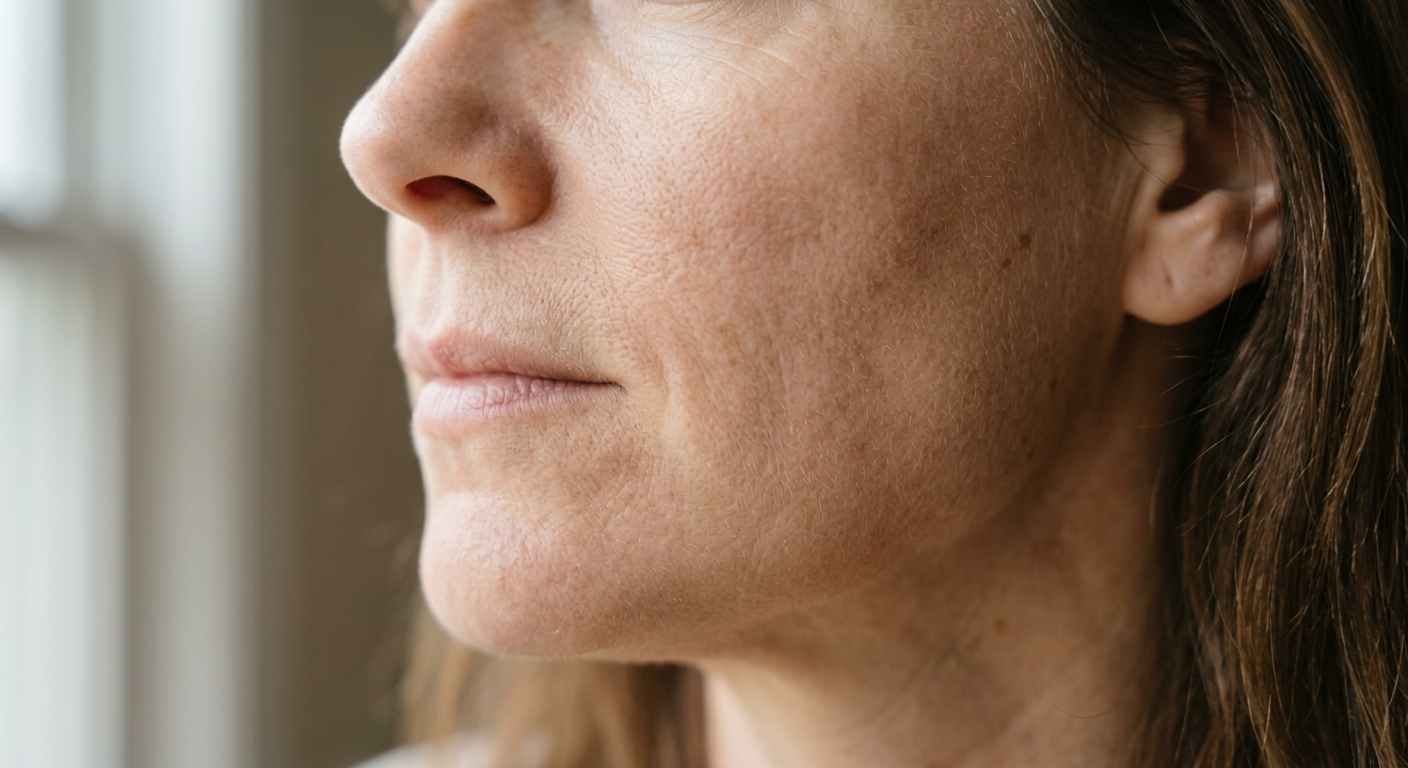
You notice it most in unforgiving light — the bathroom mirror at midday, or the front camera of your phone. The skin across your cheeks or chin looks faintly pitted and dimpled, the pores standing out like the tiny dots on a citrus rind. People call it “orange peel skin,” and while the name is unflattering, the concern behind it is real and extremely common. The good news: it is a cosmetic texture issue, not a medical one, and it responds well to the right approach.
What Orange Peel Skin Actually Is
Orange peel skin is not one single flaw. It is two things happening together: pores that have become more visible, and a surface that has lost its smooth, even reflectivity. When light hits skin with this texture, it scatters instead of bouncing back cleanly — which is why the dimpling seems to appear and disappear depending on the angle and lighting.
It tends to show up first on the cheeks, nose, and chin, and it becomes more noticeable from the late thirties onward. That timing is a clue. Orange peel texture is closely tied to skin aging, and understanding why is the key to actually improving it.
The Two Layers of the Problem
Layer one: your pores
A pore is simply the visible opening of a hair follicle, and its apparent size is governed by a few measurable factors. A thorough review of facial pores identified three main drivers: how much oil (sebum) the skin produces, the size of the hair follicle itself, and the elasticity of the skin surrounding the opening [1]. Sebum matters because oil physically widens the pore channel — one quantitative study found a direct correlation between sebum output and measured pore size [2].
But oil is only part of the story, and for mature skin it is often not the main part. Research measuring skin properties found that reduced elasticity is a dominant determinant of pore size: as the skin around each pore loses its springiness, the opening relaxes and gapes wider [3]. A pore is held in a neat round shape by the firm tissue around it. When that tissue softens, the pore loses its frame.
Orange peel texture is closely tied to skin aging, and understanding why is the key to actually improving it.
Layer two: the foundation underneath
This is where orange peel skin connects to aging. The firmness that keeps pores tight and the surface smooth comes from the dermis — the deep layer built from collagen and elastin. A comprehensive review of dermal aging describes how collagen production falls, existing collagen degrades, and the extracellular matrix that organizes the whole layer becomes disordered over time [4]. The result is skin that is thinner, laxer, and rougher at the surface.
Imaging research makes the link explicit. A confocal-microscopy study of visibly enlarged pores found they sit above measurable structural changes in the dermis — loss of collagen density and altered tissue architecture right around the pore [5]. In other words, “orange peel” texture is what dermal collagen loss looks like from the outside.
Why Sun Exposure Makes It Worse
If aging sets the stage, ultraviolet light speeds everything up. Chronic UV exposure triggers enzymes that break down dermal collagen and elastic fibers, leaving behind the disorganized matrix that dermatologists call solar elastosis [6]. Photodamaged skin is, quite literally, measurably rougher at the microscopic level. This is why orange peel texture is so often most visible on the sun-exposed cheeks rather than more sheltered areas — and why daily sun protection is non-negotiable for anyone trying to smooth their skin. Our article on solar elastosis goes deeper on this damage.
What Actually Smooths the Texture
Because the problem is rooted in the dermis, lasting improvement has to reach the dermis. Surface scrubs and blurring primers can help skin look smoother for an evening, but they do nothing for the underlying cause.
In North Biomedical’s clinical study against conventional retinol, users recorded a 61% increase in skin firmness and a 56% increase in elasticity over 56 days.
Retinoids
Retinoids — vitamin A derivatives — are the most evidence-backed option for refining texture, because they directly address both layers of the problem. They prompt the skin to build new collagen, which firms the tissue around each pore, and they normalize cell turnover, which smooths the surface. A 12-week clinical trial comparing retinoid formulations found that all of them produced progressive improvement in pore size, skin roughness, and fine lines [7]. This is the same ingredient class covered in our guide to refining skin texture.
Niacinamide
Niacinamide (vitamin B3) is a strong supporting player. A controlled clinical study found that topical niacinamide measurably improved several signs of aging facial skin, including texture-related parameters [8]. It also helps regulate oil, addressing the sebum side of the pore equation. See our full breakdown of niacinamide’s benefits for how to layer it.
Daily sunscreen
Since UV damage actively worsens texture, broad-spectrum SPF is both prevention and treatment. It is the one product that stops you from undoing your own progress.
The Delivery Problem
There is a reason so many people try a retinoid for orange peel skin and give up. Conventional retinol can be harsh — stinging, flaking, and redness are common in the first weeks, especially on the sensitive cheeks where this texture lives. Much of that irritation comes from formulas that push retinol inward by disrupting the skin barrier.
North Biomedical developed Nanoretinol to take a different route. It encapsulates retinol in biomimetic lipid nanoparticles that ferry the active across the skin barrier efficiently, without the barrier disruption that drives irritation — which is why a gentle 0.2% concentration is enough to work. In North Biomedical’s clinical study against conventional retinol, users recorded a 61% increase in skin firmness and a 56% increase in elasticity over 56 days. Since slack, low-elasticity skin is exactly what lets pores gape, firmer skin is the most direct route to a smoother, less pitted surface.
Smoothing Is a Long Game
Orange peel skin did not appear overnight, and it will not vanish overnight. But it is genuinely improvable. Protect your skin from the sun, commit to a well-tolerated retinoid, support it with niacinamide, and give the routine three to six months. You are not chasing a filter — you are rebuilding the foundation that keeps skin smooth, and that foundation is worth the patience.
References
- Lee SJ, Seok J, Jeong SY, Park KY, Li K, Seo SJ. “Facial Pores: Definition, Causes, and Treatment Options.” Dermatologic Surgery. 2016;42(3):277-285. doi:10.1097/DSS.0000000000000657
- Roh M, Han M, Kim D, Chung K. “Sebum output as a factor contributing to the size of facial pores.” British Journal of Dermatology. 2006;155(5):890-894. doi:10.1111/j.1365-2133.2006.07465.x
- Hameed A, Akhtar N, Khan HMS, Asrar M. “Skin sebum and skin elasticity: Major influencing factors for facial pores.” Journal of Cosmetic Dermatology. 2019;18(6):1968-1974. doi:10.1111/jocd.12933
- Shin SH, Lee YH, Rho NK, Park KY. “Skin aging from mechanisms to interventions: focusing on dermal aging.” Frontiers in Physiology. 2023;14:1195272. doi:10.3389/fphys.2023.1195272
- Nkengne A, Pellacani G, Ciardo S, De Carvalho N, Vié K. “Visible characteristics and structural modifications relating to enlarged facial pores.” Skin Research and Technology. 2021;27(4):560-568. doi:10.1111/srt.12984
- Watson REB, Gibbs NK, Griffiths CEM, Sherratt MJ. “Damage to skin extracellular matrix induced by UV exposure.” Antioxidants & Redox Signaling. 2014;21(7):1063-1077. doi:10.1089/ars.2013.5653
- McDaniel DH, Mazur C, Wortzman MS, Nelson DB. “Efficacy and tolerability of a double-conjugated retinoid cream vs 1.0% retinol cream or 0.025% tretinoin cream in subjects with mild to severe photoaging.” Journal of Cosmetic Dermatology. 2017;16(4):542-548. doi:10.1111/jocd.12381
- Bissett DL, Miyamoto K, Sun P, Li J, Berge CA. “Topical niacinamide reduces yellowing, wrinkling, red blotchiness, and hyperpigmented spots in aging facial skin.” International Journal of Cosmetic Science. 2004;26(5):231-238. doi:10.1111/j.1467-2494.2004.00228.x