Plumping Serum: What Actually Plumps Aging Skin After 40
A good plumping serum can make skin look fresher fast, but long-term bounce comes from hydration, barrier repair, and collagen support.
“Plumping” is one of the most abused words in skincare. It can mean a serum that gives skin a dewy cushion for three hours. It can mean a formula that hydrates the surface so fine lines look softer. Or it can mean a product that supports the deeper collagen and elastin network responsible for real bounce.
Those are very different promises.
After 40, skin often looks less plump for three overlapping reasons: it holds less water, the barrier loses lipids, and the dermal matrix loses collagen, elastin, and hyaluronic acid. A good plumping serum should address at least two of those layers. A great one gives an immediate cosmetic improvement while also supporting the structures that make skin look naturally firm.
Why Skin Stops Looking Plump
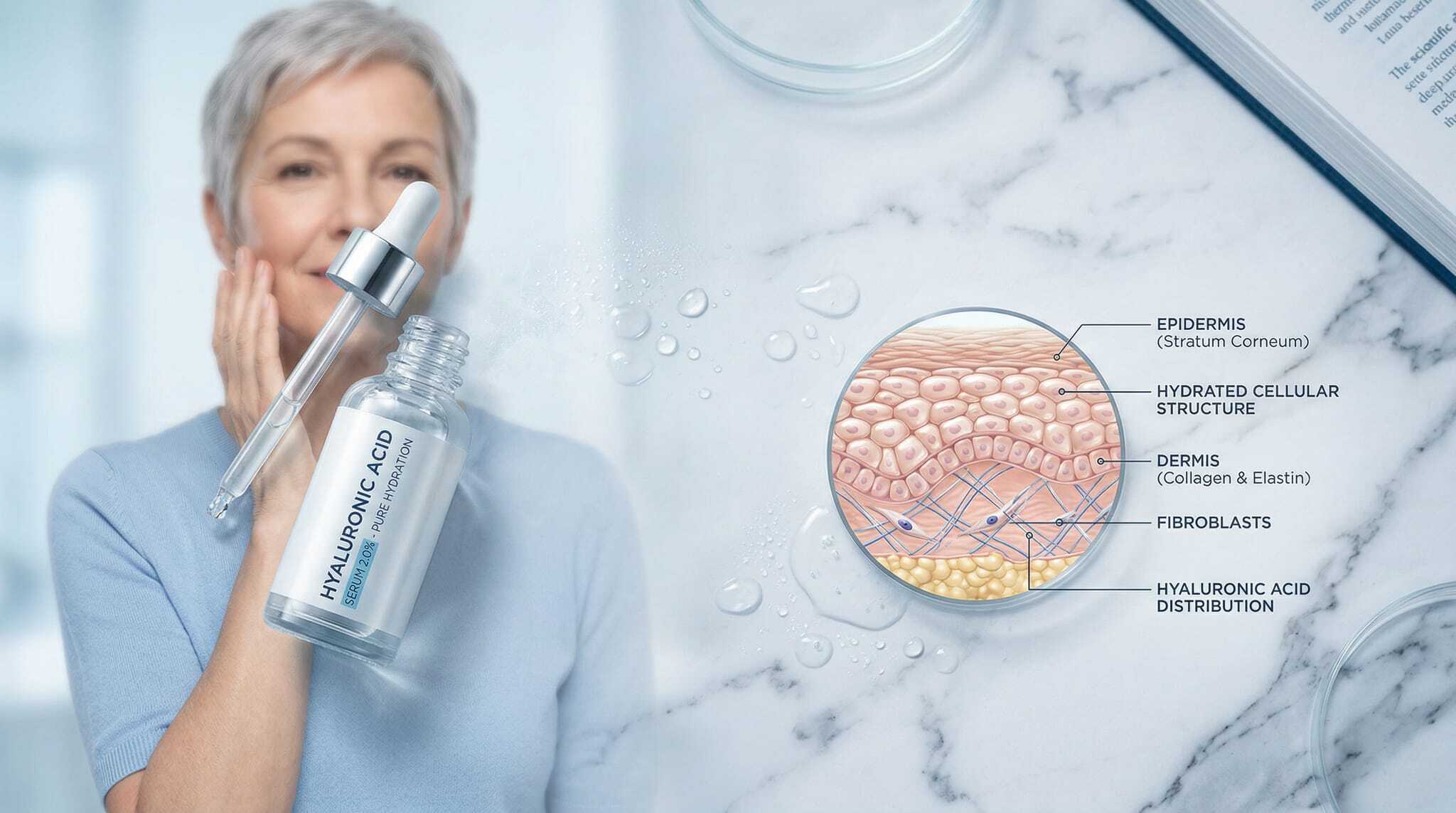
Youthful skin looks full because the dermis behaves like a water-rich mattress. Collagen provides tensile strength, elastin gives recoil, and hyaluronic acid binds water throughout the matrix. With age and UV exposure, that mattress thins. Fibroblasts become less active, collagen fragments accumulate, elastin becomes disorganized, and hyaluronic acid content shifts in ways that reduce moisture retention [1].
That is why “dehydrated” and “aged” can look similar in the mirror. Both create fine surface lines, dullness, and a flatter texture. But they are not the same. Dehydration can improve quickly. Collagen and elastin loss require longer-term active treatment.
This distinction matters because many serums give a beautiful first impression and then plateau. They pull water into the outer skin, which is useful, but they do not change the deeper architecture. For mature skin, the goal is not to choose between instant hydration and structural support. It is to combine them intelligently.
The Ingredients That Plump Fast
Hyaluronic acid is the classic plumping ingredient because it binds water efficiently. A review of hyaluronic acid and skin aging describes its central role in skin moisture, turgor, and resilience [1]. In a clinical study of topical hyaluronic acid formulas with different molecular weights, several formulas improved wrinkle appearance and skin hydration, with low-molecular-weight HA showing notable wrinkle-depth improvements [2].
Collagen provides tensile strength, elastin gives recoil, and hyaluronic acid binds water throughout the matrix.
That does not mean every HA serum is magic. Humectants work best when the skin has water available and a moisturizer or barrier-supportive layer seals it in. In dry air, a thin HA serum used alone can leave some people feeling tight. Glycerin, beta glucan, panthenol, polyglutamic acid, and sodium PCA can all contribute to the same water-binding strategy. Our guides to hyaluronic acid benefits and polyglutamic acid go deeper on that immediate hydration side.
Niacinamide is another useful plumping-adjacent ingredient because it improves barrier function and visible tone. A clinical study found topical niacinamide improved multiple signs of aging facial skin, including fine lines, wrinkles, blotchiness, and hyperpigmented spots [3]. It will not create filler-like volume, but it can make skin behave less dry, less reactive, and more even.
The Ingredients That Rebuild Bounce
For longer-term plumping, look beyond water-binding. Retinoids remain the most studied topical class for collagen support. In a randomized trial of naturally aged skin, topical retinol improved fine wrinkles and increased glycosaminoglycan and procollagen production markers [4]. Vitamin C also matters because it is required for collagen synthesis and antioxidant defense, although formula stability and packaging decide whether a vitamin C product actually delivers [5].
Peptides, growth-factor-style formulas, and copper peptides can be useful, but the evidence varies by peptide and formula. A “peptide complex” on a label is not automatically meaningful. The same is true for collagen serums: collagen molecules are generally too large to rebuild your dermis from the outside. They can moisturize; they are not replacement scaffolding. If firmness is your priority, our guide to skin firming serum ranks the evidence more directly.
What to Avoid in a Plumping Serum
Avoid formulas that confuse shine with plumpness. Heavy silicones and reflective particles can blur texture, which is not a bad thing, but they are makeup effects. They do not hydrate the skin or support the dermis.
Also be cautious with over-exfoliating “glow” serums. Acids can make skin look smoother by shedding dull cells, but too much exfoliation damages the barrier and makes mature skin look thinner, drier, and more lined. If a serum burns every time you apply it, that is not plumping. That is inflammation.
North Biomedical developed Nanoretinol® as a stabilized 0.2% retinol encapsulated in biomimetic lipid nanoparticles.
Finally, do not chase the highest retinol percentage. A strong retinol that your skin can only tolerate once a week may deliver less practical benefit than a smarter, gentler formula you can use consistently. Delivery matters as much as the ingredient name.
Where Nanoretinol® Belongs in a Plumping Routine
Nanoretinol® is not a humectant serum. It will not mimic the same instant glassy effect as a hyaluronic acid layer. Its role is deeper: supporting the collagen and elastin side of plumpness while reducing the irritation that often makes conventional retinol difficult for mature skin.
North Biomedical developed Nanoretinol® as a stabilized 0.2% retinol encapsulated in biomimetic lipid nanoparticles. The delivery system is designed to move retinol through the epithelial barrier more efficiently, without relying on the barrier-disrupting mechanisms that make many conventional retinols sting, peel, or redden skin. In North Biomedical’s research, Nanoretinol® produced 232% greater collagen recovery and 73% greater elastin recovery than conventional retinol, and clinical use showed measurable gains in firmness and elasticity over 56 days.
That makes Nanoretinol® a logical night step in a plumping routine: use a hydrating serum for immediate cushion, a moisturizer to seal it, and Nanoretinol® to support the structures that make skin look firmer over time. For a broader explanation of why firmness fades, see our guide to skin firmness loss.
A Simple Plumping Routine After 40
In the morning, use a hydrating serum with hyaluronic acid, glycerin, beta glucan, or polyglutamic acid on slightly damp skin. Follow with moisturizer, then sunscreen. Sunscreen is non-negotiable because UV exposure breaks down the same collagen network you are trying to rebuild.
At night, separate hydration from treatment. On most nights, layer a water-binding serum under moisturizer. Add Nanoretinol® or another well-tolerated retinoid according to your skin’s tolerance. If you use vitamin C, many people prefer it in the morning under SPF, but sensitive skin may do better alternating actives rather than stacking them.
You do not need ten plumping products. You need one good hydrator, one barrier-supportive moisturizer, one collagen-supportive active, and daily sunscreen. The result is less dramatic than filler, but it is also more biologically honest: smoother surface lines now, better bounce with time.
The Smart Way to Judge Results
Judge a plumping serum in two windows. The first window is the same day: does skin look smoother, more hydrated, and less tight within a few hours? The second window is eight to twelve weeks: do fine lines look less etched, does makeup sit better, and does skin recover faster from dryness?
If you only get the first result, you bought a decent hydrator. If you get both, you found a real anti-aging routine.
References
- Papakonstantinou E, Roth M, Karakiulakis G. “Hyaluronic acid: A key molecule in skin aging.” Dermato-Endocrinology. 2012;4(3):253-258. doi:10.4161/derm.21923
- Pavicic T, Gauglitz GG, Lersch P, Schwach-Abdellaoui K, Malle B, Korting HC, et al. “Efficacy of cream-based novel formulations of hyaluronic acid of different molecular weights in anti-wrinkle treatment.” Journal of Drugs in Dermatology. 2011;10(9):990-1000. PubMed: 22052267
- Bissett DL, Oblong JE, Berge CA. “Niacinamide: A B vitamin that improves aging facial skin appearance.” Dermatologic Surgery. 2005;31(7 Pt 2):860-865. doi:10.1111/j.1524-4725.2005.31732
- Kafi R, Kwak HSR, Schumacher WE, Cho S, Hanft VN, Hamilton TA, et al. “Improvement of naturally aged skin with vitamin A (retinol).” Archives of Dermatology. 2007;143(5):606-612. doi:10.1001/archderm.143.5.606
- Pullar JM, Carr AC, Vissers MCM. “The Roles of Vitamin C in Skin Health.” Nutrients. 2017;9(8):866. doi:10.3390/nu9080866