Sagging Jowls: What's Really Happening to Your Jawline and How to Fight Back
Jowl formation isn't a single event — it's the convergence of collagen loss, fat migration, and bone resorption that reshapes your lower face over decades
Why Your Jawline Isn’t What It Used to Be
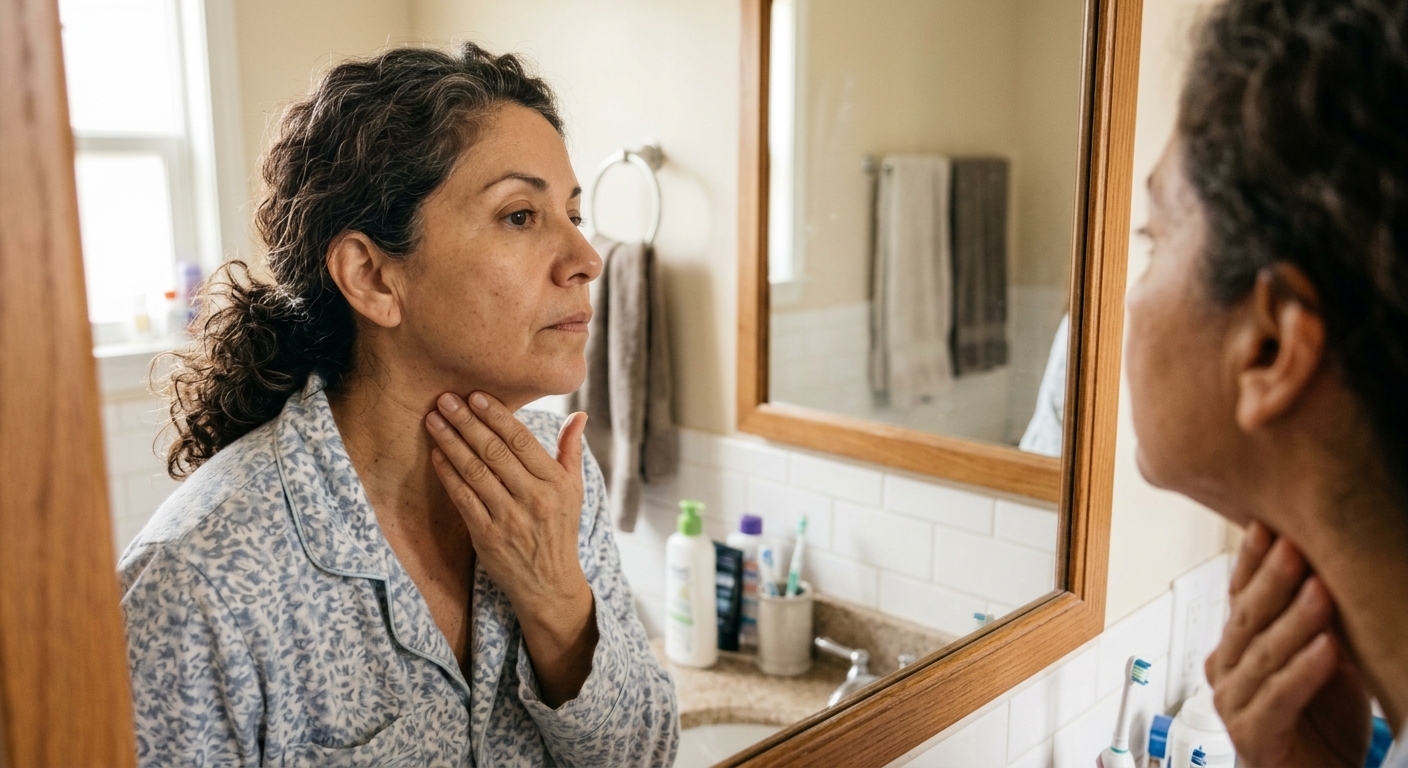
Stand in front of a mirror and trace your jawline with a finger. If you’re over 40, you’ve likely noticed that the clean, defined angle you once had has softened. The skin along your lower jaw hangs slightly below the bone — creating what dermatologists call jowls.
It’s one of the most common concerns women bring to cosmetic consultations, and it’s also one of the most misunderstood. Most people think jowls are simply “loose skin.” The reality involves three distinct biological processes happening simultaneously, and understanding them is the first step toward doing something about it.
The Anatomy of Jowl Formation
Your Collagen Scaffolding Is Shrinking
The dermis — the thick structural layer beneath your skin’s surface — is composed primarily of collagen and elastin fibers woven into a dense mesh. This mesh gives skin its firmness and ability to snap back into place. After your mid-twenties, collagen production declines steadily. By your forties, you’ve already lost a substantial percentage of your original dermal collagen, and the rate of loss accelerates sharply during perimenopause and menopause [1].
But it’s not just about making less collagen. Your body simultaneously increases production of matrix metalloproteinases (MMPs) — enzymes that actively break down existing collagen. UV exposure further amplifies this imbalance: research published in the New England Journal of Medicine demonstrated that UV-irradiated skin shows significantly elevated MMP activity alongside suppressed collagen synthesis [2]. The result is a dermis that’s both thinner and mechanically weaker — less capable of resisting the downward pull of gravity on your lower face.
Your Facial Fat Is Migrating
Your face isn’t just skin over bone — between them lies an intricate arrangement of discrete fat compartments. In youth, the malar fat pad sits high on the cheeks, the buccal fat pad fills out the mid-face, and the mandibular fat pad maintains volume along the jawline.
With age, these compartments don’t simply deflate. The malar fat pad descends, pooling below its original position. Meanwhile, fat in the lower face tends to accumulate rather than shrink, creating heaviness along the jawline that gravity pulls downward. This redistribution — loss of volume above, accumulation below — is a key driver of jowl formation [3].
Your Jawbone Is Retreating
Perhaps the least intuitive factor: the mandible itself changes shape with age. The jawbone undergoes resorption, losing both height and forward projection. Studies using CT imaging have confirmed that the mandibular angle widens with age, and the overall bone volume decreases [4]. The bone that once provided a firm shelf for your facial tissues to drape over is literally shrinking away.
Imagine removing bricks from the bottom of a wall — the structure above inevitably collapses. That’s essentially what’s happening beneath your jowls.
Your face isn’t just skin over bone — between them lies an intricate arrangement of discrete fat compartments.
Risk Factors That Accelerate Jowl Formation
While everyone experiences these age-related changes to some degree, several factors determine how quickly and severely jowls develop:
Sun exposure is the primary accelerator. Chronic UV damage degrades collagen and elastin at rates far exceeding natural aging. A person with significant photoaging may develop jowls a decade earlier than someone with similar genetics who practiced diligent sun protection [2].
Genetics determine your baseline skin thickness, collagen density, facial bone structure, and fat distribution patterns. Thin-skinned individuals with delicate bone structures are predisposed to earlier and more visible jowling.
Hormonal changes during perimenopause and menopause trigger rapid collagen loss — up to 30% of dermal collagen in the first five years after menopause, according to some estimates [5].
Weight fluctuations stretch skin and weaken elastic fibers. Repeated weight gain and loss cycles compound this effect.
Smoking reduces microcirculation to the skin and generates oxidative stress that degrades structural proteins.
Evidence-Based Treatment Strategies
Topical Retinoids: The Collagen Rebuilder
The most evidence-backed topical ingredient for collagen restoration remains retinol. A landmark randomized controlled trial published in Archives of Dermatology demonstrated that topical retinol applied to naturally aged skin significantly increased procollagen expression, improved clinical fine wrinkling, and increased overall dermal collagen production [6].
For jowls specifically, preventing further collagen and elastin breakdown preserves whatever structural integrity your skin still has.
The challenge has always been tolerability. Conventional retinol formulations penetrate the skin barrier through a process that often damages it — using chemical vehicles that disrupt the lipid matrix of the stratum corneum. This produces the familiar retinol side effects: redness, flaking, and skin barrier compromise.
Nanoretinol® offers a fundamentally different delivery mechanism. Its biomimetic lipid nanoparticles pass through the epithelial barrier by mimicking cell membranes — the body recognizes the nanoparticles as “self” rather than mounting a defensive inflammatory response. The result: 232% greater collagen recovery than conventional retinol, with dramatically reduced irritation. For jowl treatment, where consistency over months and years matters more than any single application, this tolerability advantage translates directly into real-world results.
Sunscreen: Your Most Important Anti-Jowl Product
Daily broad-spectrum SPF protection prevents further collagen degradation far more effectively than any treatment can rebuild it. Australian clinical trial data showed that people who applied sunscreen daily for 4.5 years showed no detectable increase in skin aging, while the control group aged significantly [7]. For jowls specifically, preventing further collagen and elastin breakdown preserves whatever structural integrity your skin still has.
Professional Interventions
For established jowls where topical treatments alone are insufficient, several clinical interventions have evidence supporting their efficacy:
- Microfocused ultrasound (MFU-V) delivers focused energy to the SMAS layer — the deep fascial layer that surgeons tighten during facelifts. Clinical trials have demonstrated measurable skin tightening in the lower face and neck, with improvements continuing for up to six months post-treatment as neocollagenesis progresses [8].
- Radiofrequency (RF) treatments heat the dermis to stimulate collagen remodeling. Multiple sessions are typically needed, and results are more modest than ultrasound, but the approach is well-tolerated.
- Thread lifts provide mechanical lifting using absorbable sutures that also stimulate local collagen production along the thread path.
- Surgical facelift remains the most definitive treatment for significant jowling — repositioning descended fat pads, tightening the SMAS layer, and removing excess skin.
What Doesn’t Work (Despite the Marketing)
Facial exercises and “face yoga” have limited clinical evidence for treating established jowls. While some studies suggest modest improvements in perceived facial fullness, the underlying structural changes — bone resorption and fat pad descent — cannot be reversed through muscle activity [9].
Topical “firming” creams without retinoids typically contain ingredients that create a temporary tightening sensation through film-forming polymers. These effects wash off. Without ingredients that actually stimulate collagen synthesis, no lasting structural improvement occurs.
Jade rolling and gua sha may temporarily improve lymphatic drainage and reduce puffiness, but there’s no evidence they reverse collagen loss or reposition descended fat pads.
A Practical Jowl-Fighting Protocol
Based on the current evidence, here’s what the science supports:
Foundation layer (daily): Broad-spectrum SPF 30+ sunscreen, applied every morning without exception. A retinoid with proven collagen-stimulating efficacy applied nightly — ideally one that uses advanced delivery to maximize penetration while minimizing barrier disruption, like Nanoretinol®.
Support layer: Vitamin C serum in the morning (antioxidant protection plus collagen cofactor support). Peptides like GHK-Cu to provide additional collagen-signaling stimulation.
Structural layer (as needed): Professional treatments for volume restoration and tissue tightening, selected based on severity and individual anatomy.
The sooner you start, the more architectural support you preserve. But the collagen-synthesis machinery in your fibroblasts doesn’t retire — it responds to stimulation at any age [10]. The question isn’t whether it’s too late to start, but whether you’re using the right tools to send the right signals.
References
- Quan T, Fisher GJ. “Role of Age-Associated Alterations of the Dermal Extracellular Matrix Microenvironment in Human Skin Aging: A Mini-Review.” Gerontology. 2015;61(5):427-434. doi:10.1159/000371708
- Fisher GJ, Wang ZQ, Datta SC, Varani J, Kang S, Voorhees JJ. “Pathophysiology of Premature Skin Aging Induced by Ultraviolet Light.” New England Journal of Medicine. 1997;337(20):1419-1428. doi:10.1056/NEJM199711133372003
- Rohrich RJ, Pessa JE. “The Fat Compartments of the Face: Anatomy and Clinical Implications for Cosmetic Surgery.” Plastic and Reconstructive Surgery. 2007;119(7):2219-2227. doi:10.1097/01.prs.0000265403.66886.54
- Mendelson B, Wong CH. “Changes in the Facial Skeleton with Aging: Implications and Clinical Applications in Facial Rejuvenation.” Aesthetic Plastic Surgery. 2012;36(4):753-760. doi:10.1007/s00266-012-9904-3
- Brincat MP. “Hormone Replacement Therapy and the Skin.” Maturitas. 2000;35(2):107-117. PMID: 10924836
- Kang S, Duell EA, Fisher GJ, et al. “Application of Retinol to Human Skin In Vivo Induces Epidermal Hyperplasia and Cellular Retinoid Binding Proteins Characteristic of Retinoic Acid but Without Measurable Retinoic Acid Levels or Irritation.” Journal of Investigative Dermatology. 1995;105(4):549-556. doi:10.1111/1523-1747.ep12323445
- Hughes MCB, Williams GM, Baker P, Green AC. “Sunscreen and Prevention of Skin Aging: A Randomized Trial.” Annals of Internal Medicine. 2013;158(11):781-790. doi:10.7326/0003-4819-158-11-201306040-00002
- Fabi SG. “Noninvasive Skin Tightening: Focus on New Ultrasound Techniques.” Clinical, Cosmetic and Investigational Dermatology. 2015;8:47-52. doi:10.2147/CCID.S69118
- Alam M, Walter AJ, Geisler A, et al. “Association of Facial Exercise With the Appearance of Aging.” JAMA Dermatology. 2018;154(3):365-367. doi:10.1001/jamadermatol.2017.5142
- Varani J, Warner RL, Gharaee-Kermani M, et al. “Vitamin A Antagonizes Decreased Cell Growth and Elevated Collagen-Degrading Matrix Metalloproteinases and Stimulates Collagen Accumulation in Naturally Aged Human Skin.” Journal of Investigative Dermatology. 2000;114(3):480-486. doi:10.1046/j.1523-1747.2000.00902.x