Strawberry Legs: What Causes Those Dark Dots and How to Get Rid of Them
The dermatology behind follicular plugging, oxidized pores, and the evidence-based routine that actually smooths leg skin
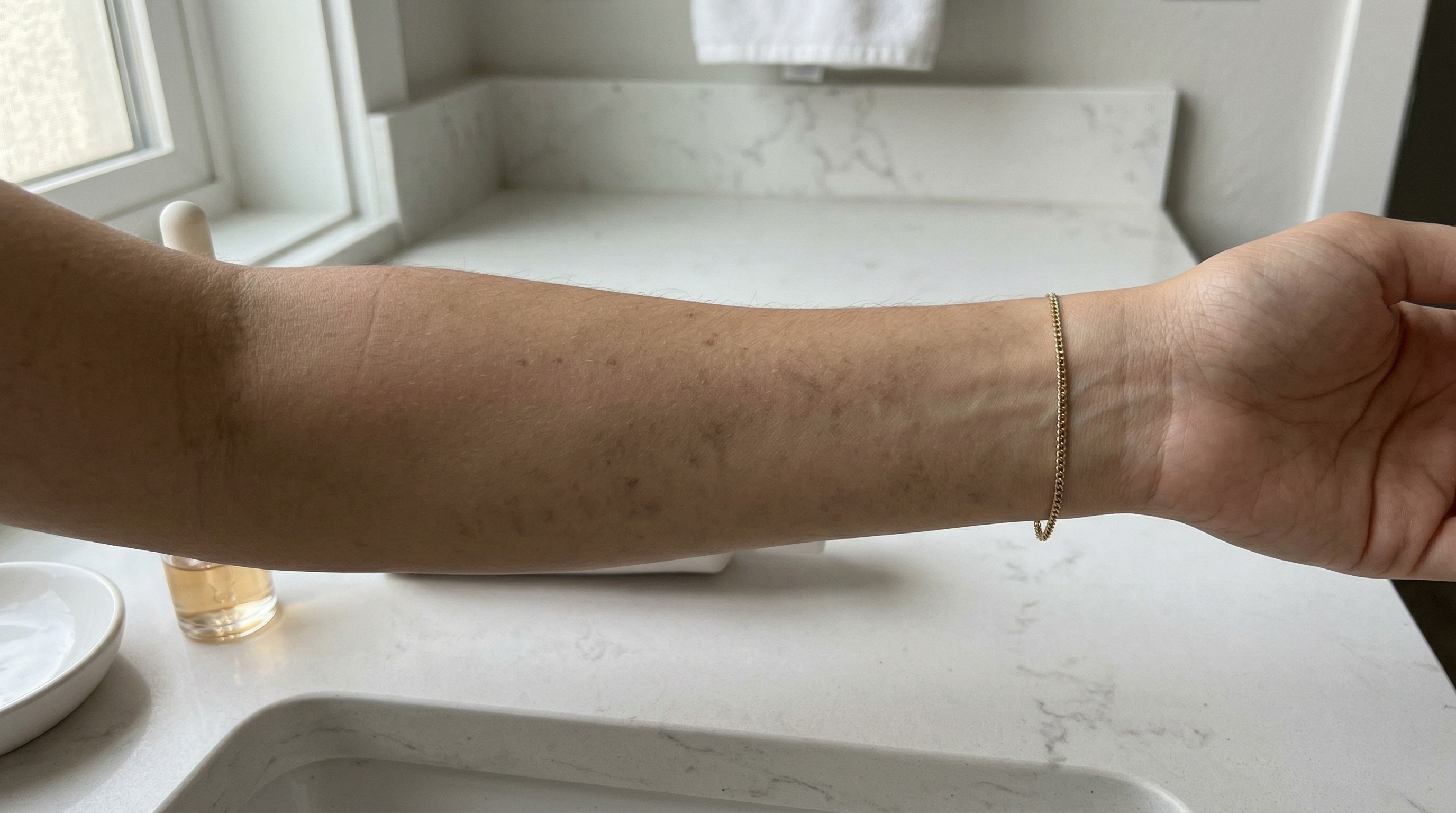
You step out of the shower, glance down, and there they are — dozens of tiny dark dots scattered across your shins and thighs like seeds on a strawberry. They’re not dirt. They don’t wash off. And if you’ve been shaving, waxing, or exfoliating in increasingly desperate attempts to make them disappear, you already know that most standard advice doesn’t work. It also explains why a self tanner often deepens the dots instead of camouflaging them.
“Strawberry legs” isn’t a medical diagnosis. It’s a colloquial term for the visible darkening of hair follicles on the legs — a pattern that affects a surprisingly large percentage of the population. Understanding what’s actually happening inside those follicles is the key to treating the appearance effectively.
What You’re Actually Seeing
Each dark dot on a strawberry leg corresponds to a single hair follicle or pore. Under normal conditions, these openings are barely visible. They become prominent when one of several things happens inside the follicular canal:
Oxidized sebum and debris. When oil, dead skin cells, and bacteria accumulate inside a hair follicle, they form a plug. If the top of that plug is exposed to air, it oxidizes — turning dark brown or black, much like a blackhead on the face. This is the most common mechanism behind strawberry legs, and it explains why the appearance worsens in areas with more active sebaceous glands [1].
Keratosis pilaris (KP). In roughly 50–80% of adolescents and a significant number of adults, the body overproduces keratin — the structural protein of skin, hair, and nails. This excess keratin plugs the follicular opening, creating rough, skin-colored or slightly reddened bumps [2]. On the legs, these plugs can trap hair beneath the surface and darken over time. KP is inherited in an autosomal dominant pattern, which means if one parent has it, you likely do too.
Folliculitis. Inflammation or mild infection of the hair follicle — often triggered by shaving — causes redness, small bumps, and sometimes darkened spots that mimic the strawberry pattern. Bacterial folliculitis and razor bumps are particularly common in people who shave against the grain or use dull blades [1].
Post-inflammatory hyperpigmentation. After any of the above conditions triggers inflammation, melanocytes in the surrounding skin can overproduce pigment. The dark dots that remain aren’t active plugs anymore — they’re pigment deposits left behind by the inflammatory process. This is especially common in deeper skin tones.
Why Shaving Often Makes It Worse
Here’s the frustrating cycle: shaving is the most common hair removal method for legs, but it’s also one of the primary triggers for strawberry legs.
When a razor cuts hair at the skin surface, the remaining hair shaft sits just below the opening of the follicle. If that follicle is slightly enlarged or the skin is dry, the dark cross-section of the cut hair becomes visible through the skin — creating the dotted appearance even without any clogging or inflammation.
Additionally, shaving can cause micro-trauma to the skin surface, triggering mild folliculitis and increasing keratin production as the skin attempts to repair itself. The result is a self-perpetuating cycle: shave to smooth the skin → irritation triggers more plugging and pigmentation → dark dots appear → shave again [1].
Breaking this cycle requires addressing the underlying follicular condition, not just removing the hair.
Understanding what’s actually happening inside those follicles is the key to treating the appearance effectively.
Evidence-Based Treatments That Actually Work
Chemical Exfoliation: The Foundation
The most effective first-line treatment for strawberry legs is consistent chemical exfoliation. The goal is to dissolve the keratin plugs and dead skin cells that clog follicles, without the micro-trauma of physical scrubbing. Our guide to the best body scrub explains why particle shape decides whether a scrub helps or harms. A lactic or glycolic exfoliating body wash is an easy starting point, though leave-on lotions do more of the work.
Salicylic acid (BHA, 1–2%) is particularly effective because it’s oil-soluble — meaning it can penetrate into the follicular canal rather than just working on the skin surface. It dissolves the sebum and keratin mix that forms the plug. The StatPearls medical reference on keratosis pilaris notes salicylic acid as a standard topical treatment for follicular hyperkeratosis [2].
Glycolic acid (AHA, 8–12%) works differently — it loosens the bonds between dead skin cells on the surface, promoting smoother turnover and reducing the buildup that contributes to visible plugging. A body lotion with glycolic acid applied after showering addresses both texture and discoloration [3].
Lactic acid offers a gentler alternative to glycolic acid with the added benefit of being a natural humectant. At concentrations of 10–15%, it exfoliates effectively while simultaneously hydrating — valuable for the typically dry skin that worsens strawberry legs [3].
Urea (10–40%) is a keratolytic that softens hardened keratin plugs. At higher concentrations (20–40%), it actively breaks down the excess keratin that defines keratosis pilaris. Lower concentrations (10%) serve primarily as a deep moisturizer. Urea is particularly effective for KP because it directly targets the protein buildup at the root of the condition [2].
Retinoids: Addressing the Underlying Cause
While chemical exfoliants manage the symptoms, retinoids address the underlying dysfunction in keratinocyte behavior that causes excessive follicular plugging in the first place.
Topical retinoids normalize keratinocyte differentiation — essentially retraining skin cells to mature and shed properly rather than accumulating in the follicle. A randomized, placebo-controlled study of tazarotene 0.05% for keratosis pilaris showed significant improvement in pruritus, erythema, and roughness compared to vehicle-treated skin after 12 weeks [4]. Another study using tazarotene 0.01% in an oil-in-water emulsion demonstrated amelioration of KP after just 4–8 weeks [4].
The challenge with retinoids on the body is tolerance. Leg skin is thicker and less sensitive than facial skin, but traditional retinol formulations can still cause dryness, peeling, and irritation — particularly during the first few weeks. This initial “retinoid dermatitis” phase often discourages people from continuing long enough to see results.
Nanoretinol® offers an advantage here: its lipid nanoparticle encapsulation delivers retinol through the skin barrier without the chemical disruption that causes irritation. The nanoparticles are recognized as “self” by skin cells, bypassing the harsh adjustment period. Clinical data show +232% greater collagen recovery and dramatically reduced cytotoxicity compared to conventional retinol — meaning you get the keratinocyte-normalizing benefits of retinoid therapy without the peeling and redness that make body retinol use uncomfortable.
Hair Removal Alternatives
If shaving is contributing to your strawberry legs, switching methods can break the irritation cycle:
At higher concentrations (20–40%), it actively breaks down the excess keratin that defines keratosis pilaris.
Epilator or waxing removes hair from below the skin surface, eliminating the visible dark cross-section that contributes to the dotted pattern. The trade-off is temporary discomfort and a small risk of ingrown hairs.
Laser hair removal permanently reduces the number of active follicles. For strawberry legs driven by follicular darkening from hair, this can be the most effective long-term solution — studies show 810 nm diode laser significantly improves the appearance of keratosis pilaris [5].
Chemical depilatories dissolve hair below the skin surface without the blade-related micro-trauma of shaving. They’re a middle ground between razors and more permanent options.
The Combined Routine
The evidence points to a layered approach:
-
Cleanse gently. Use a fragrance-free body wash. Avoid hot water, which strips skin oils and worsens dryness — a primary KP trigger.
-
Exfoliate chemically, 2–3 times per week. Salicylic acid (2%) or glycolic acid (10%) body wash or lotion. Apply to damp skin and leave on for 1–2 minutes before rinsing, or use a leave-on body lotion.
-
Apply retinoid nightly. A body-specific retinol formulation, started slowly (every other night) and built up to daily use over 4–6 weeks.
-
Moisturize daily. A urea-based (10%) or ceramide-rich body lotion locks in hydration and continues the keratolytic effect throughout the day. Ceramides reinforce the skin barrier that exfoliation temporarily disrupts.
-
Protect from UV. If legs are exposed to sun, apply SPF to prevent post-inflammatory hyperpigmentation from darkening existing spots further.
When to See a Dermatologist
Strawberry legs are cosmetically frustrating but medically harmless. However, a dermatologist visit makes sense if:
- Over-the-counter treatments show no improvement after 8–12 weeks of consistent use
- The bumps are inflamed, painful, or show signs of infection (warmth, pus, spreading redness)
- You suspect the darkened dots are related to a different condition — folliculitis can sometimes mimic strawberry legs
- You want to explore prescription-strength retinoids or laser hair removal
Setting Realistic Expectations
Strawberry legs won’t disappear overnight, and for many people — especially those with genetically driven keratosis pilaris — some degree of follicular visibility may always be present. The goal of treatment isn’t perfection but significant improvement: smaller dots, less visible plugging, smoother texture, and reduced hyperpigmentation.
Most people see meaningful improvement within 6–8 weeks of consistent chemical exfoliation, with retinoid use adding further benefits over 3–6 months. The natural history of KP also works in your favor: the condition tends to improve with age as keratin production naturally decreases [6].
The most common mistake? Stopping treatment when improvement begins and assuming the problem is solved. Strawberry legs is a maintenance condition — consistent, gentle care beats aggressive intermittent treatment every time.
References
-
Decker A, Graber EM. “Over-the-counter Acne Treatments: A Review.” Journal of Clinical and Aesthetic Dermatology. 2012;5(5):32-40. PMID: 22808307
-
Pennycook KB, McCready TA. “Keratosis Pilaris.” StatPearls. Updated 2024. PMID: 31424870
-
Tang SC, Yang JH. “Dual Effects of Alpha-Hydroxy Acids on the Skin.” Molecules. 2018;23(4):863. doi:10.3390/molecules23040863
-
Thomas M, Khopkar US. “Keratosis Pilaris Revisited: Is It More Than Just a Follicular Keratosis?” International Journal of Trichology. 2012;4(4):255-258. doi:10.4103/0974-7753.111215
-
Ibrahim O, Khan M, Bolotin D, et al. “Treatment of Keratosis Pilaris With 810-nm Diode Laser: A Randomized Clinical Trial.” JAMA Dermatology. 2015;151(2):187-191. doi:10.1001/jamadermatol.2014.2211
-
Poskitt L, Wilkinson JD. “Natural History of Keratosis Pilaris.” British Journal of Dermatology. 1994;130(6):711-713. doi:10.1111/j.1365-2133.1994.tb03406.x