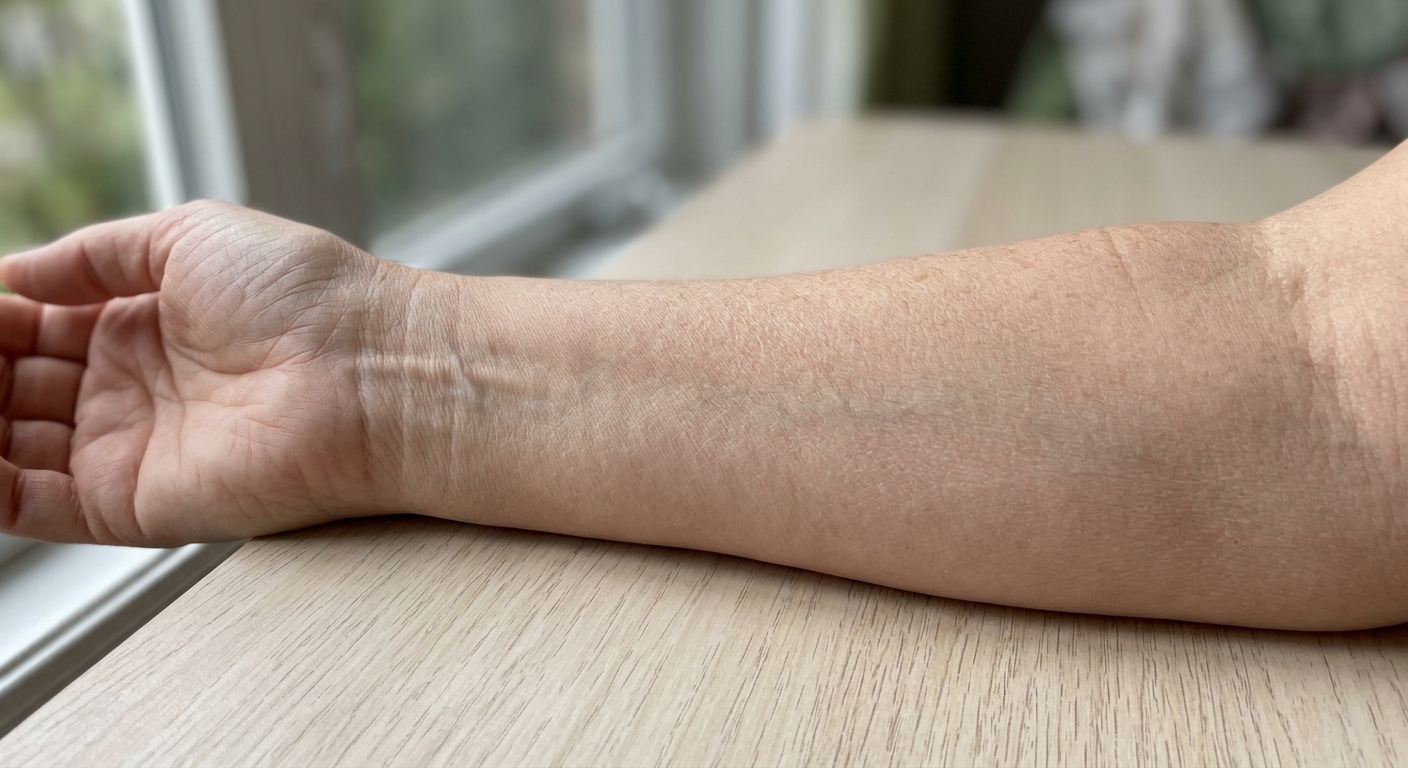
What Causes Crepey Skin? The Real Biology Behind That Thin, Papery Texture
Crepey skin is not the same as wrinkles — and understanding why it forms is the first step to reversing it
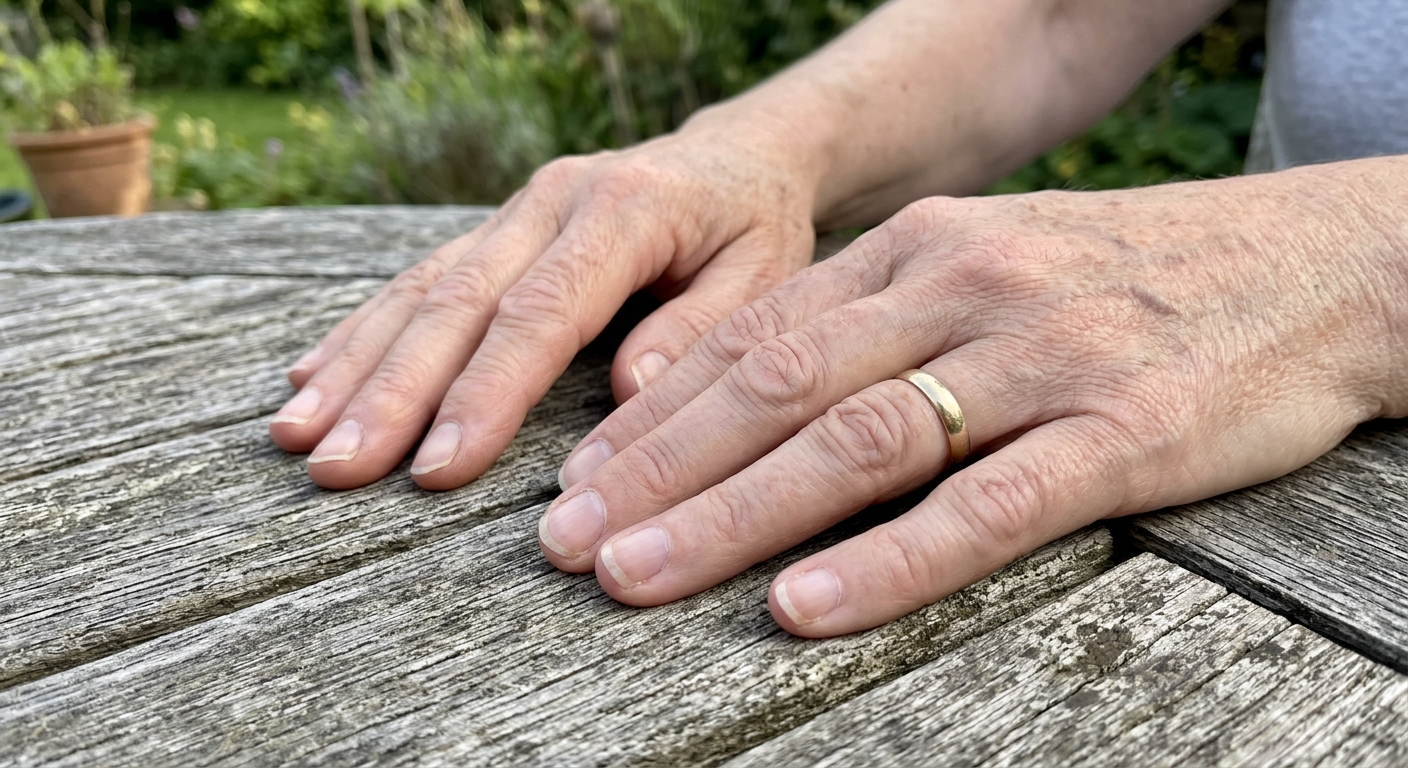
Crepey skin has a texture all its own. Run a finger across it and it feels thin and slack, covered in fine criss-crossing lines — like crepe paper, or the surface of a slowly deflating balloon. It shows up first in the places most people never think to protect: the inner arms, the backs of the hands, the chest, the eyelids, and the neck. And it often arrives with an unwelcome surprise, because it can appear on people who still have very few deep wrinkles.
So what actually causes it? Crepey skin is not simply “wrinkles by another name.” It is the visible result of the skin’s support structure — collagen, elastin, and the water they hold — thinning out beneath a surface that no longer has the scaffolding to stay taut. Understanding each of those causes matters, because a fix that works for one does almost nothing for another.
Crepey skin vs. wrinkles: why they are not the same thing
A wrinkle is a fold. It forms along a specific line, usually where a facial muscle contracts thousands of times a year, or where the skin creases the same way every night during sleep. Crepiness is different: it is a diffuse, all-over thinning and slackening across a broad patch of skin, producing shallow, overlapping lines rather than one deep groove.
That distinction is more than semantic. Because crepiness reflects lost volume and structure in the dermis — the living layer beneath the surface — treating it means rebuilding that layer, not just smoothing the top of it. A moisturizer can make crepey skin look better before an event, then leave it looking exactly the same the next morning. If you have ever wondered why a rich cream seems to work and then quietly fails, this is why.
Cause #1: The slow erosion of collagen and elastin
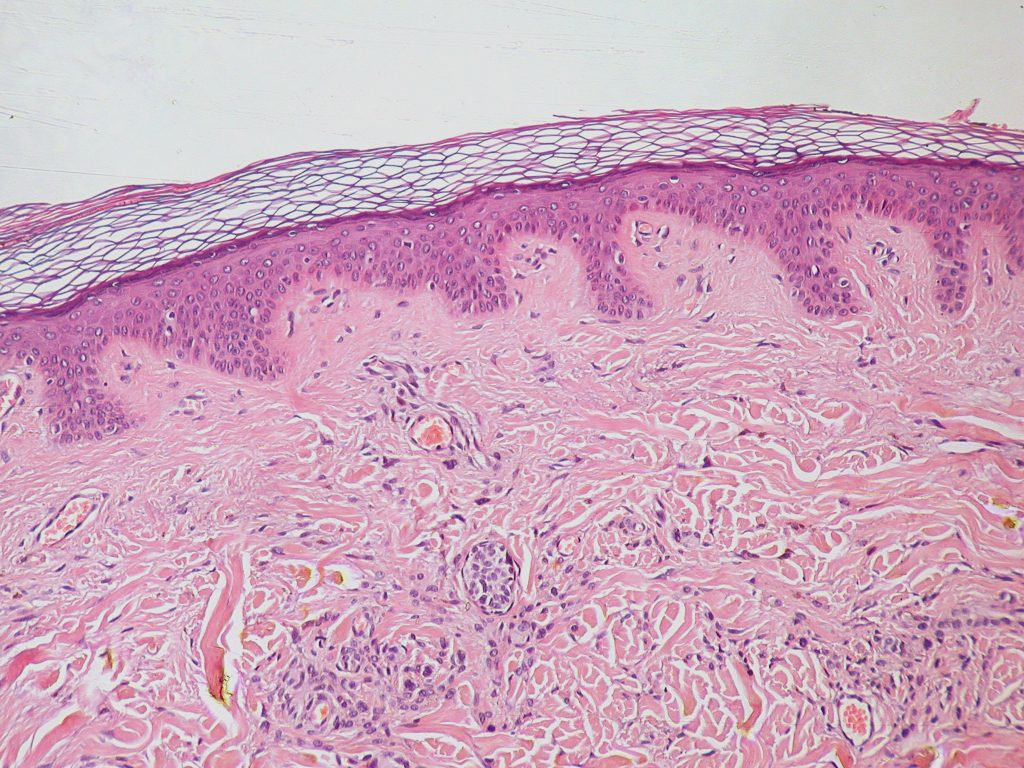
The dermis owes its firmness to two proteins. Collagen provides tensile strength and makes up roughly 70% of the skin’s dry weight; elastin gives skin its snap-back recoil [1]. Both are produced by cells called fibroblasts, and both decline steadily with age.
Collagen provides tensile strength and makes up roughly 70% of the skin’s dry weight; elastin gives skin its snap-back recoil.
The classic measurement comes from a study that sampled skin across ages 15 to 93 and found that skin collagen falls by roughly 1% per year throughout adult life, with the dermis growing measurably thinner alongside it [2]. That decline is quiet at first, then compounds. By a woman’s fifties, a large share of the dermal collagen she had in her twenties is simply gone. As the internal scaffolding shrinks, the surface it once held taut begins to pucker and settle into the fine lines that read as crepiness.
Cause #2: A lifetime of sunlight
If collagen loss sets the stage, ultraviolet light writes most of the script. This is why crepey skin appears earliest on sun-exposed areas — the forearms, chest, and neck — and why a naturally sheltered spot like the inner upper arm often stays smooth for decades longer.
UV radiation prompts skin cells to produce enzymes called matrix metalloproteinases, or MMPs, that actively break down existing collagen [3]. At the same time, years of sun produce a change called solar elastosis: a build-up of abnormal, clumped elastin that resembles elastic tissue under a microscope but has lost its function, so it can no longer provide recoil [4]. The result is skin with both less genuine collagen and a mass of degraded, useless elastin — mechanically weak, and primed for that thin, wrinkled-tissue look. The smooth inner-arm skin you were born with is a preview of what the rest of your body might still look like if the sun had never reached it.
Cause #3: Dehydration and a weakened barrier
Not all crepiness is structural — some of it is water. Older skin holds less moisture, partly because it makes fewer of the lipids and natural moisturizing factors that seal water in, and partly because the barrier itself becomes leakier with age [4]. Falling water content also changes how skin behaves mechanically, raising its stiffness and making fine lines stand out more sharply [1].
The smooth inner-arm skin you were born with is a preview of what the rest of your body might still look like if the sun had never reached it.
This is the component that responds fastest to skincare: a good humectant-and-occlusive routine can plump the surface within days. But it is also the most superficial layer of the problem. Hydration makes crepey skin look better; it does not replace what was lost underneath. That distinction is the buying test in our guide to the best body serum for crepey skin: humectants manage the surface, while a structural active addresses the dermal deficit.
Cause #4: Fat loss and the hormones of midlife
Beneath the dermis sits a cushion of fat that props the skin up from below. As that padding thins with age — in the cheeks, the backs of the hands, the décolletage — the skin above it has less to drape over and begins to look loose and finely crinkled. For women, menopause accelerates the entire sequence: the sharp drop in estrogen is linked to a rapid loss of skin collagen in the first few years afterward, thinning the dermis further and faster than intrinsic aging alone would.
Can crepey skin actually be reversed?
Partly — and the honest answer depends on which cause dominates. Water-driven crepiness improves almost immediately with better hydration. Structural crepiness, driven by lost collagen, responds only to ingredients that persuade fibroblasts to start building again.
The most studied of those ingredients is topical vitamin A. In a controlled study of naturally aged skin, retinol significantly increased collagen production and improved the appearance of fine lines [5]. The catch is delivery. Retinol is a fragile molecule that struggles to cross the skin barrier intact, which is why so many people meet irritation long before they see results — and why the journey to smoother, firmer skin so often stalls at the redness stage.
This is the problem North Biomedical set out to solve with Nanoretinol. By encapsulating retinol inside biomimetic lipid nanoparticles that the skin recognizes as “self,” Nanoretinol carries its active payload through the barrier without the chemical disruption that drives redness and peeling. In North Biomedical’s own clinical study, the encapsulated form was 232% more effective at collagen recovery than conventional retinol — precisely the mechanism crepey skin needs, delivered where the fibroblasts actually live. It is the same logic behind protecting your existing collagen with daily sun care and supporting skin elasticity from every angle at once.
The bottom line on crepiness
Crepey skin is a structural story, not a surface one. It is what you see when decades of collagen loss, accumulated sun exposure that shows up as solar elastosis, dehydration, and fat loss converge on skin that has simply grown too thin to stay smooth. You cannot moisturize your way out of it. But you can protect and rebuild the layer underneath — and the sooner you start, the more of that layer there is left to save.
References
- Park S. “Biochemical, structural and physical changes in aging human skin, and their relationship.” Biogerontology. 2022;23(3):275-288. doi:10.1007/s10522-022-09959-w
- Shuster S, Black MM, McVitie E. “The influence of age and sex on skin thickness, skin collagen and density.” British Journal of Dermatology. 1975;93(6):639-643. doi:10.1111/j.1365-2133.1975.tb05113.x
- Fisher GJ, Kang S, Varani J, et al. “Mechanisms of photoaging and chronological skin aging.” Archives of Dermatology. 2002;138(11):1462-1470. doi:10.1001/archderm.138.11.1462
- Uitto J. “The role of elastin and collagen in cutaneous aging: intrinsic aging versus photoexposure.” Journal of Drugs in Dermatology. 2008;7(2 Suppl):s12-s16. PMID: 18404866
- Kafi R, Kwak HSR, Schumacher WE, et al. “Improvement of naturally aged skin with vitamin A (retinol).” Archives of Dermatology. 2007;143(5):606-612. doi:10.1001/archderm.143.5.606