Combination Skin: Why Half Your Face Is Oily and Half Is Dry
The science of the T-zone — and how to treat two skin types on one face without making either one worse
You blot your forehead by lunchtime, yet your cheeks feel tight and flaky by evening. You buy a mattifying moisturizer and your cheeks revolt; you switch to a rich cream and your nose turns into an oil slick. If your face seems to be running two different programs at once, you are not imagining it — and you are not doing anything wrong. You have combination skin, and it is the most common skin type there is. If you are shopping rather than diagnosing, our guide to the best moisturizer for combination skin goes straight to product selection.
The frustrating part is that most skincare is designed for a single, uniform face: all oily, all dry, all “normal.” Combination skin refuses to cooperate with that model. Understanding why your face behaves like two faces is the first step to treating it properly.
What Combination Skin Actually Is
Combination skin is exactly what it sounds like: two or more skin types coexisting on the same face. Classically, that means an oily central “T-zone” — forehead, nose, and chin — paired with normal-to-dry cheeks, or “U-zone.”
This isn’t a marketing invention. In a detailed study of facial sebum, researchers mapped oil output across different regions of the face and formally proposed combination skin as a measurable type, defined by the gap between how much oil the T-zone produces versus the cheeks [1]. When that regional difference crosses a certain threshold, you have combination skin by the numbers, not just by feel. The at-home version of that measurement is described in how to know what skin type you have.
The driver is anatomy. Sebaceous (oil) glands are not distributed evenly across your skin. They cluster thickly around the nose and forehead and thin out dramatically across the cheeks and jaw. More glands in one area means more oil there, full stop.
Why Your T-Zone Behaves Differently
It isn’t only that the T-zone has more oil glands — those glands are also more reactive. When scientists examined regional sebum production, they found the T-zone’s glands are more sensitive to androgens, the hormones that switch oil production on [2]. So the central face gets a double hit: a higher density of glands, each one more eager to pump out sebum.
Here’s what most people miss: your skin type is not carved in stone.
Your cheeks, by contrast, have fewer glands and a weaker hormonal response. They rely more on a healthy lipid barrier to stay comfortable, and that barrier is easier to strip. This is the core tension of combination skin: the same product travels across a landscape where one region is drowning in oil and the neighboring region is running on empty.
Sebum itself isn’t the enemy. It’s a blend of triglycerides, wax esters, and squalene that waterproofs the skin and slows moisture loss. The problem is purely one of distribution — too much in the middle, too little at the edges.
Combination Skin Is a Moving Target
Here’s what most people miss: your skin type is not carved in stone. The same research that defined combination skin also tracked it across seasons and found that oil output shifts with temperature and humidity — the same face can read as combination in humid summer and lean dry in winter [1].
Age moves the needle too. As oil production gradually declines over the decades, a T-zone that was once aggressively shiny may quiet down, while cheeks that were merely “normal” at 30 can turn genuinely dry after menopause. If you’ve noticed your combination skin drifting drier over time, that’s biology, not your imagination — and it means the products that served you at 35 may need rethinking at 55. (Our guide to mature skin care routines covers that shift in more depth.)
Why Most Products Make Combination Skin Worse
The instinct with an oily T-zone is to attack it — foaming cleansers, alcohol toners, clay everything. But aggressive oil-stripping backfires. When you strip the barrier, the skin often responds by ramping oil production back up to compensate, leaving you shinier than before while your cheeks pay the price in dryness and irritation. Harsh cleansing is a lose-lose for a face that is already unbalanced. Choosing a gentler wash matters more here than almost anywhere else, which is why we’re picky about face wash for aging skin.
The opposite mistake is just as common: slathering the whole face in a heavy occlusive cream to rescue dry cheeks, which leaves the T-zone congested and prone to breakouts. Combination skin punishes both extremes.
When you strip the barrier, the skin often responds by ramping oil production back up to compensate, leaving you shinier than before while your cheeks pay the price in dryness and irritation.
How to Actually Treat Two Skin Types at Once
The winning strategy is to treat the face as the mosaic it is, not a single surface.
Cleanse gently, everywhere. A mild, pH-respecting cleanser removes excess oil from the T-zone without demolishing the cheeks’ barrier. Save the strong stuff. Which one to buy comes down to two checks on the label, worked through in our guide to the best face wash for combination skin.
Regulate oil chemically, not abrasively. Niacinamide (vitamin B3) is the standout ingredient for combination skin because it addresses the T-zone at the source. In controlled clinical testing, 2% niacinamide significantly reduced sebum output over several weeks [3] — and because it also supports the barrier, it’s one of the rare actives that helps oily and dry zones simultaneously. Our deep dive on niacinamide’s benefits explains the mechanism.
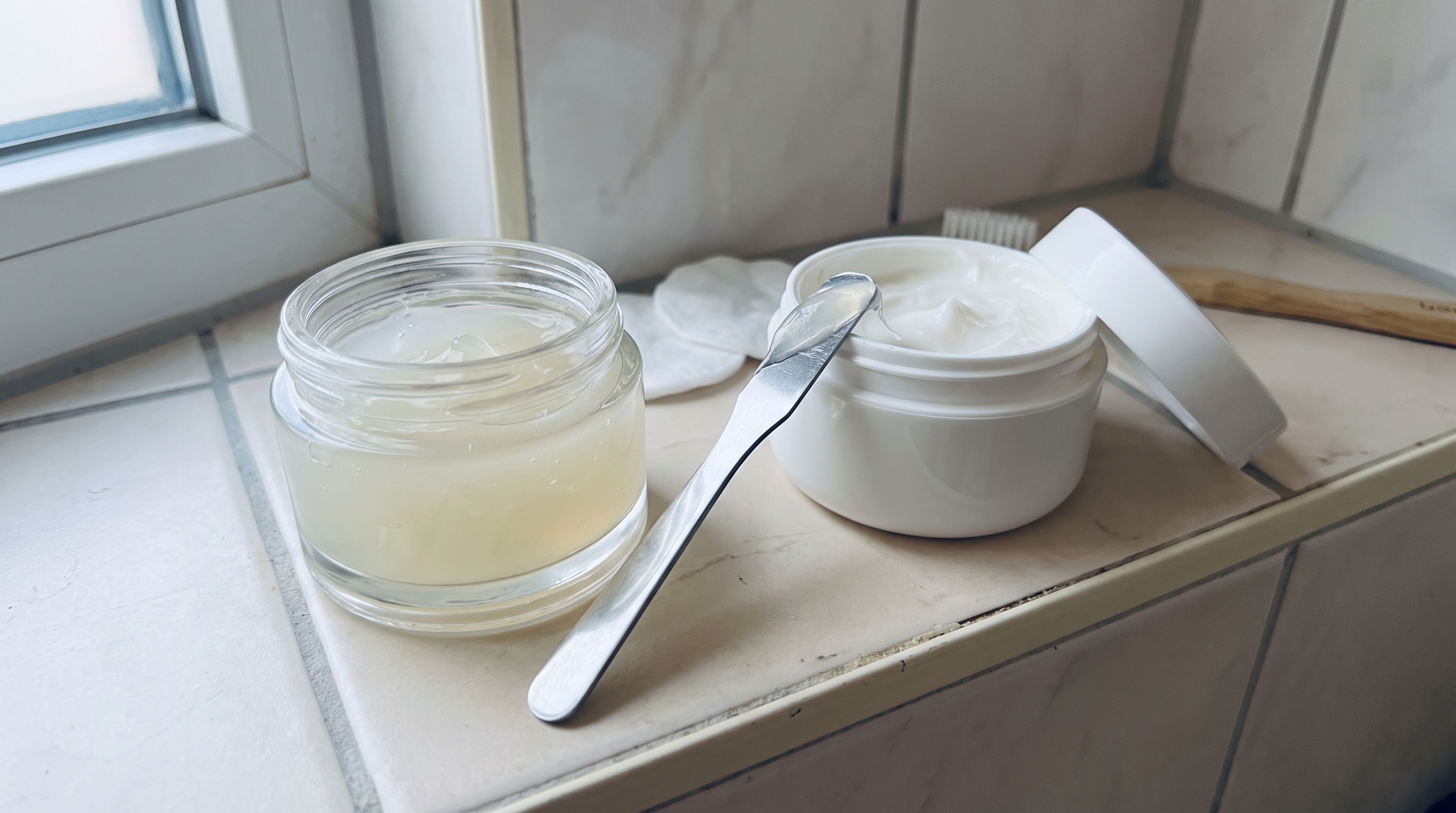
Hydrate by zone. Use a lightweight, water-based hydrator such as a gel moisturizer across the whole face, then layer a richer moisturizer only where your cheeks need it. You are allowed to use two products.
Don’t skip a retinoid. This is the part people with combination skin most often get wrong — they assume actives are only for oily or aging skin. In fact, a well-tolerated retinoid normalizes cell turnover, refines the enlarged pores of the T-zone, and improves texture across both zones. Dermatology reviews list topical retinoids among the best-evidenced options for oily and blemish-prone skin [4], and they remain the gold standard for long-term anti-aging on the drier cheeks.
Always finish with sunscreen. UV damage worsens texture and pigment irregularities that combination skin is already prone to. Matching that step to a shine-prone T-zone is covered in our guide to the best sunscreen for oily skin.
A Smarter Retinoid for Combination Skin
The catch with traditional retinol is that it’s often delivered in heavy, oil-rich creams — exactly the wrong vehicle for a T-zone that’s already greasy, yet drying enough to leave cheeks peeling. Combination skin sits in the crossfire of that trade-off.
This is where delivery format matters as much as the active itself. Nanoretinol was engineered as a light, water-based gel rather than a greasy cream, so it absorbs cleanly on the T-zone without adding shine. Its retinol is encapsulated in biomimetic lipid nanoparticles that carry the active into the skin instead of relying on barrier-disrupting solvents — which is why it stays gentle enough for sensitive cheeks while still doing real work. At a fully stabilized 0.2%, it’s formulated to suit all skin types, including oily, combination, and sensitive skin, and its 99% natural, non-greasy finish is tailor-made for a face that can’t tolerate a one-note approach. In head-to-head lab work, this nano-encapsulated form proved dramatically more effective at collagen recovery than conventional retinol, so you get the anti-aging payoff without forcing your combination skin to choose between oily and raw.
Working With Your Skin, Not Against It
Combination skin isn’t a problem to be solved so much as a balance to be managed. Once you stop trying to force your whole face into a single category — and start treating the oily middle and drier edges on their own terms — the daily blotting and tightness settle down. Gentle cleansing, niacinamide to calm the T-zone, zone-appropriate hydration, a smart retinoid, and daily sunscreen will do more than any single “combination skin” miracle product ever could. Your face was never broken. It was just asking for a little nuance.
References
- Youn SW, Na JI, Choi SY, Huh CH, Park KC. “Regional and seasonal variations in facial sebum secretions: a proposal for the definition of combination skin type.” Skin Research and Technology. 2005;11(3):189-195. PMID: 15998330
- Seo YJ, Li ZJ, Choi DK, et al. “Regional difference in sebum production by androgen susceptibility in human facial skin.” Experimental Dermatology. 2014;23(1):70-72. PMID: 24289322
- Draelos ZD, Matsubara A, Smiles K. “The effect of 2% niacinamide on facial sebum production.” Journal of Cosmetic and Laser Therapy. 2006;8(2):96-101. PMID: 16766489
- Endly DC, Miller RA. “Oily Skin: A Review of Treatment Options.” The Journal of Clinical and Aesthetic Dermatology. 2017;10(8):49-55. PMID: 28979664