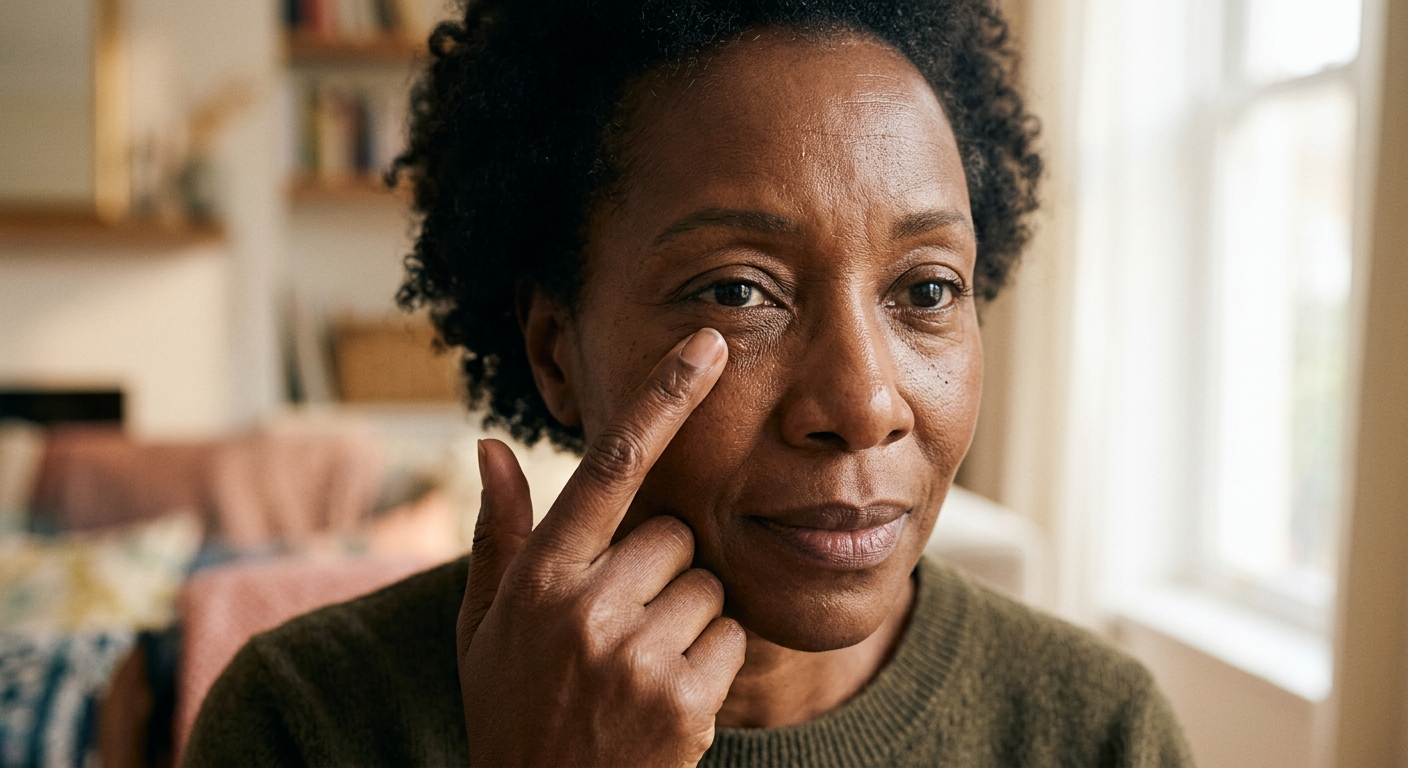
Eyelid Wrinkles: What Causes Them and What Actually Smooths Them
Why your thinnest skin ages first and the evidence behind fixing it
Why Eyelid Skin Ages Before Everything Else
Your eyelids blink approximately 15,000 times per day. That’s roughly 5.5 million contractions per year for the orbicularis oculi — the thin ring of muscle responsible for every blink, squint, and expression around the eyes. No other facial muscle works this relentlessly, and no other skin has to absorb that kind of mechanical stress with so little structural support.
Eyelid skin is the thinnest on the human body — roughly 0.5 mm compared to 2 mm on the cheeks or 3 mm on the back. It has virtually no subcutaneous fat, minimal sebaceous gland activity, and a dermis so thin that the collagen network starts at a disadvantage. When that already-sparse collagen begins its age-related decline — roughly 1% per year after 25 — eyelid skin hits the visible threshold years before the rest of the face [1].
A 2008 histological study of eyelid tissue confirmed that aging changes in the upper eyelid occur primarily in the skin and subcutaneous layers, with characteristic loss of collagen and elastic fibers. Interestingly, the orbicularis oculi muscle itself remained histologically intact — it’s not the muscle that fails, it’s the envelope around it [2].
The Anatomy of Periorbital Collapse
The periorbital area has a uniquely fragile architecture. Understanding it explains why eyelid wrinkles behave differently from forehead lines or nasolabial folds.
The dermis is paper-thin. Collagen type I and type III, which provide tensile strength, exist in much lower quantities here than anywhere else on the face. When MMPs (matrix metalloproteinases) degrade even a small percentage of this already-limited scaffold, the visible impact is disproportionately large.
There’s almost no fat cushion. Facial fat pads elsewhere provide volume that keeps skin smooth even as collagen declines. The eyelids have no such buffer — structural loss translates directly into wrinkling.
UV exposure is concentrated. The periorbital area receives high cumulative UV due to its anatomical position. Sunglasses help, but most people don’t wear them consistently enough to prevent decades of photoaging. UV-A penetrates through cloud cover and window glass, making the damage nearly unavoidable without deliberate protection.
Expression compounds everything. Smiling, squinting, and concentrating create dynamic lines that — repeated millions of times — eventually etch permanently into skin that has lost its elastic rebound. These start as fine “crinkles” visible only during movement and progress to static lines visible at rest [3].
The same reasoning decides the best eyeliner for older women, where the right formula depends on how your liner is actually failing.
What Makes Eyelid Wrinkles Worse
Several factors accelerate periorbital aging beyond normal chronological decline:
Rubbing and tugging. Removing eye makeup aggressively, rubbing tired eyes, or using thick creams that require heavy application all stretch the thin eyelid skin. Over years, this mechanical stress compounds collagen damage. Choosing products that come off without scrubbing is part of the answer, and our guide to eye makeup for mature women covers which formulas remove cleanly. On the lash line specifically, the best mascara for older women is usually a tubing formula that lifts off with warm water. The same reasoning decides the best eyeliner for older women, where the right formula depends on how your liner is actually failing.
Dehydration. The minimal sebaceous gland activity around the eyes means this area produces very little of its own natural moisture. Without adequate hydration, the surface layer contracts and amplifies the appearance of fine lines.
Sleep position. Side sleepers consistently compress one side of their face against the pillow, creating “sleep wrinkles” that become permanent over time. The periorbital area is particularly susceptible because the skin has almost no elastic reserve to bounce back.
Smoking and environmental pollution. Both generate massive free radical loads that accelerate MMP activation. Smokers develop periorbital wrinkling up to a decade earlier than non-smokers in matched populations.
Treatments That Work on Ultra-Thin Skin
The challenge with treating eyelid wrinkles is that the skin is extraordinarily sensitive. Ingredients and concentrations that work well on the cheeks or forehead can cause significant irritation around the eyes — burning, peeling, and paradoxical worsening of the very lines you’re trying to treat.
Periorbital Retinoids
Retinoids are the gold standard for stimulating new collagen, but concentration and vehicle matter enormously in this area. A 2022 clinical study published in the Journal of Drugs in Dermatology evaluated a specialized retinoid eye formulation in women aged 35 to 65 with fine to moderate periorbital wrinkles. After 12 weeks, participants showed significant improvement in wrinkle severity with minimal irritation — the key being a formulation specifically designed for the sensitivity of periorbital skin [4].
At 4–5% concentration, niacinamide strengthens the skin barrier, improves hydration, and has mild anti-inflammatory properties that reduce the irritation potential of active treatments.
A comprehensive 2024 review of eye cream ingredients confirmed that retinoids, when properly formulated, demonstrate the strongest evidence for periorbital wrinkle reduction among all active ingredients studied. The review noted that the limiting factor isn’t retinoid efficacy — it’s tolerability in the thin, reactive eyelid skin [5].
Peptides and Growth Factors
Peptides like palmitoyl pentapeptide-4 and copper peptides stimulate collagen synthesis through a different mechanism than retinoids — they act as signaling molecules rather than gene regulators. For the eye area, this gentler approach has clinical support. A double-blind, randomized study using 3D imaging found that peptide-containing eye treatments significantly improved periorbital smoothness after just 4 weeks [6].
Caffeine
Caffeine constricts blood vessels and reduces fluid retention, which addresses the puffiness component that makes eyelid wrinkles appear worse. It doesn’t rebuild collagen, but it provides an immediate visual improvement that complements longer-term treatments.
Niacinamide
At 4–5% concentration, niacinamide strengthens the skin barrier, improves hydration, and has mild anti-inflammatory properties that reduce the irritation potential of active treatments. It’s an ideal companion ingredient for retinoid-based eye care.
Why Standard Retinol Fails Around the Eyes
Most people who’ve tried retinol around their eyes report the same sequence: initial optimism, followed by redness and stinging within the first week, followed by abandoning the product entirely. The problem isn’t that retinol doesn’t work — it’s that conventional formulations deliver it through a mechanism that’s too aggressive for skin this thin.
Traditional retinol formulations use penetration enhancers that partially disrupt the lipid matrix of the stratum corneum. On thicker facial skin, this disruption is tolerable. On the eyelids, where the barrier is already minimal, it triggers inflammation that overwhelms the intended therapeutic benefit.
Lipid nanoparticle delivery fundamentally changes this equation. By encapsulating retinol in biomimetic nanoparticles that the skin recognizes as “self,” the active ingredient passes through the barrier without disrupting it [7]. This is why Nanoretinol® at just 0.2% concentration achieves +232% more collagen recovery than conventional retinol — the delivery efficiency, not the concentration, determines the result [8].
For the periorbital area specifically, this approach offers something conventional retinol cannot: consistent daily use without the irritation cycle. The gentleness of the delivery system means you can build the treatment habit that clinical trials show is necessary for structural improvement — and actually maintain it long enough to see results.
An Evidence-Based Eye Care Routine
Morning: Apply a lightweight vitamin C serum around the eyes (L-ascorbic acid at 10–15%) to provide antioxidant protection. Follow with a broad-spectrum mineral sunscreen and sunglasses whenever outdoors.
Evening: After gentle cleansing (no rubbing — use a micellar water or oil cleanser that dissolves makeup without friction), apply a retinoid formulated for sensitive skin. Use your ring finger to pat — never drag — product across the orbital bone and eyelid. Follow with a ceramide-rich moisturizer to reinforce the barrier.
Consistency is non-negotiable. The periorbital studies showing significant results all required 8 to 12 weeks of continuous use. Start with every-other-night retinoid application and increase frequency as tolerated. If the weight of the lid itself is the concern rather than the lines beneath it, our guide to the best eye cream for hooded eyes separates the part a topical can improve from the part it cannot.
Setting Realistic Expectations
Eyelid wrinkles won’t disappear completely with topical treatment alone — particularly deep static lines that have been present for years. What clinical evidence supports is a meaningful reduction in fine lines, improved skin texture and thickness, and a smoother, firmer overall appearance of the periorbital area [4][5].
The earlier you start, the more dramatic the results. Fine dynamic lines respond faster and more completely than deep static creases. But even established wrinkles show measurable improvement when the right active ingredients are delivered consistently and tolerated well enough to maintain the routine.
References
- Shin JW, Kwon SH, Choi JY, et al. “Molecular Mechanisms of Dermal Aging and Antiaging Approaches.” Int J Mol Sci. 2019;20(9):2126. doi:10.3390/ijms20092126
- Pottier F, El-Shazly NZ, El-Shazly AE. “Aging of orbicularis oculi: anatomophysiologic consideration in upper blepharoplasty.” Arch Facial Plast Surg. 2008;10(5):346-349. doi:10.1001/archfaci.10.5.346
- Ganceviciene R, Liakou AI, Theodoridis A, et al. “Skin anti-aging strategies.” Dermatoendocrinol. 2012;4(3):308-319. doi:10.4161/derm.22804
- Kaufman J, Callender VD, Young CM. “Efficacy and Tolerability of a Retinoid Eye Cream for Fine to Moderate Wrinkles of the Periorbital Region.” J Drugs Dermatol. 2022;21(9):932-937. doi:10.36849/JDD.6815
- Banga G, Patel K. “A review of the efficacy of popular eye cream ingredients.” Skin Health Dis. 2024;4(3):e366. PMC11175953
- Kaczvinsky JR, Griffiths CE, Schnicker MS, Li J. “Efficacy of anti-aging products for periorbital wrinkles as measured by 3-D imaging.” J Cosmet Dermatol. 2009;8(3):228-233. doi:10.1111/j.1473-2165.2009.00456.x
- Iqbal B, Ali J, Baboota S. “Use of Retinoids in Topical Antiaging Treatments: A Focused Review of Clinical Evidence for Conventional and Nanoformulations.” Adv Pharm Bull. 2022;12(4):649-665. doi:10.34172/apb.2022.069
- North Biomedical LLC. “Nanoretinol® vs. Conventional Retinol: Efficacy in Collagen and Elastin Recovery.” Clinical Study Summary, 2024.