What Is Ferulic Acid — And Why It's the Antioxidant Your Skin Needs After 40
How a plant-derived molecule doubles the photoprotective power of vitamin C and makes retinol work harder
A Molecule Hiding in Plain Sight
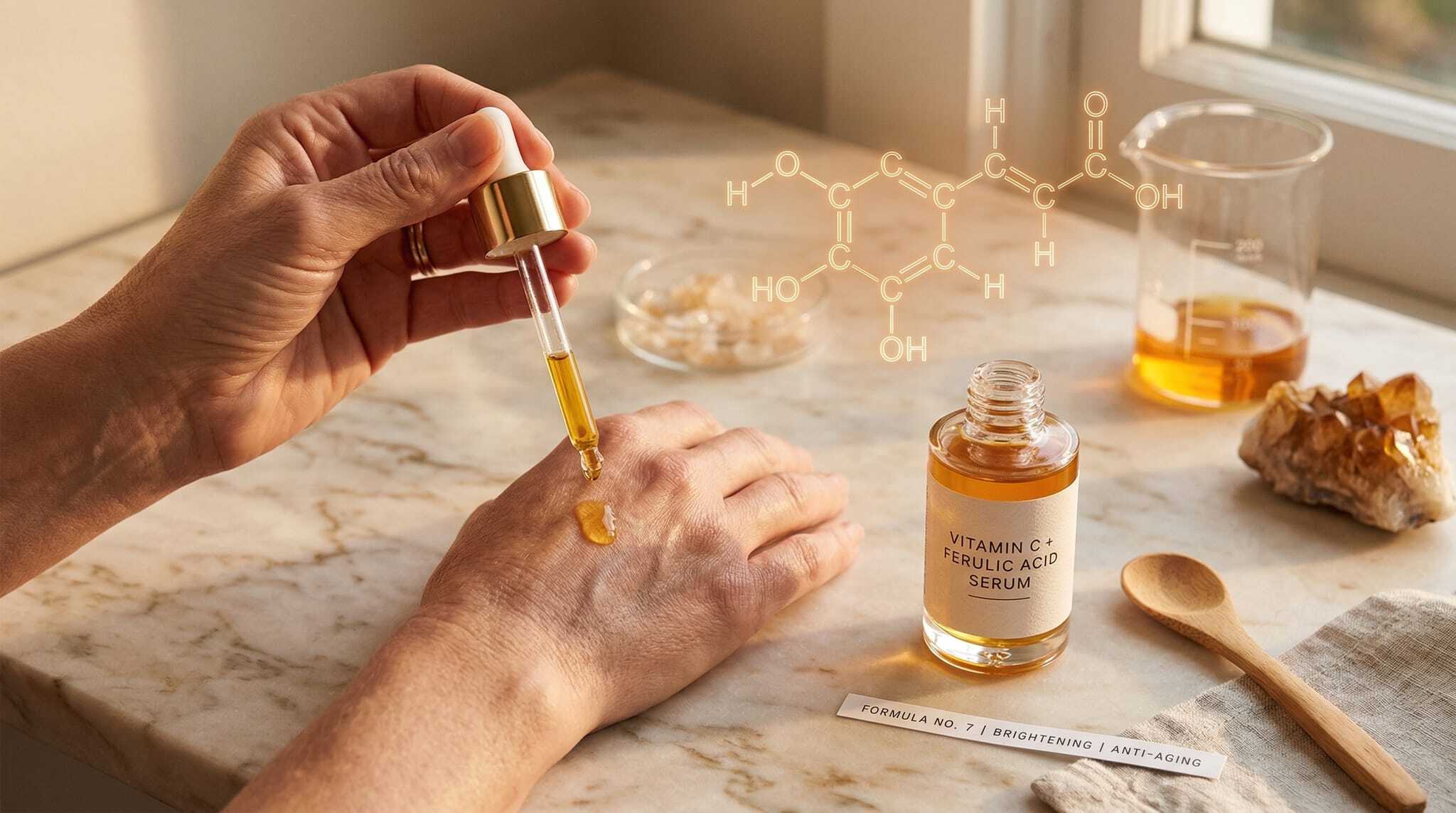
Ferulic acid is one of the most abundant antioxidants in the plant kingdom. It exists in the cell walls of oats, rice, wheat, oranges, apples, and coffee beans — structural armor that protects plants from UV radiation and oxidative stress. It has been studied since the early 1990s, and its properties have been well documented: anti-inflammatory, antimicrobial, and powerfully antioxidant [1].
What elevated ferulic acid from botanical curiosity to skincare essential was a single discovery in 2005. Researchers at Duke University found that adding 0.5% ferulic acid to a topical solution of 15% vitamin C and 1% vitamin E doubled the formulation’s photoprotective capacity — from approximately 4-fold protection to 8-fold protection against solar-simulated UV radiation [2]. That paper, published in the Journal of Investigative Dermatology, fundamentally changed how antioxidant serums are formulated.
Today, ferulic acid appears in virtually every serious vitamin C serum on the market. But most consumers do not know what it does, why it matters, or how it interacts with the rest of their routine. If you are over 40 and investing in anti-aging skincare, ferulic acid deserves to be understood — not just applied.
How Ferulic Acid Protects Your Skin
Ferulic acid operates through several overlapping mechanisms, each targeting a different pathway of skin damage.
Free radical scavenging. Every day, UV exposure generates reactive oxygen species (ROS) inside the skin — unstable molecules that damage DNA, degrade collagen fibers, and accelerate the appearance of aging. Ferulic acid neutralizes these free radicals directly, donating hydrogen atoms to stabilize the unpredictable chain reactions before they reach structural proteins [1]. Think of it as a molecular fire extinguisher: it does not stop the UV from arriving, but it prevents the fire from spreading.
Enzyme modulation. Beyond direct scavenging, ferulic acid inhibits the enzymes that generate free radicals in the first place — including xanthine oxidase and lipoxygenase — while simultaneously enhancing the activity of the body’s own antioxidant enzymes like superoxide dismutase (SOD) and catalase [3]. This dual action, suppressing production and boosting clearance, makes ferulic acid unusually efficient compared to antioxidants that only do one or the other.
Collagen and elastin protection. Ferulic acid has a documented protective role for the skin’s two most critical structural proteins. It shields fibroblasts (the cells that produce collagen and elastin) from UV-induced apoptosis, and it inhibits matrix metalloproteinases (MMPs) — the enzymes that break down collagen in response to sun exposure [3]. For skin over 40, where collagen is already declining at roughly 1% per year, preventing further degradation is as important as stimulating new production.
For skin over 40, where collagen is already declining at roughly 1% per year, preventing further degradation is as important as stimulating new production.
Melanogenesis inhibition. Ferulic acid suppresses tyrosinase activity, which means it plays a role in reducing hyperpigmentation — though its brightening effect is secondary to its antioxidant function. When paired with other brightening agents, the combination can be more effective than either ingredient alone.
The Vitamin C Partnership That Changed Skincare
The most important thing to understand about ferulic acid is that it does not work alone. Or rather, it works well alone — but it works dramatically better in combination with vitamins C and E.
The landmark 2005 study by Lin et al. tested multiple formulations on human skin exposed to solar-simulated UV radiation. The vitamin C+E solution alone provided roughly 4-fold protection. Adding just 0.5% ferulic acid doubled that to approximately 8-fold protection [2]. The mechanism is both chemical and practical: ferulic acid stabilizes the notoriously unstable L-ascorbic acid (vitamin C), extending the formulation’s shelf life, while simultaneously amplifying the antioxidant cascade.
A follow-up clinical trial in 2008 confirmed these findings in a more rigorous setting. Murray et al. demonstrated that the C+E+ferulic combination significantly reduced thymine dimer mutations — the specific DNA damage most strongly associated with skin cancer — and suppressed UV-induced inflammatory cytokines including IL-1α, IL-6, and IL-8 [4]. The protection was meaningful enough that the authors suggested it could supplement sunscreen protection through a fundamentally different mechanism.
A separate randomized controlled trial by Oresajo et al. tested a vitamin C, ferulic acid, and phloretin mixture. Subjects who applied the antioxidant formulation for four consecutive days showed significant reductions in erythema and sunburn cell formation after UV exposure compared to vehicle controls [5]. The evidence, across multiple independent studies, is consistent: ferulic acid transforms vitamin C from a useful antioxidant into a genuinely protective system.
Why Ferulic Acid Matters More After 40
Your skin’s antioxidant defense system weakens with age. Endogenous levels of vitamins C and E in the skin decline, enzymatic antioxidant activity drops, and cumulative UV exposure means the oxidative burden increases precisely when the body’s capacity to handle it is shrinking [3].
Sunscreen blocks a portion of incoming UV radiation — but no sunscreen blocks 100%.
This is why topical antioxidants become more important, not less, as you age. Sunscreen blocks a portion of incoming UV radiation — but no sunscreen blocks 100%. The UV that gets through still generates free radicals, and the cumulative damage over decades is what dermatologists call photoaging: fine lines, loss of elasticity, uneven pigmentation, rough texture.
Ferulic acid addresses the damage that sunscreen cannot prevent. It works beneath the surface, neutralizing the oxidative stress that accumulates in the hours after UV exposure — a window that sunscreen alone does not cover.
For women over 40 managing the convergence of hormonal changes, cumulative sun damage, and declining collagen reserves, a well-formulated ferulic acid serum is not a luxury. It is a frontline defense.
Ferulic Acid and Retinol: A Synergy Worth Exploring
Recent research has uncovered a particularly interesting interaction between ferulic acid and retinol. A 2024 study published in Aging examined the combined effects of ferulic acid and retinol on UVB-damaged human keratinocytes. The combination significantly improved oxidative stress markers — SOD, GSH, and catalase all increased, while MDA and ROS decreased — outperforming either ingredient used alone [6].
The practical implication: ferulic acid may help protect retinol from oxidative degradation while reducing the oxidative stress that contributes to retinol-related irritation. This makes the two ingredients natural partners in an anti-aging routine.
This synergy is especially relevant for advanced delivery systems like Nanoretinol®. Because Nanoretinol® uses lipid nanoparticle encapsulation to deliver retinol through biomimetic carriers the skin recognizes as its own, the retinol reaches target cells intact — without the barrier disruption that causes conventional retinol’s side effects [7]. Pairing this with a ferulic acid serum in the morning creates a comprehensive day-night strategy: ferulic acid protects and defends by day, while Nanoretinol® rebuilds and stimulates by night. The combination addresses both the prevention of new damage and the reversal of existing photoaging.
How to Use Ferulic Acid in Your Routine
Ferulic acid is most effective when delivered in a serum formulation at a concentration between 0.5% and 1%, ideally combined with 10–20% L-ascorbic acid and 0.5–1% vitamin E.
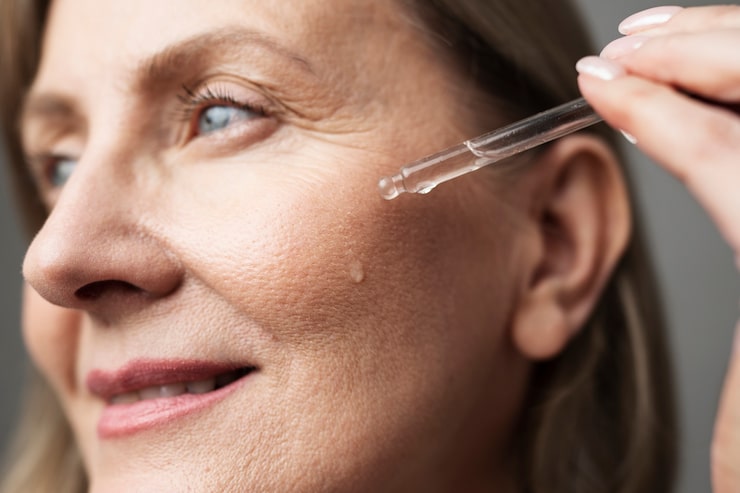
Apply in the morning. Antioxidant serums provide the most benefit when applied before sun exposure. Cleanse, apply the ferulic acid serum to bare skin, wait until it absorbs, then follow with moisturizer and sunscreen. The ferulic acid will work throughout the day, neutralizing free radicals that penetrate your SPF.
Store properly. Ferulic acid itself is susceptible to oxidation, which is one of the challenges formulators face [3]. Keep your serum away from direct sunlight and extreme heat. If the product changes color significantly — from clear or pale gold to dark brown — it has likely oxidized and should be replaced.
Be patient. Antioxidant protection is cumulative. You will not see dramatic visible changes in the first week. The real benefit is the damage you are preventing — the fine line that does not form, the dark spot that does not deepen, the collagen fiber that remains intact.
The best anti-aging strategy after 40 is not a single ingredient. It is a system: protection in the morning, repair at night, and the science-backed ingredients that make each half of that equation work at its full potential.
References
- Graf E. “Antioxidant Potential of Ferulic Acid.” Free Radic Biol Med. 1992;13(4):435-448. doi:10.1016/0891-5849(92)90184-I
- Lin FH, Lin JY, Gupta RD, et al. “Ferulic Acid Stabilizes a Solution of Vitamins C and E and Doubles Its Photoprotection of Skin.” J Invest Dermatol. 2005;125(4):826-832. doi:10.1111/j.0022-202X.2005.23768.x
- Zduńska K, Dana A, Kolodziejczak A, Rotsztejn H. “Antioxidant Properties of Ferulic Acid and Its Possible Application.” Skin Pharmacol Physiol. 2018;31(6):332-336. doi:10.1159/000491755
- Murray JC, Burch JA, Streilein RD, et al. “A Topical Antioxidant Solution Containing Vitamins C and E Stabilized by Ferulic Acid Provides Protection for Human Skin Against Damage Caused by Ultraviolet Irradiation.” J Am Acad Dermatol. 2008;59(3):418-425. doi:10.1016/j.jaad.2008.05.004
- Oresajo C, Stephens T, Hino PD, et al. “Protective Effects of a Topical Antioxidant Mixture Containing Vitamin C, Ferulic Acid, and Phloretin Against Ultraviolet-Induced Photodamage in Human Skin.” J Cosmet Dermatol. 2008;7(4):290-297. doi:10.1111/j.1473-2165.2008.00407.x
- Shu P, Mo J, Li Z, et al. “Ferulic Acid in Synergy With Retinol Alleviates Oxidative Injury of HaCaT Cells During UVB-Induced Photoaging.” Aging (Albany NY). 2024;16(8):7153-7173. doi:10.18632/aging.205749
- North Biomedical LLC. “Nanoretinol® vs. Conventional Retinol: Efficacy in Collagen and Elastin Recovery.” Clinical Study Summary, 2024. View Study