Do Hyaluronic Acid Supplements Actually Work for Your Skin?
The pills promise the plumpness of a filler in capsule form — but there's a difference between hydrating your skin and rebuilding it, and it's the whole ballgame.
The Capsule That Promises Plumper Skin
Hyaluronic acid built its reputation as a filler — the injectable that plumps lips and smooths folds on the spot — and as the star of every hydrating serum on the shelf. So the logic of the supplement version is seductive: if HA plumps skin from a needle and a bottle, surely swallowing it plumps you from the inside. Sales of hyaluronic acid pills, powders, and drinks have followed that intuition into a booming category, especially among women over 40 watching their skin lose its bounce.
It’s a fair question to ask whether they actually work. And unlike a lot of supplement marketing, there is real clinical research here. The honest answer is more interesting than a simple yes or no.
Why Skin Loses Hyaluronic Acid in the First Place
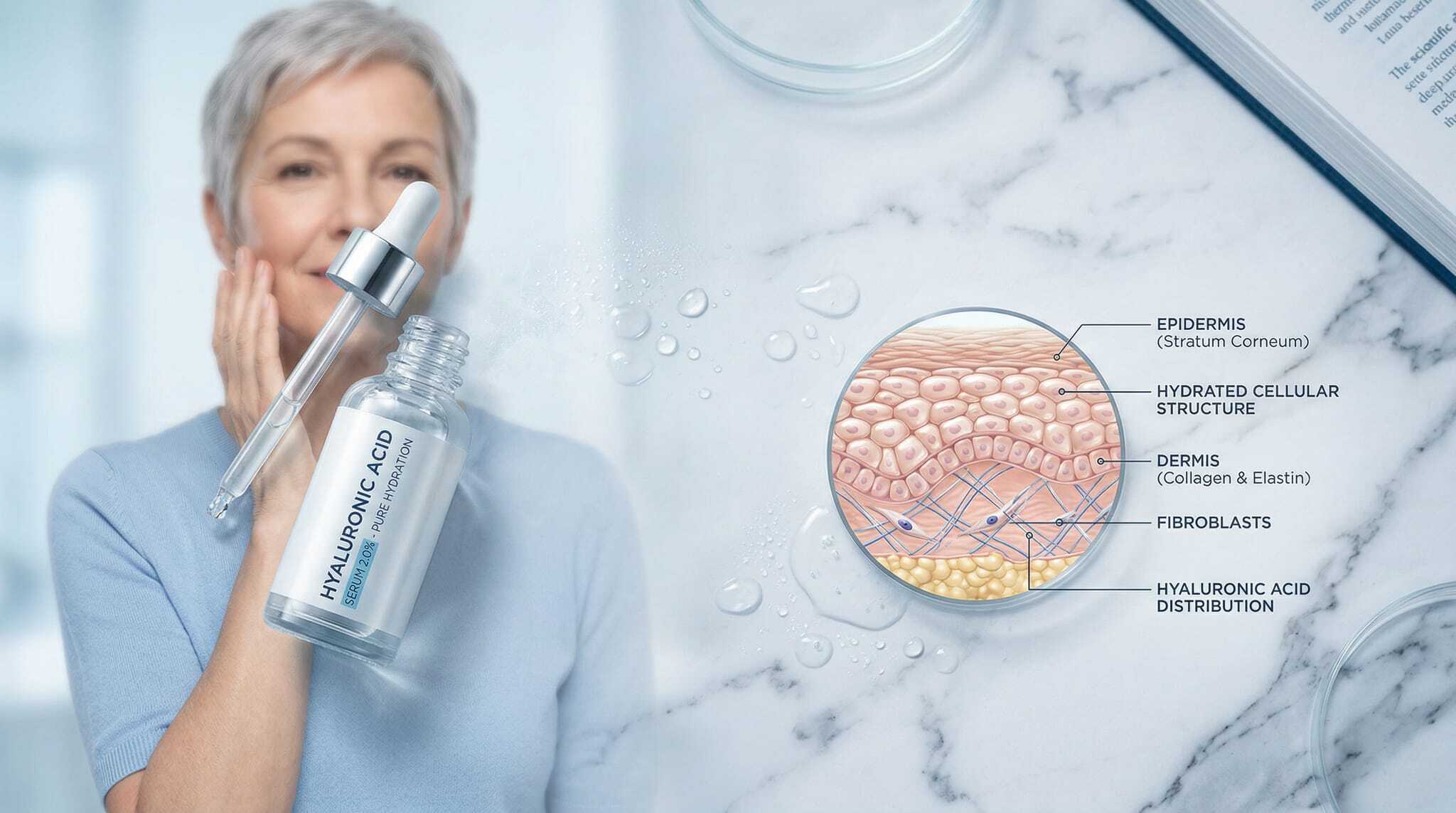
Hyaluronic acid is one of the most important molecules in your skin. It’s a component of the extracellular matrix with a remarkable ability to bind water — holding many times its weight — which is what keeps youthful skin dewy and full. The trouble is that it declines with age. The most dramatic histochemical change in aging skin is the near-disappearance of HA from the epidermis, alongside a progressive shrinking of the HA polymers that remain [1].
That loss is genuinely part of why skin looks drier and less plump over time. So topping it back up seems like it should help. The real question is whether a molecule you eat ever reaches your skin in a form that matters.
Hyaluronic acid is one of the most important molecules in your skin.
What the Clinical Trials Actually Found
Here’s where fairness matters: the studies are not all negative. In a 12-week double-blind, placebo-controlled trial, participants taking 120 mg of oral hyaluronan daily showed significant improvements in skin moisture, elasticity, and wrinkle measurements versus placebo, with benefits emerging after about eight weeks [2]. A separate 40-day study in women aged 45 to 60 reported meaningful gains in hydration and elasticity and a reduction in wrinkle depth [3].
So the supplements aren’t snake oil. But look closely at what improves: hydration, surface roughness, elasticity, the depth of fine lines. These are moisture-driven, largely temporary metrics. When your skin is better hydrated, fine lines soften and it looks plumper — exactly what you’d expect from raising the water-binding content of the tissue. What the trials do not show is the supplement rebuilding the skin’s structural framework.
That distinction is everything. Hyaluronic acid is the water in the mattress; collagen and elastin are the springs. You can top up the water and the mattress feels fuller for a while — but if the springs have worn out, no amount of water fixes the sag. Sagging, crepiness, and deep folds are structural problems, and HA, whether swallowed or applied, doesn’t touch the springs.
Tretinoin, retinol’s prescription cousin, drove an 80 percent jump in new collagen formation in photodamaged skin.
The Absorption Question
There’s also the matter of what happens between your mouth and your face. Ingested hyaluronic acid is broken down and distributed throughout the body; only a fraction is thought to reach the skin, and the exact mechanism by which oral HA influences skin remains debated. The measurable-but-modest results in the trials are consistent with that picture: a real signal, but a gentle one, and one that competes with the far cheaper option of simply drinking enough water and using a good topical humectant. If you want the surface-hydration angle done well, our guide to topical hyaluronic acid covers how molecular weight determines whether a serum actually performs.
This is the same ceiling we run into with ingestible collagen, and for the same reason — see our breakdown of whether collagen supplements improve skin elasticity. Eating a building material is not the same as instructing your skin to manufacture it.
The More Fundamental Fix: Make Your Skin Produce Its Own
Here’s the part the supplement aisle doesn’t advertise. You don’t have to choose between eating hyaluronic acid and eating collagen, because there’s an ingredient that prompts your skin to make more of both on its own. When researchers applied retinol to naturally aged skin, it significantly increased not only procollagen but also glycosaminoglycan expression — and glycosaminoglycans are the water-binding family that hyaluronic acid belongs to [4]. In other words, retinol tells your skin to build fresh collagen and restock its own hyaluronic acid, right where it’s needed. Tretinoin, retinol’s prescription cousin, drove an 80 percent jump in new collagen formation in photodamaged skin [5]. That’s the springs and the water, generated internally rather than borrowed from a capsule. Our guide to retinol and collagen goes deeper on the mechanism.
The historical drawback of retinol has been irritation and inefficient delivery — much of the active never gets where it needs to go. Nanoretinol was engineered specifically to solve that. It wraps retinol in biomimetic lipid nanoparticles the skin recognizes as “self,” letting it pass the barrier efficiently without the harsh penetration chemistry that makes traditional retinol sting and peel. In North Biomedical’s clinical study, this delivery system proved 232 percent more effective at collagen recovery and 73 percent more effective at elastin recovery than conventional retinol, improving skin firmness by 61 percent and elasticity by 56 percent over 56 days — while remaining gentler on skin cells.
So, Should You Take Them?
If you enjoy your hyaluronic acid supplement and your skin feels more hydrated, there’s no harm in it — the research supports a modest, hydration-led benefit, and it’s well tolerated. Just be clear about what you’re buying: better moisture, not a rebuilt foundation. For the plumpness that comes from actual structure — firmer, more elastic, less crepey skin — the evidence points not to a pill you swallow but to prompting your skin to remake its own collagen and hyaluronic acid. That’s a job for a well-delivered retinol, working quietly every night where the springs actually live.
References
- Papakonstantinou E, Roth M, Karakiulakis G. “Hyaluronic Acid: A Key Molecule in Skin Aging.” Dermato-Endocrinology. 2012;4(3):253-258. doi:10.4161/derm.21923
- Hsu TF, Su ZR, Hsieh YH, Wang MF, Oe M, Matsuoka R, Masuda Y. “Oral Hyaluronan Relieves Wrinkles and Improves Dry Skin: A 12-Week Double-Blinded, Placebo-Controlled Study.” Nutrients. 2021;13(7):2220. doi:10.3390/nu13072220
- Göllner I, Voss W, von Hehn U, Kammerer S. “Ingestion of an Oral Hyaluronan Solution Improves Skin Hydration, Wrinkle Reduction, Elasticity, and Skin Roughness: Results of a Clinical Study.” Journal of Evidence-Based Integrative Medicine. 2017;22(4):816-823. doi:10.1177/2156587217743640
- Kafi R, Kwak HSR, Schumacher WE, et al. “Improvement of Naturally Aged Skin With Vitamin A (Retinol).” Archives of Dermatology. 2007;143(5):606-612. doi:10.1001/archderm.143.5.606
- Griffiths CE, Russman AN, Majmudar G, Singer RS, Hamilton TA, Voorhees JJ. “Restoration of Collagen Formation in Photodamaged Human Skin by Tretinoin (Retinoic Acid).” New England Journal of Medicine. 1993;329(8):530-535. doi:10.1056/NEJM199308193290803