How to Improve Skin Texture: What the Science Actually Says
From rough and uneven to smooth and luminous — the evidence-based ingredients and strategies that genuinely transform texture
Run your fingertips across your cheek. Is the surface smooth, even, reflective — the kind of skin that catches light uniformly? Or do you feel bumps, dry patches, enlarged pores, maybe a slightly rough grain that no foundation can fully mask?
Skin texture is one of the first things people unconsciously register about a face, yet it’s one of the most misunderstood aspects of skincare. Unlike wrinkles (which are structural) or dark spots (which are pigmentary), texture issues arise from how the outermost layers of skin are organized — and that organization is disrupted by a surprisingly wide range of factors.
What Creates Uneven Texture
Several biological mechanisms contribute to rough or uneven texture, and understanding which one (or which combination) you’re dealing with determines which solution will actually work.
Accumulated dead cells. Your epidermis constantly sheds old cells and replaces them with new ones from below. In your 20s, this turnover cycle takes about 28 days. By your 40s, it stretches to 45-60 days [1]. The practical result: dead corneocytes pile up on the surface, creating a dull, rough, slightly bumpy canvas that scatters light instead of reflecting it.
Enlarged or congested pores. Pores become more visible when they’re stretched by sebum buildup or when the surrounding skin loses collagen support and can no longer keep them taut. The result is an “orange peel” texture that’s particularly noticeable on the nose, cheeks, and chin.
Post-inflammatory marks. Acne, even mild breakouts, can leave behind textural irregularities — shallow depressions, raised areas, or persistent roughness where the skin healed imperfectly. These marks are structural, living in the dermis, and won’t respond to surface-level exfoliation alone.
Sun damage. Chronic UV exposure thickens the stratum corneum irregularly, degrades collagen unevenly, and creates areas of solar elastosis where elastic fibers clump into dysfunctional masses [2]. The surface result is roughness, leatheriness, and an uneven grain that worsens with each year of unprotected exposure.
Dehydration. This is the most straightforward cause and the easiest to fix. When the stratum corneum lacks moisture, individual corneocytes curl at their edges instead of lying flat, creating a rough, flaky surface that exaggerates every other texture issue.
In your 20s, this turnover cycle takes about 28 days.
Chemical Exfoliation: The Foundation of Texture Improvement
Physical scrubs — apricot pits, walnut shells, microbeads — have largely fallen out of dermatological favor. They create micro-tears in the skin surface, cause uneven exfoliation, and can worsen texture issues in sensitive or mature skin. Chemical exfoliants, by contrast, dissolve the bonds between dead cells uniformly, allowing them to shed evenly.
Alpha Hydroxy Acids (AHAs)
Glycolic acid is the gold standard AHA for texture improvement. Its small molecular size allows it to penetrate more deeply than larger AHAs, and clinical studies demonstrate significant improvement in skin smoothness, fine lines, and overall photodamage after 12-24 weeks of use at concentrations of 5-10% [3].
A landmark double-blind clinical trial found that 50% glycolic acid peels performed at four-week intervals produced clinically significant improvement in skin texture, with histological confirmation of increased epidermal thickness and collagen density [4]. For at-home use, lower concentrations (5-10%) used 2-3 times weekly offer cumulative benefits without the downtime of professional peels.
Lactic acid is a gentler alternative. Its larger molecular size means slower penetration and less irritation potential — making it ideal for sensitive or mature skin that can’t tolerate glycolic acid.
Beta Hydroxy Acids (BHAs)
Salicylic acid at 1-2% excels specifically at pore-related texture issues. Unlike AHAs (which are water-soluble and work primarily on the skin surface), salicylic acid is oil-soluble, allowing it to penetrate into pores and dissolve the sebum plugs that cause congestion and visible enlargement.
If your texture issues are concentrated in the T-zone — nose, forehead, chin — salicylic acid may be more effective than glycolic acid for your specific pattern.
Retinoids: The Multi-Mechanism Texture Transformer
If there’s a single ingredient that most dermatologists would recommend for skin texture improvement, it’s retinol. And the evidence supports the consensus.
Retinoids improve texture through at least four simultaneous mechanisms [5][6]:
Clinical studies consistently demonstrate that topical retinol at 0.1-1.0% improves skin roughness, fine wrinkle depth, and overall texture scores after 8-12 weeks of use.
- Accelerated cell turnover — pushing fresh cells to the surface faster, preventing dead cell accumulation
- Increased collagen synthesis — rebuilding the dermal structure that keeps the surface smooth and supports pore walls
- MMP inhibition — preventing enzymatic breakdown of existing collagen and elastin
- Normalized keratinization — ensuring skin cells mature and shed properly instead of clumping
Clinical studies consistently demonstrate that topical retinol at 0.1-1.0% improves skin roughness, fine wrinkle depth, and overall texture scores after 8-12 weeks of use [6]. The effects are dose-dependent but so are the side effects — which is why delivery technology matters significantly.
Conventional retinol formulations penetrate the skin barrier through a mechanism that partially disrupts it, causing the characteristic redness, flaking, and irritation known as the “retinol purge.” This peeling can initially worsen texture before improving it, and many users abandon treatment during this phase.
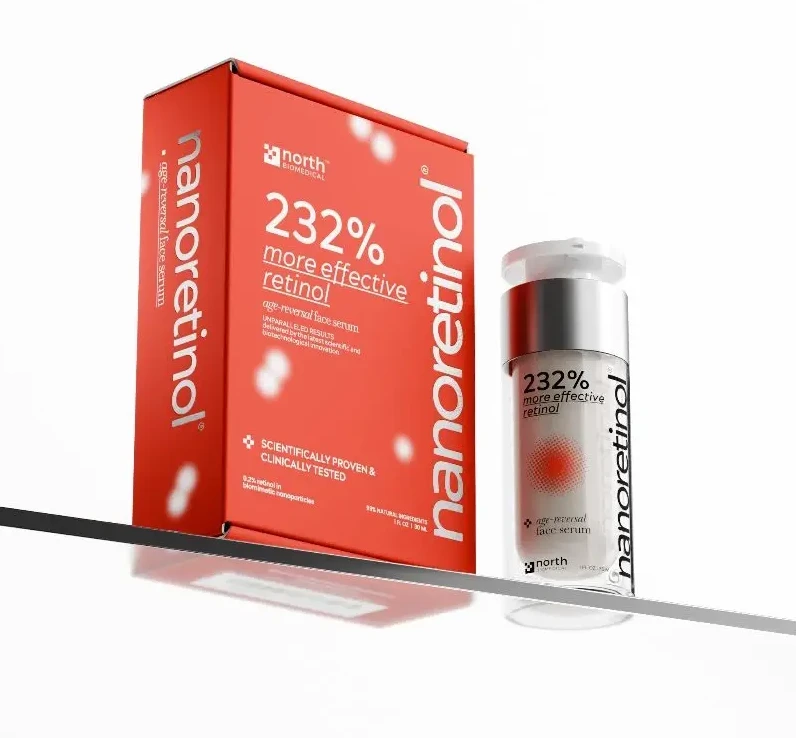
Nanoretinol® by North Biomedical® addresses this directly. By encapsulating retinol in biomimetic lipid nanoparticles that are recognized by skin cells as “self,” the formulation bypasses barrier disruption entirely. Clinical testing showed 232% greater collagen recovery compared to conventional retinol — delivering more of the texture-improving benefits with significantly reduced irritation. For anyone who has quit retinol because of the adjustment period, this represents a fundamentally different experience.
The Supporting Cast
Niacinamide
Niacinamide (vitamin B3) at 2-5% improves texture through several pathways: it enhances barrier function (reducing the dehydration that worsens texture), increases ceramide and fatty acid synthesis in the stratum corneum, and reduces the appearance of pores and surface roughness [7]. It’s exceptionally well-tolerated and pairs well with virtually every other active ingredient.
Hyaluronic Acid
As mentioned, dehydration is the simplest texture issue to address. Hyaluronic acid in multi-molecular-weight formulations hydrates both the surface and deeper layers, causing corneocytes to lie flat and reflect light evenly. The texture improvement from hydration alone can be dramatic — and visible within days rather than weeks.
Vitamin C
L-ascorbic acid at 10-20% provides antioxidant protection against the UV-induced collagen degradation that contributes to rough texture over time. It also brightens the skin surface by inhibiting melanin production, which can make textural irregularities less visible even before structural improvement occurs [2].
Building a Texture-Focused Protocol
The most effective approach layers complementary mechanisms rather than relying on a single active:
Morning:
- Gentle cleanser (non-foaming, pH 4.5-5.5)
- Vitamin C serum (10-15%)
- Niacinamide moisturizer (3-5%)
- Broad-spectrum SPF 30+ (daily, non-negotiable)
Evening:
- Oil-based cleanser to remove sunscreen
- Chemical exfoliant (AHA or BHA, 2-3 nights/week) OR retinoid (alternate nights)
- Hydrating serum (hyaluronic acid)
- Barrier-repair moisturizer (ceramides, squalane)
Important: Don’t use AHA/BHA exfoliants and retinoids on the same night. Both increase cell turnover, and combining them — especially on mature or sensitive skin — risks over-exfoliation, which worsens texture rather than improving it.
What to Expect — and When
Texture improvement follows a predictable timeline because it depends on measurable biological processes:
- Week 1-2: Hydration improvement (if dehydration was a factor). Skin feels smoother to the touch.
- Week 4-6: First visible improvement from accelerated turnover. Surface dullness lifts. One full skin cycle has completed with your new actives on board.
- Week 8-12: Collagen remodeling begins to show. Pores appear smaller (better collagen support), overall texture visibly smoother.
- Month 3-6: Cumulative structural improvement. Post-inflammatory texture marks fade. Skin reflects light more uniformly.
The trajectory is gradual but consistent — and it continues improving beyond six months if you maintain the routine. Texture improvement isn’t a destination you arrive at. It’s a direction you maintain.
References
- Mukherjee S, Date A, Patravale V, et al. “Retinoids in the treatment of skin aging: an overview of clinical efficacy and safety.” Clinical Interventions in Aging. 2006;1(4):327-348. doi:10.2147/ciia.2006.1.4.327
- Cao C, Xiao Z, Wu Y, Ge C. “Fighting against Skin Aging: The Way from Bench to Bedside.” Cell Transplantation. 2018;27(5):729-738. doi:10.1177/0963689717725755
- Sharad J. “Glycolic acid peel therapy — a current review.” Clinical, Cosmetic and Investigational Dermatology. 2013;6:281-288. doi:10.2147/CCID.S34029
- Newman N, Newman A, Moy LS, et al. “Clinical improvement of photoaged skin with 50% glycolic acid. A double-blind vehicle-controlled study.” Dermatologic Surgery. 1996;22(5):455-460. PMID: 8634809
- Zasada M, Budzisz E. “Retinoids: active molecules influencing skin structure formation in cosmetic and dermatological treatments.” Postepy Dermatologii i Alergologii. 2019;36(4):392-397. doi:10.5114/ada.2019.87443
- Ryu YS, Kang KA, Piao MJ, et al. “Human Skin Aging and the Anti-Aging Properties of Retinol.” Biomolecules. 2023;13(11):1614. doi:10.3390/biom13111614
- Bissett DL, Oblong JE, Berge CA. “Niacinamide: A B vitamin that improves aging facial skin appearance.” Dermatologic Surgery. 2005;31(7 Pt 2):860-865. doi:10.1111/j.1524-4725.2005.31732