At-Home Microneedling: Does It Really Work, and Is It Safe?
The gap between a $20 derma roller and a dermatologist's device comes down to a fraction of a millimeter — and that fraction changes almost everything about the result.
The Promise of a $20 Derma Roller
Search “microneedling at home” and you’ll find a tempting proposition: the same collagen-building treatment estheticians charge $300 a session for, delivered by a handheld roller you can buy for the price of lunch. The logic seems airtight. Professionals prick your skin with tiny needles to trigger repair; the roller on your bathroom shelf has tiny needles too. Same principle, tiny fraction of the cost.
The problem is that microneedling is one of those treatments where the details aren’t details — they’re the entire mechanism. And the single detail that matters most, needle depth, is precisely the one that separates a clinical device from the roller in the drugstore aisle.
What Microneedling Actually Does to Skin
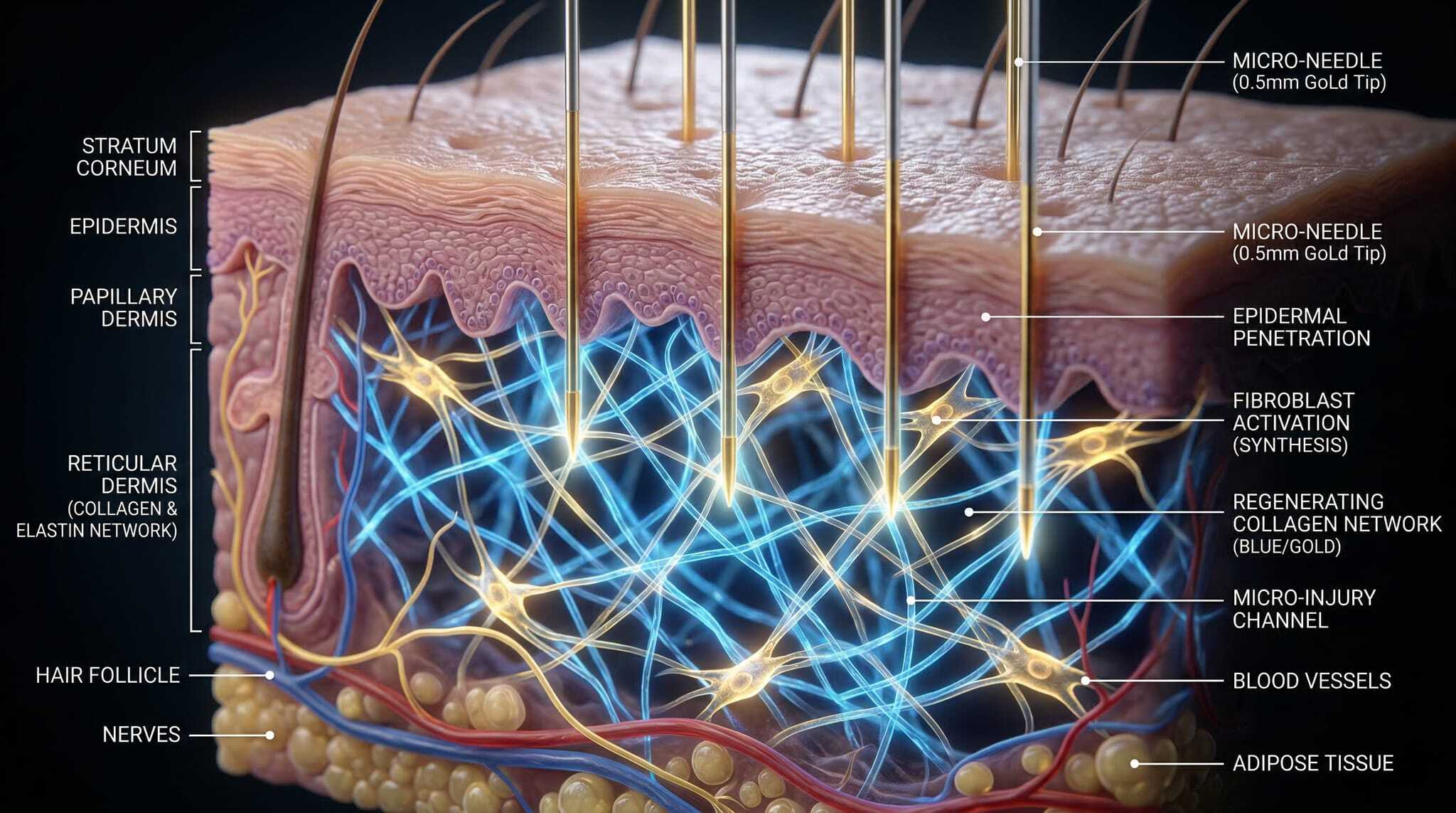
Microneedling’s proper name is percutaneous collagen induction, and it works by controlled sabotage. Fine needles create hundreds of microscopic channels in the skin. Your body reads these as injuries and launches its wound-healing cascade: growth factors flood the area, fibroblasts activate, and new collagen and elastin are laid down [2]. Done at the right depth by a trained hand, the results are real and measurable. In one of the foundational studies, histological analysis six months after treatment showed a considerable increase in both collagen and elastin deposition, while the epidermis stayed intact and even thickened [1].
That last point is the elegant part. Unlike ablative lasers or deep peels, needling rebuilds the deeper layers without destroying the surface. But “at the right depth” is doing enormous work in that sentence.
The Number That Decides Everything: Needle Depth
Here is where the at-home dream meets biology. To trigger genuine collagen induction, needles have to reach the dermis — the living, collagen-producing layer beneath the surface. Medical microneedling devices use needles ranging from 0.5 to 1.5 millimeters, and up to 2.5 millimeters for deeper scar work. Needle lengths of 0.5 to 1 millimeter are the standard for treating aging skin and wrinkles [3].
Professionals prick your skin with tiny needles to trigger repair; the roller on your bathroom shelf has tiny needles too.
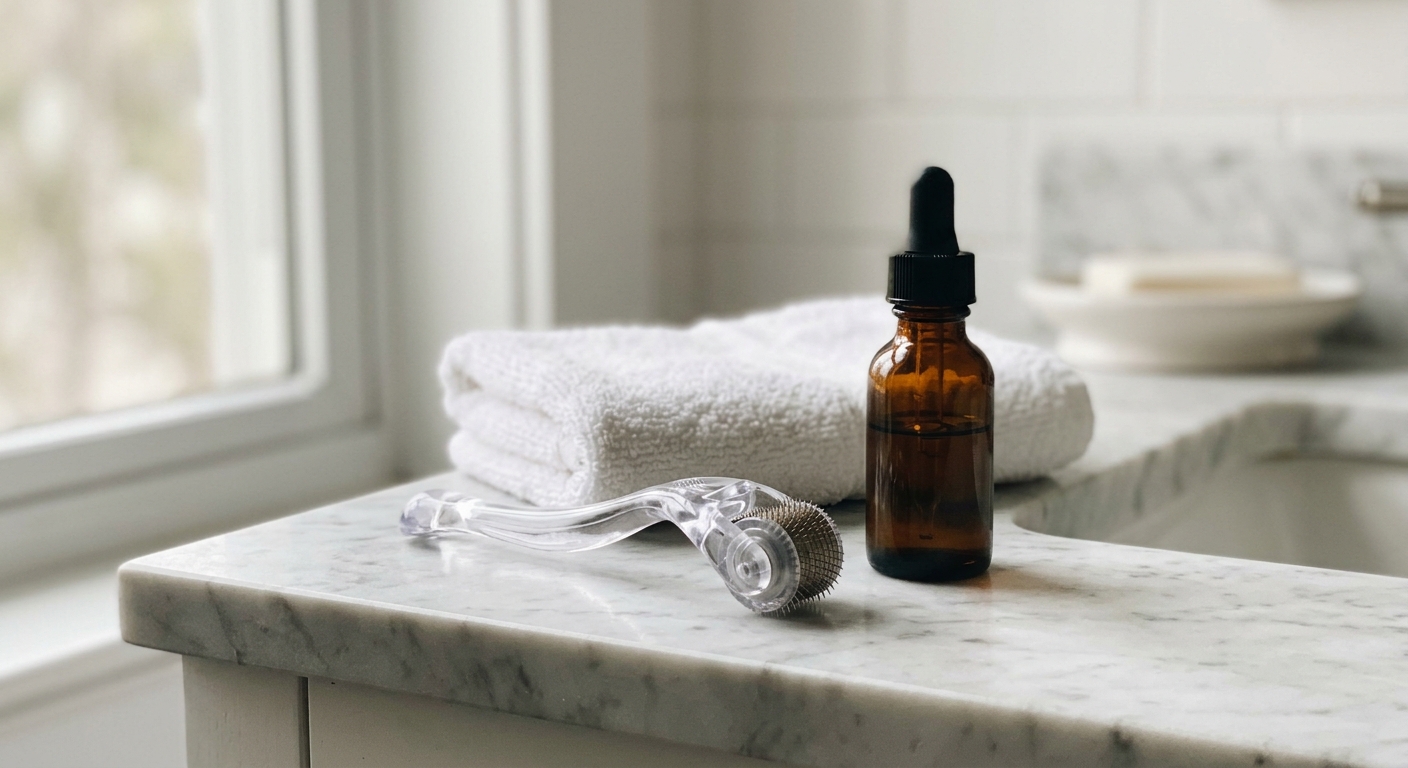
Consumer rollers sold for unsupervised home use are a different tool entirely. Their needles are typically shorter than 0.15 millimeters — deliberately kept in the epidermis for safety [3]. At that length they cannot create the controlled micro-injuries that set off the deeper healing response. What they can do is modestly help product absorption and temporarily smooth the look of fine lines and pores. Useful, perhaps. But structural collagen remodeling is not on the menu at 0.15 millimeters.
This is the quiet truth behind most “at-home microneedling before and after” photos: what you’re often seeing is short-term swelling and hydration, not new collagen. A comprehensive review of the technique notes that outcomes hinge on needle length, number of passes, and device design — parameters that home users rarely control precisely [2].
Where At-Home Devices Get Risky
If a home roller stayed harmlessly shallow, the worst outcome would be a wasted purchase. Unfortunately, the temptation is always to press harder, roll longer, or buy a longer-needle “pro” roller online — and that is where trouble starts.
Longer needles used without training and sterile technique carry real risks: infection, post-inflammatory hyperpigmentation, and scarring — the very outcomes people are trying to reverse [2]. Rollers are especially problematic because a rotating drum tears rather than punctures cleanly, and they are notoriously hard to sterilize between uses. Reused, unsterile needles on skin you’ve broken open are a textbook route to bacterial infection. People with active acne, eczema, rosacea flares, or a tendency toward keloids can make their skin meaningfully worse.
In photodamaged skin, tretinoin drove an 80 percent increase in new collagen I formation.
None of this means professional microneedling is a bad treatment. It means the professional part — depth control, sterile single-use tips, trained assessment of your skin — is not the part you can skip. What you apply once the skin is open matters for the same reason, which we cover in our guide to the best serum for microneedling.
A Gentler Route to the Same Destination
Step back and remember what microneedling is actually for. The needles are not the goal; collagen is. The wounding is just a way to convince your fibroblasts to get back to work. And it turns out there’s a well-studied way to send fibroblasts that same message without breaking the skin barrier at all: retinoids.
Topical retinoids switch on collagen production directly through the skin’s own signaling pathways. In photodamaged skin, tretinoin drove an 80 percent increase in new collagen I formation [5]. Even over-the-counter retinol, applied to genuinely aged skin, significantly raised both procollagen and glycosaminoglycan levels — more collagen and more of the water-binding molecules that plump fine lines [4]. That’s the same collagen-and-hydration endpoint microneedling chases, achieved by instruction rather than injury.
The historic catch with retinol has been tolerance and delivery: conventional formulas irritate the surface while much of the active never penetrates efficiently. This is the problem Nanoretinol was engineered around. It encapsulates retinol in biomimetic lipid nanoparticles that the skin recognizes as “self” and admits through the barrier — no wounding, no petroleum-derived penetration enhancers stripping your skin. In North Biomedical’s clinical study, this delivery approach proved 232 percent more effective at collagen recovery and 73 percent more effective at elastin recovery than conventional retinol, with clinical firmness up 61 percent over 56 days — and it did so while being gentler on skin cells, not harsher.
If you’re drawn to at-home microneedling because you want firmer, smoother skin without a clinic budget, that instinct is right. It’s the tool that’s mismatched to the setting. For deep structural work, see a professional who can control the depth safely — our guides to professional microneedling and RF microneedling explain when it’s worth it. For daily, barrier-safe collagen support you can actually run at home, a well-delivered retinol does the job the roller only promises. If you’re new to the ingredient, start with our retinol for beginners guide.
The Honest Verdict on Home Rollers
A derma roller is not a miniature version of a clinical device — it’s a different instrument working in a different skin layer. Kept shallow, it does little of consequence for wrinkles; pushed deep enough to matter, it becomes a genuine safety hazard in untrained hands. The collagen you’re after is real and achievable. It just responds far better to a consistent, well-formulated retinol than to a gadget rolled across the bathroom sink.
References
- Aust MC, Fernandes D, Kolokythas P, Kaplan HM, Vogt PM. “Percutaneous Collagen Induction Therapy: An Alternative Treatment for Scars, Wrinkles, and Skin Laxity.” Plastic and Reconstructive Surgery. 2008;121(4):1421-1429. doi:10.1097/01.prs.0000304612.72899.02
- Hou A, Cohen B, Haimovic A, Elbuluk N. “Microneedling: A Comprehensive Review.” Dermatologic Surgery. 2017;43(3):321-339. doi:10.1097/DSS.0000000000000924
- Tehrani L, Tashjian M, Mayrovitz HN. “Physiological Mechanisms and Therapeutic Applications of Microneedling: A Narrative Review.” Cureus. 2025;17(3):e80510. doi:10.7759/cureus.80510
- Kafi R, Kwak HSR, Schumacher WE, et al. “Improvement of Naturally Aged Skin With Vitamin A (Retinol).” Archives of Dermatology. 2007;143(5):606-612. doi:10.1001/archderm.143.5.606
- Griffiths CE, Russman AN, Majmudar G, Singer RS, Hamilton TA, Voorhees JJ. “Restoration of Collagen Formation in Photodamaged Human Skin by Tretinoin (Retinoic Acid).” New England Journal of Medicine. 1993;329(8):530-535. doi:10.1056/NEJM199308193290803