
RF Microneedling: How It Tightens Skin and Whether It's Worth It
A clear-eyed look at the science of radiofrequency microneedling, what it can realistically do for skin laxity, and the gentler everyday alternative most people overlook.
Somewhere in your forties, the mirror starts telling a different story. The jawline that used to be a clean line softens. Cheeks that sat high begin to drift. Skin that once snapped back when you smiled now keeps a faint crease a beat too long. This is skin laxity, and it is one of the most common reasons women over 40 walk into a dermatologist’s office asking, “What can actually tighten this?”
One answer they hear again and again is RF microneedling. It has become one of the most requested in-office treatments of the decade, promising firmer, smoother skin without surgery. But the marketing runs well ahead of the science, and the price tag is steep. Here is what radiofrequency microneedling really does, what the evidence supports, and how to think about it against gentler options you can use every night.
What RF Microneedling Actually Is
RF microneedling combines two technologies that work on different layers of your skin. The “microneedling” part uses an array of fine needles to create thousands of microscopic channels in the skin. The “RF” part — radiofrequency — delivers controlled heat through those needles directly into the dermis, the deep layer where collagen and elastin live. If you are choosing between energy devices, our microneedling vs laser comparison covers where radiofrequency sits between plain needling and ablative resurfacing.
Think of it as a wake-up call delivered with precision. The needles tell your skin that a controlled injury has occurred; the heat amplifies that signal and concentrates it exactly where aging does its damage. Standard microneedling only reaches so deep. Adding radiofrequency lets practitioners deposit energy several millimeters down without burning the surface, which is why devices like Morpheus8 and Secret RF became so popular for laxity rather than just texture.
How It Tightens Skin: The Collagen Story
Your skin’s firmness is essentially a collagen problem. Collagen is the scaffolding that holds everything taut, and from your mid-twenties onward, you lose roughly 1% of it per year. By 40, the architecture is visibly thinner and looser.
Collagen is the scaffolding that holds everything taut, and from your mid-twenties onward, you lose roughly 1% of it per year.
RF microneedling works by provoking a repair response. When the needles deliver thermal energy into the dermis, they cause fractional zones of tissue coagulation. Your body reads this as damage and launches a healing cascade — clearing out old, degraded collagen and synthesizing fresh fibers in its place [1]. The clinical term is neocollagenesis, and it is the entire reason the treatment can firm skin over time rather than just plump it temporarily.
The evidence for this mechanism is genuinely solid. A 2025 clinical and histological dose-response study found that higher delivered energy produced measurable, dose-dependent volume and tightening effects in the treated tissue, confirming that the collagen response scales with how the device is used [1]. A separate clinical, histometric, and immunohistochemical study of combined microneedle and fractional radiofrequency for photoaging documented better-organized collagen fibers, a significant increase in type I collagen, and restoration of normal-appearing elastic fibers with a reduction in abnormal elastin [2]. In plain terms: under the microscope, treated skin actually rebuilt its scaffolding.
A comprehensive review of the technology in modern plastic surgery practice reached the same conclusion — RF microneedling reliably stimulates dermal remodeling and is well-suited to skin tightening, mild laxity, acne scars, and stretch marks [3].
What It Treats Best — and What It Won’t Do
RF microneedling shines for early to moderate laxity: a softening jawline, crepey texture, enlarged-looking pores, and acne scarring. It is a remodeling tool, not a lifting tool.
What it will not do is replace a facelift. If gravity has produced significant jowls or hanging skin, no amount of collagen stimulation will hoist that tissue back into place. Honest practitioners screen for this, because the most common source of disappointment is a patient expecting a surgical result from a collagen-building treatment.
It encapsulates a fully stabilized 0.2% retinol inside biomimetic lipid nanoparticles that the skin recognizes as “self” and ushers through the barrier intact, rather than chemically forcing a path.
The Honest Downsides
The science is real, but so are the trade-offs. A single session typically runs several hundred to well over a thousand dollars, and meaningful results usually require three or more sessions spaced a month apart. The needles plus heat make it genuinely uncomfortable; numbing cream is mandatory, and you can expect redness, swelling, and a sandpapery texture for several days afterward. People with deeper skin tones need an experienced provider, because heat-based devices carry a real risk of post-inflammatory pigmentation when settings are wrong.
And the results, while real, are gradual. New collagen takes weeks to months to mature, so the firmer skin you are paying for arrives slowly and fades over a year or two as natural aging resumes. RF microneedling is best understood as a periodic reset, not a permanent fix.
Building Collagen Without the Needles
Here is the part the clinics rarely emphasize: the entire goal of RF microneedling — triggering fibroblasts to lay down new collagen — is something your skin can be coaxed to do every single night, without thermal injury.
The reason aged skin looks lax is not only that collagen breaks down but that aging fibroblasts simply produce less of it [4]. The most evidence-backed way to push those fibroblasts back into production is the retinoid family. In a landmark controlled study, topical retinol significantly increased collagen production in naturally aged skin and improved fine lines, with the benefit confirmed at the molecular level, not just by appearance [5]. Decades of dermatology rest on this finding: retinol is one of the few ingredients proven to rebuild the same scaffolding RF microneedling targets.
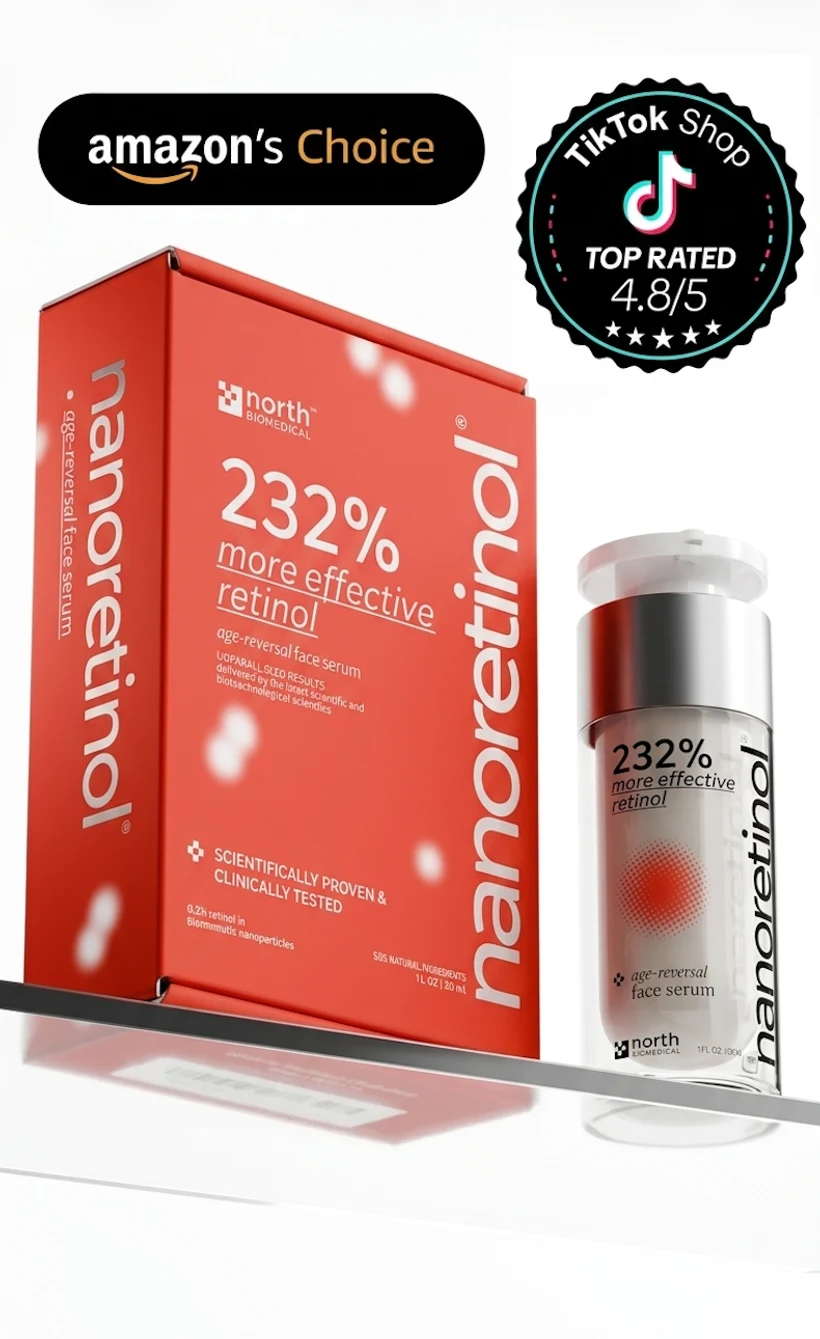
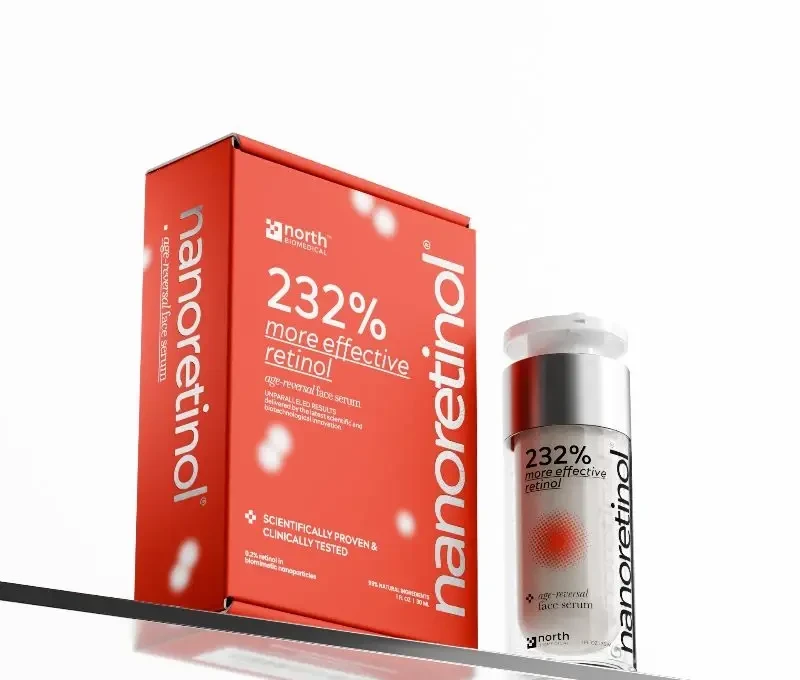
The catch with conventional retinol has always been delivery and tolerance — most of it never penetrates far enough to matter, and the irritation drives people to quit. This is the problem Nanoretinol was engineered to solve. It encapsulates a fully stabilized 0.2% retinol inside biomimetic lipid nanoparticles that the skin recognizes as “self” and ushers through the barrier intact, rather than chemically forcing a path. In North Biomedical’s testing, that delivery system made it 232% more effective at collagen recovery and 73% more effective at elastin recovery than conventional retinol — while being significantly gentler on skin cells.
That does not make a serum a substitute for a procedure when you have moderate laxity and the budget for it. But it does mean the foundation of firmer skin is something you build nightly, between or instead of expensive sessions. Many people find that consistent retinol use is what makes any in-office investment last longer. If you are weighing your options, it is worth reading how non-surgical skin tightening approaches compare, what Morpheus8 specifically offers, and the broader science of how to boost collagen production. For what to apply during and immediately after a session, see our guide to the best serum for microneedling.
Where RF Microneedling Fits
Radiofrequency microneedling is one of the better-validated energy treatments for mild to moderate skin laxity, with real histological evidence behind its collagen-building claims. It is not magic, not permanent, and not cheap — and it does nothing the night you skip it. The smartest approach treats it as one tool in a longer strategy, anchored by the nightly habit of feeding your fibroblasts the one ingredient proven to keep building the scaffolding that holds your face in place.
References
- Nguyen L, Bartholomeusz J, Schneider SW, Herberger K. “Histological and clinical dose-response analysis of radiofrequency microneedling treatment for skin rejuvenation.” Lasers in Medical Science. 2025;40(1):75. doi:10.1007/s10103-025-04335-9
- El-Domyati M, Moawad O, Abdel-Wahab H, Behairy EF, Rezk AF. “A New Approach with Combined Microneedle and Sublative Fractional Radiofrequency for Photoaging Management: A Clinical, Histometric, and Immunohistochemical Study.” Aesthetic Plastic Surgery. 2025;49(5):1435-1443. doi:10.1007/s00266-024-04416-0
- Shauly O, Marxen T, Menon A, Gould DJ, Miller LB, Losken A. “Radiofrequency Microneedling: Technology, Devices, and Indications in the Modern Plastic Surgery Practice.” Aesthetic Surgery Journal Open Forum. 2023;5:ojad100. doi:10.1093/asjof/ojad100
- Varani J, Dame MK, Rittie L, Fligiel SE, Kang S, Fisher GJ, Voorhees JJ. “Decreased collagen production in chronologically aged skin: roles of age-dependent alteration in fibroblast function and defective mechanical stimulation.” The American Journal of Pathology. 2006;168(6):1861-1868. doi:10.2353/ajpath.2006.051302
- Kafi R, Kwak HS, Schumacher WE, Cho S, Hanft VN, Hamilton TA, King AL, Neal JD, Varani J, Fisher GJ, Voorhees JJ, Kang S. “Improvement of naturally aged skin with vitamin A (retinol).” Archives of Dermatology. 2007;143(5):606-612. doi:10.1001/archderm.143.5.606