Can You Actually Reverse Sun Damage on Your Face? Science Says Yes — Here's How
Photoaging is the #1 cause of visible skin aging — and it's more reversible than you think
Why Sun Damage Matters More Than Your Age
Here is a fact that surprises most people: the majority of what we call “aging skin” is not caused by getting older. It’s caused by the sun.
Dermatologists call it photoaging — cumulative skin damage from ultraviolet radiation — and it accounts for up to 80% of visible facial aging [1]. The wrinkles, the uneven texture, the dark spots, the leathery feel — most of it traces back to UV exposure from your 20s and 30s, quietly accumulating beneath the surface long before it becomes visible.
The encouraging part? Unlike chronological aging, which is largely genetic and irreversible, photoaging involves specific molecular damage that the skin can partially undo — if you give it the right signals.
What UV Light Actually Does to Your Skin
Understanding whether sun damage is reversible starts with understanding what UV radiation breaks. The visible tan that follows an exposure runs on a separate and much faster clock, which we cover in how to remove sun tan from your face.
Collagen Destruction via Matrix Metalloproteinases
Every time UV rays hit your skin, they trigger a signaling cascade that activates enzymes called matrix metalloproteinases (MMPs) — particularly MMP-1, MMP-3, and MMP-9 [1]. These enzymes are collagen demolition crews. They chop up Type I and Type III collagen fibers in the dermis, fragmenting the structural scaffold that keeps skin firm and smooth.
A single significant sun exposure can elevate MMP levels for days, and those exposures include hours spent behind glass, where UVA passes through and UVB largely does not, a distinction covered in sunscreen indoors. Over years of cumulative exposure, the damage compounds: collagen fragments accumulate, new collagen synthesis slows, and the dermis becomes progressively thinner and more disorganized [2].
DNA Damage and Cellular Stress
UV radiation — particularly UVB — directly damages DNA by creating cyclobutane pyrimidine dimers (CPDs), which distort the DNA helix and interfere with normal cell function [1]. While the body has DNA repair mechanisms, they become less efficient with age. Unrepaired mutations accumulate, contributing to both visible aging and skin cancer risk.
Tretinoin at 0.05% showed the most consistent results, though retinol at cosmetic concentrations produced comparable molecular effects with significantly less irritation.
UVA radiation, which penetrates deeper, generates reactive oxygen species (ROS) that damage lipids, proteins, and mitochondrial DNA through oxidative stress [3]. The combined effect of UVA and UVB creates a multi-layered assault on skin structure and function. The wavelength-by-wavelength comparison is laid out in UVA vs UVB.
The Collagen Deficit
In one of the most cited studies on photoaging, Griffiths et al. measured collagen formation in photodamaged forearm skin versus sun-protected buttock skin from the same individuals. The result: collagen I formation was 56% lower in the sun-exposed areas [4]. That is not subtle thinning — that is more than half the collagen-producing capacity, suppressed by light.
The Evidence for Reversal
So can you actually rebuild what the sun has broken? The clinical data says yes — with important caveats.
Retinoids: The Gold Standard for Photoaging Reversal
Retinoids are the most extensively studied topical agents for reversing sun damage. The landmark 1993 study in the New England Journal of Medicine demonstrated that 10–12 months of topical tretinoin produced an 80% increase in Type I collagen formation in photodamaged skin — while placebo-treated skin showed a 14% further decline [4].
That single finding changed dermatology. It proved that the collagen-producing machinery in photodamaged skin is not destroyed — it’s suppressed. With the right molecular signal, fibroblasts can be reactivated.
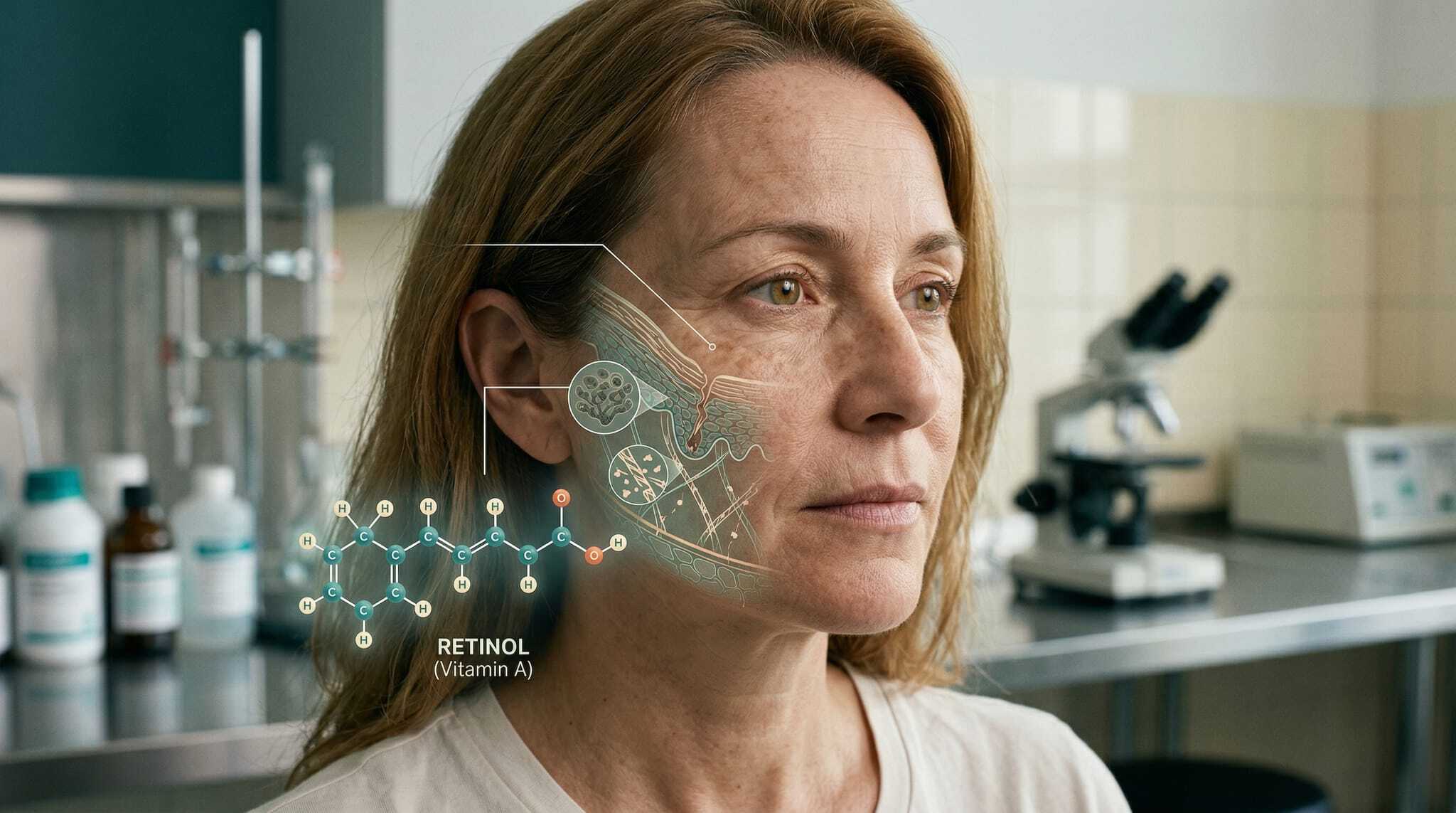
A comprehensive review of retinoid clinical trials confirmed that both tretinoin and retinol produce statistically significant improvements in wrinkles, hyperpigmentation, roughness, and overall photodamage severity [5]. Tretinoin at 0.05% showed the most consistent results, though retinol at cosmetic concentrations produced comparable molecular effects with significantly less irritation [6].
The limitation of conventional retinol has always been delivery. Retinol is unstable and poorly absorbed through the skin barrier, meaning most of it degrades before reaching the dermal fibroblasts where collagen synthesis occurs. Modern encapsulated delivery systems address this directly.
Comparative testing showed 232% greater collagen recovery versus unencapsulated retinol, which means more repair signal reaching the cells that actually need it.
Nanoretinol® encapsulates retinol within biomimetic lipid nanoparticles that the skin recognizes as biological — allowing passage through the epithelial barrier without the chemical disruption that conventional formulations require [7]. Comparative testing showed 232% greater collagen recovery versus unencapsulated retinol, which means more repair signal reaching the cells that actually need it [7].
Antioxidants: Neutralizing Ongoing Damage
Vitamin C (L-ascorbic acid) serves a dual role in photoaging repair. First, it directly scavenges the reactive oxygen species that UV radiation generates [3]. Second, it acts as an essential cofactor for prolyl hydroxylase and lysyl hydroxylase — enzymes required for stable collagen synthesis [8]. Without adequate vitamin C, even retinoid-stimulated fibroblasts cannot produce properly structured collagen.
Topical vitamin C at 10–20% concentration has been shown to reduce UV-induced erythema, improve photodamage scores, and increase dermal collagen density in clinical trials [8]. For maximum photoaging reversal, it works best in the morning — neutralizing oxidative damage from sun exposure in real time — while retinol works at night to stimulate repair.
Sunscreen: Stopping the Damage at Source
This sounds obvious, but the data is stark: daily sunscreen use alone — without any active treatment — allows measurable photoaging reversal. A four-year Australian study found that participants assigned to daily SPF 15+ use showed no detectable increase in skin aging over the study period, while the control group continued to age visibly [9]. The skin’s own repair mechanisms can make progress when the daily damage stops.
For women already using retinoids, sunscreen is non-negotiable, and a zinc-led formula is the usual choice for skin already carrying an active, which our best mineral sunscreen guide covers in detail. Retinol increases photosensitivity by accelerating cell turnover and thinning the dead cell layer that provides some UV protection [5].
A Science-Based Approach to Sun Damage Repair
The optimal strategy for reversing facial sun damage combines three mechanisms:
- Stop ongoing damage — Daily broad-spectrum SPF 30+ prevents new MMP activation and gives repair pathways time to work, and SPF 30 vs 50 covers how much the higher number adds in practice, while men skip the step far more often than women, which our guide to the best sunscreen for men addresses head on
- Stimulate collagen synthesis — Nightly retinol, ideally in a nanoparticle delivery system that maximizes dermal penetration. Start at 0.2% and gradually increase frequency
- Support the repair process — Morning vitamin C serum (10–15% L-ascorbic acid) for antioxidant defense and collagen cofactor support
Additional strategies with clinical backing include:
- Niacinamide — Reduces hyperpigmentation and improves barrier function, addressing the uneven skin tone that characterizes photodamaged skin
- Alpha hydroxy acids — Gentle exfoliation accelerates removal of damaged surface cells, improving texture and allowing better penetration of active ingredients
- Ceramides — Repair the lipid barrier that UV exposure compromises, reducing moisture loss and sensitivity
What Reversal Realistically Looks Like
Clinical studies consistently show improvement in fine lines, pigmentation, roughness, and overall skin texture with retinoid therapy over 6–12 months [5]. Deep structural damage — severe wrinkling, significant elastin loss, dermal thinning — can be improved but not fully reversed through topical treatment alone. For the pigment and redness themselves, an in-office option like BBL broadband light clears existing sun spots faster than any cream.
The underlying machinery for collagen synthesis is still largely intact — it just needs consistent signals to stay active. Whether your sun damage came from childhood sunburns, teenage tanning, or decades of daily commuting, the biology of repair responds to the same interventions. If you are dealing with a fresh burn right now, start with how to heal sunburn fast and come back to this once the peeling has stopped. Preventing the next decade of it depends less on the SPF number than on how much sunscreen you actually apply and on reapplying, and powder sunscreen sets out what a brush-on top-up genuinely contributes, while a sunscreen stick is the other way to reapply over makeup and carries its own dosing caveats. The best time to start was twenty years ago. The second best time is now.
References
- Fisher GJ, Wang ZQ, Datta SC, et al. “Mechanisms of photoaging and chronological skin aging.” Archives of Dermatology. 2002;138(11):1462-1470. doi:10.1001/archderm.138.11.1462
- Rittié L, Fisher GJ. “UV-light-induced signal cascades and skin aging.” Ageing Research Reviews. 2002;1(4):705-720. doi:10.1016/S1568-1637(02)00024-7
- Masaki H. “Role of antioxidants in the skin: anti-aging effects.” Journal of Dermatological Science. 2010;58(2):85-90. doi:10.1016/j.jdermsci.2010.03.003
- Griffiths CEM, Russman AN, Majmudar G, et al. “Restoration of collagen formation in photodamaged human skin by tretinoin (retinoic acid).” New England Journal of Medicine. 1993;329(8):530-535. doi:10.1056/NEJM199308193290803
- Mukherjee S, Date A, Patravale V, et al. “Retinoids in the treatment of skin aging: an overview of clinical efficacy and safety.” Clinical Interventions in Aging. 2006;1(4):327-348. doi:10.2147/ciia.2006.1.4.327
- Kang S, Duell EA, Fisher GJ, et al. “Application of retinol to human skin in vivo induces epidermal hyperplasia and cellular retinoid binding proteins characteristic of retinoic acid but without measurable retinoic acid levels or irritation.” Journal of Investigative Dermatology. 1995;105(4):549-556. doi:10.1111/1523-1747.ep12323445
- North Biomedical LLC. “Nanoretinol® vs. Conventional Retinol: Efficacy in Collagen and Elastin Recovery.” Clinical Study Summary, 2024. View Study
- Pullar JM, Carr AC, Vissers MCM. “The Roles of Vitamin C in Skin Health.” Nutrients. 2017;9(8):866. doi:10.3390/nu9080866
- Hughes MCB, Williams GM, Baker P, Green AC. “Sunscreen and prevention of skin aging: a randomized trial.” Annals of Internal Medicine. 2013;158(11):781-790. doi:10.7326/0003-4819-158-11-201306040-00002