Best Primer for Mature Skin: How to Choose One That Doesn't Settle Into Lines
The right primer can blur texture for a day — but understanding why makeup catches on mature skin changes how you choose one.
If you’ve watched foundation that looked flawless at 8 a.m. gather into the fine lines around your eyes and mouth by lunch, you already understand why primer becomes a bigger deal after 40. The makeup itself often isn’t the problem. The canvas has changed, and primer is the layer most people reach for to compensate.
The trouble is that “best primer for mature skin” turns up hundreds of products making nearly identical promises. Choosing well is easier once you understand the one thing they’re all trying to solve — and the one thing none of them can actually fix.
Why Makeup Behaves Differently on Mature Skin
Skin doesn’t just develop deeper wrinkles with age; its entire surface texture shifts. When researchers measured skin micro-topography across age groups, they found that surface roughness parameters increase measurably with age, while the fine, even network of tiny “polygons” that gives young skin its smooth, uniform texture becomes sparser and more irregular [1].
Other work using optical 3D imaging to map the skin’s surface confirms the same trend: with age, the peaks and valleys of the skin’s microrelief grow deeper and more pronounced [2]. Those deeper channels are exactly where liquid and powder makeup collects and casts tiny shadows — the visual effect we read as “settling into lines.”
Add two more age-related changes — reduced oil production and lower hydration, which leave the surface less supple — and you have skin that grips makeup unevenly and lets it migrate into every crease over the course of a day. A primer is essentially a corrective layer designed to even out that microscopic terrain before color goes on top.
Not all primers do the same job, and the wrong type can make mature skin look worse.
What to Look For in a Primer for Mature Skin
Not all primers do the same job, and the wrong type can make mature skin look worse. Here’s what actually matters.
Hydrating, not mattifying. The mattifying, oil-absorbing primers built for younger, oilier skin tend to emphasize dryness and texture on mature skin. Look instead for primers built on humectants like glycerin or hyaluronic acid, which keep the surface plump and supple so makeup glides rather than catches.
Smart blurring agents. The “soft focus” effect in good primers usually comes from film-forming silicones (dimethicone and its relatives) and light-diffusing powders. These work optically: they fill the micro-channels of the surface and scatter incoming light so that fine lines reflect more evenly instead of casting hard shadows. This is genuine, useful camouflage — just understand that it’s a surface illusion that resets every time you cleanse.
Light reflection over heavy coverage. Subtle luminosity helps mature skin look fresher, because dull, rough skin absorbs light unevenly. Primers with fine light-reflecting particles soften the appearance of lines. Heavy, thick formulas, by contrast, tend to sit in creases and accentuate them. Primer is one decision among several, and our guide to the best makeup for mature skin sequences the whole category.
A gentle, compatible base. Since mature skin often has a more reactive barrier, fragrance-free formulas are the safer default. If your primer also offers broad-spectrum SPF, that’s a meaningful bonus — sun protection does more for long-term skin appearance than any cosmetic step. If that SPF has to live under makeup, the best SPF for under makeup explains which formats pill and which sit quietly underneath.
How you apply what goes on top matters as well, which we cover in makeup for wrinkles.
For the layers that go over your primer, our guides on choosing foundation for mature skin and stopping concealer from creasing under the eyes cover the rest of the routine.
Application Matters as Much as the Product
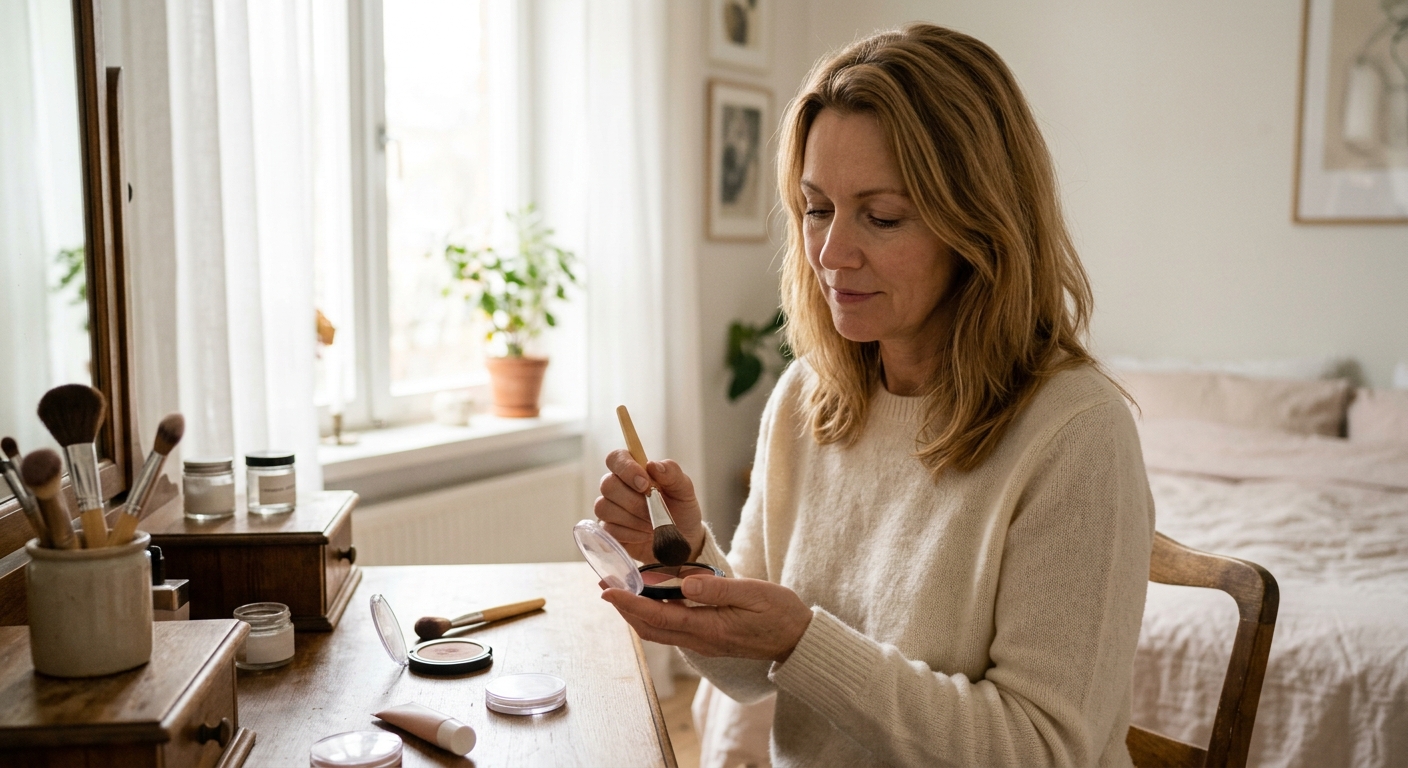
Even the best primer for mature skin disappoints if it’s applied like spackle. Use a small amount, press it into the skin rather than dragging it, and give it 30 to 60 seconds to set before foundation. Concentrate it where texture is most visible — around the nose, the smile lines, the forehead — rather than coating the whole face. Less product, well placed, almost always looks more natural and lasts longer than a thick, all-over layer. If the finished base still breaks into dry-looking islands, use this cakey-makeup troubleshooting sequence before changing primer. The same restraint governs what goes on top, which our guide to the best setting powder for mature skin works through in detail. When what goes on top is sheer rather than full coverage, our guide to the best tinted moisturizer for mature skin covers how to judge one. The final step follows the same restraint, and our guide to the best setting spray for mature skin separates the sprays that genuinely set from the ones that only hydrate.
The Limit Every Primer Shares
Here’s the honest part. A primer is camouflage. It improves how light hits your skin for the hours you’re wearing it, and then it washes off. It cannot change the skin’s actual surface, refill the lost collagen beneath a wrinkle, or smooth the deepening microrelief that made makeup catch in the first place. The better your underlying skin, the less your primer has to hide — and the more natural your makeup looks. How you apply what goes on top matters as well, which we cover in makeup for wrinkles. A sheer colour-correcting layer is often the easier answer, and our guide to the best CC cream for mature skin covers how to read those formulas.
That’s why the most effective long-term strategy isn’t a better primer. It’s improving the canvas itself, so fine lines and rough texture are genuinely smaller targets. The single most evidence-backed way to do that is with a retinoid. Across decades of controlled trials, topical retinol has been shown to reduce fine lines, improve skin texture, and stimulate new collagen — the structural change a cosmetic primer can only imitate [3]. Our overview of anti-wrinkle serums and fixing skin texture goes deeper on the active side of the equation.
Treating the Canvas, Not Just Covering It
The obstacle that historically kept people from getting these results was tolerance: conventional retinols are notoriously irritating, and irritated, flaky skin makes makeup look worse, not better. Newer delivery science has largely solved that. A 2022 review of topical retinoids highlighted that nanotechnology-based formulations — retinol encapsulated in lipid nanoparticles — penetrate the skin better and release the active more steadily than conventional creams, improving results while reducing irritation [4].
This is the principle behind Nanoretinol, which delivers a stabilized 0.2% retinol inside biomimetic lipid nanoparticles the skin accepts as “self.” In North Biomedical’s testing it outperformed conventional retinol on collagen and elastin recovery while staying gentle enough for sensitive, mature skin — and its water-based, non-greasy finish doesn’t interfere with the makeup that goes on top. Over weeks, as fine lines soften and texture evens out, the practical payoff is simple: your primer has less to do, and your makeup stays where you put it.
Choosing With Clear Eyes
The best primer for mature skin is the one matched to your reality — hydrating, lightly blurring, light-reflecting, and gentle. Use it, and use it well. Just keep its job in perspective: a primer makes today look better, while treating the skin underneath makes every day look better. Pair the two, and you get the smoothest result available — both in the mirror this morning and in the photographs a year from now. The colour that goes on top follows the same rule, which is why choosing a blush for mature skin comes down to the formula rather than the shade.
References
- Trojahn C, Dobos G, Schario M, Ludriksone L, Blume-Peytavi U, Kottner J. “Relation between skin micro-topography, roughness, and skin age.” Skin Research and Technology. 2015;21(1):69–75. doi:10.1111/srt.12158
- Jacobi U, Chen M, Frankowski G, Sinkgraven R, Hund M, Rzany B, Sterry W, Lademann J. “In vivo determination of skin surface topography using an optical 3D device.” Skin Research and Technology. 2004;10(4):207–214. doi:10.1111/j.1600-0846.2004.00075.x
- Mukherjee S, Date A, Patravale V, Korting HC, Roeder A, Weindl G. “Retinoids in the treatment of skin aging: an overview of clinical efficacy and safety.” Clinical Interventions in Aging. 2006;1(4):327–348. doi:10.2147/ciia.2006.1.4.327
- Milosheska D, Roškar R. “Use of Retinoids in Topical Antiaging Treatments: A Focused Review of Clinical Evidence for Conventional and Nanoformulations.” Advances in Therapy. 2022;39(12):5351–5375. doi:10.1007/s12325-022-02319-7