Dry Skin Around the Nose: Why It Flakes There and How to Fix It
The creases beside your nose dry out and flake more than anywhere else on your face. Here's the barrier science behind it — and how to calm it for good.
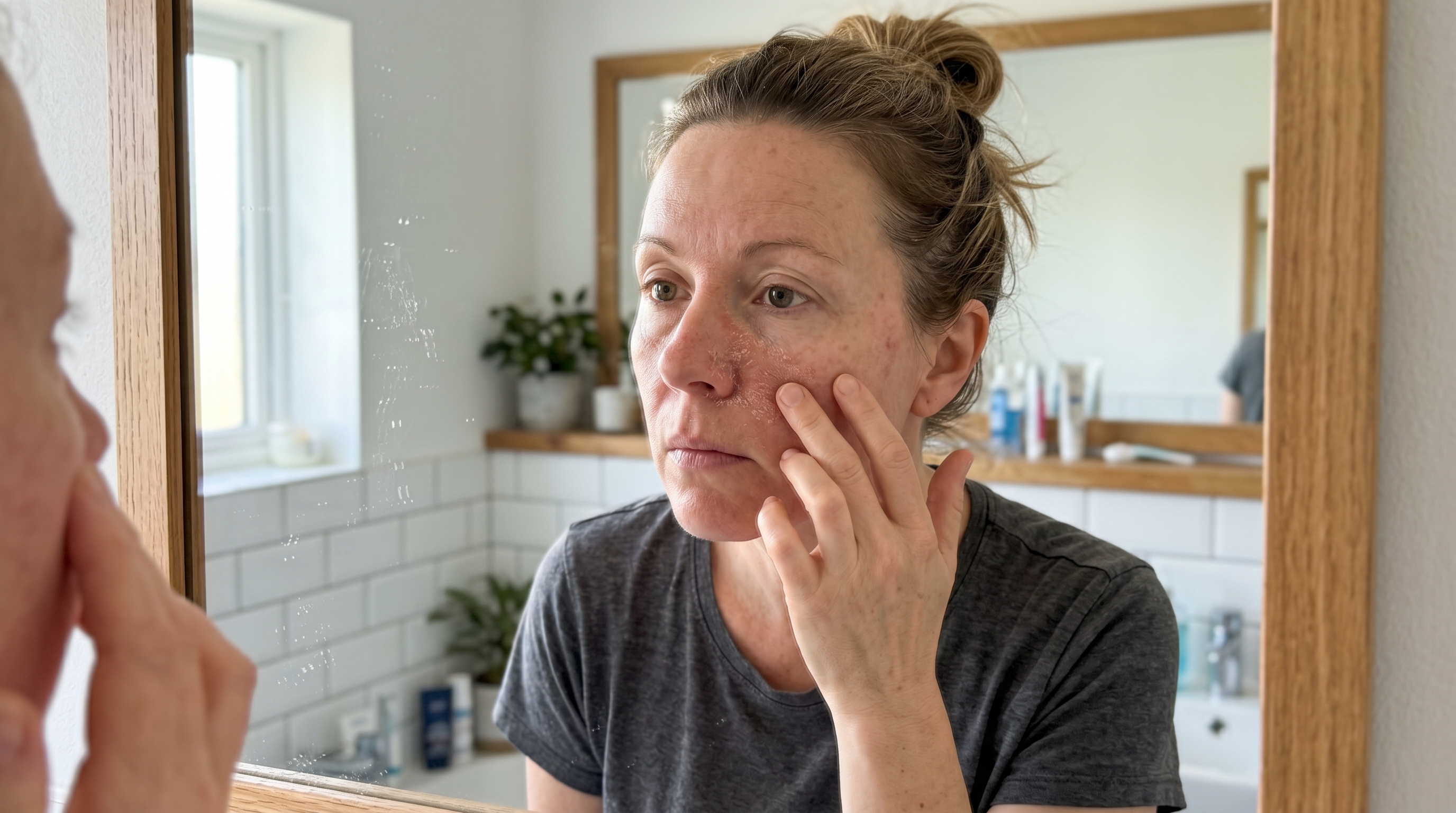
You moisturize your whole face, but there’s one spot that never quite cooperates: the creases where your nose meets your cheeks. The skin there gets tight, then flaky, then peels in little papery flecks that catch your makeup and refuse to smooth over. You can slather on cream and it comes right back the next morning.
If that sounds familiar, the problem probably isn’t that this patch is “too dry.” It’s that the skin’s protective barrier there has quietly broken down — and until you repair the barrier, no amount of moisturizer will hold.
Why the Skin Around Your Nose Flakes First
The folds beside your nose live a harder life than the rest of your face. The skin there is thin and constantly moving as you talk, smile, and sneeze, so the surface is under mechanical stress all day. It’s also one of the most product-exposed zones on your face — every cleanser, exfoliant, and active you apply pools right into those creases. Add cold weather, indoor heating, and low humidity, and you have the perfect setting for the outer layer of skin to dry out and shed unevenly.
That uneven shedding is the flaking you see. Healthy skin releases its dead surface cells invisibly, a few at a time. When the surface is stressed and dehydrated, those cells clump and lift off in visible flakes instead.
The Barrier Is the Real Story
Your skin’s outermost layer, the stratum corneum, works like a brick wall: flattened cells are the “bricks,” and a mortar of lipids — ceramides, cholesterol, and fatty acids — seals the gaps between them. That mortar is what keeps water in and irritants out.
You moisturize your whole face, but there’s one spot that never quite cooperates: the creases where your nose meets your cheeks.
When the lipid mortar is depleted, water evaporates too quickly through the surface, a process called transepidermal water loss. Ceramides are the single most important lipid in that mortar, and when ceramide levels fall, the barrier can’t hold moisture the way it should — the skin becomes dry, rough, and prone to flaking [1]. Studies of ceramide-containing formulations show the reverse is also true: restore those lipids and both hydration and barrier function measurably improve [2].
This is why the fix for a flaky nose isn’t simply “more water.” Water applied to a leaky barrier evaporates almost as fast as you add it. You have to patch the wall, not just refill the room.
Why It Shows Up More After 40
If your nose never used to flake and now it does, aging is part of the reason. As skin matures, it produces fewer of the very lipids that make up the barrier mortar. The aged epidermis shows a measurable decline in lipid content and a slower ability to repair itself after any disruption — meaning that once the barrier around your nose is compromised, it takes longer to bounce back than it did in your twenties [3]. Falling ceramide production with age is directly linked to the dryness and roughness that mature skin is prone to [4].
This connects flaky-nose skin to the broader picture of dehydrated skin: it’s less about how much oil your face makes and more about whether the barrier can keep the water you have.
If your nose never used to flake and now it does, aging is part of the reason.
The Over-Cleansing Trap
Here’s the mistake that quietly makes it worse. When skin flakes, the instinct is to scrub or cleanse harder to “get rid of” the dead skin. But most facial cleansers are built around surfactants, and harsh surfactants strip away the very lipids your barrier depends on. Research shows that cleanser surfactants can disrupt the stratum corneum’s lipids and proteins, producing exactly the tightness, dryness, and irritation people are trying to wash away [5]. Every aggressive wash sets the repair clock back to zero.
If you’re double-cleansing or using a foaming wash twice a day, the delicate skin around your nose is often the first casualty. Our guide to double cleansing explains how to get a thorough cleanse without stripping — the goal is clean skin that still feels comfortable, never squeaky or tight.
When It’s Not Just Dryness
One honest caveat: persistent redness with greasy, yellowish scaling in the nose folds — especially if it flares and settles repeatedly — can be seborrheic dermatitis rather than simple dryness, and that’s worth a dermatologist’s eye. Ordinary environmental dryness and over-cleansing, though, account for the large majority of flaky-nose complaints, and they respond well to barrier repair.
How to Calm and Repair It
The playbook is short and forgiving:
- Cleanse gently. Switch the area to a mild, non-stripping cleanser and use lukewarm — not hot — water.
- Layer humectants under occlusives. Apply a humectant (glycerin, hyaluronic acid) onto slightly damp skin to draw in water, then seal it with a moisturizer containing ceramides to rebuild the mortar [2].
- Pause your strong actives on that spot. Give high-strength acids and vitamin C a rest around the nose until the flaking calms.
- Protect the barrier daily. A well-formulated moisturizer plus sunscreen shields the repair you’re doing. For the full method, see how to repair a damaged skin barrier and why ceramides are the cornerstone ingredient.
Where a Gentle Retinoid Fits
Once the barrier is calm, supporting healthy cell turnover keeps that flaky patch from returning, because it helps the skin shed its surface cells evenly instead of in clumps [6]. The catch is that conventional retinol — the usual turnover ingredient — is often too harsh for skin that already flakes, and it can make things worse before better.
This is precisely the gap Nanoretinol was designed to fill. It delivers retinol inside biomimetic lipid nanoparticles that the skin accepts as “self,” so it works without the barrier-stripping penetration that conventional formulas rely on. Because it’s water-based, 99% natural, and demonstrably gentler on skin cells, it lets even barrier-sensitive skin get the benefit of steady renewal — the opposite of what a flaky nose has been getting.
Flaky skin around your nose isn’t stubborn for no reason. It’s a small, overworked patch with a leaky barrier. Stop stripping it, rebuild the lipids, and support gentle turnover — and it finally stays smooth.
References
- Kono T, Miyachi Y, Kawashima M. “Clinical significance of the water retention and barrier function-improving capabilities of ceramide-containing formulations: A qualitative review.” The Journal of Dermatology. 2021;48(12):1807-1816. doi:10.1111/1346-8138.16175
- Jonca N. “Ceramides metabolism and impaired epidermal barrier in cutaneous diseases and skin aging.” OCL — Oilseeds and fats, Crops and Lipids. 2019;26:17. doi:10.1051/ocl/2019013
- Ghadially R, Brown BE, Sequeira-Martin SM, Feingold KR, Elias PM. “The aged epidermal permeability barrier. Structural, functional, and lipid biochemical abnormalities in humans and a senescent murine model.” Journal of Clinical Investigation. 1995;95(5):2281-2290. doi:10.1172/JCI117919
- Wang X, Jia Y, He H. “The Role of Linoleic Acid in Skin and Hair Health: A Review.” International Journal of Molecular Sciences. 2024;26(1):246. doi:10.3390/ijms26010246
- Ananthapadmanabhan KP, Moore DJ, Subramanyan K, Misra M, Meyer F. “Cleansing without compromise: the impact of cleansers on the skin barrier and the technology of mild cleansing.” Dermatologic Therapy. 2004;17(Suppl 1):16-25. doi:10.1111/j.1396-0296.2004.04s1002.x
- Motamedi M, Chehade A, Sanghera R, Grewal P. “A Clinician’s Guide to Topical Retinoids.” Journal of Cutaneous Medicine and Surgery. 2021;26(1):71-78. doi:10.1177/12034754211035091