Dehydrated Skin vs Dry Skin: Why They're Not the Same and How to Fix Each One
Dehydrated skin lacks water; dry skin lacks oil. Confusing the two leads to the wrong routine — here is how to tell the difference and treat both effectively
The Confusion That Wrecks Skincare Routines
Walk into any skincare aisle and you will find hundreds of products for “dry skin.” But a surprising number of people who think they have dry skin actually have dehydrated skin — a condition that looks similar on the surface but has a completely different cause and requires a completely different solution.
Dry skin is a skin type. Dehydrated skin is a skin condition. If the type is what you are dealing with, our skin care routine for dry skin sets out the sequence that follows from it. This distinction matters because treating one as if it were the other is one of the most common reasons skincare routines fail to deliver results, especially for women over 40.
The Science: What Makes Skin Dry vs Dehydrated
Dry skin is a genetic skin type characterized by insufficient sebum (oil) production. People with truly dry skin produce fewer lipids in their sebaceous glands, which means the stratum corneum — the outermost protective layer — lacks the oily component needed to form a complete barrier. This is a chronic condition that you are born with, similar to having oily or combination skin [1]. Either way, the cleanser sets the starting point, which our guide to the best face wash for dry skin works through in detail.
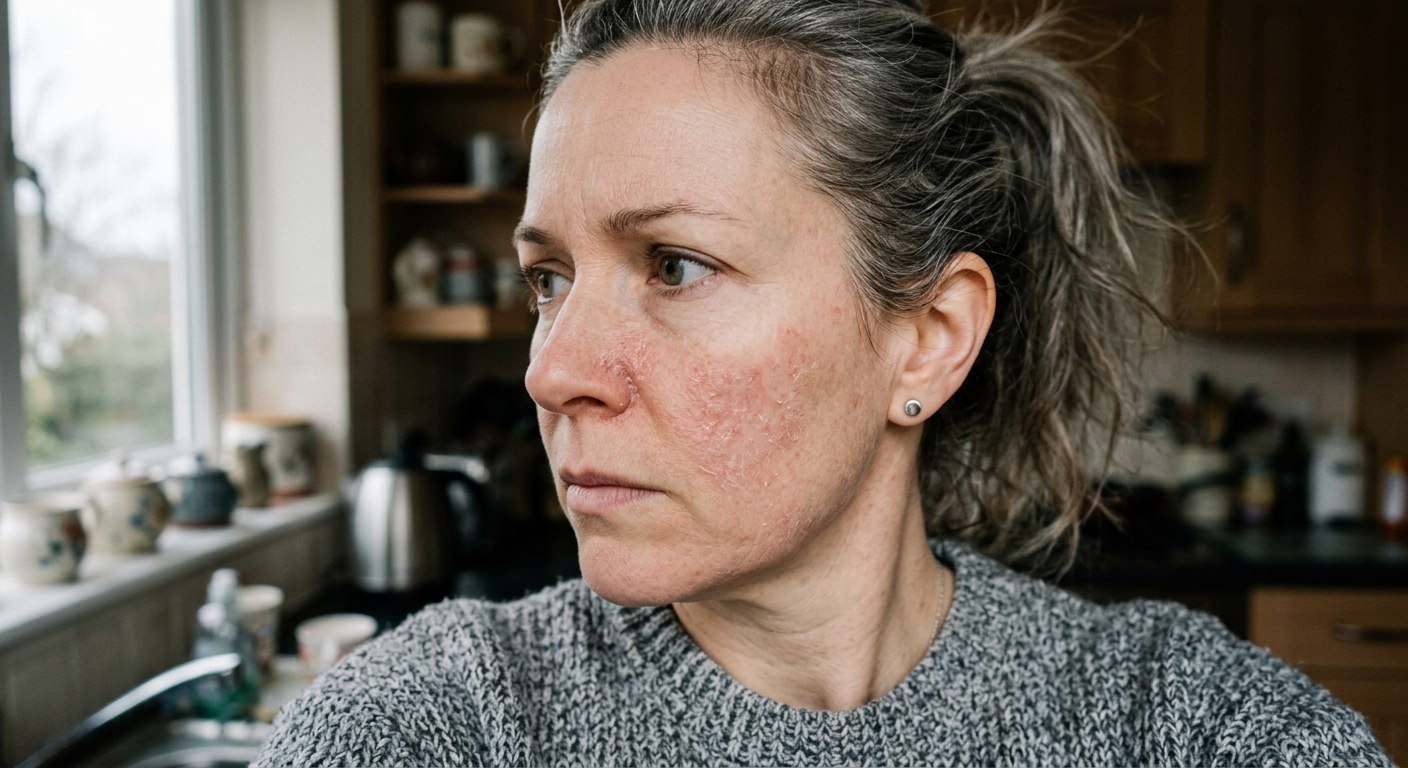
Dehydrated skin is a temporary condition caused by insufficient water content in the stratum corneum. Anyone can develop dehydrated skin, regardless of their skin type — even people with oily skin. In fact, oily-yet-dehydrated skin is one of the most commonly misdiagnosed conditions in dermatology [2]. If you are unsure which applies to you, start with how to know what skin type you have.
The stratum corneum normally contains 20–30% water. When water content drops below 10%, skin begins to show visible signs of dehydration: tightness, flakiness, dullness, and the sudden appearance of fine lines that were not there yesterday [1].
What controls this water content is a two-part system. First, natural moisturizing factors (NMFs) — a mix of amino acids, urea, lactic acid, and other hygroscopic molecules — attract and hold water inside corneocytes (the cells of the stratum corneum). Second, the intercellular lipid matrix — primarily ceramides, cholesterol, and free fatty acids — acts as a waterproof sealant between those cells, preventing water from evaporating through the skin surface [3]. Choosing a formula that supports both halves of that system is the central question in the best face moisturizer for men.
When either component fails, water escapes faster than it can be replenished. Scientists measure this escape rate as transepidermal water loss (TEWL), and it is one of the most important objective markers of skin barrier health [4]. It is also why drinking more water raises stratum corneum hydration only in people who were genuinely under-drinking: controlled trials find no meaningful change in TEWL either way. The clearest exception is alcohol, which suppresses vasopressin and produces a genuine fluid deficit worth replacing.
Why Dehydration Gets Worse After 40
Aging fundamentally changes the skin’s ability to retain water. After 40, several things happen simultaneously:
Ceramide production declines. The intercellular lipid matrix thins, creating gaps in the waterproof seal. A study published in the Journal of Investigative Dermatology found that ceramide levels in the stratum corneum decrease by approximately 30% between the ages of 20 and 60 [5].
NMF production slows. The natural moisturizing factors that attract water into corneocytes are produced during the normal desquamation (skin shedding) process. As cell turnover slows with age, NMF production drops correspondingly [1]. Replacing those humectants topically is the main job of a well-chosen moisturizer for dry skin.
Hormonal changes amplify the problem. Estrogen decline during perimenopause and menopause directly affects skin hydration. Estrogen receptors in keratinocytes and fibroblasts influence hyaluronic acid synthesis, sebum production, and barrier lipid composition. As estrogen falls, the skin’s water-holding capacity diminishes from multiple directions [6].
The result is a skin surface that may still produce oil (so it does not feel “dry” in the traditional sense) but cannot hold onto water. This is why many women in their 40s and 50s notice their skin simultaneously feels tight and looks shiny — a paradox that only makes sense when you understand the dry-versus-dehydrated distinction. It also helps explain why foundation can turn powdery despite surface shine; our cakey-makeup diagnostic separates dehydration from excess product and formula conflict.
If you are unsure which applies to you, start with how to know what skin type you have.
How to Tell Which One You Have
Signs of dry skin (oil deficiency):
- Skin feels rough and flaky consistently, not just seasonally
- Pores appear very small or invisible
- Skin rarely gets shiny, even by end of day
- Feels tight after cleansing, regardless of the cleanser used
- Family members tend to have similarly dry skin
Signs of dehydrated skin (water deficiency):
- Fine lines appear suddenly and seem to shift day to day
- Skin looks dull and papery despite using moisturizer
- Makeup settles into lines within hours of application
- Skin feels tight but still produces oil in the T-zone
- Pinching the cheek produces fine crepe-like lines that disappear quickly
The pinch test. Gently pinch the skin on the back of your hand or your cheek. If fine lines fan out where you pinched and take a moment to smooth back, your skin is likely dehydrated. This is a rough indicator of skin turgor — the skin’s ability to snap back — which decreases when water content is low [2].
Many women over 40 have both conditions simultaneously: genetically dry skin that has become additionally dehydrated due to age-related changes. In that case, both oil replenishment and water retention need to be addressed.
The Fix: Ingredients That Actually Work
Treating dehydrated skin requires a two-pronged approach: attract water into the skin and seal it there. Choosing between the two humectants you will meet most often is covered in hyaluronic acid vs glycerin. For an acute, event-driven version of the same two-pronged approach, our guide to sheet masks explains how long to leave one on before the benefit reverses.
Humectants (water attractors):
Hyaluronic acid is the most effective humectant in skincare. A single molecule can hold up to 1,000 times its weight in water. Low-molecular-weight hyaluronic acid (under 50 kDa) penetrates into the epidermis to hydrate from within, while high-molecular-weight HA sits on the surface and draws moisture from the environment [3]. If you prefer a single step, see what to look for in a hyaluronic acid moisturizer.
Glycerin is the unsung hero of hydration. Clinical studies consistently show that glycerin-containing moisturizers reduce TEWL more effectively than many premium ingredients. It is inexpensive, non-irritating, and works across all skin types.
Occlusives (water sealers):
Ceramides are the gold standard for barrier repair. They replicate the natural lipids that form the intercellular matrix, physically plugging the gaps that allow water to escape. Look for products containing ceramide NP, AP, and EOP — these correspond to the major ceramide classes found in human skin [5].
Squalane is a lightweight emollient that mimics the skin’s natural squalene. It seals in moisture without the heavy, greasy feel of petroleum-based occlusives.
Active ingredients that support hydration long-term:
Niacinamide stimulates ceramide synthesis in the stratum corneum. A 4% niacinamide solution has been shown to increase ceramide and free fatty acid levels within 4 weeks, directly strengthening the barrier from within [7].
If you notice increased tightness or flaking, reduce frequency and add a ceramide-rich moisturizer.
Retinol accelerates cell turnover, which indirectly improves hydration by increasing the rate at which new, healthy corneocytes — complete with their full complement of natural moisturizing factors — replace old, depleted ones. Nanoretinol® is particularly relevant here: its lipid nanoparticle delivery system does not rely on disrupting the skin barrier to deliver retinol (unlike conventional formulations that use penetration enhancers). This means you get the cell turnover benefits of retinol without the barrier damage that would worsen dehydration — a critical distinction for anyone dealing with compromised skin hydration.
Common Mistakes That Make Dehydration Worse
Over-cleansing. Foaming cleansers containing sodium lauryl sulfate strip both oil and water-binding molecules from the stratum corneum. Switch to a gentle, non-foaming cleanser if your skin feels tight after washing.
Skipping moisturizer because skin is oily. This is the single most common mistake for dehydrated-oily skin. Without a moisturizer to reduce TEWL, the skin compensates by producing even more sebum — creating a vicious cycle of oil and dehydration.
Using glycolic acid or retinol too aggressively. Both are excellent anti-aging ingredients, but overuse can compromise the barrier. Flaking that shows up specifically under sunscreen is usually a vehicle mismatch rather than an active, which our guide to the best sunscreen for dry skin works through. If you notice increased tightness or flaking, reduce frequency and add a ceramide-rich moisturizer.
Ignoring indoor humidity. Central heating and air conditioning can reduce indoor humidity to 20–30% — well below the 40–60% range that supports skin hydration. A humidifier in the bedroom can make a measurable difference in skin moisture levels overnight. The measured effects, and the humidity range actually worth targeting, are covered in what running a humidifier for dry skin changes. Heat exposure cuts the other way from what most people assume, and the controlled evidence on sauna skin benefits is worth reading before you blame the hot room. The full seasonal picture, including why heated indoor air rather than cold outdoor air is the real driver, is in dry skin in winter.
Relying on facial mists alone. Spraying water on dehydrated skin without sealing it in actually increases TEWL as the water evaporates. Always follow a mist with a moisturizer or occlusive. Which sprays genuinely add hydration and which ones quietly cost you moisture is covered in our guide to the hydrating face mist.
Building a Hydration-First Routine
Morning:
- Gentle, non-foaming cleanser (or just water)
- Hyaluronic acid serum on damp skin
- Niacinamide serum (4–5%)
- Moisturizer with ceramides and glycerin
- Sunscreen (SPF 30+)
Evening:
- Oil-based cleanser to remove SPF and makeup
- Water-based cleanser (double cleanse)
- Retinol treatment (applied correctly)
- Rich moisturizer or sleeping mask with ceramides and squalane
For severely dehydrated skin, consider a “moisture sandwich” technique: apply hyaluronic acid to damp skin, follow with moisturizer, then seal with a thin layer of squalane or a sleeping mask. This three-layer approach addresses all three elements of the hydration system — humectant, emollient, and occlusive — in the correct order.
When Dehydration Is More Than Skin Deep
Persistent dehydration that does not respond to topical treatment may signal an underlying issue. Conditions like eczema, rosacea, and psoriasis all involve barrier dysfunction and elevated TEWL. Certain medications — including diuretics, retinoids (oral, not topical), and some blood pressure medications — can also cause systemic dehydration that manifests in the skin.
If your skin remains dry, tight, and flaky despite a well-formulated hydration routine for more than 4–6 weeks, consult a dermatologist to rule out underlying conditions.
The Real Difference Between Plump Skin and Aging Skin
Much of what people attribute to “aging” is actually dehydration. Fine lines that appear in your late 30s and early 40s are often dehydration lines — not true wrinkles caused by collagen loss. The difference? Dehydration lines disappear when skin is properly hydrated. True wrinkles do not.
This is why a good moisturizer can make you look five years younger overnight — it is not magic, it is physics. Water plumps the corneocytes, smoothing the skin surface and reflecting light more evenly. Combine that plumping effect with genuine collagen-building ingredients like retinol, and you address both the surface appearance and the structural decline happening deeper in the dermis.
Your skin is 64% water. Give it what it is asking for.
References
-
Rawlings AV, Harding CR. “Moisturization and Skin Barrier Function.” Dermatologic Therapy. 2004;17(Suppl 1):43-48. doi:10.1111/j.1396-0296.2004.04S1005.x
-
Purnamawati S, Indrastuti N, Danarti R, Saefudin T. “The Role of Moisturizers in Addressing Various Kinds of Dermatitis: A Review.” Clinical Medicine & Research. 2017;15(3-4):75-87. doi:10.3121/cmr.2017.1363
-
Papakonstantinou E, Roth M, Karakiulakis G. “Hyaluronic Acid: A Key Molecule in Skin Aging.” Dermato-Endocrinology. 2012;4(3):253-258. doi:10.4161/derm.21923
-
Alexander H, Brown S, Danby S, Flohr C. “Research Techniques Made Simple: Transepidermal Water Loss Measurement as a Research Tool.” Journal of Investigative Dermatology. 2018;138(11):2295-2300. doi:10.1016/j.jid.2018.09.001
-
Imokawa G, Abe A, Jin K, et al. “Decreased Level of Ceramides in Stratum Corneum of Atopic Dermatitis: An Etiologic Factor in Atopic Dry Skin?” Journal of Investigative Dermatology. 1991;96(4):523-526. doi:10.1111/1523-1747.ep12470233
-
Thornton MJ. “Estrogens and Aging Skin.” Dermato-Endocrinology. 2013;5(2):264-270. doi:10.4161/derm.23872
-
Tanno O, Ota Y, Kitamura N, Katsube T, Inoue S. “Nicotinamide Increases Biosynthesis of Ceramides as Well as Other Stratum Corneum Lipids to Improve the Epidermal Permeability Barrier.” British Journal of Dermatology. 2000;143(3):524-531. doi:10.1111/j.1365-2133.2000.03705.x