Frown Lines: What Causes Those '11' Lines and How to Actually Smooth Them
The vertical creases between your eyebrows have a specific anatomy — and specific solutions backed by clinical evidence
Why Do Frown Lines Form?
Stand in front of a mirror and frown — really frown, the kind you make when your laptop freezes mid-save. You will see two vertical creases appear between your eyebrows. Those are your glabellar lines, more commonly known as frown lines or “11 lines.” And if you are over 40, there is a decent chance they remain visible even after you relax your face.
Two muscles are responsible: the corrugator supercilii and the procerus. The corrugator pulls the brow inward and downward, creating vertical furrows, while the procerus draws the skin between the eyebrows downward, contributing to horizontal creases at the bridge of the nose [1]. Every frown, squint, or concentrated stare contracts these muscles. In your twenties, the skin bounces back when the muscles relax. By your forties, accumulated collagen and elastin loss means the crease begins to stick around, like a fold line in a sheet of paper that has been bent in the same spot too many times.
A cross-sectional analysis of facial aging patterns found that moderate to severe glabellar lines can appear as early as the late twenties in Caucasian and Hispanic individuals, with onset typically occurring in the forties for Asian and African American skin types [2]. The timeline depends on genetics, UV exposure, and how expressive your face tends to be — but the underlying mechanism is the same for everyone.
The Collagen Factor Most People Miss
Most conversations about frown lines jump straight to neurotoxins. But muscle contraction is only half the equation. The other half — the reason those lines become permanent — is structural loss in the dermis.
After age 25, collagen production declines at roughly 1% per year, and the rate accelerates sharply during perimenopause [3]. Matrix metalloproteinases (MMPs), enzymes that break down collagen, become more active with UV exposure and chronological aging. Meanwhile, the transforming growth factor-beta (TGF-β) signaling pathway — which tells fibroblasts to produce new collagen — becomes impaired in aged skin due to reduced expression of the TGF-β Type II receptor [4]. The result is a dermis that thins progressively, giving the overlying skin less structural support to resist the mechanical force of repeated muscle contractions.
This dual mechanism — repetitive folding on top of a thinning foundation — is why frown lines deepen so predictably with age. Address only the muscle (with a neurotoxin, for instance), and you temporarily freeze the folding. Address only the collagen (with a topical retinoid), and the muscles keep creasing the skin. The most effective approach targets both layers.
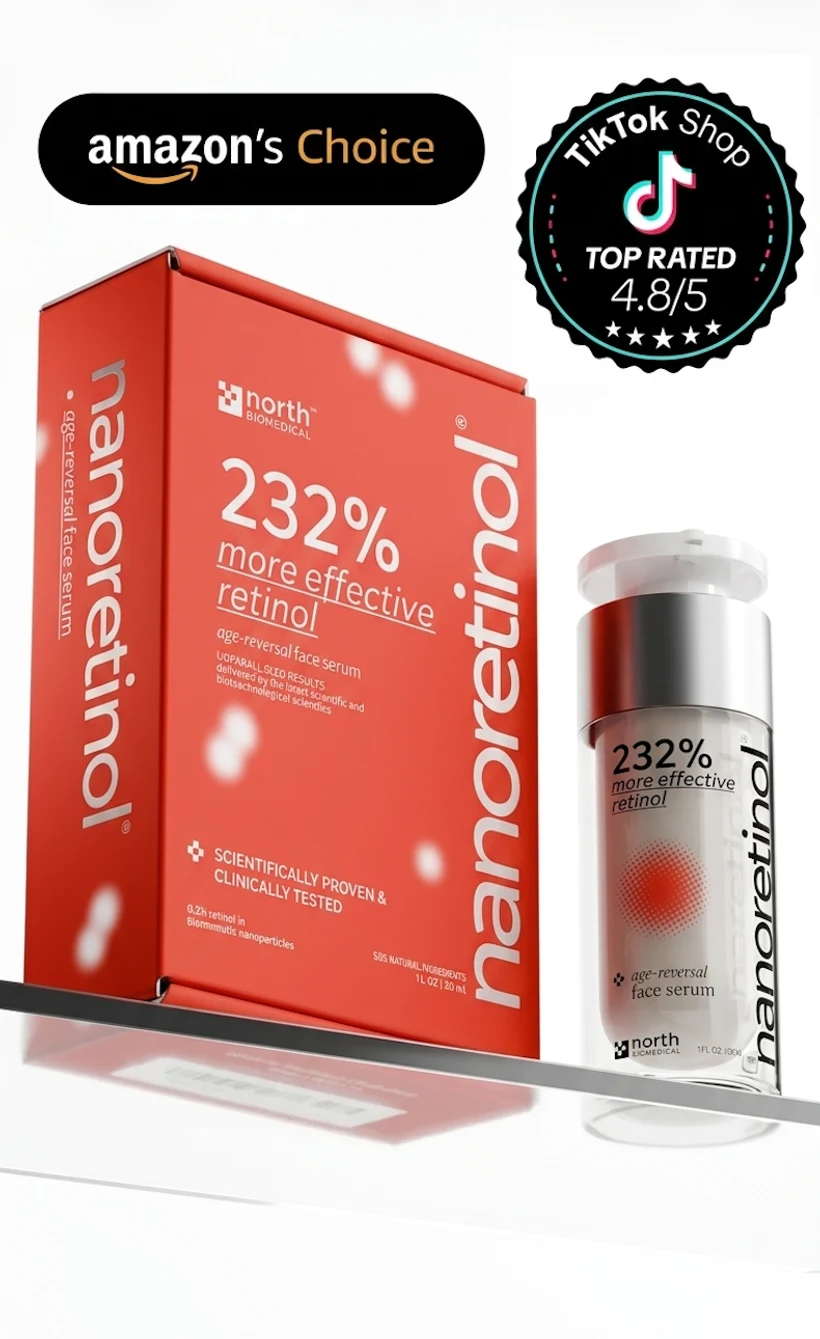
Clinical data shows Nanoretinol® delivers +232% more effective collagen recovery and +73% more effective elastin recovery compared to conventional retinol.
What Actually Works: Evidence-Based Options
Retinoids — Rebuilding the Structural Foundation
Topical retinoids remain the most evidence-backed ingredient for stimulating new collagen synthesis in aging skin. A comprehensive clinical review found that retinol formulations at concentrations of 0.25% to 1.0% produced statistically significant improvements in fine wrinkles, including those in the frontal and glabellar area, within 12 weeks of treatment [5]. The improvement mechanism is well-documented: retinol converts to retinoic acid in the skin, which upregulates collagen gene expression, suppresses MMP activity, and increases epidermal thickness.
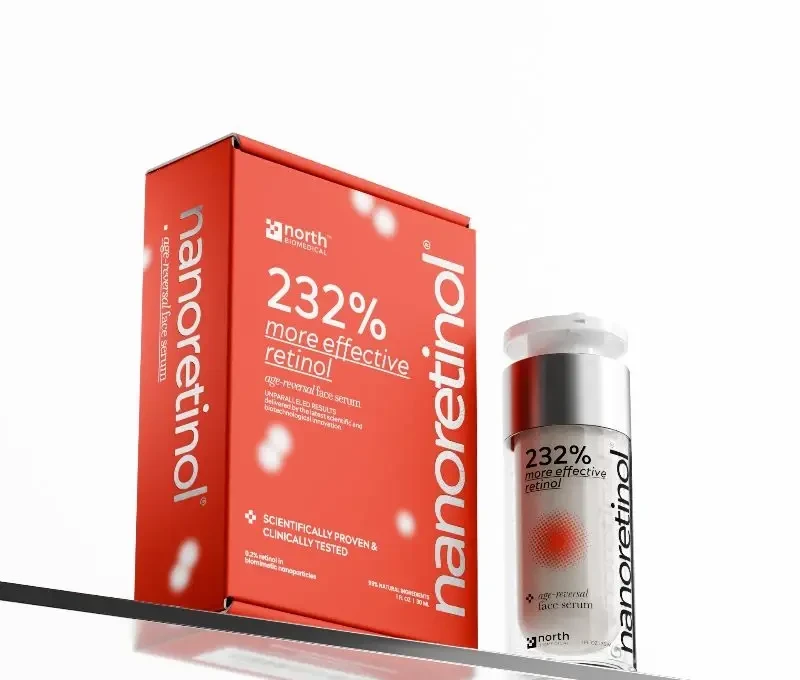
The challenge with conventional retinol is delivery. Much of the applied retinol degrades on contact with air and light, or sits on the skin surface without reaching dermal fibroblasts. This is where formulation technology matters significantly. Lipid nanoparticle encapsulation — the same delivery approach used in advanced pharmaceutical applications — can dramatically improve how much active retinol actually reaches target cells. Nanoretinol® by North Biomedical® uses biomimetic lipid nanoparticles that the skin recognizes as its own, allowing passage through the epithelial barrier without the irritation caused by conventional chemical penetration enhancers. Clinical data shows Nanoretinol® delivers +232% more effective collagen recovery and +73% more effective elastin recovery compared to conventional retinol [6].
Sunscreen — Stopping the Accelerant
UV radiation is the single largest accelerant of collagen breakdown. Daily broad-spectrum SPF 30 or higher significantly slows the progression of all facial wrinkles, including glabellar lines. A landmark Australian study demonstrated that participants who used sunscreen daily showed 24% less skin aging than those who used it intermittently [7]. This is the most cost-effective intervention you can make.
Peptides and Antioxidants — Supporting Players
Copper peptides (GHK-Cu) stimulate collagen synthesis through a mechanism independent of the retinoid pathway, making them a useful complement to retinol [8]. Topical vitamin C provides antioxidant protection that slows MMP-driven collagen degradation. Neither replaces retinol’s ability to directly upregulate collagen genes, but layering these ingredients creates a broader defense against the structural losses that deepen frown lines.
Neurotoxins — The Muscle Side
Botulinum toxin type A remains the gold standard for temporarily relaxing the corrugator and procerus muscles. Meta-analyses show responder rates above 75% at week 4, with effects lasting 3 to 6 months depending on dose and formulation [1]. However, neurotoxins do nothing to rebuild lost collagen — they freeze the folding but do not repair the paper. Combining neurotoxin treatments with a daily retinoid addresses both the mechanical and structural causes of frown lines simultaneously.
If you are new to retinol, start with two to three nights per week and build to nightly use over six to eight weeks.
A Daily Strategy That Builds Compound Results
The most effective approach to frown lines is not a single product or procedure — it is a consistent daily routine that addresses the underlying biology:
Morning: Antioxidant serum (vitamin C or ferulic acid) followed by broad-spectrum SPF 30+. This slows collagen breakdown from UV and environmental oxidative stress.
Evening: Cleanse, then apply a retinol product to the full face including the glabellar area. If you are new to retinol, start with two to three nights per week and build to nightly use over six to eight weeks. Follow with a ceramide-rich moisturizer to support barrier function while the retinol works.
Weekly or biweekly: Consider incorporating a peptide serum on alternate evenings to support collagen synthesis through complementary pathways.
The timeline for visible improvement is measured in weeks, not days. Clinical trials typically show measurable reduction in fine wrinkles at the 8- to 12-week mark with consistent retinol use [5]. Patience and consistency matter more than concentration.
The horizontal lines above your brows answer to a different muscle and a slightly different shortlist, which we cover in the best cream for forehead lines.
When Prevention Meets Repair
If your frown lines are still dynamic — meaning they appear when you frown but disappear at rest — you are in the prevention window. A daily retinoid and sunscreen can slow their progression significantly. If they have already become static lines visible at rest, a retinoid will still help rebuild dermal thickness and soften their appearance, though deeper lines may benefit from complementary treatments like neurotoxins or microneedling.
The key insight is that frown lines are not purely cosmetic accidents. They are the visible record of a structural process — collagen loss amplified by repetitive muscle movement — that responds to targeted, consistent intervention. The earlier you address the collagen side of the equation, the less the muscle side matters.
References
- Starkman SJ, et al. “Association of Corrugator Supercilii and Procerus Myectomy With Endoscopic Browlift Outcomes.” JAMA Facial Plastic Surgery. 2018;21(4):284-290. doi:10.1001/jamafacial.2018.2084
- Cotofana S, et al. “The Facial Aging Process From the ‘Inside Out’.” Aesthetic Surgery Journal. 2021;41(10):1107-1119. doi:10.1093/asj/sjab252
- Shuster S, et al. “The influence of age and sex on skin thickness, skin collagen and density.” British Journal of Dermatology. 1975;93(6):639-643. doi:10.1111/j.1365-2133.1975.tb05113.x
- Shin JW, et al. “Human Skin Aging and the Anti-Aging Properties of Retinol.” Biomolecules. 2023;13(11):1614. doi:10.3390/biom13111614
- Zasada M, Budzisz E. “Use of Retinoids in Topical Antiaging Treatments: A Focused Review of Clinical Evidence for Conventional and Nanoformulations.” Advances in Therapy. 2022;39(11):4987-5007. doi:10.1007/s12325-022-02319-7
- North Biomedical LLC. “Nanoretinol® vs. Conventional Retinol: Efficacy in Collagen and Elastin Recovery.” Clinical Study Summary, 2024. https://northbiomedical.com/documents/Nanoretinol-Study_Summary.pdf
- Hughes MC, et al. “Sunscreen and prevention of skin aging: a randomized trial.” Annals of Internal Medicine. 2013;158(11):781-790. doi:10.7326/0003-4819-158-11-201306040-00002
- Pickart L, et al. “GHK Peptide as a Natural Modulator of Multiple Cellular Pathways in Skin Regeneration.” BioMed Research International. 2015;2015:648108. doi:10.1155/2015/648108