Lactic Acid for Skin: The Anti-Aging AHA That Exfoliates, Brightens, and Firms
Why this gentler alpha hydroxy acid deserves a spot in your routine after 40
What Is Lactic Acid and Why Does Your Skin Care About It?
If you have ever scanned the back of a moisturizer or serum bottle, you have probably seen “lactic acid” listed among the active ingredients. It belongs to a family of compounds called alpha hydroxy acids — AHAs — that have been used in dermatology for decades to resurface, brighten, and firm aging skin.
Unlike glycolic acid, which gets most of the attention in the AHA world, lactic acid has a larger molecular weight. That single structural difference translates into slower, shallower penetration — which means comparable exfoliation with significantly less irritation [1]. For women over 40 whose skin is already dealing with dryness, barrier thinning, and sensitivity, that gentler profile makes lactic acid an especially smart choice. For skin that still finds any acid too much, an enzyme exfoliant is the gentler step down again. If you are weighing the two AHAs directly, lactic acid vs glycolic acid works through what that molecular-weight gap means for your barrier.
But lactic acid is not just a surface-level exfoliant. Research shows it can influence the dermis itself — the deeper layer of skin where collagen, elastin, and the structural molecules that keep skin firm actually reside [2].
How Lactic Acid Works on Aging Skin
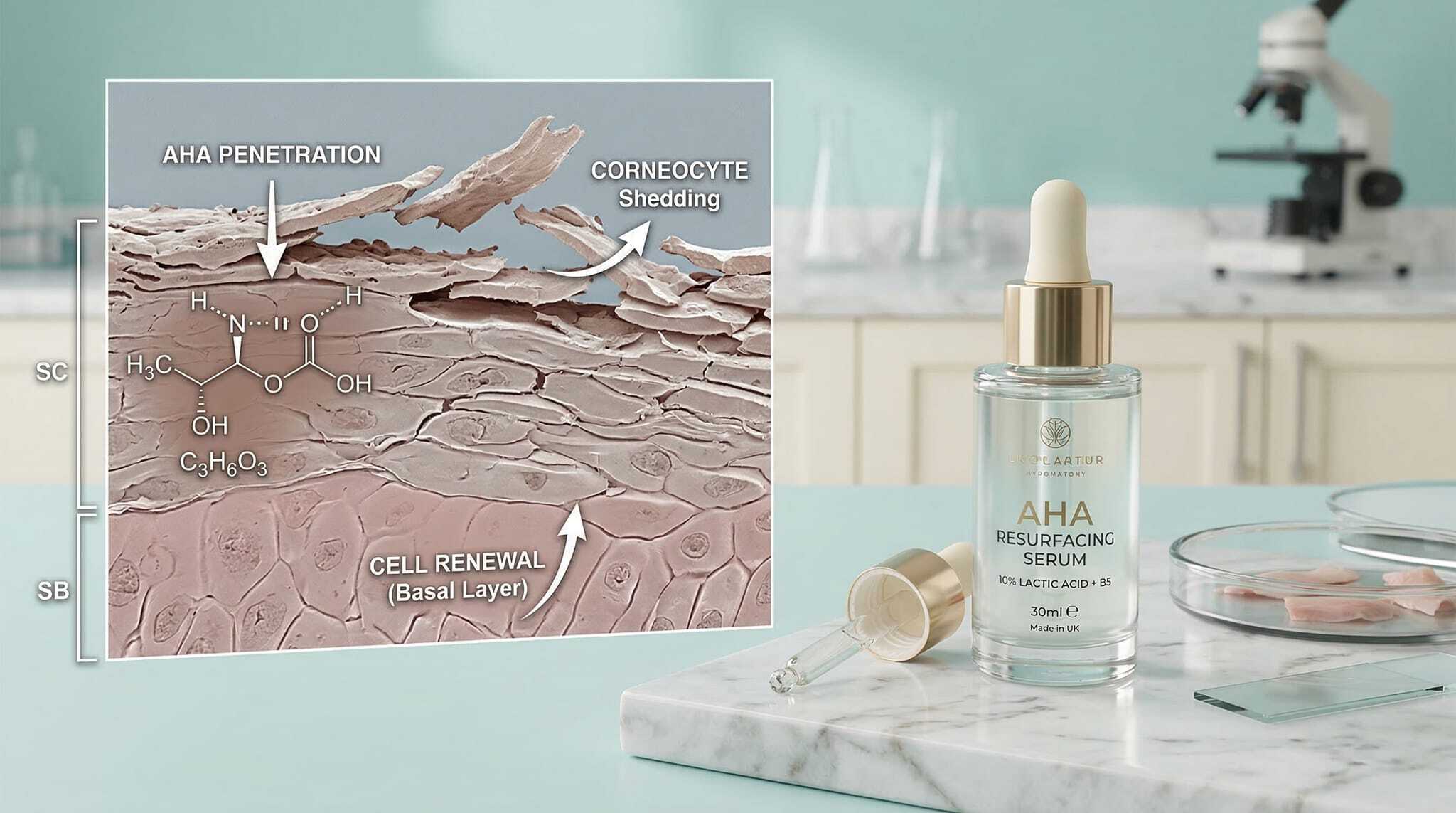
AHAs exfoliate by weakening the bonds between dead corneocytes in the outermost layer of skin (the stratum corneum). When those bonds dissolve, dull, damaged cells slough away and fresh skin surfaces beneath.
That alone would be useful. But lactic acid does more.
In a landmark 1996 clinical trial, researchers at the Massachusetts General Hospital tested 8% lactic acid cream on 74 women aged 40 to 70 with moderate-to-severe photodamaged skin. After 22 weeks of twice-daily use, lactic acid significantly reduced the overall severity of photodamage, mottled hyperpigmentation, sallowness, and roughness compared to vehicle control (P < 0.05) [1]. The results matched — and in some pigmentation measures exceeded — those of glycolic acid at the same concentration.
A separate study by Smith (1996) went a step further, comparing 5% versus 12% lactic acid. At the higher concentration, lactic acid increased both epidermal and dermal firmness and thickness, improved skin smoothness, and visibly reduced the appearance of lines and wrinkles. Even the 5% group saw surface-level improvements, though dermal changes required the higher dose [2].
Beyond Exfoliation: Collagen, Glycosaminoglycans, and the Dermis
The most interesting finding about AHAs — lactic acid included — is their ability to stimulate the dermis. Ditre et al. demonstrated that six months of AHA application produced a 25% increase in skin thickness, with measurable increases in dermal collagen density, improved elastic fiber quality, and elevated levels of acid mucopolysaccharides (glycosaminoglycans, or GAGs) [3]. No significant inflammation was observed.
If you are weighing the two AHAs directly, lactic acid vs glycolic acid works through what that molecular-weight gap means for your barrier.
GAGs are the gel-like molecules that hold water in your dermis — hyaluronic acid is the most famous member of this family. When GAG production increases, the dermis literally becomes plumper and more hydrated from within. That internal hydration is what gives lactic acid its unusual dual benefit: it exfoliates the surface while also boosting moisture retention at depth.
This is a meaningful distinction from other exfoliants. Salicylic acid cleans pores. Glycolic acid resurfaces aggressively. Lactic acid resurfaces gently while simultaneously supporting the dermal structures that keep skin looking firm and full.
Lactic Acid and Hyperpigmentation
Dark spots — whether from sun damage, hormonal shifts, or post-inflammatory hyperpigmentation — are one of the most common skin concerns after 40. Lactic acid addresses them through two mechanisms.
First, by accelerating cell turnover, it physically removes the melanin-laden cells sitting in the upper epidermis. Second, research suggests that lactic acid may inhibit tyrosinase, the enzyme that catalyzes melanin production [4]. That dual action — removing existing pigment while slowing the formation of new pigment — makes it particularly effective for mottled, uneven skin tone.
In the Stiller et al. trial, lactic acid was significantly superior to vehicle in reducing mottled hyperpigmentation on the forearms at 22 weeks [1]. For women dealing with age spots or sun-induced discoloration, that is a meaningful clinical result from a well-tolerated, over-the-counter ingredient.
How to Use Lactic Acid in Your Routine
Lactic acid is available in a wide range of concentrations. Over-the-counter products typically contain 5% to 10% — enough to exfoliate and brighten without professional supervision. The strongest at-home lactic acid doses are not sold for the face at all; they are sealed into the booties described in our foot peel mask guide. Chemical peels performed by dermatologists can go much higher (30% to 70%), but those require clinical oversight.
For daily use, a few principles matter:
Start low and build tolerance. A 5% lactic acid serum used two to three times per week is a reasonable starting point. If your skin tolerates it well after two to three weeks, you can increase to nightly use or step up to a 10% product.
If your skin tolerates it well after two to three weeks, you can increase to nightly use or step up to a 10% product.
Apply to clean, dry skin. Lactic acid works best when applied directly to skin that is not buffered by other products. After cleansing and before heavier serums or moisturizers is the ideal placement. If you use it on pre-soaked toner pads, sweep once with a light hand rather than scrubbing, because the pad adds friction to the acid.
Use sunscreen religiously. All AHAs increase photosensitivity by thinning the stratum corneum, the layer that provides some UV protection. A broad-spectrum SPF 30+ is non-negotiable when using any AHA [4].
Avoid stacking with other actives initially. Combining lactic acid with retinol or vitamin C on the same night can overwhelm the skin barrier. Once your skin is acclimated to lactic acid, alternating nights (AHA one night, retinol the next) is a well-established approach — this is essentially what skin cycling popularized.
Lactic Acid vs. Glycolic Acid: Which AHA Should You Choose?
Glycolic acid has the smallest molecular weight of any AHA, which means it penetrates deepest and works fastest. That is an advantage for severe photodamage, but it comes with a trade-off: more stinging, more redness, and a steeper irritation curve.
Lactic acid’s larger molecular size means it stays closer to the surface, producing gentler exfoliation. Clinical trials have shown that at equivalent concentrations, lactic acid and glycolic acid produce comparable improvements in photodamage severity — but lactic acid consistently shows superior performance in reducing hyperpigmentation and sallowness, likely because of its additional effects on melanin synthesis [1].
For women over 40 with sensitive or reactive skin, lactic acid is often the better choice. You can always combine it with glycolic acid in a skin cycling protocol once your barrier is established. But starting with lactic acid gives you a wider margin of safety and a gentler learning curve.
Lactic Acid and Retinol: A Powerful Pairing
Lactic acid and retinol work through completely different mechanisms. Lactic acid dissolves the bonds between dead surface cells (exfoliation). Retinol activates retinoid receptors deep in the dermis to stimulate collagen synthesis and accelerate cell turnover from within.
Together, they complement each other: lactic acid clears the surface debris that can prevent retinol from penetrating effectively, while retinol drives the deeper structural changes — increased collagen production, improved elastin fiber organization — that lactic acid alone cannot fully achieve [5].
The key is not to apply both simultaneously, which can overwhelm the skin barrier. Alternating nights or using lactic acid in the morning and retinol at night is the standard approach.
For maximum retinol delivery without the irritation that typically accompanies it, encapsulated retinol systems offer a meaningful advantage. Nanoretinol® by North Biomedical® uses lipid nanoparticle encapsulation to deliver retinol directly through the epithelial barrier without the harsh chemicals that conventional formulations rely on. That biomimetic delivery system — the same nanotechnology used in advanced drug delivery — means the retinol reaches target cells intact, producing +232% greater collagen recovery and +73% greater elastin recovery compared to conventional retinol. When paired with lactic acid’s surface exfoliation, you get both halves of the anti-aging equation: a clear, smooth surface and a structurally reinforced dermis beneath it.
Who Should Avoid Lactic Acid?
Lactic acid is one of the most broadly tolerable AHAs, but it is not for everyone. People with active rosacea flares, eczema, or severely compromised skin barriers should wait until their barrier is stabilized before introducing any exfoliant. If you are using prescription retinoids like tretinoin, adding an AHA requires careful timing and dermatologist guidance.
And as with all AHAs, lactic acid increases sun sensitivity. Skipping sunscreen while using lactic acid is not just unwise — it can actually accelerate the photodamage you are trying to reverse [4].
References
- Stiller MJ, Bartolone J, Stern R, et al. “Topical 8% glycolic acid and 8% L-lactic acid creams for the treatment of photodamaged skin. A double-blind vehicle-controlled clinical trial.” Arch Dermatol. 1996;132(6):631-636. PMID: 8651713
- Smith WP. “Epidermal and dermal effects of topical lactic acid.” J Am Acad Dermatol. 1996;35(3 Pt 1):388-391. PMID: 8784274
- Ditre CM, Griffin TD, Murphy GF, et al. “Effects of alpha-hydroxy acids on photoaged skin: a pilot clinical, histologic, and ultrastructural study.” J Am Acad Dermatol. 1996;34(2 Pt 1):187-195. PMID: 8642081
- Tang SC, Yang JH. “Dual Effects of Alpha-Hydroxy Acids on the Skin.” Molecules. 2018;23(4):863. doi:10.3390/molecules23040863
- Almeman AA. “Evaluating the Efficacy and Safety of Alpha-Hydroxy Acids in Dermatological Practice: A Comprehensive Clinical and Legal Review.” Clin Cosmet Investig Dermatol. 2024;17:1661-1685. PMID: 39050562