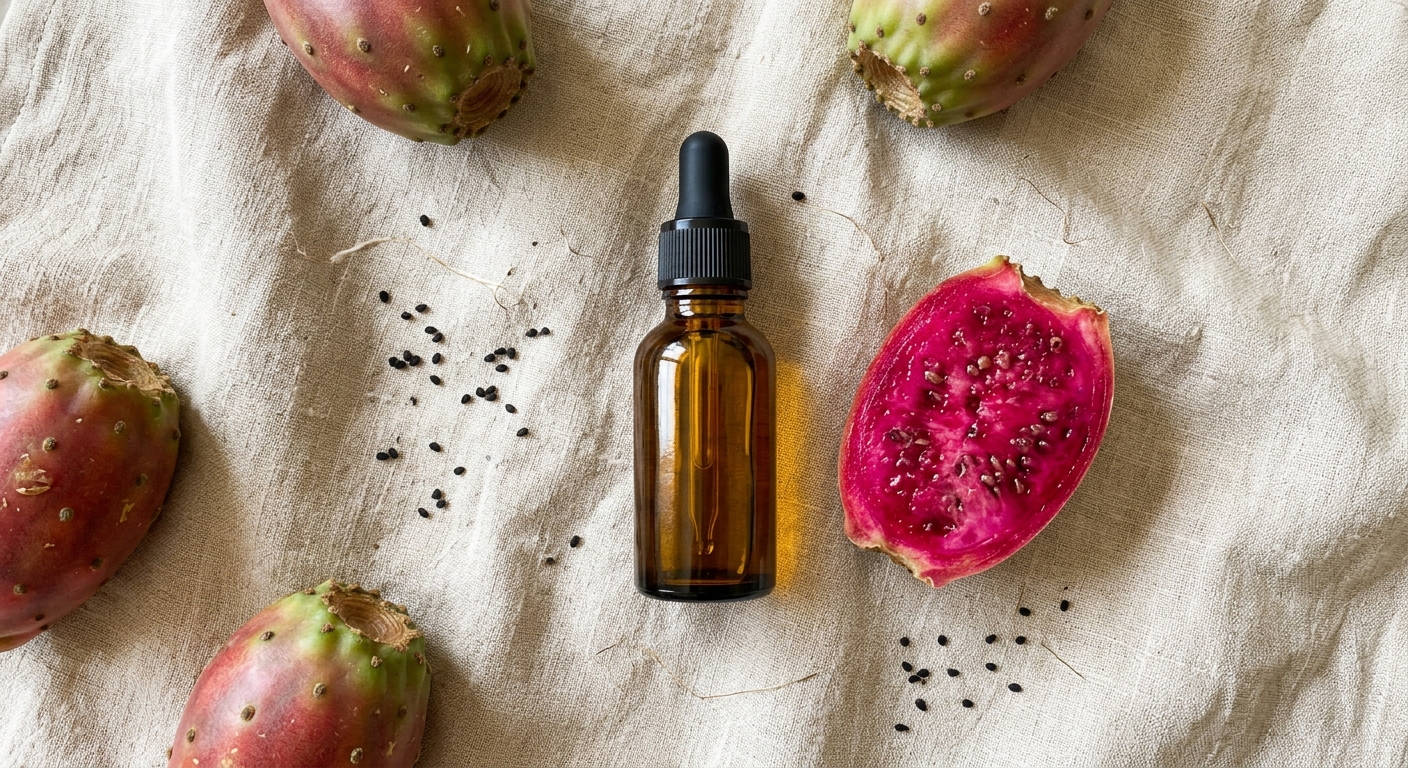
Prickly Pear Seed Oil: What the Science Says This Desert Oil Can (and Can't) Do
It's one of the most expensive facial oils on the market and one of the richest in vitamin E. Here's what prickly pear seed oil actually does for aging skin.
Ounce for ounce, prickly pear seed oil is one of the most expensive ingredients in your bathroom cabinet — sometimes costing more than the serums around it. The price comes from sheer effort: it takes roughly a ton of prickly pear fruit to yield about a liter of oil, because each tiny seed holds only a trace. That scarcity has given it a luxury mystique. But mystique isn’t science, so let’s look at what this desert oil actually does for aging skin — and, just as importantly, what it doesn’t.
The Problem It’s Meant to Solve
Every day, your skin is under oxidative siege. UV light, pollution, and even normal metabolism generate unstable molecules called free radicals that damage collagen, degrade the barrier, and accelerate the visible signs of aging. Younger skin neutralizes much of this with its own antioxidant reserves. As we age, those reserves run down, and the balance tips toward damage — which is why topical antioxidants become a smart line of defense after 40. This is the job prickly pear seed oil is built for.
What Prickly Pear Seed Oil Actually Is
Prickly pear seed oil is pressed from the seeds of Opuntia ficus-indica, the cactus that thrives across arid regions of Mexico, North Africa, and the Mediterranean. Chemically, it belongs to the same family of dry, fast-absorbing “polyunsaturated” oils that skin tends to love.
Its defining feature is fatty-acid composition. Prickly pear seed oil is dominated by polyunsaturated fatty acids, with linoleic acid typically the major component — though the exact percentage shifts with where the cactus is grown, since climate and soil measurably change the oil’s fatty-acid and vitamin profile [1]. That linoleic-acid richness matters for skin specifically: linoleic acid is a building block of the skin’s own barrier lipids, and topical linoleic acid supports barrier integrity and helps limit water loss through the surface [2].
A Vitamin E Powerhouse
If prickly pear seed oil has one genuine claim to fame, it’s vitamin E. The oil is among the most tocopherol-rich seed oils studied, unusually high in gamma-tocopherol, a form of vitamin E prized for its antioxidant strength [1][3]. Alongside the tocopherols it carries phytosterols and polyphenols — including compounds like ferulic and vanillic acid — that add to its antioxidant toolkit [3].
But mystique isn’t science, so let’s look at what this desert oil actually does for aging skin — and, just as importantly, what it doesn’t.
Those aren’t just numbers on a certificate of analysis. In laboratory testing, Opuntia ficus-indica seed oil showed potent free-radical-scavenging activity, in one analysis outperforming the synthetic antioxidant BHT in a standard assay [3]. For skin under daily oxidative stress, a stable, vitamin-E-dense oil is a legitimately useful thing to apply.
What It Can Actually Do for Your Skin
Read past the marketing, and the evidence supports a specific, modest set of benefits:
- Antioxidant defense. Its tocopherols and polyphenols help neutralize free radicals at the surface, complementing — not replacing — a morning vitamin C and sunscreen. It fits naturally into a broader antioxidant skincare strategy.
- Barrier support and moisture retention. As a linoleic-acid-rich oil, it helps reinforce the lipid barrier and reduce transepidermal water loss, leaving skin softer and more comfortable [2].
- Soothing and repair. Beyond antioxidants, the oil has shown measurable wound-healing and skin-repair activity in controlled animal studies, consistent with a calming, restorative effect on stressed skin [4].
In practice, that makes it an excellent finishing oil for dry, mature, or reactive skin — light enough to absorb without greasiness, rich enough to seal in hydration.
Prickly pear seed oil contains no retinoids and does not act like one — a distinction we cover in natural retinol alternatives.
Its texture is part of the appeal. Because it’s so highly polyunsaturated, prickly pear seed oil sinks in quickly and leaves a dry, non-shiny finish, unlike heavier oils that sit on top and feel occlusive. That makes it comfortable even for skin that leans combination, and it plays well under other products rather than blocking them. If your skin has felt tight and depleted through winter or after a course of strong actives, a few drops of a barrier-friendly, antioxidant-dense oil can be the difference between skin that merely looks hydrated and skin that stays comfortable through the day.
What It Can’t Do
Here’s where honesty matters more than hype. Prickly pear seed oil is a superb antioxidant and barrier oil, but it is not a collagen-builder. No amount of tocopherol will instruct your fibroblasts to lay down new collagen or reorganize the dermis. Antioxidant oils defend the skin you have; they don’t remodel it. If your goal is fading etched wrinkles, firming laxity, or rebuilding the structural support that thins with age, an antioxidant oil is a supporting player, not the lead.
It’s also worth setting expectations on the “natural retinol” claims that sometimes attach to botanical oils. Prickly pear seed oil contains no retinoids and does not act like one — a distinction we cover in natural retinol alternatives.
The Ingredient That Does Rebuild
For actual collagen remodeling, the most proven ingredient remains retinol. Where prickly pear seed oil defends the barrier, retinol goes deeper — signaling the skin to renew, thicken the living epidermis, and rebuild collagen over time. The two are complementary: antioxidants guard, retinoids rebuild.
The historical obstacle has been that retinol is harsh, and pairing it with a soothing oil was a way to survive the irritation. Nanoretinol changes that calculus. By encapsulating retinol inside biomimetic lipid nanoparticles that the skin accepts as “self,” it delivers the active efficiently without the barrier-stripping penetration conventional retinol relies on — which is why its stabilized 0.2% formula is water-based, 99% natural, and measurably gentler on skin cells. You get the rebuilding ingredient in a form that a soothing oil like prickly pear can complement rather than rescue.
How to Use It
Apply a few drops of prickly pear seed oil as the last step of your evening routine, pressing it over your serum and moisturizer to seal everything in. If you use it alongside a retinoid, apply the retinoid to clean skin first and let it absorb, then layer the oil on top to buffer and comfort. Like other dry, fast-absorbing oils such as marula or squalane, a little goes a long way — that ton of cactus in every bottle is not to be wasted.
Prickly pear seed oil earns its place as a luxurious antioxidant finisher. Just hold it to the right standard: it’s a shield for aging skin, not a scaffold. Pair the shield with a proven rebuilder, and you’re covering both halves of the job.
References
- Matthäus B, Özcan MM. “Habitat effects on yield, fatty acid composition and tocopherol contents of prickly pear (Opuntia ficus-indica L.) seed oils.” Scientia Horticulturae. 2011;131:95-98. doi:10.1016/j.scienta.2011.09.027
- Wang X, Jia Y, He H. “The Role of Linoleic Acid in Skin and Hair Health: A Review.” International Journal of Molecular Sciences. 2024;26(1):246. doi:10.3390/ijms26010246
- Alqurashi AS, Al Masoudi LM, Hamdi H, Abu Zaid A. “Chemical Composition and Antioxidant, Antiviral, Antifungal, Antibacterial and Anticancer Potentials of Opuntia ficus-indica Seed Oil.” Molecules. 2022;27(17):5453. doi:10.3390/molecules27175453
- Koshak AE, Algandaby MM, Mujallid MI, Abdel-Naim AB, Alhakamy NA, Fahmy UA, et al. “Wound Healing Activity of Opuntia ficus-indica Fixed Oil Formulated in a Self-Nanoemulsifying Formulation.” International Journal of Nanomedicine. 2021;16:3889-3905. doi:10.2147/IJN.S299696