Rice Water for Skin: What the Science Actually Says About the Viral Toner
Rice water has real antioxidants and a centuries-old reputation — but the gap between the bowl on your counter and the lab studies is bigger than it looks.
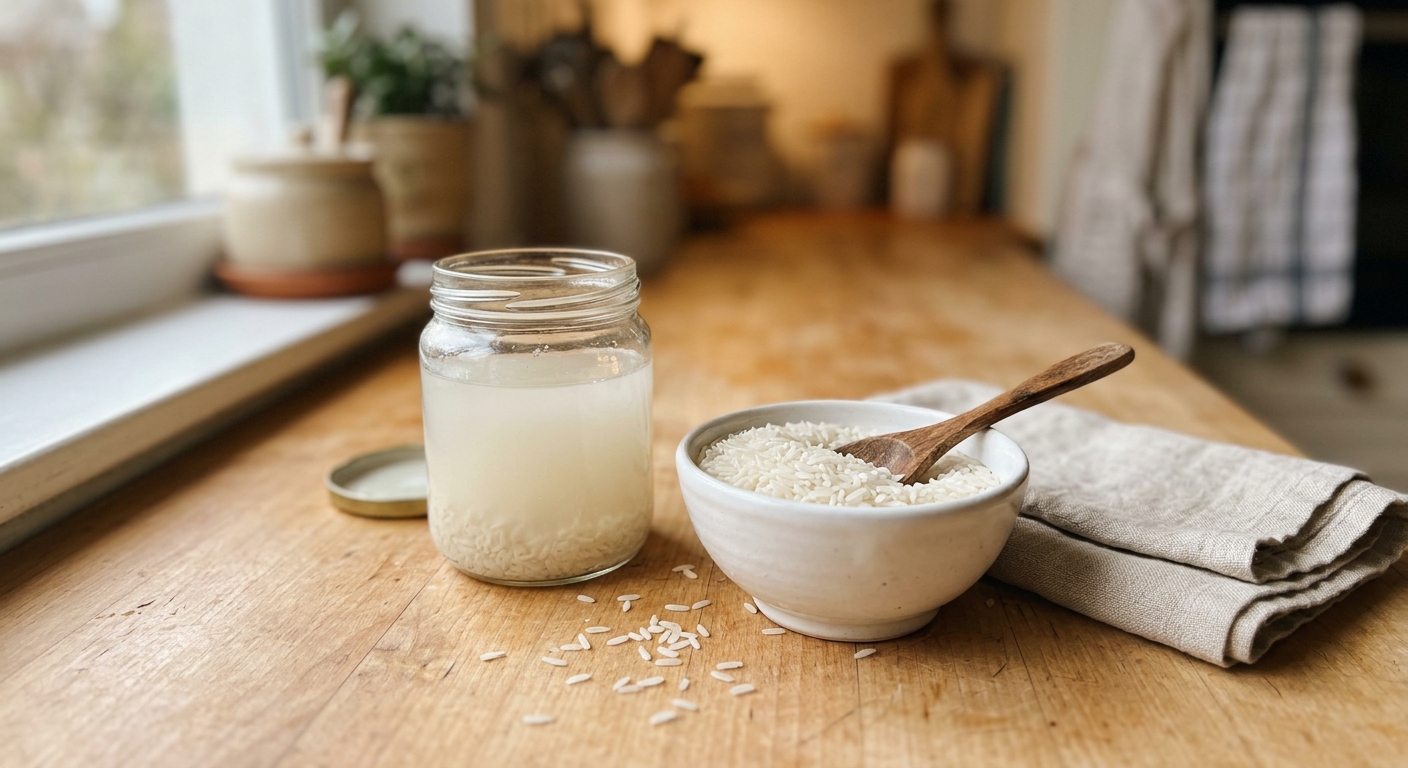
Rice water has one of the oldest reputations in skincare. The court women of Japan’s Heian era reportedly rinsed their hair and skin with it; the Yao women of Huangluo in China credit it for famously long, dark hair well into old age. A thousand years later it’s a viral toner, with millions of videos showing people straining cloudy water off a bowl of rice and patting it onto their faces.
When a remedy survives that long, it’s usually because there’s something real underneath the folklore. With rice water, there is — just not quite what the trend promises. Sorting the genuine benefits from the wishful ones requires looking at what’s actually in the water, and at the often-overlooked detail of how skincare ingredients have to be delivered to work.
What’s Actually in Rice Water
Rice and its bran are surprisingly rich in bioactive compounds. The most interesting for skin is ferulic acid, a potent antioxidant, alongside gamma-oryzanol, inositol, phytic acid, vitamin E compounds, amino acids, and a generous amount of starch. The cloudiness you see is mostly that starch, with the active molecules dissolved throughout.
Ferulic acid is the standout. It’s the same antioxidant that dermatology has studied seriously in other contexts — a landmark study found that adding ferulic acid to a vitamin C and E serum stabilized those vitamins and roughly doubled the formula’s photoprotection against UV damage [1]. Antioxidants like this neutralize the free radicals generated by sun and pollution, which is one of the main drivers of skin aging. So the foundational claim — that rice water carries skin-friendly antioxidants — is legitimate. You can read more about why this category matters in our guide to antioxidant skincare and the dedicated piece on ferulic acid serums.
Antioxidants like this neutralize the free radicals generated by sun and pollution, which is one of the main drivers of skin aging.
What the Research Genuinely Supports
Beyond antioxidants, the strongest evidence sits with rice bran extract — the concentrated material derived from rice’s outer layer. In a 2025 study, fermented rice bran extract significantly increased the synthesis of both collagen and elastin in skin cells and animal models, with collagen content rising and elastin fibers regenerating over 28 days of treatment [2]. Other research formulated rice bran’s bioactive compounds into topical products and documented real improvements: enhanced antioxidant activity and roughly 20–30% better skin hydration in one study [3], and measurable gains in skin elasticity, thickness, and roughness across 30 human volunteers over 28 days in another [4].
That sounds like a ringing endorsement — until you read the methods closely.
The Gap Between the Lab and the Bowl
Every one of those impressive studies has something in common, and it isn’t rice water. They used concentrated, standardized rice bran extracts — and in the human trials, those extracts were encapsulated in niosomes, microscopic delivery vehicles engineered to carry the actives into the skin rather than letting them sit on top and evaporate.
Homemade rice water is a different animal entirely. It’s dilute, unstandardized, and unstable — the active concentration in any given batch is unknown and low, and much of it is starch and water. Patted onto the face and often rinsed away, most of those small molecules never get past the outermost layer of skin. The skin barrier is built specifically to keep things out, and water-soluble antioxidants don’t cross it easily on their own.
If you enjoy the ritual and your skin likes it, there’s no reason to stop.
This is the part the viral videos skip: in skincare, an ingredient’s track record on paper means little if it can’t reach the cells that need it at a meaningful dose. The researchers who got rice bran to build collagen didn’t just apply it — they had to engineer a delivery system to make it work. The bowl on your counter has no such system.
Where Rice Water Honestly Fits
None of this makes rice water useless. As a gentle, hydrating, mildly antioxidant rinse or toner, it’s a pleasant and low-risk addition to a routine — closer in spirit to a soothing snail mucin essence or a hydrating niacinamide step than to an active treatment. If you enjoy the ritual and your skin likes it, there’s no reason to stop.
What rice water cannot do is the structural work — rebuilding the collagen and elastin that give a face its firmness. Expecting a rinsed-off rice rinse to reverse fine lines is setting yourself up for disappointment, no matter how old or romantic the tradition.
The Lesson Rice Water Teaches
The most useful thing the rice bran research reveals isn’t really about rice — it’s about delivery. The same actives did almost nothing loose in water and a great deal once they were properly encapsulated and carried into the skin. Concentration and delivery, not folklore, decide whether an ingredient works.
That’s precisely the principle behind Nanoretinol. Retinol is the single most proven anti-aging active in dermatology, but conventional formulas struggle to get it through the barrier without irritation, and a recent review noted that lipid-nanoparticle delivery systems penetrate better and release the active more steadily than conventional creams [5]. Nanoretinol encapsulates a stabilized 0.2% retinol inside biomimetic lipid nanoparticles the skin recognizes as “self,” allowing it through the barrier without the chemical disruption older retinols rely on. In North Biomedical’s research, that delivery advantage translated to 232% greater collagen recovery and 73% greater elastin recovery than conventional retinol — while being significantly gentler on skin cells. It’s the engineered version of the lesson rice water teaches by accident: get a proven active to the right place, and skin responds.
The Honest Verdict
Rice water earns a modest, real place in skincare — a gentle, antioxidant-carrying toner backed by a genuinely ancient tradition. Just keep its job in proportion. For hydration and a soothing ritual, enjoy it. For the firmer, smoother skin the trend videos imply, you’ll need an active that’s both proven and actually delivered where it counts.
References
- Lin FH, Lin JY, Gupta RD, Tournas JA, Burch JA, Selim MA, Monteiro-Riviere NA, Grichnik JM, Zielinski J, Pinnell SR. “Ferulic acid stabilizes a solution of vitamins C and E and doubles its photoprotection of skin.” Journal of Investigative Dermatology. 2005;125(4):826–832. PubMed: 16185284
- Yan X, Yang M, Cai X, Shen Y, Jiang R, Huang R, et al. “Fermented rice bran extract delays skin aging by increasing the synthesis of collagen and elastin.” Frontiers in Pharmacology. 2025;16:1692491. doi:10.3389/fphar.2025.1692491
- Manosroi A, Chutoprapat R, Sato Y, Miyamoto K, Hsueh K, Abe M, Manosroi W, Manosroi J. “Antioxidant activities and skin hydration effects of rice bran bioactive compounds entrapped in niosomes.” Journal of Nanoscience and Nanotechnology. 2011;11(3):2269–2277. doi:10.1166/jnn.2011.3532
- Manosroi A, Chutoprapat R, Abe M, Manosroi W, Manosroi J. “Anti-aging efficacy of topical formulations containing niosomes entrapped with rice bran bioactive compounds.” Pharmaceutical Biology. 2012;50(2):208–224. doi:10.3109/13880209.2011.596206
- Milosheska D, Roškar R. “Use of Retinoids in Topical Antiaging Treatments: A Focused Review of Clinical Evidence for Conventional and Nanoformulations.” Advances in Therapy. 2022;39(12):5351–5375. doi:10.1007/s12325-022-02319-7