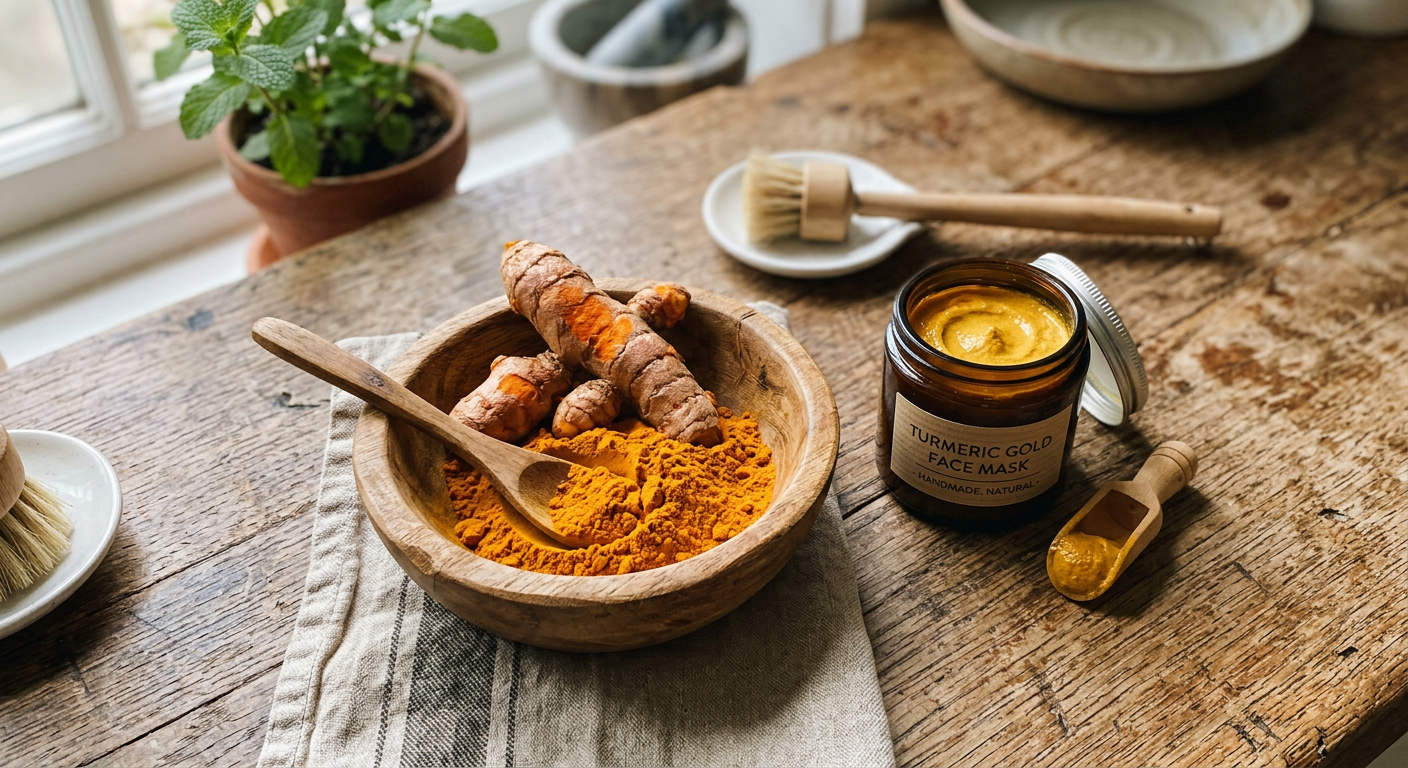
Turmeric for Skin: What Science Says About Curcumin's Anti-Aging Power
From ancient Ayurvedic remedy to modern clinical trials — how curcumin fights photoaging, inflammation, and wrinkles
Why a 4,000-Year-Old Spice Is Making Dermatologists Pay Attention
Turmeric (Curcuma longa) has been used in Ayurvedic medicine for over four millennia — applied to wounds, mixed into face masks, and consumed as a systemic anti-inflammatory long before modern science had a framework to explain why it worked. The active compound responsible for most of turmeric’s biological activity is curcumin, a polyphenol that gives the spice its characteristic golden color and accounts for roughly 2–5% of the root by weight [1].
What transformed curcumin from folk remedy to legitimate research subject is the sheer breadth of its pharmacological activity. Over 12,000 peer-reviewed papers have been published on curcumin, documenting anti-inflammatory, antioxidant, antimicrobial, and anti-cancer properties [2]. For dermatology specifically, the evidence has reached a critical mass: randomized controlled trials now demonstrate measurable effects on skin firmness, wrinkle reduction, wound healing, and barrier function.
The challenge — and it is a significant one — has always been delivery. Curcumin is notoriously difficult to get into the skin in therapeutic concentrations. But the same nanotechnology revolution that is transforming retinoid delivery is now being applied to curcumin, with promising results.
The Anti-Aging Mechanism: How Curcumin Fights Photoaging
Curcumin’s anti-aging effects operate through three interconnected pathways:
1. NF-κB Inhibition (The Master Anti-Inflammatory Switch)
Nuclear factor kappa-B (NF-κB) is a transcription factor that controls over 200 genes involved in inflammation. When UV light hits your skin, it activates NF-κB, which triggers an inflammatory cascade that upregulates matrix metalloproteinases (MMPs) — the enzymes that literally digest collagen and elastin fibers in the dermis [1].
Curcumin is one of the most potent natural NF-κB inhibitors identified. By blocking this master switch, it suppresses the entire downstream inflammatory cascade — reducing MMP activation, collagen degradation, and the chronic low-grade inflammation (sometimes called “inflammaging”) that accelerates visible aging [3].
2. Antioxidant Defense
Curcumin neutralizes multiple types of reactive oxygen species (ROS), including superoxide radicals, hydroxyl radicals, and singlet oxygen. A 2025 review in Frontiers in Pharmacology described curcumin as having “potent ROS scavenging capacity” that protects against UV-induced oxidative damage at the cellular level [4]. This antioxidant activity complements other antioxidant ingredients like vitamin C and glutathione, each of which targets different ROS species through different mechanisms.
3. Collagen Protection and Synthesis Support
Beyond preventing collagen destruction, curcumin has been shown to support collagen synthesis. In vitro studies demonstrate that curcumin upregulates type I collagen expression in dermal fibroblasts while simultaneously inhibiting MMP-1, MMP-3, and MMP-9 — the primary enzymes responsible for collagen breakdown [4]. This dual action — building new collagen while protecting existing collagen — is exactly the therapeutic profile that makes an ingredient genuinely relevant for anti-aging.
Participants used a combination of oral curcumin (70 mg daily) plus topical 0.02% curcumin cream for four weeks.
Clinical Trial Evidence
Skin Firmness and Wrinkle Reduction
The most compelling clinical data comes from a 2022 randomized trial (N=60) studying curcumin’s effects on photoaged skin. Participants used a combination of oral curcumin (70 mg daily) plus topical 0.02% curcumin cream for four weeks. Results showed [4]:
- Skin firmness: 11.2% improvement (vs. 5.5% in topical-only group, p<0.01)
- Skin elasticity: 12.7% improvement measured by Cutometer
- Forehead wrinkle volume: 16.5% reduction measured by Visioface
- Transepidermal water loss (TEWL): 10.8% reduction (improved barrier function)
- Collagen density: Increased, validated by Dermascan ultrasound imaging
The combined oral-plus-topical approach significantly outperformed topical application alone, suggesting that systemic anti-inflammatory effects amplify local skin benefits — a finding consistent with curcumin’s mechanism of action through NF-κB suppression.
Wound Healing
A 2025 scoping review analyzed 19 clinical trials on curcumin’s wound healing effects. The findings were striking: 89% of studies reported statistically significant improvements in healing outcomes compared to placebo or standard care. No adverse events were reported in 84% of studies, with only minor, temporary side effects in the remainder [5].
Curcumin’s wound-healing mechanism involves acceleration of re-epithelialization, increased fibroblast proliferation, enhanced angiogenesis (new blood vessel formation), and reduced inflammatory markers at the wound site [5]. These same processes are relevant for recovery after skin procedures like microneedling or chemical peels.
Inflammatory Skin Conditions
Clinical studies have documented curcumin’s efficacy in psoriasis, where it improves barrier function by upregulating involucrin and filaggrin — structural proteins critical for maintaining the stratum corneum [6]. In a randomized, placebo-controlled, double-blind trial, high-dose curcuminoids significantly reduced symptoms in oral lichen planus [6]. A 2025 double-blind trial (N=52) in breast cancer radiotherapy patients found that topical 2% curcumin gel dramatically reduced radiation-induced skin damage compared to placebo [4].
The Delivery Problem — and Its Solution
Here is the uncomfortable reality about curcumin in skincare: the molecule faces severe bioavailability challenges.
Oral curcumin has notoriously poor absorption. Standard curcumin supplements achieve plasma bioavailability of less than 1% due to rapid hepatic metabolism and intestinal clearance [1]. This is why the clinical trial achieving significant skin improvements used specialized curcumin formulations — not raw turmeric powder.
Standard curcumin supplements achieve plasma bioavailability of less than 1% due to rapid hepatic metabolism and intestinal clearance.
Topical curcumin faces the barrier problem. Curcumin is lipophilic but has low aqueous solubility and limited penetration through the stratum corneum at standard concentrations. Additionally, it stains skin bright yellow, creating obvious cosmetic acceptability issues [6].
Nanodelivery systems are transforming this picture. Curcumin-loaded nanoparticles, liposomes, and solid lipid nanoparticles have shown dramatically improved skin penetration and cellular uptake in recent studies [4]. This is the same nanotechnology principle that Nanoretinol® applies to retinol — encapsulating the active molecule in biomimetic lipid nanoparticles that the skin recognizes as its own tissue. The result for retinol is 232% greater collagen recovery and 73% greater elastin recovery compared to conventional formulations, achieved not by changing the active ingredient but by solving the delivery problem.
The parallel is instructive: curcumin and retinol are both proven active molecules held back primarily by delivery limitations. The future of skincare is not discovering new molecules — it is delivering the ones we already have to the cells that need them.
How to Use Turmeric for Skin Effectively
Oral supplementation: Look for curcumin formulations with enhanced bioavailability — those using piperine (black pepper extract), phospholipid complexes (phytosome technology), or nanoparticle delivery. Standard turmeric capsules deliver very little absorbable curcumin. The clinical studies showing skin benefits used doses of 70–500 mg of bioavailable curcumin daily.
Topical products: Choose formulations specifically designed to address curcumin’s staining and penetration challenges. Look for encapsulated or “colorless” turmeric extracts that have undergone processing to remove the staining curcuminoids while retaining biological activity.
DIY turmeric masks: While popular, homemade turmeric face masks deliver unpredictable concentrations and will stain skin yellow. They are unlikely to match the efficacy of standardized formulations used in clinical trials.
Pair with retinoids for comprehensive anti-aging. Curcumin excels at inflammation suppression and antioxidant protection — the defensive side of anti-aging. For the offensive side — actively rebuilding collagen, accelerating cellular turnover, and reducing wrinkle depth — a retinoid is essential. Using curcumin to calm inflammation while Nanoretinol® drives dermal repair creates a strategy that addresses aging from both directions.
Morning or evening use. Curcumin is stable enough for daytime use (unlike retinol, it is not photosensitizing). Use oral curcumin with a meal containing fat for best absorption; apply topical curcumin formulations as part of either your AM or PM routine.
References
-
Hewlings SJ, Kalman DS. “Curcumin: A Review of Its Effects on Human Health.” Foods. 2017;6(10):92. doi:10.3390/foods6100092
-
Vaughn AR, Branum A, Sivamani RK. “Effects of Turmeric (Curcuma longa) on Skin Health: A Systematic Review of the Clinical Evidence.” Phytotherapy Research. 2016;30(8):1243-1264. doi:10.1002/ptr.5640
-
Tyagi AK, Prasad S, Yuan W, et al. “Identification of a Novel Compound (β-Sesquiphellandrene) from Turmeric (Curcuma longa) with Anticancer Potential: Comparison with Curcumin.” Investigational New Drugs. 2015;33(6):1175-1186. doi:10.1007/s10637-015-0296-5
-
Chen Y, Lu Y, Li J, et al. “Curcumin: A Potential Anti-Photoaging Agent.” Frontiers in Pharmacology. 2025;16:1559032. doi:10.3389/fphar.2025.1559032
-
Alkabbani S, Al-Hashimi I, Alrashidi Y, et al. “A Scoping Review of Clinical Trials on the Efficacy of Curcumin and Its Derivatives in Wound Healing.” Advances in Skin and Wound Care. 2025;38(7):1-14. doi:10.1097/ASW.0000000000000259
-
Nguyen TA, Friedman AJ. “Curcumin: A Novel Treatment for Skin-Related Disorders.” Journal of Drugs in Dermatology. 2013;12(10):1131-1137. PMID: 24085048