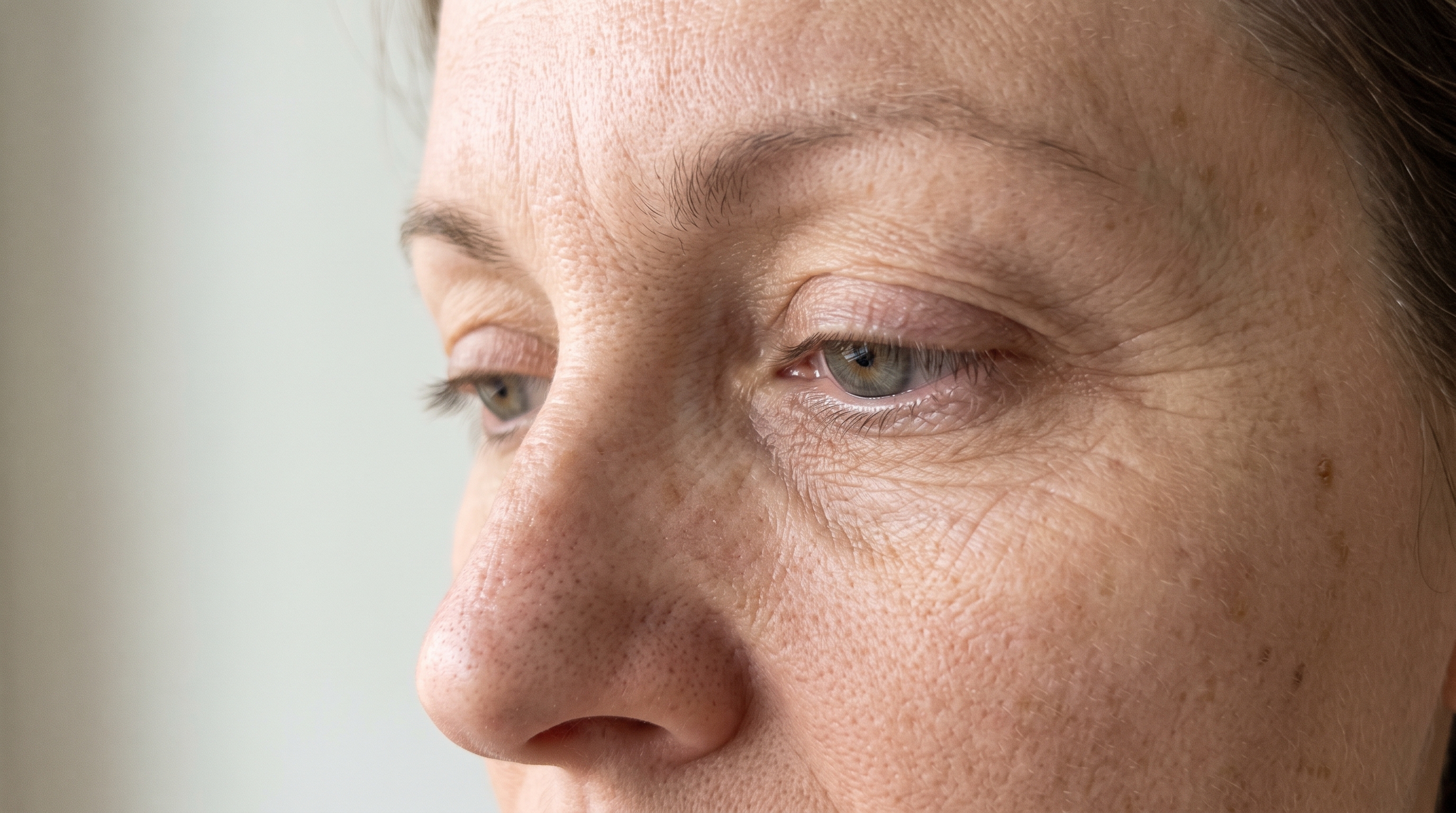
Cheek Filler: The Science of Midface Volume — and Its Blind Spot
Why cheeks deflate with age, how hyaluronic acid filler restores them, and the one thing volume can never fix.
Look at a photograph of yourself from your late twenties and one difference tends to jump out before any wrinkle does: the cheeks. They sat higher, fuller, catching the light across the top of the cheekbone in a soft curve. That curve is the first casualty of facial aging, and it is why cheek filler has become one of the most requested treatments in aesthetics. Restore the volume, the logic goes, and the whole face lifts. The logic is half right — and understanding which half is the difference between a natural result and a disappointing one.
Why cheeks deflate in the first place
For years, aging was explained as simple sagging — skin loosening and sliding downward under gravity. The real story, revealed by anatomical dissection, is more interesting. The fat of the midface is not one soft mass but a set of distinct compartments, each walled off by ligaments, that age at different rates [1]. Some deflate, some descend, and the boundaries between them become visible as grooves and hollows. The high, seamless curve of a young cheek is really several full compartments blending together; the aged cheek is those same compartments emptying and separating.
At the same time, the bone underneath is quietly remodeling and receding, and the skin draped over the whole structure is thinning. The result reads to the eye as “flat,” “tired,” or “gaunt,” and it drags on everything below it — deepening the nasolabial folds and softening the jawline. This is the deficit cheek filler is designed to address.
What the evidence shows
Hyaluronic acid cheek filler works by replacing volume in these deflated compartments, lifting the overlying tissue back toward its original position. The clinical data is solid. A 2024 systematic review and network meta-analysis of HA fillers for cheek volume augmentation found consistent, measurable improvement across studies [2]. A pivotal single-blind randomized controlled study of a volumizing HA filler reported that results were still visible two years after treatment, with patients rating themselves as looking years younger [3]. For a genuine volume deficit, filler is one of the most reliable tools aesthetic medicine has.
For years, aging was explained as simple sagging — skin loosening and sliding downward under gravity.
That reliability is also why it is so easy to over-rely on it. When the only tool is a syringe, every aging face starts to look like a volume problem — and the cheeks are where over-filling shows up most obviously, in the flat, wide, “pillow-faced” look that fools no one.
The blind spot: volume is not quality
Here is the distinction that gets lost in the marketing. Filler changes the shape of the face. It does nothing for the surface of it.
Picture a slightly deflated balloon. Inflate it and the wrinkles on its surface stretch smooth — but the rubber itself is no thicker, no stronger, no younger. Cheek filler does something similar: it re-inflates the scaffolding, and skin that was crumpled by lost volume pulls taut. What it cannot do is improve the skin’s actual condition — its thickness, its firmness, its texture, its tone. If your cheeks show fine crepiness, enlarged pores, dullness, or sun damage, filler leaves every bit of that exactly where it was. Sometimes, stretched over a newly plumped cheek, that texture is easier to see, not harder.
This is why two people can get identical, technically excellent filler and walk away with different levels of satisfaction. One had a pure volume deficit and looks refreshed. The other had a volume deficit layered over poor skin quality, fixed only the first, and can’t understand why the result feels incomplete.
Skin collagen declines by roughly 1% per year across adult life , and it is that protein — not fat — that gives skin its firmness and resilience.
The clock that filler doesn’t stop
Underneath the volume question runs a slower, steadier one: collagen. Skin collagen declines by roughly 1% per year across adult life [4], and it is that protein — not fat — that gives skin its firmness and resilience. As collagen falls, skin becomes thinner and less elastic, so even a perfectly volumized cheek can look lax and papery if the skin itself has thinned. Filler is a snapshot correction of a moving target; the collagen keeps declining underneath it. Treating that decline is a separate job, and it is worth understanding how to improve skin elasticity as its own goal rather than assuming a filler appointment covers it.
Rebuilding the skin, not just refilling the face
The best-studied way to actually rebuild collagen in living skin is a retinoid. In a controlled trial on naturally aged skin, topical retinol increased collagen production and improved fine wrinkling — working with the skin’s own biology rather than adding bulk beneath it [5]. That is the exact capability filler lacks, which is why the two are complementary rather than competing: one restores structure under the skin, the other restores the skin. If you are focused on firmness from the inside out, it also helps to know how to boost collagen production through the habits that support it.
Where conventional retinol stumbles is getting in. Traditional formulas must partly damage the skin barrier to penetrate, which is why so many are irritating and why results plateau. Nanoretinol was built to solve that. It carries a fully stabilized 0.2% retinol inside biomimetic lipid nanoparticles the skin accepts as its own, so the active reaches the cells that build collagen without the barrier disruption that causes redness and peeling. Because efficiency of delivery — not concentration — is the real bottleneck, that modest percentage punches far above its weight: North Biomedical’s clinical study measured 232% greater collagen recovery and 73% greater elastin recovery versus conventional retinol, with a 61% increase in skin firmness over 56 days of use.
None of that replaces filler for someone with true, significant volume loss — you cannot topically re-inflate a deflated fat compartment. But it addresses the layer filler can’t reach, and for many people bothered by “aging cheeks,” a good share of what they are seeing is skin quality, not volume at all.
How to think about it
Cheek filler is a genuinely effective volume tool, backed by real evidence, when the problem is genuinely volume. The mistake is treating it as an all-purpose fix for an aging midface. Before you book, separate the two questions: Has my face lost structure, or has my skin lost quality — or both? Volume loss is filler’s job. Mid-cheek filler also outlasts every other placement, a difference how long filler lasts quantifies. Firmness, texture, and tone are the skin’s, and those you rebuild — patiently, from within — with proven ingredients and consistent care.
References
- Rohrich RJ, Pessa JE. “The fat compartments of the face: anatomy and clinical implications for cosmetic surgery.” Plastic and Reconstructive Surgery. 2007;119(7):2219-2227. doi:10.1097/01.prs.0000265403.66886.54
- Elrosasy A, Abo Zeid M, Hindawi MD, et al. “Efficacy and safety of different hyaluronic acid fillers on cheek volume augmentation: systematic review and network meta-analysis.” Archives of Dermatological Research. 2024;317(1):152. doi:10.1007/s00403-024-03567-z
- Jones D, Murphy DK. “Volumizing Hyaluronic Acid Filler for Midface Volume Deficit: 2-Year Results from a Pivotal Single-Blind Randomized Controlled Study.” Dermatologic Surgery. 2013;39(11):1602-1612. doi:10.1111/dsu.12343
- Shuster S, Black MM, McVitie E. “The influence of age and sex on skin thickness, skin collagen and density.” British Journal of Dermatology. 1975;93(6):639-643. doi:10.1111/j.1365-2133.1975.tb05113.x
- Kafi R, Kwak HS, Schumacher WE, et al. “Improvement of naturally aged skin with vitamin A (retinol).” Archives of Dermatology. 2007;143(5):606-612. doi:10.1001/archderm.143.5.606