Fine Lines Around Eyes: Why the Skin There Ages First — and What Actually Smooths It
The eye area is the thinnest, most expressive, most poorly defended skin on your face. Here's the dermatology of why fine lines appear there first, and which ingredients have evidence behind them.
The first wrinkle most women notice isn’t on the forehead or between the brows. It’s at the outer corner of the eye, visible when smiling, then visible at rest, then visible from across a room. By the time they appear on the lower lid, the question has shifted from why? to what works? Both questions have surprisingly specific answers.
The skin around the eye is engineered differently from the skin on your cheek, and that engineering is the reason the first signs of aging tend to cluster there.
Why this skin gives up first
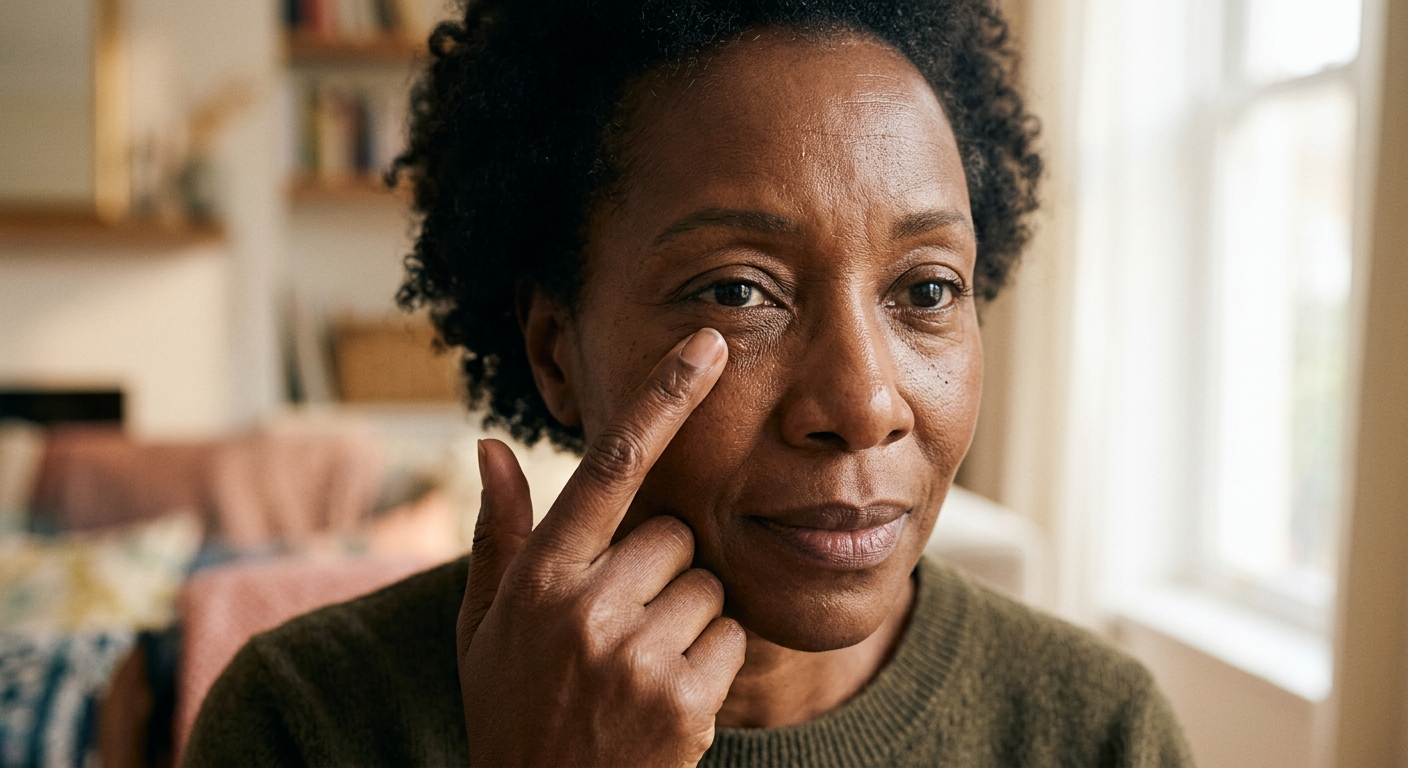
Periorbital skin — the area orbiting the eye, from upper lid to crow’s-foot zone to under-eye — is the thinnest skin on the human body. The dermis is about 0.5 mm thick, compared with 2 mm or more on the cheek. It has fewer sebaceous glands, less subcutaneous fat, and a sparser network of collagen and elastin to begin with. Then it gets used harder than any other skin on the face.
A 2025 narrative review in the Journal of Clinical Medicine mapped the structural reasons periocular aging is so visible. Three mechanisms stack on top of each other [1]:
- Repetitive muscle contraction. The orbicularis oculi — the ring of muscle around the eye — fires every time you blink, squint, or smile. Over decades, those contractions etch perpendicular creases into the overlying dermis.
- Extracellular matrix breakdown. Collagen, elastin, and fibronectin all decline measurably with age, and they decline faster in periorbital skin because the baseline density was lower.
- Cumulative photodamage. Periorbital skin is thinner, sits forward on the face, and is rarely covered as carefully with sunscreen.
A 2025 Journal of Clinical Medicine pilot study on the orbicularis itself added an interesting wrinkle. The muscle gets weaker with age — but the wrinkles it creates persist anyway, because the dermis above it has lost the elastic recoil to spring back between contractions [2].
This is why “fine lines around eyes” is the umbrella term that captures a slightly different concern in each zone: outer-corner crow’s feet from the orbicularis fanning out, fine under-eye wrinkles from cumulative dermal thinning, and upper eyelid wrinkles from skin laxity over the orbital fat. All three share the same fundamental problem: a dermis too thin and too damaged to hold its shape under repeated movement.
The skin around the eye is engineered differently from the skin on your cheek, and that engineering is the reason the first signs of aging tend to cluster there.
The ingredient evidence, ranked
A 2024 International Journal of Women’s Dermatology review systematically assessed the active ingredients in popular eye creams. Four categories had meaningful clinical evidence; many others did not [3].
Retinoids — the consistent winner
Retinoids restructure the dermis itself. The 1993 NEJM trial that put tretinoin on the dermatology map showed an 80% increase in collagen I formation in photodamaged skin after 10–12 months of daily application, compared with a 14% decrease in the vehicle group [4]. A 2016 prospective split-face comparison in Annals of Dermatology tested 0.1% tretinoin against fractional laser and intense pulsed light specifically for periorbital wrinkles. The tretinoin side held its own, with the authors concluding it was “a minimally invasive and convenient treatment for fine periorbital wrinkles” [5].
The catch, as everyone who has tried prescription tretinoin near the eye knows, is irritation. The same thin skin that benefits most from a retinoid is the same thin skin that reacts most aggressively. This is the central design problem of periorbital skincare: deliver enough retinoid to remodel the dermis without lighting up the skin barrier.
Peptides — well-evidenced supporting players
A 2010 British Journal of Dermatology trial of 196 women compared a cosmetic niacinamide/peptide/retinyl-propionate regimen against prescription 0.02% tretinoin over 24 weeks. The two regimens produced statistically equivalent wrinkle reduction [6]. Peptides like Matrixyl (palmitoyl pentapeptide) signal fibroblasts to produce more collagen — they don’t drive the same magnitude of change as a retinoid, but they’re well tolerated and combine well.
Growth factors and heparan sulfate
A 2019 Journal of Cosmetic Dermatology trial of an eye cream containing low-molecular-weight heparan sulfate and naturally derived extracts found measurable global periorbital rejuvenation — improved fine lines, firmness, and texture — over 12 weeks [7]. This is a less-discussed category that has been quietly accumulating evidence.
Skin-barrier and antioxidant support
A 2015 review in the Journal of Clinical and Aesthetic Dermatology on periorbital cosmeceuticals emphasized that the thin periorbital barrier needs reinforcement before, and during, any active treatment. Vitamin C, ferulic acid, and ceramides do not erase wrinkles directly, but they protect the dermis from the oxidative and inflammatory stress that accelerates fine-line formation [8].
The catch, as everyone who has tried prescription tretinoin near the eye knows, is irritation.
What doesn’t work as well as marketing suggests
Caffeine. Reduces puffiness short-term by constricting blood vessels. Does nothing for the dermis. The 2024 ingredient review explicitly noted that caffeine’s anti-wrinkle effect is weak [3].
Hyaluronic acid alone. Plumps the surface by binding water, smoothing the appearance of fine lines for a few hours. Does not rebuild collagen. Useful as a base layer, not as the active. For the immediate optical problem, the guide to eyeshadow for older women explains why thin satin or cream films expose less texture than heavy sparkle or chalky matte powder.
Eye-area massagers and rollers. Often pleasant, occasionally counterproductive. Aggressive friction on thin periorbital skin can worsen dark circles and pull at the eyelid skin.
How to assemble a routine that actually moves the needle
Three principles, supported by the ingredient evidence:
- A nightly retinoid is the structural intervention. This is the only step that has been shown to thicken the dermis over months. Choose a delivery system the periorbital skin can tolerate every night — not the highest concentration you can find.
- Layer peptides for additive effect. Apply morning or alternate evenings. They do not compete with retinoids and they keep the fibroblast signal going.
- Defend the barrier ruthlessly. Daily sunscreen on the orbital bone (not in the eye), niacinamide for barrier function, no harsh cleansing or rubbing.
This is where retinoid delivery becomes the deciding variable. Most retinol products that work on the cheek are too irritating to use nightly on the lower lid. That’s why the periorbital area is where the difference between conventional retinol and modern encapsulated delivery becomes most visible in real life.
Why a gentler retinol is the right tool for periorbital skin
Nanoretinol was developed specifically around the delivery problem. Conventional retinol formulations use surfactants and petroleum-derived vehicles that disrupt the lipid bilayer of the stratum corneum to push retinol through — effective for absorption, harsh on barrier function, and particularly poorly tolerated on periorbital skin. Nanoretinol encapsulates retinol inside biomimetic lipid nanoparticles that pass through the epithelial barrier intact, recognized as “self” rather than as a foreign disruptor.
The clinical study summary reports 232% greater collagen recovery and 73% greater elastin recovery versus conventional retinol, alongside a 61% improvement in skin firmness and 56% in elasticity after 56 days of use [9]. Because the formulation is water-based, 99% natural, and significantly less cytotoxic than conventional retinol, it’s safe for use around the eye area — exactly where the periorbital dermis needs the most consistent retinoid signaling and the least irritation.
For fine lines around the eyes specifically, that combination — proven retinoid mechanism, gentler delivery, daily-use tolerance — addresses the structural cause of the problem rather than masking the appearance.
What to expect
Periorbital improvement is slow because the skin is rebuilding architecture, not surface texture. Most clinical trials measure at 12 weeks because that’s when measurable change tends to register. Personal observation usually lags slightly behind measurement — the wrinkle that’s been there for ten years rarely vanishes in three months, but it should soften, sit shallower, and stop deepening.
The trade-off is permanent only if you abandon the work. Fine lines around the eyes respond to consistent intervention better than almost any other facial concern, because the skin remembers what it used to be. Give it the right signal, deliver that signal gently enough that you can use it every night, and the periorbital dermis is more cooperative than its reputation suggests. For the products that only smooth the surface while that work happens, see eye patches for wrinkles.
References
- Tao BK, Butt FR, Dhivagaran T, et al. Periocular Aging Across Populations and Esthetic Considerations: A Narrative Review. Journal of Clinical Medicine. 2025;14(2):535. doi:10.3390/jcm14020535
- Krajewska-Węglewicz L, Felczak P, Dorobek M. Effects of Aging on Orbicularis Oculi Muscle Strength and Ultrastructure in Dermatochalasis: A Pilot Study. Journal of Clinical Medicine. 2024;14(1):162. doi:10.3390/jcm14010162
- Hamie H, Yassine R, Shoukfeh R, Turk D, Huq F, Moossavi M. A review of the efficacy of popular eye cream ingredients. International Journal of Women’s Dermatology. 2024;10(2):e156. doi:10.1097/JW9.0000000000000156
- Griffiths CE, Russman AN, Majmudar G, Singer RS, Hamilton TA, Voorhees JJ. Restoration of Collagen Formation in Photodamaged Human Skin by Tretinoin (Retinoic Acid). New England Journal of Medicine. 1993;329(8):530-535. doi:10.1056/NEJM199308193290803
- Park SE, Kim SS, Kim CW, Her Y. A Prospective Split-Face Comparative Study of Periorbital Wrinkle Treatments: Fractional Erbium-Doped Yttrium Aluminum Garnet Laser, Intense Pulsed Light, and Topical 0.1% Tretinoin Cream. Annals of Dermatology. 2016;28(5):650-652. doi:10.5021/ad.2016.28.5.650
- Fu JJJ, Hillebrand GG, Raleigh P, et al. A randomized, controlled comparative study of the wrinkle reduction benefits of a cosmetic niacinamide/peptide/retinyl propionate product regimen vs. a prescription 0.02% tretinoin product regimen. British Journal of Dermatology. 2010;162(3):647-654. doi:10.1111/j.1365-2133.2009.09436.x
- Colvan L, Fleck T, Vega VL. Global periorbital skin rejuvenation by a topical eye cream containing low molecular weight heparan sulfate (LMW-HS) and a blend of naturally derived extracts. Journal of Cosmetic Dermatology. 2019;18(2):530-538. doi:10.1111/jocd.12857
- Pilkington SJ, Belden S, Miller RA. The Tricky Tear Trough: A Review of Topical Cosmeceuticals for Periorbital Skin Rejuvenation. Journal of Clinical and Aesthetic Dermatology. 2015;8(9):39-47. PMC4587894
- North Biomedical LLC. “Nanoretinol vs. Conventional Retinol: Efficacy in Collagen and Elastin Recovery.” Clinical Study Summary, 2024. northbiomedical.com/documents/Nanoretinol-Study_Summary.pdf