Loose Skin After Weight Loss: Why It Happens and What Actually Helps
The dermatological reality behind sagging skin after major weight loss — and what topical treatments can and cannot fix.
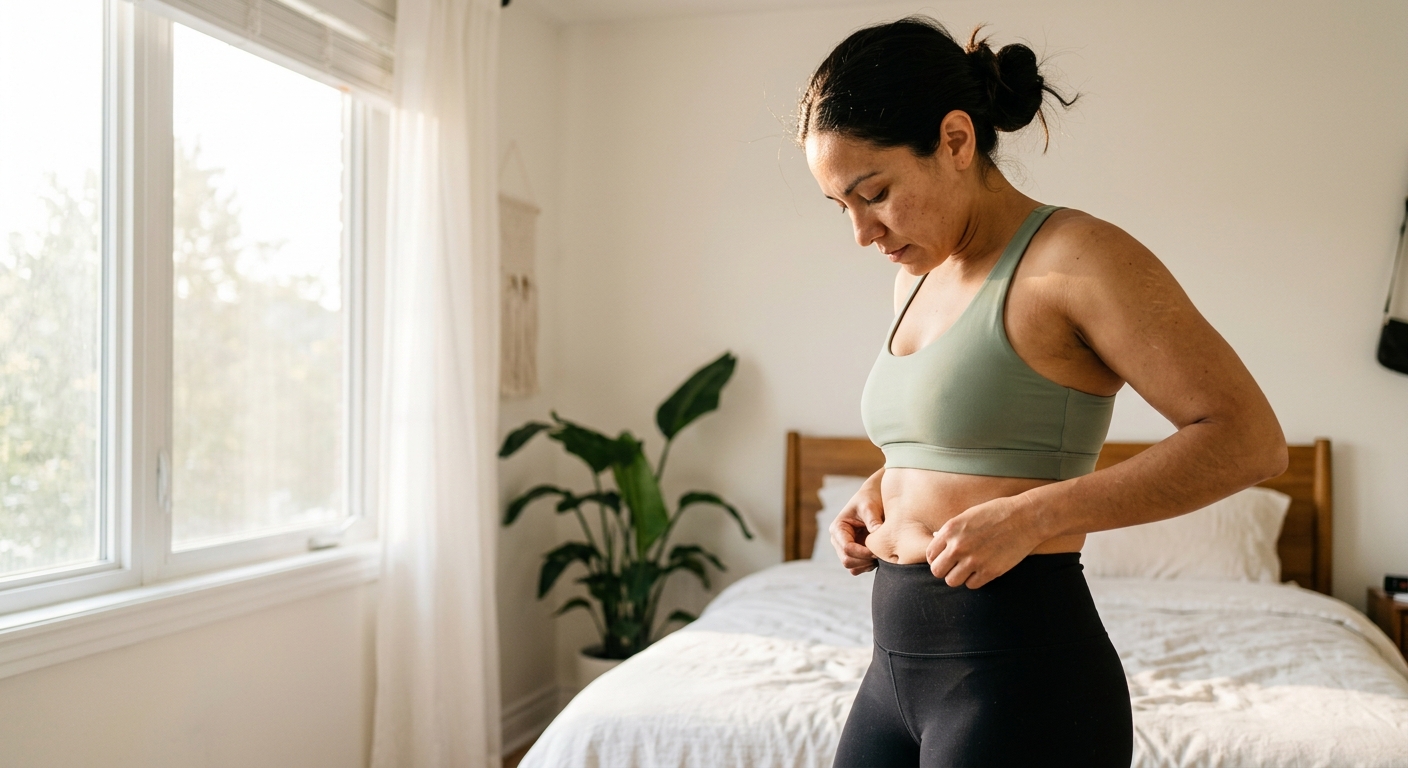
You did the hard part. You changed your eating, you found a workout you can stick to, you lost the weight you spent years carrying. Then you saw yourself in the mirror and the skin on your stomach, your inner arms, your thighs, and your chin had a crepey, hanging quality you did not expect. Nobody warned you about this part.
Loose skin after weight loss is one of the most under-discussed parts of any major transformation, and the standard advice you’ll find online is mostly wrong. “Drink more water and your skin will tighten” is wrong. “Massage it with coconut oil” is wrong. The reason these tips fail is that loose skin after weight loss is not a hydration problem or a circulation problem. It is a histological problem — meaning the actual structure of the dermis has changed in measurable ways, and topical or behavioral fixes can only address part of what changed.
This article walks through what the dermatology research actually shows about why this happens, which interventions have evidence behind them, and how to set realistic expectations for what skincare can do.
What Actually Changes in the Skin
To understand why loose skin doesn’t always snap back, you need a quick mental model of what holds skin taut in the first place.
The dermis — the layer beneath the surface — contains two structural proteins that do most of the heavy lifting. Collagen provides tensile strength, like the warp threads of a fabric. Elastin provides recoil, the ability to stretch and bounce back, like a rubber band woven through the fabric. A well-functioning dermis is densely packed with thick, organized collagen bundles and a fine network of elastic fibers anchored at the dermal-epidermal junction [1].
When skin is stretched gradually over years — by pregnancy, by significant weight gain, by puberty growth spurts — those fibers physically remodel to accommodate the new volume. Stretch them long enough and two things happen at the cellular level: fibroblasts (the cells that produce new collagen and elastin) become less active, and the existing fibers reorganize into a thinner, more disorganized arrangement.
A 2021 study in Obesity Surgery took skin biopsies from patients before and after massive weight loss following bariatric surgery. The researchers found a measurable shift away from thick, organized, structured collagen fibers toward thin, misaligned, loosely arranged ones [2]. The dermis was still there. It was just architecturally weakened — like a building whose steel beams had been replaced with thinner, bent versions of themselves.
Elastin tells an even harder story. Unlike collagen, which fibroblasts can produce throughout life, elastin synthesis essentially shuts down after puberty [3]. The elastic fiber network you have at age 25 is, biologically, the network you will have for the rest of your life — minus whatever damage accumulates from UV exposure, oxidative stress, and mechanical stretching. When weight gain expands and then weight loss collapses that network, the fibers cannot regenerate the way collagen can.
Why Some People Snap Back and Others Don’t
Two people can lose the same 80 pounds and end up with completely different skin outcomes. Six factors do most of the explaining.
GLP-1 agonists and very-low-calorie diets can produce 15-25% body weight reduction in months.
Age at the time of weight gain and loss. Skin loses its baseline elasticity progressively after the early twenties. Someone who carried excess weight from age 20 to 30 and lost it at 32 has dramatically more recoil capacity than someone who gained at 35 and lost at 55.
How long you carried the weight. A 2015 image-analyzer study of skin from patients with morbid obesity found significant histological changes — thinning of the dermis, disorganization of the collagen-elastin matrix — that scaled with the duration of obesity, not just its severity [4]. A decade of stretched skin reorganizes the dermis more than two years does.
Speed of weight loss. GLP-1 agonists and very-low-calorie diets can produce 15-25% body weight reduction in months. Skin remodeling happens on a timescale of years. The faster the volume loss, the larger the gap between how much skin volume you have and how much volume the body underneath can fill.
Sun exposure history. UV radiation activates matrix metalloproteinases that degrade existing elastin and collagen [5]. Two people the same age, the same weight history — the one with two decades of sun exposure on the abdomen has a structurally weaker dermis to begin with.
Genetics. Variations in genes coding for tropoelastin and fibrillin-1 affect baseline elastin density. Some people simply produce a more resilient elastic fiber network.
Where the weight was. Loose skin shows up most dramatically in areas with the largest stretch ratio — the abdomen after pregnancy or major weight loss, the inner arms, the inner thighs, and the lower face. Areas like the calves and forearms, which carry less expandable adipose tissue, rarely show the same effect.
The Spectrum of Loose Skin
It helps to think about loose skin on a spectrum rather than as a yes-or-no problem.
Mild crepey-ness describes skin that looks textured and finely wrinkled when pinched but lies relatively flat against the body. This is the version that responds best to topical treatment. If dimpling is part of the picture, the best cellulite cream guide explains what a topical can and cannot reach.
Moderate laxity describes skin that hangs slightly when you’re standing — visible folds at the inner arms, a soft pouch at the lower abdomen, a less defined jawline. Topicals can improve the surface and modestly improve recoil over many months. Strength training that builds underlying muscle volume helps the skin sit more taut.
Most people who try a retinol body lotion give up within three weeks.
Severe excess skin describes folds that hang several inches, that chafe and trap moisture, that interfere with movement. This is the territory where surgical body contouring (panniculectomy, brachioplasty, thigh lift) is the only intervention that produces the result people are usually picturing when they search for solutions [2]. No cream, supplement, or laser will close that gap, and being told otherwise by a marketing site is part of why people lose months chasing fixes that cannot work.
What Actually Helps Mild-to-Moderate Loose Skin
Once you know what’s broken in the dermis, the list of evidence-based interventions becomes shorter and more specific.
Strength training to fill the volume
This one is not skincare, but it does more for the appearance of loose skin than most topicals. Building muscle in areas like the upper arms, legs, and core fills out the volume the skin used to drape over, reducing the slack. Resistance training also promotes systemic protein synthesis, which supports tissue repair generally. It will not regenerate elastin, but it changes how the skin sits on the body underneath. Our guide to strength training for loose skin separates the volume problem lifting solves from the dermal problem it cannot.
Topical retinoids — the only ingredient with strong dermal evidence
Retinol and prescription tretinoin are the most studied topical interventions for stimulating dermal remodeling. Retinoic acid binds to nuclear receptors in fibroblasts and switches on collagen synthesis genes while suppressing the matrix metalloproteinases that break collagen down [6].
The 2007 Archives of Dermatology trial led by Kafi and colleagues at the University of Michigan applied 0.4% retinol lotion three times a week to the arms of subjects whose skin had significant signs of aging and laxity. After 24 weeks, the retinol-treated arms showed measurable reductions in fine wrinkles, improved firmness, and a 40% increase in glycosaminoglycans — the water-binding molecules that plump the dermis from within [7].
More relevant to loose skin specifically, a 2011 study showed that retinol increases the synthesis of tropoelastin and fibrillin-1, the precursor molecules for new elastic fibers [8]. This is one of very few interventions shown to nudge adult skin to make any new elastin at all.
Sunscreen on every exposed area
This is the lowest-effort, highest-leverage intervention for anyone who still has the elastin they have. UV radiation continuously activates the enzymes that degrade dermal proteins. Skin you are trying to tighten and rebuild is skin you cannot also be slowly degrading.
What the evidence does not support
Collagen powders and bone broth show inconsistent results in independent trials. Topical “skin tightening creams” with caffeine, DMAE, or peptide blends produce modest, temporary effects — the skin may look tighter for a few hours after application, then return to baseline. Massage and dry brushing improve circulation but do not change dermal architecture.
Why Most Retinol Treatments Fail on Body Skin
Most people who try a retinol body lotion give up within three weeks. The reason is straightforward: conventional retinol is unstable (it oxidizes when exposed to air and light), poorly absorbed (large hydrophobic molecules don’t pass easily through the epidermal barrier), and irritating (the petroleum-derived solvents that get it across the barrier damage the barrier in the process).
The result is a familiar pattern. You apply the lotion. Your skin gets red and flaky. You assume the product is “working.” It is — but most of what’s happening is barrier damage, not collagen stimulation. After a couple of weeks of irritation you stop using it, and the small amount of dermal remodeling that began stops with you.
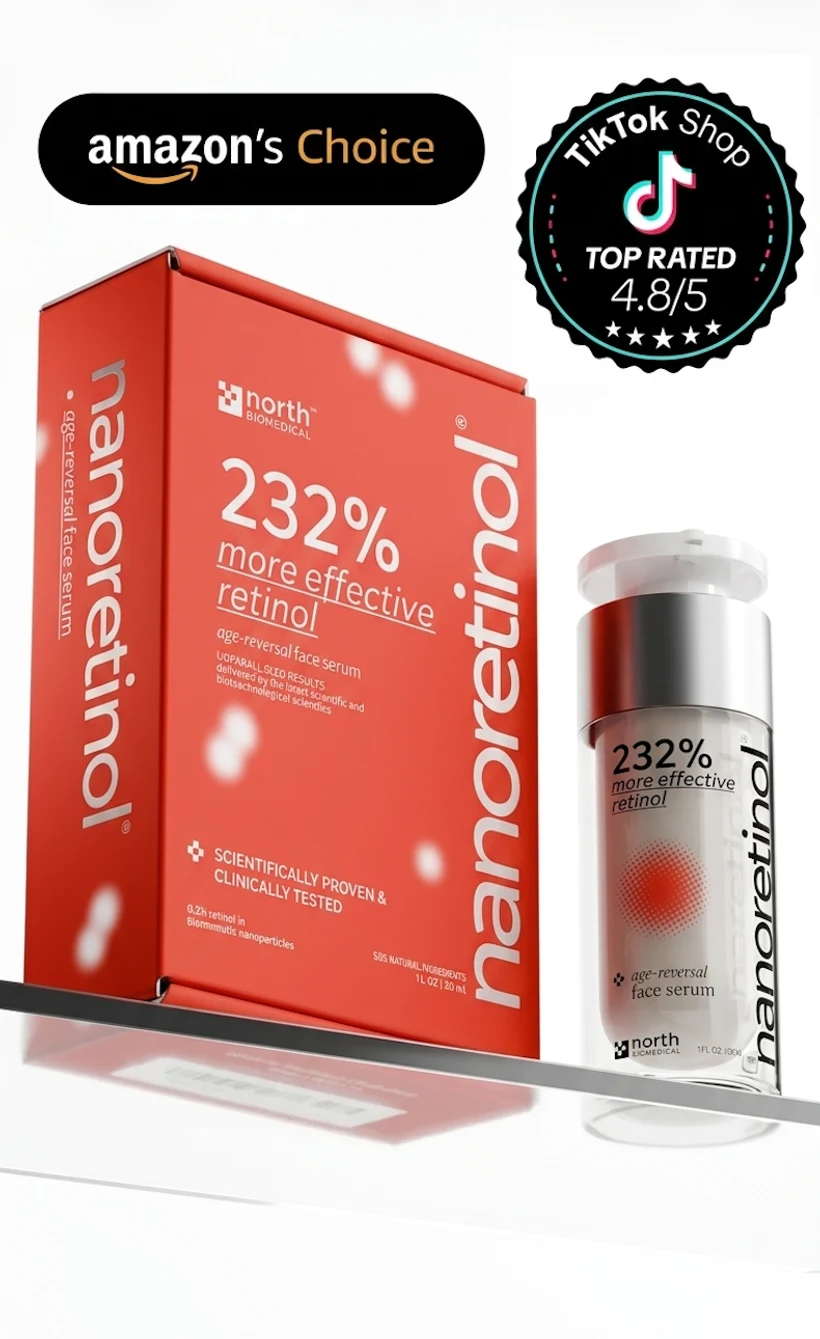
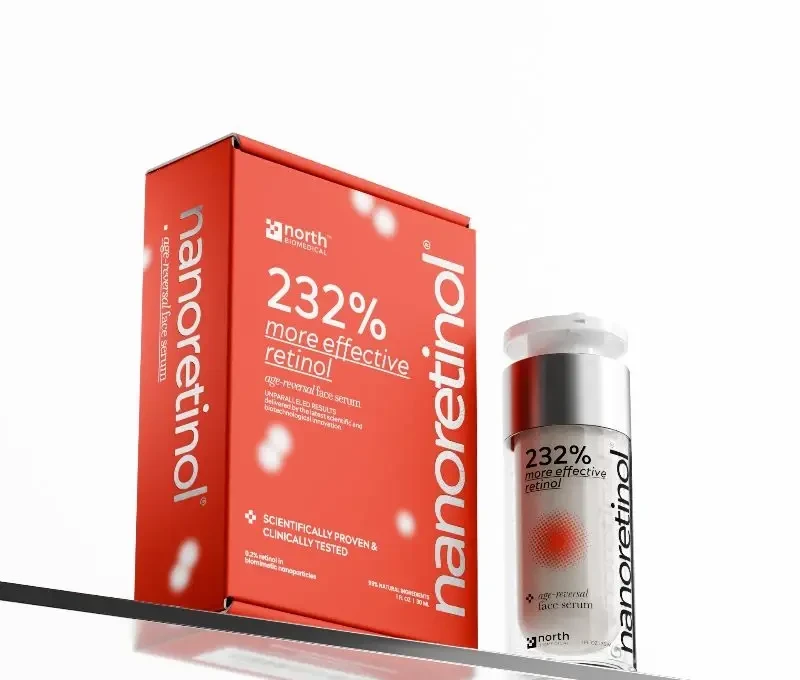
Nanoretinol was developed to address this exact problem. Conventional retinol fails to reach fibroblasts in any meaningful concentration because the delivery system is the bottleneck. Nanoretinol encapsulates 0.2% retinol inside biomimetic lipid nanoparticles — particles externally identical to skin cells, which the epidermal barrier recognizes as “self” and lets pass through intact, without the destructive chemistry that drives conventional retinol’s irritation. Once in the dermis, the retinol is released to interact with fibroblasts the way the research describes.
In North Biomedical’s clinical evaluation, the formulation produced 232% greater collagen recovery and 73% greater elastin recovery compared to conventional retinol — the structural changes that loose skin actually requires. For body areas like the inner arms, abdomen, and thighs, where consistent application is the limiting factor, a non-irritating retinol that you will actually keep using for six months is worth far more than a more aggressive one you’ll abandon in three weeks.
Setting Realistic Expectations
The hardest part of treating loose skin after weight loss is the gap between what the internet promises and what biology allows. Surface hydration shows up in 24 hours; structural remodeling of the dermis happens over six to twelve months of consistent treatment, and the magnitude of improvement is bounded by how much elastin your skin had to begin with.
For mild crepey-ness, the realistic outcome is meaningful smoothing and improved texture. For moderate laxity, the realistic outcome is somewhat improved tone and a less crepey surface. For severe excess skin, the realistic outcome of any topical is “this looks a bit better” — and the result you actually want will require a plastic surgery consultation.
The work that you did to lose the weight matters more than what your skin does next. But knowing what’s actually possible to change — and what the research says works — at least lets you spend your money and your time on the things that can move the needle.
References
- Baumann L, Bernstein EF, Weiss AS, Bates D, Humphrey S, Silberberg M, Daniels R. “Clinical Relevance of Elastin in the Structure and Function of Skin.” Aesthetic Surgery Journal Open Forum. 2021;3(3):ojab019. doi:10.1093/asjof/ojab019
- Rocha RI, Cintra Junior W, Modolin MLA, Takahashi GG, Caldini ETEG, Gemperli R. “Skin Changes Due to Massive Weight Loss: Histological Changes and the Causes of the Limited Results of Contouring Surgeries.” Obesity Surgery. 2021;31(4):1505-1513. doi:10.1007/s11695-020-05100-3
- Weihermann AC, Lorencini M, Brohem CA, de Carvalho CM. “Elastin structure and its involvement in skin photoageing.” International Journal of Cosmetic Science. 2017;39(3):241-247. doi:10.1111/ics.12372
- Sami K, Elshahat A, Moussa M, Abbas A, Mahmoud A. “Image Analyzer Study of the Skin in Patients With Morbid Obesity and Massive Weight Loss.” Eplasty. 2015;15:e4. PMC: PMC4311578
- Uitto J. “The role of elastin and collagen in cutaneous aging: intrinsic aging versus photoexposure.” Journal of Drugs in Dermatology. 2008;7(2 Suppl):s12-16. PubMed: 18404866
- Mukherjee S, Date A, Patravale V, Korting HC, Roeder A, Weindl G. “Retinoids in the treatment of skin aging: an overview of clinical efficacy and safety.” Clinical Interventions in Aging. 2006;1(4):327-348. doi:10.2147/ciia.2006.1.4.327
- Kafi R, Kwak HSR, Schumacher WE, Cho S, Hanft VN, Hamilton TA, King AL, Neal JD, Varani J, Fisher GJ, Voorhees JJ, Kang S. “Improvement of Naturally Aged Skin With Vitamin A (Retinol).” Archives of Dermatology. 2007;143(5):606-612. doi:10.1001/archderm.143.5.606
- Rossetti D, Kielmanowicz MG, Vigodman S, Hu YP, Chen N, Nkengne A, Oddos T, Fischer D, Seiberg M, Lin CB. “A novel anti-ageing mechanism for retinol: induction of dermal elastin synthesis and elastin fibre formation.” International Journal of Cosmetic Science. 2011;33(1):62-69. doi:10.1111/j.1468-2494.2010.00588.x
- North Biomedical LLC. “Nanoretinol vs. Conventional Retinol: Efficacy in Collagen and Elastin Recovery.” Clinical Study Summary, 2024.