
Microneedling vs Laser: Which One Actually Rebuilds More Collagen?
Two ways of injuring skin on purpose, compared on the evidence that should decide it
Sit in enough consultation rooms and you will notice that the recommendation tends to match the equipment in the building. The clinic with a fractional CO2 laser recommends resurfacing. The clinic with a microneedling pen recommends collagen induction. Both are describing real science. Neither is describing your face specifically.
The comparison is worth getting right, because these are the two dominant ways of asking skin to rebuild itself, they cost very different amounts, and they carry very different risks depending on how much melanin you have.
The Same Trick, Performed Two Ways
Both treatments exploit the same biology. Injure the dermis in a controlled, fractional pattern, leave healthy tissue between the injuries as a reservoir for repair, and the wound-healing cascade that follows deposits new collagen where the old collagen thinned out.
The difference is the instrument. Microneedling uses fine needles, typically 0.5 to 2.5 mm deep, to make purely mechanical channels. Ablative fractional lasers use columns of heat to vaporise microscopic cores of tissue, leaving thermal damage in the surrounding walls. Mechanical injury heals differently from thermal injury, and almost every practical difference between the two treatments traces back to that one distinction.
What the Biopsies Show
Neither modality is running on marketing claims. Both have been biopsied.
For microneedling, ten patients with moderate photoaging underwent six sessions at two-week intervals with biopsies at baseline, one month, and three months. Collagen types I, III, and VII all rose significantly, tropoelastin increased, and total degraded elastin fell, which is the signature of genuine matrix remodelling rather than swelling [1].
The laser won on efficacy and was not close: 32.9% improvement in scar grade versus 9.3%, with rolling scars improving 42.9% against 16.2%.
For ablative fractional lasers the numbers are larger and faster. After CO2 laser resurfacing of photodamaged skin, type I procollagen messenger RNA climbed to roughly 7.5 times baseline and type III to about 8.9 times, peaking near day 21 and staying elevated for at least six months. The matrix metalloproteinase response that clears out damaged collagen first was enormous, with MMP-1 rising several thousand-fold [2].
Read together, those two studies explain the trade-off cleanly. The laser drives a much bigger remodelling response, and it does so by causing much more damage first.
The Head-to-Head Data
A split-face study in thirty patients with atrophic acne scars put fractional CO2 on one side and microneedling on the other. The laser won on efficacy and was not close: 32.9% improvement in scar grade versus 9.3%, with rolling scars improving 42.9% against 16.2% [3].
Then look at the safety column of the same study. Post-inflammatory hyperpigmentation appeared in 30% of patients on the laser side and 6.67% on the microneedling side [3].
Radiofrequency microneedling narrows the gap considerably. In a split-face randomised trial, a single session of ablative fractional CO2 and a single session of microneedle radiofrequency produced an equal median one-point improvement in scar texture at three months, with similar patient satisfaction. The laser side showed more intense erythema and loss of skin integrity in the first days; the radiofrequency side was rated more painful during the treatment itself [4]. A separate split-face trial found comparable efficacy with significantly less pain, less erythema, and a lower melanin index on the microneedling-radiofrequency side at one and two months [5].
The Variable That Should Decide It
For anyone with Fitzpatrick skin type IV and above, pigmentation risk is not a footnote. It is the deciding input.
Photodamaged human skin makes 56% less type I collagen than sun-protected skin from the same person, and topical tretinoin raised collagen I formation by 80% while vehicle-treated skin fell by 14%.
In a series of 119 fractional resurfacing sessions in Chinese patients, generalised post-inflammatory hyperpigmentation occurred in 7.1% of high-energy low-density sessions and 12.4% of low-energy high-density sessions, with both energy and density independently driving the risk [6]. Combined with the 30% figure from the acne-scar comparison [3], the pattern is consistent: heat plus melanin plus inflammation is the recipe for a pigmentation problem that can outlast the improvement you paid for.
Mechanical microneedling generates no chromophore-targeted heat, which is precisely why its pigmentation risk stays low across skin tones. That single fact reverses the ranking for a large share of the population.
Downtime, Sessions, and Cost
Microneedling generally means one to three days of redness and pinpoint bleeding, with three to six sessions spaced two to four weeks apart. Radiofrequency microneedling sits at roughly three to five days of recovery over two to four sessions. Ablative fractional laser resurfacing runs about five to ten days of erythema, crusting, and re-epithelialisation, but frequently delivers its result in one to three sessions.
Pricing varies by market and provider rather than by protocol, but the usual ranges in the United States run roughly $200 to $700 per microneedling session, $600 to $1,500 for radiofrequency microneedling, and $1,000 to $3,000 or more for a full-face ablative CO2 resurfacing treatment. Multiply by session count before comparing sticker prices, because six microneedling sessions and one aggressive laser pass can land in the same place.
What Neither of Them Is
Both are events. Collagen remodelling after a single course of either treatment peaks and then tapers, and the underlying decline that brought you into the clinic continues at roughly the same rate it always did. Nobody resurfaces their way out of chronological aging permanently.
That is why the daily layer matters more than most treatment plans admit. Photodamaged human skin makes 56% less type I collagen than sun-protected skin from the same person, and topical tretinoin raised collagen I formation by 80% while vehicle-treated skin fell by 14% [7]. A retinoid drives the same fibroblast pathway a needle or a laser triggers, except it does it every night, without downtime, and for a rounding error of the cost. It is also the cheapest way to boost collagen production between sessions.
Where Nanoretinol Fits
The practical objection to retinol has always been tolerance. Conventional retinol barely crosses the epithelial barrier, and the formulations that force it through use chemicals and petroleum derivatives that break that barrier down, which is why so many people quit during the peeling phase.
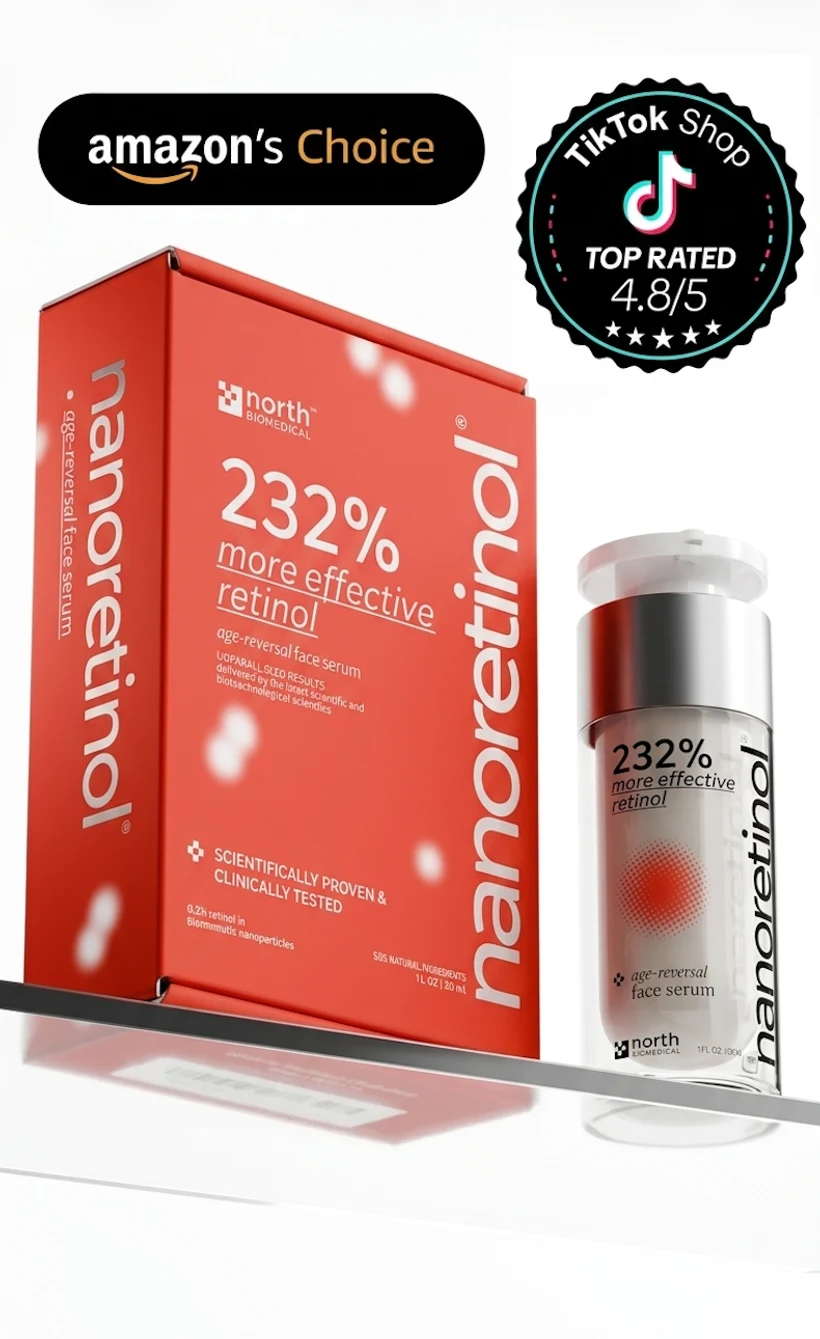
Nanoretinol encapsulates 0.2% retinol inside biomimetic lipid nanoparticles that the body recognises as self and admits through the barrier intact, using the same nanotechnology class as modern drug delivery systems. Against conventional retinol it proved 232% more effective in collagen recovery and 73% more effective in elastin recovery, with drastically reduced cytotoxicity and milder side effects [8]. For anyone maintaining a procedure result, or deciding they would rather not book one at all, that combination is the point.
Choosing Between Them
If you have deep atrophic scars, significant photodamage, fair skin, and the ability to hide for a week, ablative fractional laser will do more per session than anything else on this list. If your skin is medium to deep in tone, if your concern is texture and early laxity rather than deep scarring, or if the recovery window is the binding constraint, microneedling gives you most of the remodelling with a fraction of the pigmentation risk. Radiofrequency microneedling is the reasonable middle, and the split-face evidence increasingly supports treating it as a genuine alternative rather than a compromise.
Whichever you pick, the result is a head start, not a finish line. What you apply on the two hundred nights between appointments decides how much of it you keep.
References
- El-Domyati M, Barakat M, Awad S, Medhat W, El-Fakahany H, Farag H. “Multiple microneedling sessions for minimally invasive facial rejuvenation: an objective assessment.” International Journal of Dermatology. 2015;54(12):1361-1369. doi:10.1111/ijd.12761
- Orringer JS, Kang S, Johnson TM, Karimipour DJ, Hamilton T, Hammerberg C, et al. “Connective tissue remodeling induced by carbon dioxide laser resurfacing of photodamaged human skin.” Archives of Dermatology. 2004;140(11):1326-1332. doi:10.1001/archderm.140.11.1326
- Agrawal K, Belgaumkar VA, Chavan RB, Pradhan SN. “Evaluating the Pros and Cons of Fractional CO2 Laser Versus Microneedling in Atrophic Acne Scars in the Skin of Color: A Split Face Study.” Indian Dermatology Online Journal. 2024;15(6):942-948. doi:10.4103/idoj.idoj_96_24
- Hendel K, Karmisholt K, Hedelund L, Haedersdal M. “Fractional CO2-laser versus microneedle radiofrequency for acne scars: A randomized, single treatment, split-face trial.” Lasers in Surgery and Medicine. 2023;55(4):335-343. doi:10.1002/lsm.23655
- Qu L, Sha S, He C, Chen HD, Wu Y. “Comparison of Non-insulated Microneedle Fractional Radiofrequency and Ablative Fractional Carbon Dioxide Laser for the Treatment of Facial Atrophic Acne Scarring: A Pilot Randomized Split-face Clinical Study.” Acta Dermato-Venereologica. 2025;105:adv43611. doi:10.2340/actadv.v105.43611
- Chan HHL, Manstein D, Yu CS, Shek S, Kono T, Wei WI. “The prevalence and risk factors of post-inflammatory hyperpigmentation after fractional resurfacing in Asians.” Lasers in Surgery and Medicine. 2007;39(5):381-385. doi:10.1002/lsm.20512
- Griffiths CEM, Russman AN, Majmudar G, Singer RS, Hamilton TA, Voorhees JJ. “Restoration of collagen formation in photodamaged human skin by tretinoin (retinoic acid).” New England Journal of Medicine. 1993;329(8):530-535. doi:10.1056/NEJM199308193290803
- North Biomedical LLC. “Nanoretinol vs. Conventional Retinol: Efficacy in Collagen and Elastin Recovery.” Clinical Study Summary, 2024. Study summary