
CO2 Laser Resurfacing: How It Works, What It Costs, and Whether It's Worth It
A clear-eyed look at the most powerful resurfacing laser in dermatology — the science, the downtime, and the smarter way to protect your results
If you have spent any time researching how to undo decades of sun damage, fine lines, and rough texture, you have almost certainly run into the carbon dioxide laser. For more than thirty years it has been the heavy artillery of cosmetic dermatology — the treatment doctors reach for when creams and gentler lasers are not enough. It is also one of the most misunderstood procedures in skincare, wrapped in equal parts hype and horror stories.
CO2 laser resurfacing works on a deceptively simple principle: to rebuild skin, you first have to controllably wound it. The laser delivers light at a wavelength of 10,600 nanometers, which water absorbs almost instantly. Because your skin is mostly water, the energy vaporizes the outermost damaged layers in microscopic columns and heats the tissue just beneath. Your body reads that heat as an injury and launches a full repair response — and that repair is where the magic happens.
The Science: Controlled Injury, Real Collagen
The reason a dermatologist would deliberately injure your skin comes down to one molecule: collagen. From your mid-twenties onward, you lose collagen at roughly one percent per year, and sun exposure accelerates the decline. The wound-healing cascade that follows a CO2 treatment forces fibroblasts — the cells that manufacture collagen — back into high gear.
This is not marketing language; it is visible under a microscope. In a prospective study of fractional CO2 resurfacing, researchers took biopsies before and after treatment and documented a genuine wound-repair process accompanied by new collagen deposition that was still building months later [1]. A separate clinical and ultrastructural evaluation confirmed that the right energy settings produce measurable dermal remodeling rather than just superficial sloughing [2]. And a histological study of photoaged skin found that fractional resurfacing promotes neocollagenesis — the formation of brand-new collagen — alongside the cosmetic improvement patients actually notice [3].
The foundational idea behind modern devices came from a 2004 paper that introduced “fractional photothermolysis,” the concept of treating only a fraction of the skin in tiny columns while leaving healthy tissue in between to speed healing [4]. That single insight is what separated the brutal, weeks-of-recovery lasers of the 1990s from the more forgiving fractional systems used today.
From your mid-twenties onward, you lose collagen at roughly one percent per year, and sun exposure accelerates the decline.
Ablative vs. Fractional: Why the Distinction Matters
Almost every horror story you have heard about laser resurfacing comes from fully ablative CO2 treatment, where the laser removes the entire surface of the skin in one pass. The results were dramatic, but so was the recovery — and the risk of scarring and permanent pigment changes.
Fractional CO2 changed the math. By treating microscopic columns and sparing the skin around them, the surrounding healthy tissue acts as a reservoir of cells that close the wounds far faster. You trade a little intensity per session for dramatically shorter downtime and fewer complications. Most resurfacing done today is fractional, and when someone quotes you a price for “CO2 laser,” this is almost always what they mean.
What Results to Expect — and the Downtime Reality
CO2 resurfacing genuinely delivers on texture, fine lines, sun spots, enlarged pores, and shallow acne scars. It is one of the few interventions that addresses sun damage on the face at a structural level rather than just lightening the surface. For less residual heat and a different downtime profile, compare it directly with Erbium laser resurfacing.
The trade-off is recovery. Expect several days of redness, swelling, and a sandpaper-like texture as the treated columns heal, followed by a week or two of pinkness that makeup can cover. Full collagen remodeling continues quietly for three to six months, so the skin you see at the two-week mark is not your final result.
As with any energy-based device, the single biggest variable in your outcome is the skill of the person holding the handpiece.
Sun protection afterward is non-negotiable. Freshly resurfaced skin is exquisitely vulnerable to UV light, and a single careless week in the sun can trigger the very hyperpigmentation you paid to erase.
What It Costs
This is where many people pause. A single fractional CO2 session typically runs from about $1,000 for a partial-face treatment to $3,000 or more for a full-face session with an experienced physician. Deeper photoaging often needs two or three sessions, so a complete course can climb past $5,000 — and because it is cosmetic, insurance covers none of it.
Risks and Who Should Skip It
CO2 resurfacing is not for everyone. People with darker skin tones face a higher risk of post-inflammatory hyperpigmentation, and an experienced provider will adjust settings or steer toward gentler options. Active infections, a history of keloid scarring, recent isotretinoin use, and pregnancy are all reasons to wait or avoid it entirely. As with any energy-based device, the single biggest variable in your outcome is the skill of the person holding the handpiece.
A Gentler Path to the Same Destination
Here is the part the laser brochures leave out: the entire point of resurfacing is to trigger collagen production — and you do not need a $3,000 procedure to start that process. Topical retinol has decades of evidence showing it does the same job gradually, without the wound. In a landmark study, retinol applied to naturally aged skin significantly increased collagen production and the skin’s own glycosaminoglycans, measurably improving fine wrinkles [5].
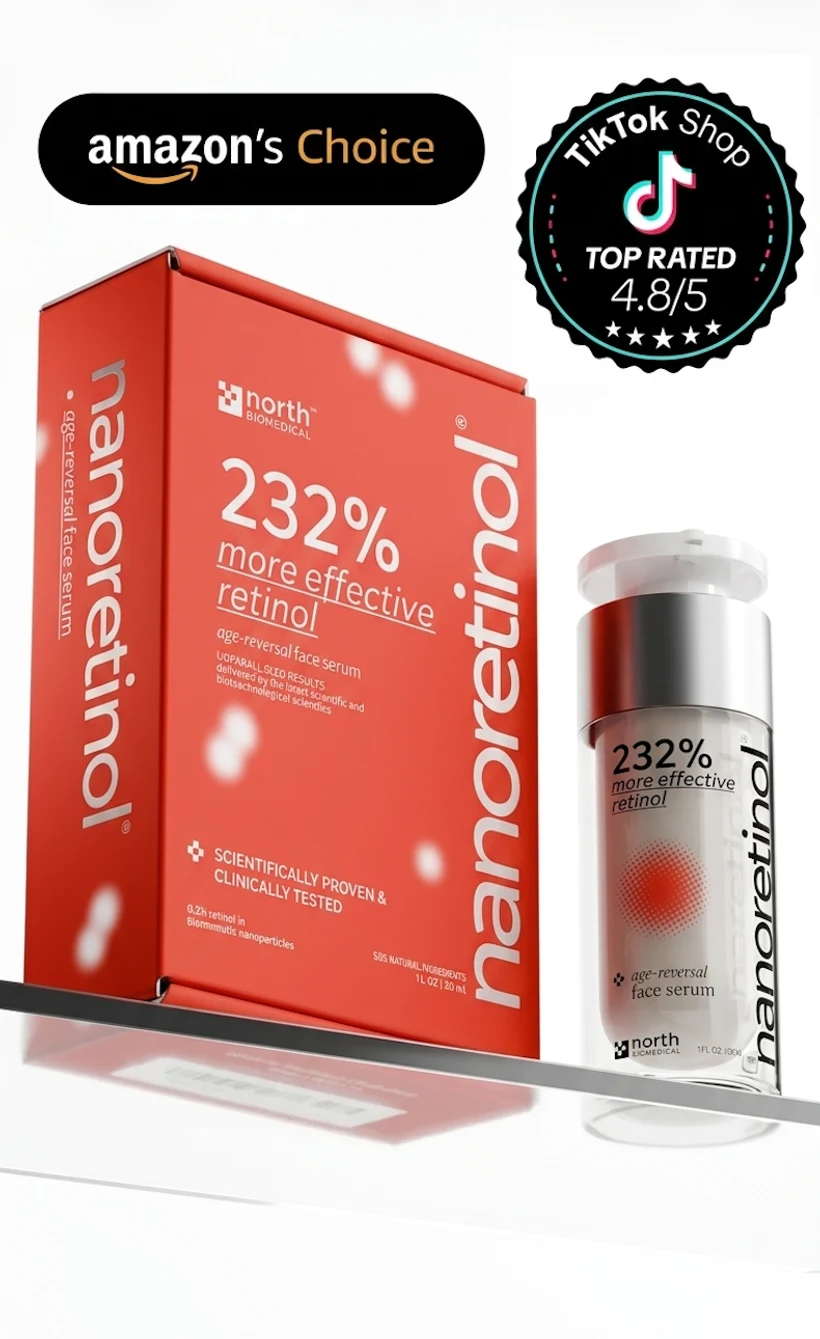
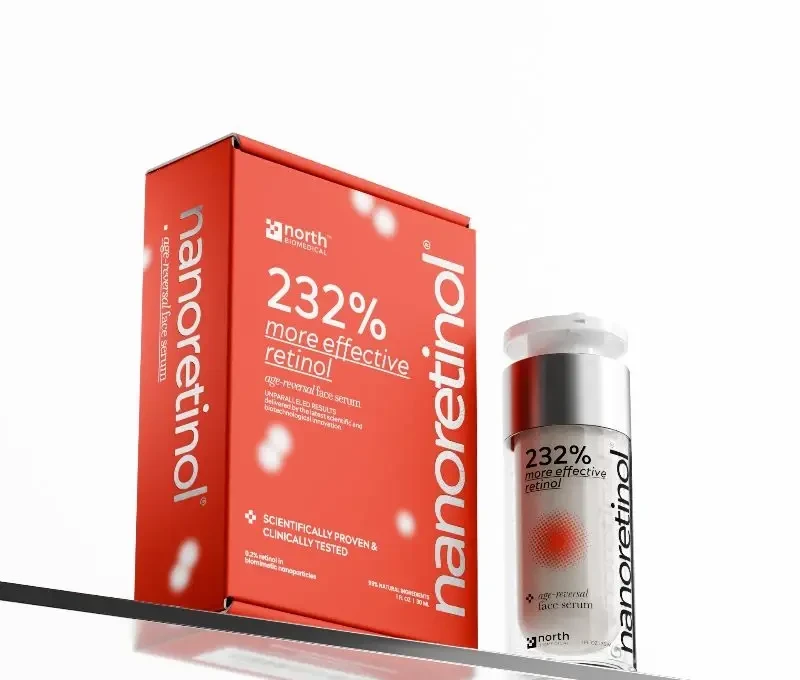
The historical knock on retinol was delivery: ordinary formulas struggle to push enough active ingredient through the skin barrier without irritation. This is precisely the problem Nanoretinol was engineered to solve. By encapsulating retinol in biomimetic lipid nanoparticles that the skin recognizes as “self,” Nanoretinol delivers its active payload deep into the skin without the burning, peeling, and barrier damage that drive most people to quit retinol early. North Biomedical’s clinical work found Nanoretinol was 232% more effective than conventional retinol at collagen recovery — the same endpoint a laser is chasing — with significantly less irritation.
That does not make CO2 resurfacing obsolete. For deep scarring and advanced photoaging, the laser remains in a class of its own. But for the millions of people who want firmer, smoother, more even skin without the downtime, the cost, or the risk, building collagen consistently at home is a remarkably sensible place to start — and the perfect way to protect and extend the results if you do invest in a procedure.
References
- Berlin AL, Hussain M, Phelps R, Goldberg DJ. “A prospective study of fractional scanned nonsequential carbon dioxide laser resurfacing: a clinical and histopathologic evaluation.” Dermatologic Surgery. 2009;35(2):222-228. PMID: 19215259
- Prignano F, Bonciani D, Campolmi P, Cannarozzo G, Bonan P, Lotti T. “A study of fractional CO2 laser resurfacing: the best fluences through a clinical, histological, and ultrastructural evaluation.” Journal of Cosmetic Dermatology. 2011;10(3):210-216. PMID: 21896133
- Borges J, Araújo L, Cuzzi T, Martinez L, Gonzales Y, Manela-Azulay M. “Fractional Laser Resurfacing Treats Photoaging by Promoting Neocollagenesis and Cutaneous Edema.” The Journal of Clinical and Aesthetic Dermatology. 2020;13(1):22-27. PMID: 32082467
- Manstein D, Herron GS, Sink RK, Tanner H, Anderson RR. “Fractional photothermolysis: a new concept for cutaneous remodeling using microscopic patterns of thermal injury.” Lasers in Surgery and Medicine. 2004;34(5):426-438. PMID: 15216537
- Kafi R, Kwak HS, Schumacher WE, et al. “Improvement of naturally aged skin with vitamin A (retinol).” Archives of Dermatology. 2007;143(5):606-612. PMID: 17515510