Puffy Eyes: Why They Happen and How to Actually De-Puff
The real causes of under-eye puffiness — fluid, fat, and thinning skin — and what genuinely reduces it after 40
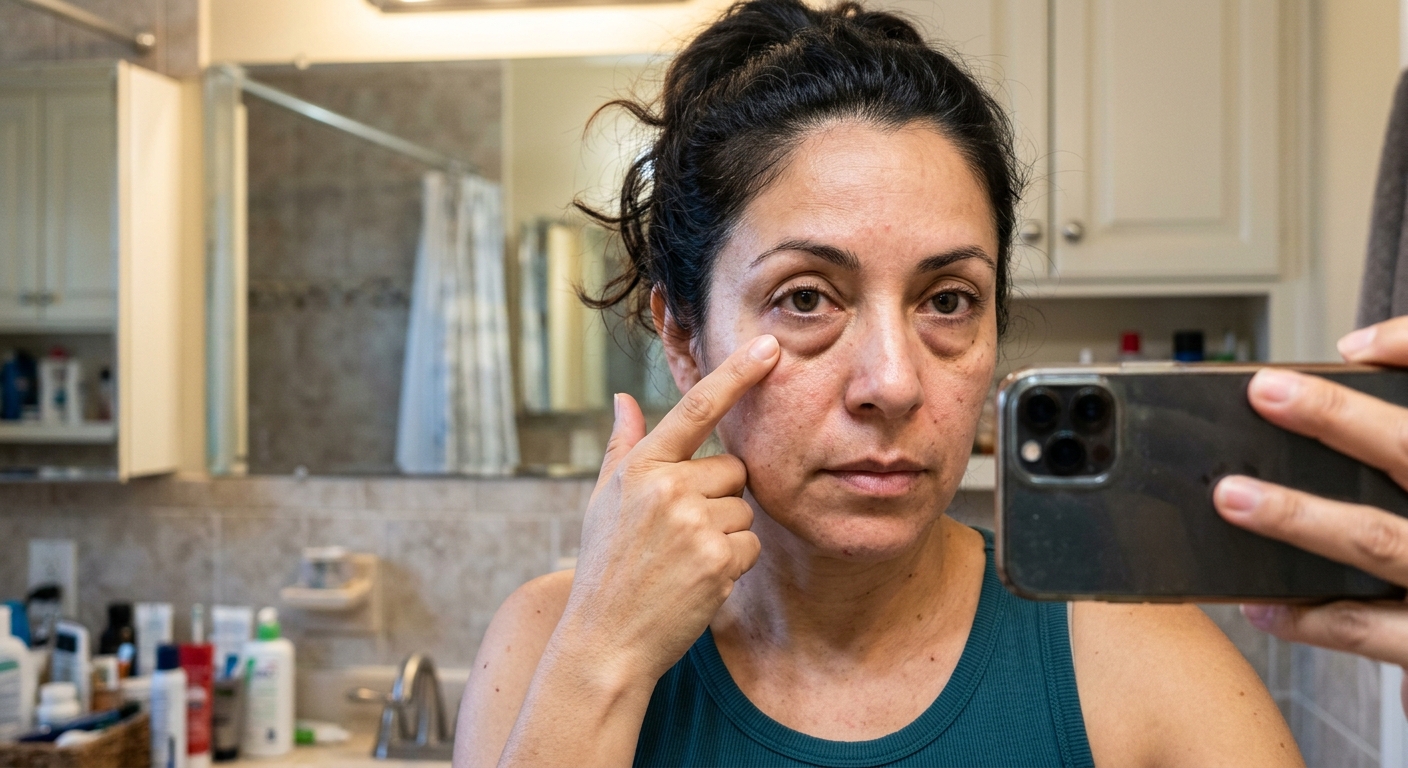
You catch your reflection at 7 a.m. and your eyes look swollen, heavy, almost like you didn’t sleep — even though you did. By mid-morning it has mostly settled. If that pattern sounds familiar, you have puffy eyes, and you are far from alone: “puffy eyes” and its close cousins are searched hundreds of thousands of times a month, overwhelmingly by women noticing the change sometime after 40.
The frustrating part is that most advice treats puffy eyes as one problem with one fix. It isn’t. Puffiness around the eyes comes from at least three separate mechanisms, and a remedy that works beautifully for one does almost nothing for another. Understanding which kind of puffiness you have is the difference between a routine that works and a drawer full of gadgets that don’t.
Puffiness Is Not the Same as Bags or Dark Circles
First, a quick untangling, because these terms get used interchangeably and they shouldn’t be. Dark circles are a color problem — pigment or shadow making the under-eye look darker. Eye bags are usually a structural bulge that’s there all day. Puffiness is the swollen, slightly inflated look that tends to fluctuate, often worse in the morning and better by afternoon.
If your main concern is the discoloration, our guide to dark circles under the eyes is the better starting point, and if your issue is a fixed bulge, see eye bags. This article is about the puffiness itself. Once you know which mechanism you are dealing with, our guide to the best eye cream for puffy eyes covers what to buy for it.
The First Cause: Overnight Fluid
The most common reason eyes look puffy in the morning is simple fluid. When you lie flat for hours, fluid that gravity would normally pull downward during the day pools in the loose, low-pressure tissue around the eyes. The skin here is the thinnest on the entire body, so even a small amount of retained fluid shows up dramatically.
You catch your reflection at 7 a.m. and your eyes look swollen, heavy, almost like you didn’t sleep — even though you did.
This fluid has to drain somewhere, and it leaves through the lymphatic system. Imaging studies that tracked where eyelid lymph actually goes found it drains predominantly toward the preauricular nodes — the lymph nodes just in front of your ears [1]. When that drainage is sluggish, or when you’ve given your body more fluid to deal with (a salty dinner, alcohol, crying, allergies, or hormonal shifts), the morning puffiness is worse.
This is the kind of puffiness that responds to the “boring” advice, which happens to be the advice that works: sleeping with your head slightly elevated, easing off late-night salt and alcohol, managing allergies, and a few minutes of gentle downward-and-outward massage to nudge fluid toward those drainage points. A cold compress helps too, because cold temporarily constricts small blood vessels and reduces the swollen look. If facial puffiness in general is your issue, not just the eyes, our piece on how to de-bloat your face goes deeper.
The Second Cause: Age-Related Fat
The second mechanism is the one that creeps in with age and doesn’t drain away by lunchtime. Behind your eyes sit small fat pads that cushion the eyeball. With age, these pads tend to push forward — herniate — and create a more permanent bulge.
This isn’t speculation. A CT study of 167 patients measured lower-eyelid fat herniation and found it increases steadily from the third decade of life onward, accelerating later in life [2]. Intriguingly, the driver isn’t simply gaining fat. Research on the bony orbit — the eye socket itself — shows that as the rim of the socket lowers and changes angle with age, it mechanically pushes the fat pads forward [3]. Other work found that even when total orbital fat volume starts to decline around 60, the proportion sitting in the visible, forward position keeps rising [4].
The honest takeaway: true age-related fat herniation is a structural change. No cream, roller, or chilled spoon removes it, and anyone promising otherwise is selling hope. This is the type of under-eye change that, if it genuinely bothers you, is addressed by a dermatologist or oculoplastic surgeon. Knowing this saves you money and disappointment.
It delivers a fully stabilized 0.2% retinol encapsulated in biomimetic lipid nanoparticles that the skin recognizes as “self” and lets through — no barrier disruption required.
The Third Cause: Thinning, Crepey Skin
The third factor is subtler but very treatable, and it’s where skincare earns its keep. As the skin around the eyes loses collagen and elastin, it thins and becomes lax and crepey. Thinner, looser skin both holds onto fluid more visibly and drapes more loosely over any underlying bulge — so it makes the other two causes look worse than they otherwise would.
Collagen loss here is not gradual background noise; it accelerates with hormonal change. A classic study measuring skin thickness in postmenopausal women found that collagen content declined in step with menopausal age rather than chronological age, and was preserved in women receiving sex hormones [5]. That’s why so many women notice their under-eye skin change rather suddenly in their late 40s and 50s.
Improving skin quality here genuinely changes how puffy the area looks. The most evidence-backed topical actives for thin, crepey periorbital skin are retinoids and peptides. In a 12-week randomized controlled trial, a stabilized retinoid significantly reduced periorbital wrinkles, outperforming both placebo and conventional retinol [6]. Peptides have their own controlled data: a split-face study found a palmitoyl pentapeptide significantly reduced fine lines and wrinkles versus placebo [7]. Topical caffeine is also worth a place — it penetrates the skin, boosts local microcirculation, and inhibits an enzyme called phosphodiesterase, the mechanistic basis for its near-universal presence in de-puffing eye products [8]. For more on the active that does the heavy lifting here, see retinol around the eyes and crepey eyelids.
Where a Gentler Retinoid Fits
Here’s the catch with retinoids around the eyes: the skin is delicate, and conventional retinol — which works partly by disrupting the skin barrier — often leaves the eye area red, flaky, and irritated. Many women try it once, react badly, and abandon the one ingredient class with the strongest evidence for thin, crepey skin.
This is the problem Nanoretinol was built to solve. It delivers a fully stabilized 0.2% retinol encapsulated in biomimetic lipid nanoparticles that the skin recognizes as “self” and lets through — no barrier disruption required. In testing, that delivery system proved significantly gentler and less cytotoxic than conventional retinol, with clinical side effects that were minimal and milder when present at all, and it is gentle enough for the eye contour. On the efficacy side, the encapsulated delivery showed 232% greater collagen recovery and 73% greater elastin recovery than conventional retinol, with a 61% increase in skin firmness and 56% increase in elasticity over 56 days of use.
To be clear about what that does and doesn’t do: firmer, thicker, more elastic skin makes the eye area look smoother and less crepey, and it stops thin skin from exaggerating fluid and bulges. It does not drain fluid or remove herniated fat. Matched to the right cause, though, it’s the most useful thing a serum can offer this region.
Putting It Together
Look at your own pattern before you buy anything. Morning-only puffiness that fades by afternoon is fluid — fix sleep, salt, allergies, and drainage. A fixed bulge that’s there all day is structural fat — a conversation for a professional. Crepey, papery skin that makes everything look worse is the part skincare can actually firm, and a gentle retinoid is the tool with the evidence behind it. Most people over 40 have some mix of all three, which is exactly why no single trick ever seemed to fully work.
References
- Nijhawan N, Marriott C, Harvey JT. “Lymphatic Drainage Patterns of the Human Eyelid: Assessed by Lymphoscintigraphy.” Ophthalmic Plastic and Reconstructive Surgery. 2010;26(4):281-285. doi:10.1097/IOP.0b013e3181c32e57
- Chen YS, Tsai TH, Wu ML, Chang KC, Lin TW. “Evaluation of Age-Related Intraorbital Fat Herniation through Computed Tomography.” Plastic and Reconstructive Surgery. 2008;122(4):1191-1198. doi:10.1097/PRS.0b013e318185d370
- Kim SJ, Kim HJ, Choi YJ, et al. “Ageing of the Bony Orbit Is a Major Cause of Age-Related Intraorbital Fat Herniation.” Journal of Plastic, Reconstructive & Aesthetic Surgery. 2018;71(5):658-664. doi:10.1016/j.bjps.2017.11.029
- Lee JM, Lee H, Park M, Lee TE, Lee YH, Baek S. “The Volumetric Change of Orbital Fat With Age in Asians.” Annals of Plastic Surgery. 2011;66(2):192-195. doi:10.1097/SAP.0b013e3181e6d052
- Brincat M, Moniz CJ, Studd JW, et al. “Long-Term Effects of the Menopause and Sex Hormones on Skin Thickness.” British Journal of Obstetrics and Gynaecology. 1985;92(3):256-259. doi:10.1111/j.1471-0528.1985.tb01091.x
- Kim H, Kim N, Jung S, et al. “Improvement in Skin Wrinkles From the Use of Photostable Retinyl Retinoate: A Randomized Controlled Trial.” British Journal of Dermatology. 2010;162(3):497-502. doi:10.1111/j.1365-2133.2009.09483.x
- Robinson LR, Fitzgerald NC, Doughty DG, Dawes NC, Berge CA, Bissett DL. “Topical Palmitoyl Pentapeptide Provides Improvement in Photoaged Human Facial Skin.” International Journal of Cosmetic Science. 2005;27(3):155-160. doi:10.1111/j.1467-2494.2005.00261.x
- Herman A, Herman AP. “Caffeine’s Mechanisms of Action and Its Cosmetic Use.” Skin Pharmacology and Physiology. 2013;26(1):8-14. doi:10.1159/000343174