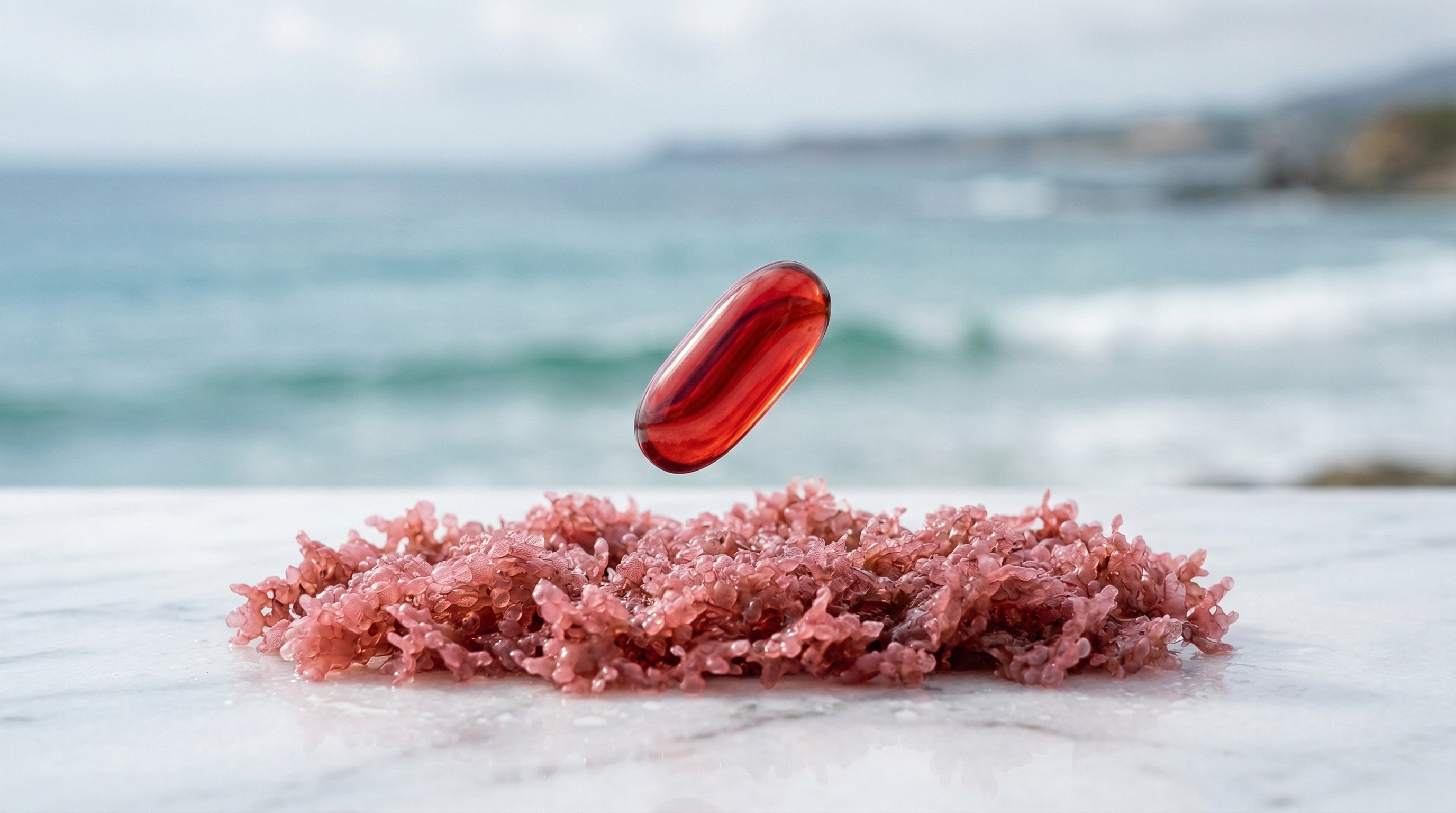
Astaxanthin for Skin: Why This Marine Antioxidant Is 6,000× Stronger Than Vitamin C
The clinical evidence behind astaxanthin's effects on wrinkles, UV protection, and skin moisture
What Is Astaxanthin and Where Does It Come From?
Astaxanthin is a xanthophyll carotenoid — the same family of pigments that gives salmon its pink color, flamingos their blush, and lobster shells their red hue. But unlike beta-carotene or lycopene, astaxanthin has a molecular structure that allows it to span the entire width of a cell membrane, positioning itself to neutralize free radicals on both the water-soluble and fat-soluble sides simultaneously [1].
The richest natural source is the freshwater microalga Haematococcus pluvialis, which accumulates astaxanthin as a survival mechanism when stressed by UV light, nutrient depletion, or high salinity. The same molecule that protects a single-celled alga from oxidative destruction has become one of the most studied antioxidants in skin science [2].
In laboratory comparisons of singlet oxygen quenching — the ability to neutralize one of the most damaging reactive oxygen species generated by UV exposure — astaxanthin proved approximately 6,000 times more active than vitamin C, 800 times more active than CoQ10, and 550 times more active than green tea catechins [3]. These numbers come from a specific assay measuring singlet oxygen neutralization in solution, not a general antioxidant ranking. But they explain why astaxanthin has attracted serious clinical attention.
How Astaxanthin Reaches and Protects Your Skin
Unlike many antioxidants that struggle with bioavailability, astaxanthin has a clear path from ingestion to skin. After oral supplementation, astaxanthin is absorbed from the small intestine, transported via lipoproteins in plasma and erythrocytes, and accumulates in the skin — including both the epidermis and dermis [1].
This accumulation is what makes astaxanthin unusual among oral supplements marketed for skin health. Many oral antioxidants are metabolized extensively in the liver, leaving minimal concentrations available for cutaneous tissue. Astaxanthin’s lipophilic structure and resistance to metabolic breakdown mean it reaches the skin in bioactive form [4].
Once in the skin, astaxanthin works through multiple mechanisms: it quenches singlet oxygen and scavenges free radicals generated by UV exposure; it modulates inflammatory mediators (including NF-κB and IL-6) that contribute to matrix degradation; and it supports membrane stability in keratinocytes and fibroblasts by integrating into lipid bilayers [1][2].
What Clinical Trials Show About Astaxanthin and Skin Aging
The clinical evidence for astaxanthin in skin aging is stronger than most supplement ingredients, though still limited in scale. A 2021 systematic review and meta-analysis examined eleven human studies — nine randomized controlled trials and two open-label prospective studies — and found statistically significant effects [5].
The meta-analysis reported that oral astaxanthin supplementation significantly improved skin moisture content (SMD = 0.53, p = 0.03) and elasticity (SMD = 0.77, p = 0.009) compared to placebo. The effect on wrinkle depth showed a trend toward improvement but did not reach statistical significance (SMD = −0.26, p = 0.11) [5].
In one of the key studies, Tominaga et al. (2012) conducted an open-label trial with 28 women showing that combined oral (6 mg/day) and topical astaxanthin application for eight weeks reduced wrinkle depth, decreased age spot size, and improved skin elasticity, texture, and moisture content [6].
Astaxanthin as Internal Sunscreen: The UV Protection Evidence
Perhaps the most intriguing clinical finding involves astaxanthin’s ability to protect skin from UV damage when taken orally — functioning as a kind of internal photoprotection.
The richest natural source is the freshwater microalga Haematococcus pluvialis, which accumulates astaxanthin as a survival mechanism when stressed by UV light, nutrient depletion, or high salinity.
In a 2018 randomized, double-blind, placebo-controlled trial, Ito et al. studied 23 healthy Japanese participants who took 4 mg of astaxanthin daily for nine weeks. The astaxanthin group showed an increased minimal erythema dose (MED) — meaning their skin required more UV exposure to produce redness — compared to placebo. The supplemented group also experienced reduced loss of skin moisture in UV-irradiated areas [7].
This does not mean astaxanthin replaces sunscreen. The effect is modest compared to topical UV filters. But it suggests that oral astaxanthin may complement external sun protection by reducing the oxidative cascade that UV radiation triggers within the skin. For women over 40 whose cumulative sun damage is already significant, this additive protection has practical value.
How Astaxanthin Compares to Other Skin Antioxidants
The antioxidant landscape in skincare is crowded — vitamin C, vitamin E, resveratrol, CoQ10, green tea extract, and now astaxanthin all compete for attention. How does astaxanthin actually compare?
Versus Vitamin C: Vitamin C (L-ascorbic acid) is the gold standard topical antioxidant for skin. It directly stimulates collagen synthesis through a mechanism independent of its antioxidant activity, and it inhibits melanin production. Astaxanthin does not replicate these benefits — its value is in oxidative protection, not collagen gene activation. The two are complementary, not interchangeable.
Versus CoQ10: Both are lipid-soluble antioxidants that integrate into cell membranes. Astaxanthin has significantly higher singlet oxygen quenching capacity in laboratory assays [3]. However, CoQ10 plays a direct role in mitochondrial energy production that astaxanthin does not replicate.
Versus Retinol: This comparison matters most for readers deciding where to allocate their skincare budget. Retinol directly upregulates collagen gene expression through retinoic acid receptor activation — a mechanism fundamentally different from antioxidant protection. Astaxanthin protects against the oxidative damage that degrades collagen; retinol tells fibroblasts to make more of it. A strategy that includes both addresses aging from two directions simultaneously.
Oral Supplements vs. Topical Application: Which Works Better?
The 2021 meta-analysis noted that oral supplementation appears to produce more sustained and pronounced effects on skin parameters compared to topical application alone [5]. This makes biological sense — oral astaxanthin distributes systemically and accumulates in the skin over time, while topical application must contend with the stratum corneum barrier.
However, two open-label studies suggested that combining oral and topical astaxanthin produced the strongest results [5][6]. The oral route provides systemic antioxidant levels in dermal tissue, while the topical route adds surface-level protection.
Typical clinical doses in positive studies range from 4–12 mg per day, with most using 6 mg daily. Effects typically become measurable after 6–8 weeks of consistent supplementation [5].
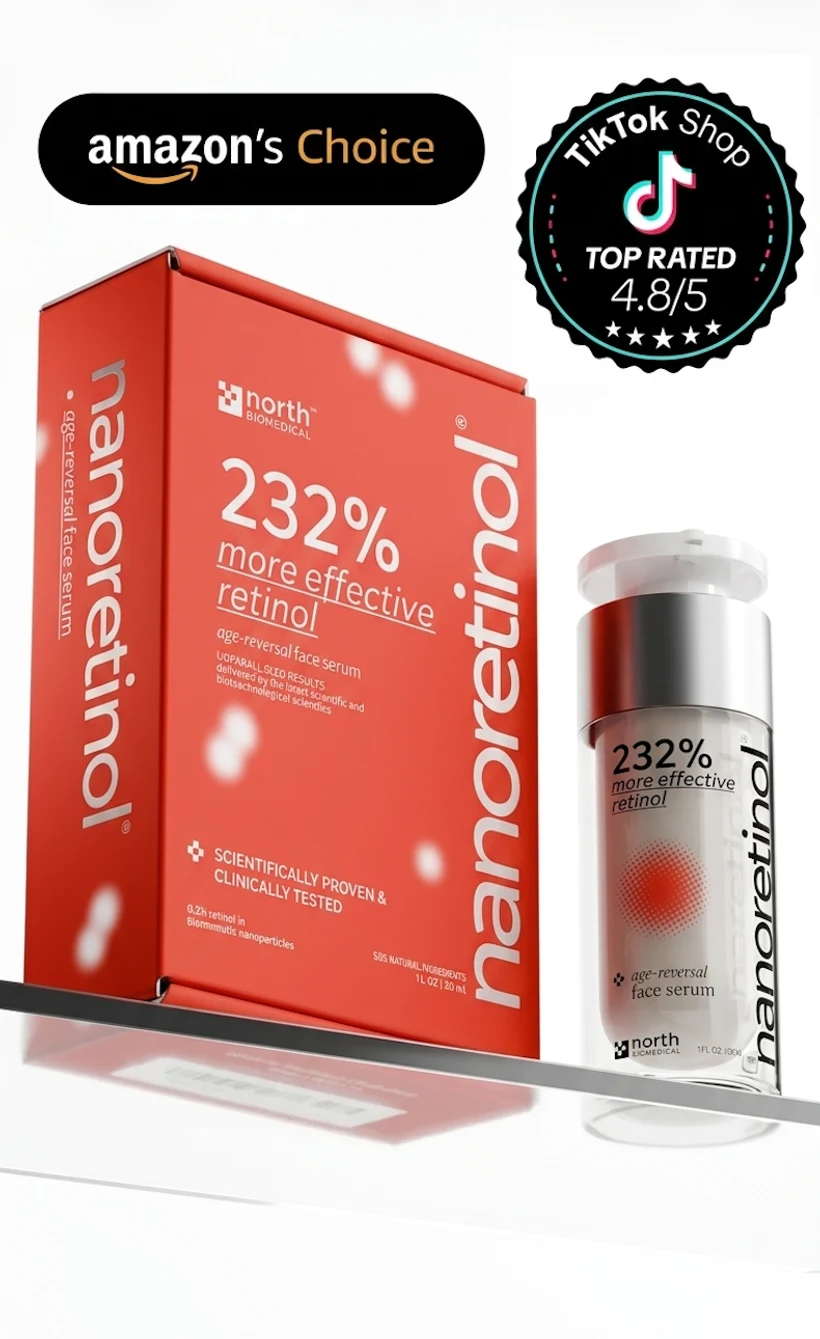
Nanoretinol® delivers retinol via biomimetic lipid nanoparticles that bypass the epithelial barrier, achieving 232% greater collagen recovery than conventional formulations at the same concentration.
One important caveat: the reliability of the evidence is limited by small sample sizes (most studies had 20–40 participants), imperfect study designs, and potential conflicts of interest — several studies were funded by astaxanthin manufacturers [5]. More large-scale, independent trials are needed before astaxanthin can be recommended with the same confidence as retinol or vitamin C.
Building an Anti-Aging Strategy That Includes Astaxanthin
Astaxanthin is best understood as one layer in a multi-component approach to skin aging — not a replacement for proven topical actives.
A science-informed strategy might include:
Topical retinol for direct collagen stimulation and cell turnover. Nanoretinol® delivers retinol via biomimetic lipid nanoparticles that bypass the epithelial barrier, achieving 232% greater collagen recovery than conventional formulations at the same concentration [8]. This addresses the structural side of aging — rebuilding what has been lost.
Topical vitamin C in the morning for photoprotection and melanin inhibition.
Oral astaxanthin (4–6 mg daily) for systemic antioxidant protection — reducing the oxidative damage that degrades collagen, elastin, and ceramides faster than the body can replace them.
Daily sunscreen remains non-negotiable. No antioxidant — oral or topical — replaces broad-spectrum UV protection.
This layered approach targets aging through different mechanisms: retinol rebuilds, vitamin C protects and brightens, astaxanthin reduces systemic oxidative load, and sunscreen prevents the primary source of extrinsic damage. Each ingredient addresses a gap the others leave open.
The Takeaway on Astaxanthin for Skin
Astaxanthin has earned its reputation as a serious antioxidant with genuine clinical backing for skin health. The evidence for improved moisture and skin elasticity is statistically significant across multiple trials. The UV protection data is promising. The wrinkle reduction evidence is trending positive but not yet conclusive.
It is not a miracle ingredient — no single molecule is. But as part of an evidence-based approach to skin aging that combines proven topicals like retinol and vitamin C with internal antioxidant support, astaxanthin fills a gap that most skincare routines leave unaddressed. The strongest version of your anti-aging strategy is one that works from the outside in and the inside out.
References
-
Davinelli S, Nielsen ME, Scapagnini G. “Astaxanthin in Skin Health, Repair, and Disease: A Comprehensive Review.” Nutrients. 2018;10(4):522. doi:10.3390/nu10040522
-
Zhou X, Cao Q, Orfila C, Zhao J, Zhang L. “Systematic Review and Meta-Analysis on the Effects of Astaxanthin on Human Skin Ageing.” Nutrients. 2021;13(9):2917. doi:10.3390/nu13092917
-
Nishida Y, Yamashita E, Miki W. “Quenching Activities of Common Hydrophilic and Lipophilic Antioxidants against Singlet Oxygen Using Chemiluminescence Detection System.” Carotenoid Science. 2007;11:16-20. Available at Cyanotech
-
Ambati RR, Phang SM, Ravi S, Aswathanarayana RG. “Astaxanthin: sources, extraction, stability, biological activities and its commercial applications — a review.” Marine Drugs. 2014;12(1):128-152. doi:10.3390/md12010128
-
Zhou X, Cao Q, Orfila C, Zhao J, Zhang L. “Systematic Review and Meta-Analysis on the Effects of Astaxanthin on Human Skin Ageing.” Nutrients. 2021;13(9):2917. doi:10.3390/nu13092917
-
Tominaga K, Hongo N, Karato M, Yamashita E. “Cosmetic benefits of astaxanthin on humans subjects.” Acta Biochimica Polonica. 2012;59(1):43-47. PMID: 22428137
-
Ito N, Seki S, Ueda F. “The Protective Role of Astaxanthin for UV-Induced Skin Deterioration in Healthy People — A Randomized, Double-Blind, Placebo-Controlled Trial.” Nutrients. 2018;10(7):817. doi:10.3390/nu10070817
-
North Biomedical LLC. “Nanoretinol® vs. Conventional Retinol: Efficacy in Collagen and Elastin Recovery.” Clinical Study Summary, 2024.