How to Improve Skin Elasticity: What the Science Says Actually Works
Why skin loses its snap after 40 — and the evidence-backed ingredients and habits that genuinely restore it
Yes, skin elasticity can improve, but no topical can fully restore the recoil of younger skin. The strongest at-home evidence supports consistent retinoid use plus daily broad-spectrum sunscreen; moisturizers can make skin feel more supple, while procedures are needed for larger changes in established laxity.
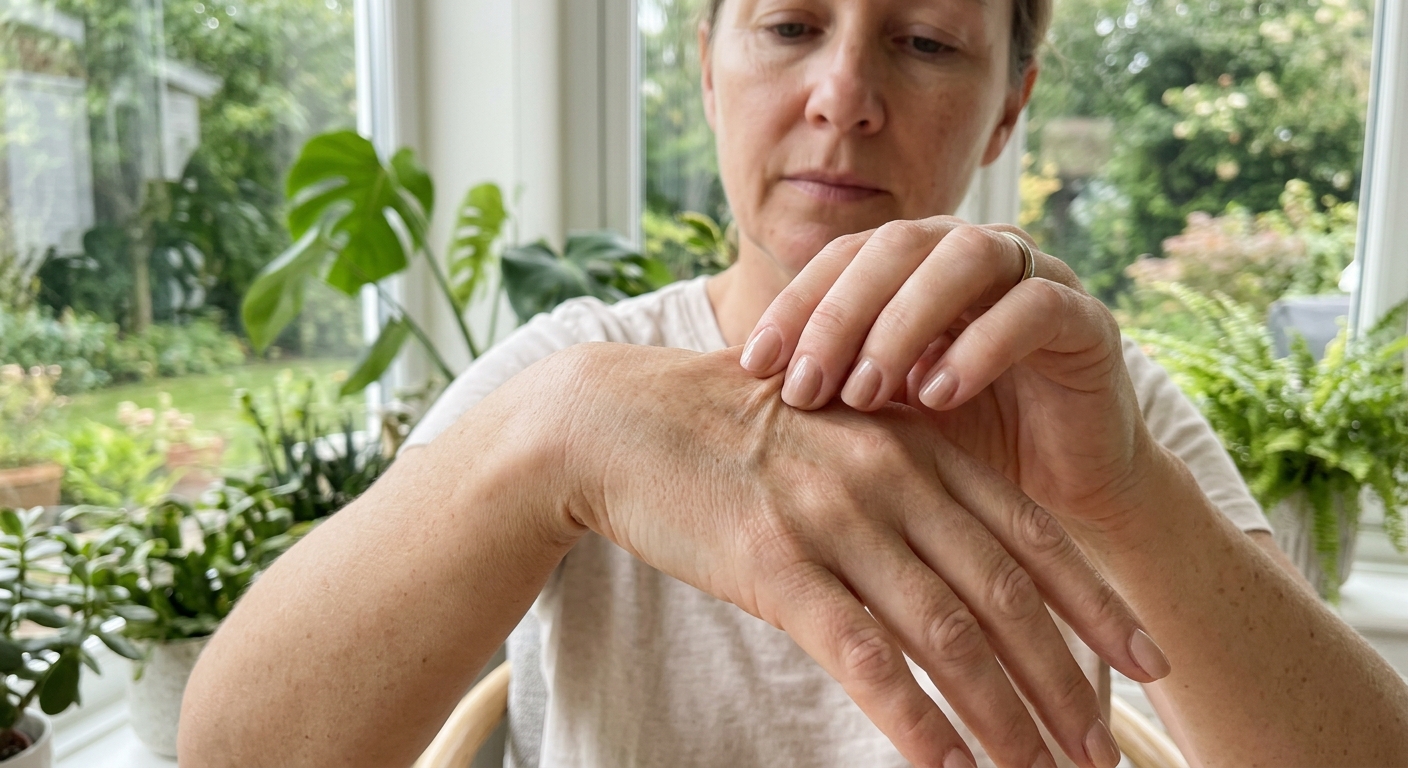
Pull the skin on the back of your hand upward, then let go. If you’re in your 20s, it snaps back instantly. If you’re in your 40s or 50s, there may be a moment of delay before it settles. That simple test captures something real: skin elasticity declines with age, and the change is measurable. The useful question is not whether every “firming” product works, but which mechanism is actually limiting your skin’s recoil.
Why Skin Loses Elasticity After 40
Elasticity comes from two structural proteins: collagen (which provides tensile strength) and elastin (which provides recoil). Think of collagen as the scaffolding and elastin as the springs. Both are produced by fibroblasts in the dermis, and both degrade with age.
From roughly age 25 onward, collagen production declines at approximately 1% per year. Elastin is produced primarily in fetal development and early childhood; the supply in adult skin is largely static. What changes in adulthood is the rate of degradation. UV radiation, inflammation, and glycation all accelerate the breakdown of both proteins, while the fibroblasts responsible for rebuilding them become progressively less active [1].
The extracellular matrix — the scaffolding that holds fibroblasts, collagen, and elastin in organized relationship — also becomes disorganized. Fragmented collagen fibrils accumulate rather than being cleared, and fibroblasts that can no longer feel properly organized ECM stop producing new collagen, creating a feedback loop that accelerates structural decline [1].
By the time the effects are visible — skin that sags rather than bouncing back, a jawline that softens, a neck that creases — the underlying changes have been occurring for years.
Collagen and elastin are not interchangeable
Collagen gives skin tensile strength; elastin lets it stretch and return. Most topical anti-aging evidence concerns collagen because adult skin can still increase collagen synthesis. Mature elastin fibers are harder to replace, so claims that a cream “rebuilds bounce” should be treated more cautiously. A useful plan therefore protects both proteins from UV-driven degradation while using retinoids to support the remodeling pathways with the strongest human evidence [1,4].
This distinction also explains why hydration and structural firming can look similar for a few hours but are not the same outcome. Humectants and occlusives swell the outer skin and soften fine dehydration lines. Retinoids and selected procedures act more slowly on epidermal or dermal structure. The egg white face mask is the clearest example of the short-lived version of firmness.
What Has Solid Clinical Evidence
Topical Retinol
The strongest over-the-counter evidence for improving skin elasticity belongs to retinol. A landmark University of Michigan randomized controlled trial applied 0.4% topical retinol to elderly subjects three times weekly for 24 weeks. The result: significant induction of procollagen type I, restoration of glycosaminoglycans, and measurable improvement in dermal structural organization [2].
A molecular study in naturally aged human skin confirmed that 0.4% retinol increases epidermal thickness and stimulates elastin production — without the level of irritation seen with prescription tretinoin.
Retinol works through nuclear retinoic acid receptors that directly upregulate collagen gene expression while downregulating the matrix metalloproteinases (enzymes that destroy collagen). It also stimulates fibroblast activity. A molecular study in naturally aged human skin confirmed that 0.4% retinol increases epidermal thickness and stimulates elastin production — without the level of irritation seen with prescription tretinoin [4].
A 12-week split-face clinical trial comparing 0.3% and 0.5% retinol serums found significant improvement in skin firmness and elasticity at both concentrations, with minimal tolerability difference between them [3]. The practical takeaway: concentration matters less than most labels imply; consistent use and formulation quality matter more.
Collagen Supplements
The collagen supplement market is enormous, and the evidence is genuinely mixed. A frequently-cited double-blind, placebo-controlled trial in women ages 35–55 found statistically significant improvement in skin elasticity after 8 weeks of specific collagen peptide supplementation (2.5g or 5g daily) vs. placebo [5].
However, a 2025 independent meta-analysis examining the full body of collagen supplement trials found that when controlling for industry funding, statistically significant effects seen in funded studies largely disappear in independent high-quality trials. This doesn’t mean supplements are definitively ineffective — the picture is still being clarified — but the enthusiastic claims in marketing materials are ahead of the independent evidence base.
What isn’t in dispute: consuming adequate dietary protein (which provides the amino acid building blocks for collagen synthesis) is important for skin structure.
The Delivery Problem With Topical Retinol
One underappreciated variable in retinol’s effectiveness is delivery. Standard retinol formulations face two problems: instability (retinol degrades on exposure to light and air before it reaches skin cells) and poor epidermal penetration. Conventional formulations rely on disrupting the skin barrier to deliver retinol deeper — the redness, peeling, and sensitivity many people experience are not incidental side effects; they reflect the delivery mechanism [6].
Encapsulated retinol addresses both problems. Lipid nanoparticle technology can protect retinol from degradation and carry it through the epithelial barrier without the destructive mechanism, significantly extending retinol half-life and substantially reducing irritation compared to conventional formulations [6].
Nanoretinol uses biomimetic lipid nanoparticles that are recognized as “self” by skin cells, allowing passage through the barrier intact. Clinical results include a +56% increase in skin elasticity and a +61% increase in skin firmness after 56 days of use — outcomes that exceed what clinical trials of conventional 0.4–0.5% retinol typically report, at a lower stated concentration (0.2%).
What Gets a Lot of Attention but Has Weaker Evidence
Facial exercises. There’s limited, low-quality evidence suggesting certain exercises modestly improved fullness in older women in one small trial. The jury is still out, and the evidence doesn’t extend to elasticity specifically.
A 12-week split-face clinical trial comparing 0.3% and 0.5% retinol serums found significant improvement in skin firmness and elasticity at both concentrations, with minimal tolerability difference between them.
Jade rollers and gua sha. These produce temporary increases in circulation and lymphatic drainage, leading to brief visible plumping — but no evidence of lasting structural change to elastin or collagen.
Collagen-boosting supplements beyond collagen peptides (biotin, specific vitamins in megadoses): vitamin C is genuinely required for collagen synthesis — severe deficiency causes structural collapse — but supplementing above adequate levels in people who aren’t deficient doesn’t appear to turbocharge production.
Supporting Ingredients Worth Adding
Retinol works best as part of a layered approach. Ingredients with complementary mechanisms:
Vitamin C is a required cofactor for collagen synthesis and a potent antioxidant that reduces the oxidative stress driving elastin degradation. Vitamin C serum benefits covers the clinical evidence in depth.
Copper peptides both stimulate collagen and elastin production and inhibit the enzymes that break them down. Copper peptides for skin have among the most consistent dermal-remodeling evidence outside of retinoids.
Sunscreen. UV damage is the single most powerful accelerant of elastin and collagen degradation available — vastly outpacing intrinsic aging in sun-exposed skin. Without consistent photoprotection, every other intervention is partially undone. Sunscreen for aging skin details what the clinical evidence shows.
Match the Intervention to the Cause
| What you notice | Likely dominant driver | Most useful first step | What not to expect |
|---|---|---|---|
| Dry, temporarily creased skin | Low water content or barrier disruption | Humectant plus ceramide-rich moisturizer | Permanent tightening |
| Gradual loss of bounce and fine lines | Photoaging and collagen fragmentation | Retinoid plus daily SPF | A visible lift in days |
| Softening after menopause | Accelerated collagen loss plus dryness | Retinoid, barrier support, and clinician discussion when symptoms are broader | A topical substitute for medical care |
| Pronounced jowling or loose skin | Structural laxity involving skin, fat, ligaments, and bone | In-person procedural assessment | A serum reproducing surgery or a device result |
| Concern about supplements | Possible modest effect from specific collagen peptides | Evaluate dose, trial quality, cost, and dietary protein first | Guaranteed firming [5] |
A Practical Protocol
For improving skin elasticity at home, the evidence most clearly supports:
- Topical retinol or Nanoretinol applied nightly, consistently. Results typically appear around 8–12 weeks.
- Broad-spectrum SPF 30+ daily. This is not negotiable if skin quality is the goal.
- Adequate dietary protein (1.2–1.6g/kg body weight for active adults) to support fibroblast synthesis capacity.
- Vitamin C in the morning routine for antioxidant protection and collagen cofactor support.
What to Expect
Skin elasticity can meaningfully improve with consistent retinol use over 3–6 months. You won’t recover the elasticity of a 25-year-old skin, but measurable improvements in firmness, bounce, and skin quality are well within reach based on the clinical evidence. The key variables are consistency of application, photoprotection to prevent ongoing degradation, and the quality of the retinol vehicle being used.
The most common reason retinol fails to produce results: irritation causing users to stop before results develop, and formulation instability reducing the amount of active retinol that actually reaches skin cells. Addressing both — through encapsulated delivery systems that protect stability and eliminate barrier disruption — is where the meaningful advances in this space are occurring.
References
-
Shin SH, Lee YH, Rho N, Park KY. “Skin aging from mechanisms to interventions: focusing on dermal aging.” Frontiers in Physiology. 2023;14:1195272. doi:10.3389/fphys.2023.1195272
-
Kafi R, Kwak HS, Schumacher WE, et al. “Improvement of naturally aged skin with vitamin A (retinol).” Archives of Dermatology. 2007;143(5):606–612. doi:10.1001/archderm.143.5.606
-
Zasada M, Budzisz E, Erkiert-Polguj A. “A Clinical Anti-Ageing Comparative Study of 0.3 and 0.5% Retinol Serums: A Clinically Controlled Trial.” Skin Pharmacology and Physiology. 2020;33(2):102–116. doi:10.1159/000508168
-
Shao Y, He T, Fisher GJ, Voorhees JJ, Quan T. “Molecular basis of retinol anti-ageing properties in naturally aged human skin in vivo.” International Journal of Cosmetic Science. 2017;39(1):56–65. doi:10.1111/ics.12348
-
Proksch E, Segger D, Degwert J, Schunck M, Zague V, Oesser S. “Oral supplementation of specific collagen peptides has beneficial effects on human skin physiology: a double-blind, placebo-controlled study.” Skin Pharmacology and Physiology. 2014;27(1):47–55. doi:10.1159/000351376
-
Shields CW 4th, White JP, Osta EG, et al. “Encapsulation and controlled release of retinol from silicone particles for topical delivery.” Journal of Controlled Release. 2018;278:37–48. doi:10.1016/j.jconrel.2018.03.023