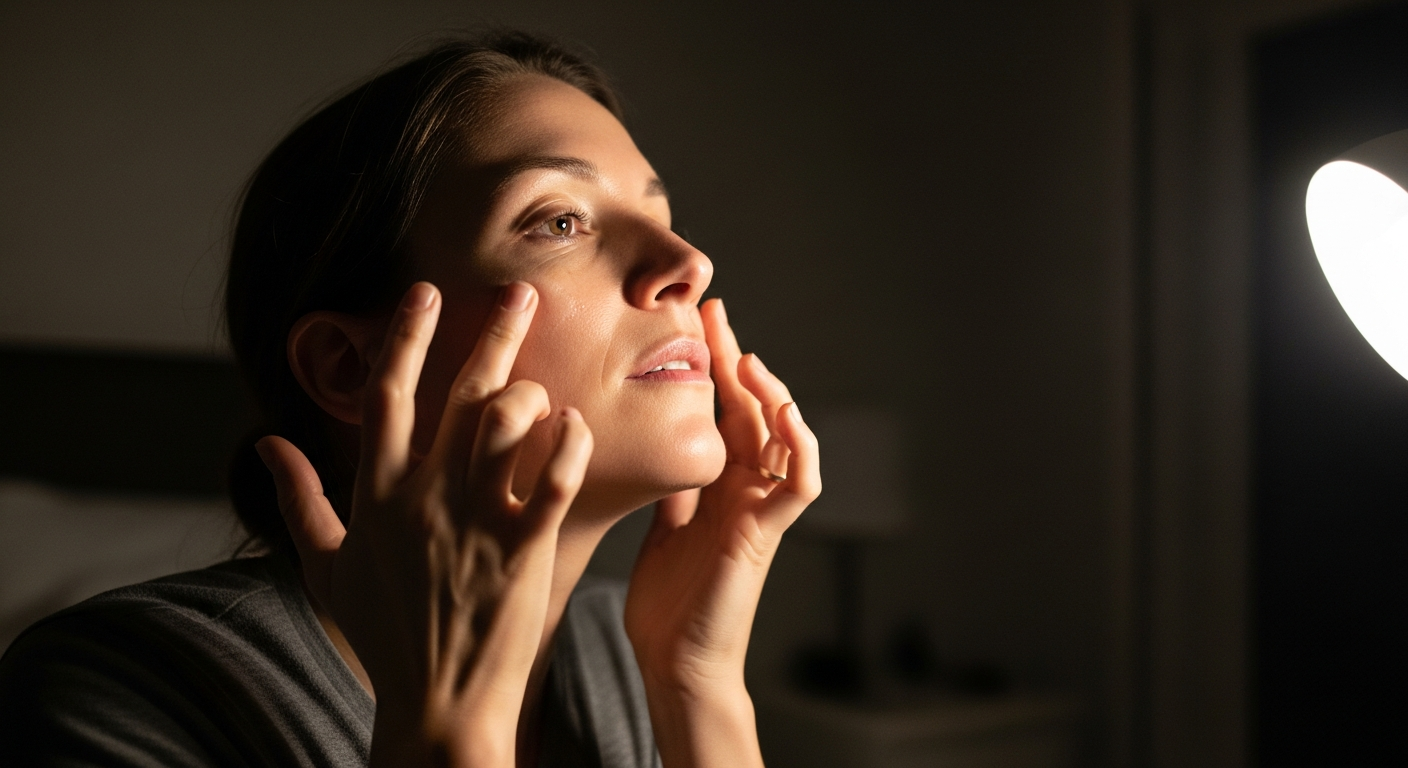
Your Skin Has a Clock — and You're Probably Fighting It
The science of circadian skincare and why nighttime is when real anti-aging work happens
Most skincare advice focuses on what to put on your skin. Very little focuses on when. That’s a significant oversight—because the skin isn’t a passive surface that simply absorbs whatever you apply to it. It’s a living organ with its own internal clock, and that clock governs when the skin is best equipped to repair, renew, and respond to the active ingredients you’re paying for.
This isn’t wellness metaphor. It’s molecular biology with a growing body of peer-reviewed evidence behind it—and it has direct implications for how you structure your skincare routine.
The Clock Genes Inside Your Skin Cells
Circadian rhythms aren’t just about when you feel sleepy. They’re a fundamental property of most cells in the body, including skin cells. Fibroblasts, keratinocytes, and epidermal stem cells all carry molecular clocks—a set of transcription factors (CLOCK, BMAL1, Per, Cry) that cycle over roughly 24 hours, switching hundreds of genes on and off in a coordinated daily rhythm [1][2].
This means skin function isn’t constant throughout the day. It oscillates. Some processes are upregulated in the morning. Others peak at night. The clock controls DNA repair efficiency, stem cell activity, inflammatory response, barrier function, and the rate of cell division—all of which affect how well your skin can respond to active ingredients [3].
In a landmark study published in Nature, researchers showed that the skin’s molecular clock directly determines which epidermal stem cells are in an active, proliferating state versus a quiescent one [3]. The implication is significant: apply a cell-turnover-promoting ingredient during the wrong phase of the skin’s clock, and you may be working against the underlying biology rather than with it.
What the Skin Does at Night
The clearest circadian signal in skin is the day/night split in function: daytime is defense mode, nighttime is repair mode. Turning that split into an actual protocol is covered in our night skincare routine guide.
During the day, the skin faces UV radiation, pollution, and oxidative stress. The clock primes the skin to mount antioxidant defenses and heighten UV damage surveillance during daylight hours. Sensibly, DNA repair enzymes are also most active in the hours after UV exposure—running the necessary damage correction before cell division spreads mutations [5].
At night, the priorities invert. UV is no longer a threat. The skin shifts into a regenerative phase. Cell division rates in the epidermis peak during the late-night and early-morning hours [10]. Collagen synthesis in fibroblasts follows a nocturnal pattern—genes responsible for collagen assembly and secretion are more active during dark-phase hours than during the day [7]. The extracellular matrix—the network of proteins that gives skin its structure—undergoes its primary maintenance cycle overnight [6]. Skin also synthesizes its own melatonin locally, independent of the pineal gland, where it acts as a mitochondrial antioxidant rather than a sleep signal.
Transepidermal water loss also follows a circadian pattern: the skin barrier is slightly more permeable at night [8], which has a nuanced implication. Increased permeability means certain active ingredients can penetrate more effectively. It also means more hydration is lost—which is why a good nighttime moisturizer matters.
It stimulates procollagen synthesis, accelerates epidermal cell turnover, and partially reverses both chronological aging and UV damage at the cellular level.
Why Retinol Belongs in the Dark
Retinol is the most evidence-supported anti-aging topical ingredient available without a prescription. It stimulates procollagen synthesis, accelerates epidermal cell turnover, and partially reverses both chronological aging and UV damage at the cellular level [9]. But retinol belongs specifically at night—not just because of skin clock alignment, but because of photochemistry.
Retinol is highly sensitive to UV light and atmospheric oxygen. Applied in the morning, it degrades rapidly before it can penetrate to the dermis—breaking down into inactive compounds on the skin surface or in the upper epidermis. Night application eliminates the UV degradation problem entirely, giving the molecule a full 6-8 hours to penetrate and interact with skin cells during precisely the repair window when those cells are most receptive [9].
The alignment here is not coincidental. The skin’s nighttime repair mode—elevated cell turnover, active collagen synthesis, higher extracellular matrix maintenance—is exactly the biological context in which a collagen-stimulating, cell-renewal-promoting ingredient like retinol would be expected to be most effective.
The Two-Phase Skincare Framework
Thinking in terms of circadian rhythm, the logic of a day/night skincare split becomes less arbitrary and more principled:
Daytime: Apply ingredients that support the skin’s defensive functions. Antioxidants (vitamin C, vitamin E, ferulic acid) help neutralize the free radicals generated by UV and pollution. Sunscreen is essential—not optional, not situational. The goal is to minimize the oxidative and UV damage load that the nighttime repair cycle will need to address.
Nighttime: Apply ingredients that support and amplify the skin’s repair functions. Retinol is the gold standard. Peptides, growth factors, and ceramides also play well in this phase. Hydrating actives like hyaluronic acid and glycerin can help offset the increased transepidermal water loss that occurs at night.
Many people already follow some version of this split intuitively—wearing SPF in the morning and using actives at night. What circadian research adds is the biological rationale that makes this split non-negotiable rather than a lifestyle preference. The practical build-out of the daytime half lives in our morning skincare routine guide.
The Delivery Problem Nobody Talks About
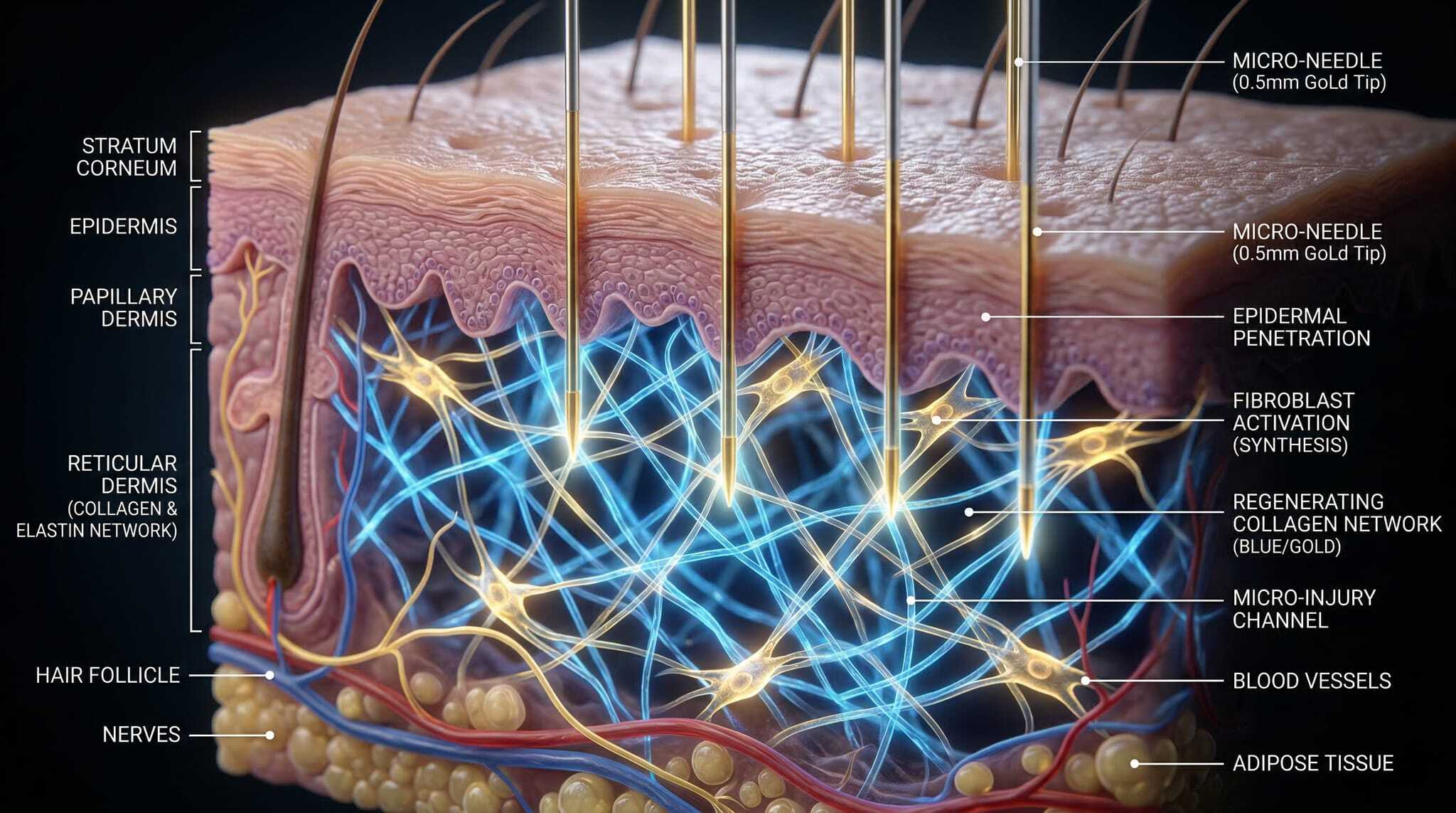
Even with perfect timing, retinol faces a structural problem: the skin barrier. The stratum corneum—the outermost layer of the epidermis—is designed to keep things out. Conventional retinol formulations must passively diffuse through this barrier, and they’re not particularly efficient at it. A significant portion of the applied retinol degrades or remains in the surface layers before reaching the dermis, where fibroblasts actually synthesize collagen.
In head-to-head testing against conventional retinol, Nanoretinol showed 232% greater collagen recovery and 73% greater elastin recovery.
Nanoretinol addresses this directly. Its lipid nanoparticles are engineered to mimic the composition of skin cell membranes—making them biologically recognizable rather than foreign. The skin allows them through rather than blocking them. Once through the barrier, the particles release their retinol payload into the deeper dermal layers where it actually needs to work.
This delivery advantage is measurable. In head-to-head testing against conventional retinol, Nanoretinol showed 232% greater collagen recovery and 73% greater elastin recovery. In clinical use, participants saw a 61% increase in skin firmness and a 56% increase in elasticity over 56 days—outcomes that reflect not just the ingredient, but the timing and delivery precision working together.
Applied at night—when the skin barrier is slightly more permeable, when fibroblasts are in active collagen-synthesis mode, and when there’s no UV exposure to degrade the retinol before it can penetrate—this system is working in alignment with the skin’s own biological programming.
Putting Your Skin Clock to Work
The practical upshot is straightforward. Apply your protective, antioxidant-rich products during the day. Reserve your collagen-stimulating actives—retinol first and foremost—for nighttime, and make sure the formulation you’re using can actually reach the dermis rather than oxidizing on the surface.
The skin’s circadian clock isn’t a wellness trend. It’s a fundamental feature of how skin biology operates. Working with it rather than ignoring it is simply the most rational approach to anti-aging skincare—and one that requires no new products, just better timing.
References
-
Duan J, Greenberg EN, Karri SS, Andersen B. “The Circadian Clock and Diseases of the Skin.” FEBS Letters. 2021;595(19):2413-2436. doi:10.1002/1873-3468.14192
-
Plikus MV, Van Spyk EN, Pham K, Geyfman M, Kumar V, Takahashi JS, Andersen B. “The Circadian Clock in Skin: Implications for Adult Stem Cells, Tissue Regeneration, Cancer, Aging, and Immunity.” Journal of Biological Rhythms. 2015;30(3):163-182. doi:10.1177/0748730414563537
-
Janich P, Pascual G, Merlos-Suárez A, Batlle E, Ripperger J, Albrecht U, Cheng H-YM, Obrietan K, Di Croce L, Aznar Benitah S. “The Circadian Molecular Clock Creates Epidermal Stem Cell Heterogeneity.” Nature. 2011;480(7376):209-214. doi:10.1038/nature10649
-
Janich P, Toufighi K, Solanas G, Luis NM, Minkwitz S, Serrano L, Lehner B, Aznar Benitah S. “Human Epidermal Stem Cell Function Is Regulated by Circadian Oscillations.” Cell Stem Cell. 2013;13(6):745-753. doi:10.1016/j.stem.2013.09.004
-
Wang H, van Spyk E, Liu Q, Geyfman M, Salmans ML, Kumar V, Ihler A, Li N, Takahashi JS, Andersen B. “Time-Restricted Feeding Shifts the Skin Circadian Clock and Alters UVB-Induced DNA Damage.” Cell Reports. 2017;20(5):1061-1072. doi:10.1016/j.celrep.2017.07.022
-
Sherratt MJ, Hopkinson L, Naven M, Hibbert SA, Ozols M, Eckersley A, Newton VL, Bell M, Meng Q-J. “Circadian Rhythms in Skin and Other Elastic Tissues.” Matrix Biology. 2019;84:97-110. doi:10.1016/j.matbio.2019.08.004
-
Wang C, Song T, Zhang Y, Li N, Xie L, Xie M, Jiang X, Lü G, Meng Y, Wang C, Yue L, Yang W, Li Y, Wu Y, Chen L. “Targeting Circadian Rhythm for the Regulation of Skin Collagen Metabolism.” Journal of Cosmetic Dermatology. 2026;25(1):e70638. doi:10.1111/jocd.70638
-
Iwanaszko M, Waldeck N, Anafi R, Paller AS, Zee PC, Fishbein AB. “Circadian Rhythms in Skin Barrier Function in Atopic Dermatitis: A Pilot Study.” Journal of Biological Rhythms. 2024;39(2):208-214. doi:10.1177/07487304231220695
-
Quan T. “Human Skin Aging and the Anti-Aging Properties of Retinol.” Biomolecules. 2023;13(11):1614. doi:10.3390/biom13111614
-
Lyons AB, Moy L, Moy R, Tung R. “Circadian Rhythm and the Skin: A Review of the Literature.” Journal of Clinical and Aesthetic Dermatology. 2019;12(9):42-45. https://pubmed.ncbi.nlm.nih.gov/31641418/