Fragrance-Free Skincare: What That Label Actually Means
The difference between fragrance-free and unscented is not marketing pedantry — it decides whether your skin calms down or keeps reacting
If your skin has been stinging, flushing, or breaking out in patches that never quite resolve, someone has almost certainly told you to switch to fragrance-free skincare. It is the single most common piece of advice in a dermatology office, and it is good advice. The problem is what happens next: you go to the shelf, you pick up something that says unscented or for sensitive skin, and six weeks later nothing has changed.
That is not because the advice was wrong. It is because the label did not mean what you assumed it meant.
Why fragrance gets singled out
Dermatologists do not pick on fragrance arbitrarily. When the North American Contact Dermatitis Group publishes its periodic patch-test results — the closest thing the field has to a scoreboard of what people actually react to — fragrance materials sit near the top of the list every cycle, alongside metals and preservatives [1]. These are not exotic reactions in a handful of unlucky patients. They are among the most frequently positive results across thousands of consecutively tested people.
What makes fragrance unusual is that it is not one ingredient. A single scent can be built from dozens of individual aroma chemicals, and under EU and US labelling conventions the entire blend can collapse into one word on the ingredient list. You are not reading an ingredient. You are reading a category.
A single scent can be built from dozens of separate aroma chemicals, and the label is allowed to compress all of them into one word.
Some of those chemicals are also more reactive after they have been sitting in your bathroom for a while. Linalool and limonene — the compounds that give products a soft floral or bright citrus character — are relatively benign in the bottle but oxidise on exposure to air, and the oxidation products are considerably more sensitising than the parent molecules. When researchers patch-tested consecutive dermatitis patients against these oxidised forms, roughly seven percent reacted to oxidised linalool and roughly five percent to oxidised limonene [2]. A product that was fine in March can genuinely be a problem in September.
”Unscented” is not “fragrance-free”
Here is the distinction that costs people months.
Fragrance-free should mean no fragrance material has been added for the purpose of scent. Unscented means the finished product does not smell of much — which is a description of the outcome, not the formula. An unscented product can, and often does, contain a masking fragrance: an aroma chemical added specifically to cover the raw smell of the base. The product smells of nothing. Your immune system still sees the molecule.
Neither term is tightly policed. In an analysis of best-selling moisturizers, researchers found that 45 percent of products marketed as fragrance-free still contained a fragrance cross-reactor or a botanical ingredient capable of provoking the same response [3]. Nearly half. If you have been diligently buying fragrance-free products and getting nowhere, that statistic is probably your answer.
The botanical loophole
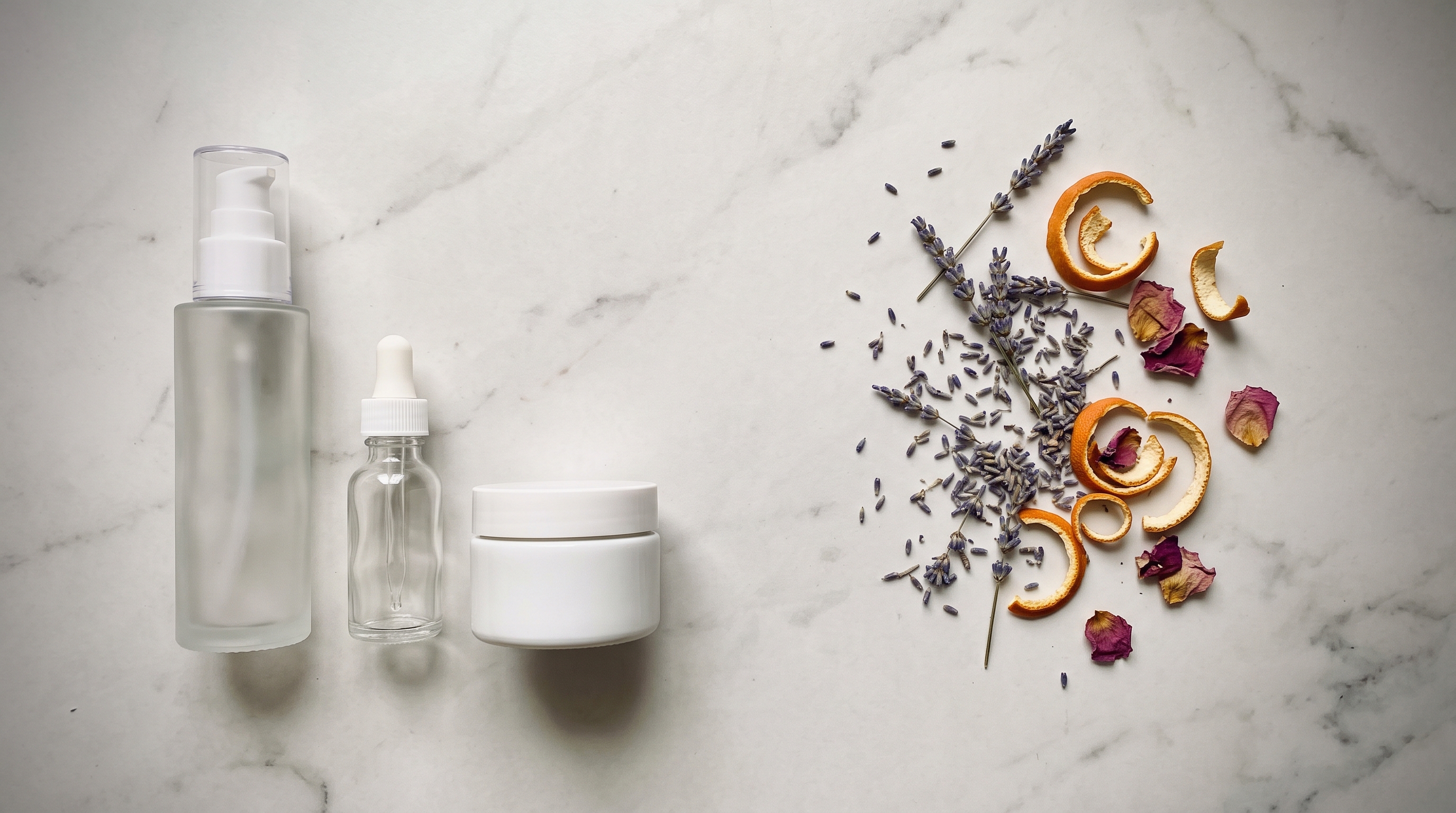
The other gap is the one that looks healthiest. Essential oils and botanical extracts are fragrance — chemically, functionally, immunologically — but they rarely appear under the word “fragrance.” They appear under their plant names, which read like reassurance rather than risk.
Lavender oil, ylang-ylang, sweet orange peel, peppermint, tea tree, and citrus extracts are all common sensitisers. A product can be technically free of parfum and still be carrying a meaningful load of the exact compounds that flagged positive on the patch test. “Natural” says nothing about whether your skin will tolerate it.
What this does to a barrier that is already struggling
Sensitive skin is now recognised as a defined clinical syndrome rather than a vague complaint — a pattern of stinging, burning, and tightness in response to stimuli that most people never notice [4]. And it has a measurable physical basis. When researchers modelled transepidermal water loss curves in people who self-identify as sensitive, they found genuine differences in barrier behaviour, not just differences in perception [5].
This matters because it explains the loop people get stuck in. A compromised barrier lets more material through. More material through means more contact with the immune system. More immune activity means more inflammation, and inflammation degrades the barrier further. Fragrance is not the only thing that can start that cycle, but it is the most common avoidable one — which is why removing it is the first move, not the last.
If you are trying to break that loop, it is worth reading our guide to repairing a damaged skin barrier alongside this one, because removing the irritant and rebuilding the barrier are two different jobs.
Removing the irritant and rebuilding the barrier are two separate jobs, and doing only the first one is why progress stalls.
Reading a label in ten seconds
You do not need to memorise a chemistry syllabus. You need to check four things:
- Scan for the word itself. Fragrance, parfum, aroma, or flavor anywhere on the list means added scent, regardless of what the front of the box claims.
- Scan for the named aroma chemicals. Linalool, limonene, citronellol, geraniol, eugenol, coumarin. In the EU these must be declared separately above a threshold, which is why you will sometimes see them listed after everything else.
- Scan for plant oils in the back half. An extract high on the list is doing formulation work. A cluster of aromatic oils near the bottom is usually there for smell.
- Ignore the front of the packaging entirely. Dermatologist-tested, hypoallergenic, for sensitive skin, and clean are marketing terms with no fixed definition. The ingredient list is the only part of the package that has to be true.
Where actives fit once the fragrance is gone
Stripping fragrance out solves an irritation problem. It does not solve an ageing problem — and this is where people who have finally calmed their skin down tend to stall, because the actives with the strongest evidence behind them have a reputation for being harsh.
That reputation is mostly about delivery, not about the molecule. Retinoids remain the most thoroughly documented topical route to rebuilding dermal collagen; the classic trial showing restored collagen formation in photodamaged skin is now three decades old and has been replicated many times since [6]. The burning and peeling people associate with retinol come largely from formulations that use solvents and penetration enhancers to force the active through a barrier that is doing its job.
This is the problem Nanoretinol was built to solve. Rather than disrupting the barrier chemically, it encapsulates retinol inside biomimetic lipid nanoparticles that the skin recognises as self and allows through intact — the same class of delivery technology used in modern drug development. The formula is water-based, 99% natural, contains no added fragrance, and is suitable for sensitive skin and the eye contour. In testing against conventional retinol it was 232% more effective in collagen recovery and 73% more effective in elastin recovery, with drastically reduced cytotoxicity — which is the technical way of saying it does the work without the collateral damage.
For anyone easing an active back in after a period of reactivity, our guide to using retinol on sensitive skin covers the sequencing in more detail, and the sensitive skin routine walks through what to keep and what to cut.
Making it boring on purpose
The goal of a fragrance-free routine is not minimalism for its own sake. It is removing enough variables that you can finally tell what is working. Cut the scented products, hold the routine steady for six to eight weeks, and reintroduce one thing at a time. Skin that has been reacting for months will not settle in a week — but it will settle, and when it does you will actually know why.
References
- DeKoven JG, Warshaw EM, Reeder MJ, et al. “North American Contact Dermatitis Group Patch Test Results: 2019-2020.” Dermatitis. 2023;34(2):90-104. doi:10.1089/derm.2022.29017.jdk
- Sukakul T, Bruze M, Mowitz M, et al. “Contact allergy to oxidized linalool and oxidized limonene: Patch testing in consecutive patients with dermatitis.” Contact Dermatitis. 2022;86(1):15-24. doi:10.1111/cod.13980
- Xu S, Kwa M, Lohman ME, Evers-Meltzer R, Silverberg JI. “Consumer Preferences, Product Characteristics, and Potentially Allergenic Ingredients in Best-selling Moisturizers.” JAMA Dermatology. 2017;153(11):1099-1105. doi:10.1001/jamadermatol.2017.3046
- Wollenberg A, Giménez-Arnau A. “Sensitive skin: A relevant syndrome, be aware.” Journal of the European Academy of Dermatology and Venereology. 2022;36(Suppl 5):3-5. doi:10.1111/jdv.17903
- Pinto P, Rosado C, Parreirão C, Rodrigues LM. “Is there any barrier impairment in sensitive skin?: a quantitative analysis of sensitive skin by mathematical modeling of transepidermal water loss desorption curves.” Skin Research and Technology. 2011;17(2):181-185. doi:10.1111/j.1600-0846.2010.00478.x
- Griffiths CE, Russman AN, Majmudar G, Singer RS, Hamilton TA, Voorhees JJ. “Restoration of collagen formation in photodamaged human skin by tretinoin (retinoic acid).” New England Journal of Medicine. 1993;329(8):530-535. doi:10.1056/NEJM199308193290803