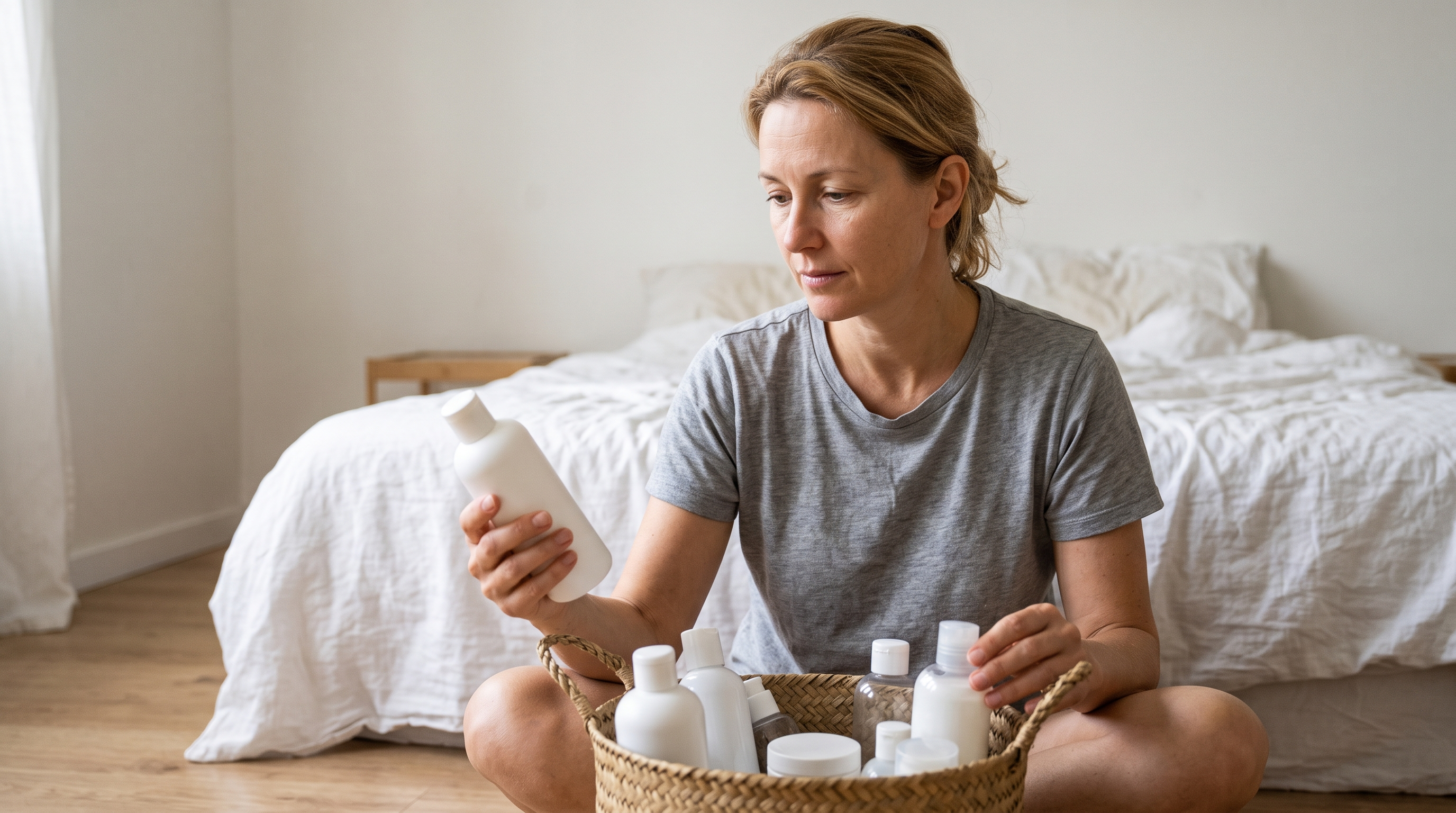
Non-Toxic Skincare: What the Label Means and Which Ingredients Deserve Caution
"Non-toxic" has no legal definition. Here is what the evidence says about parabens, preservatives, fragrance, PFAS and natural oils, and how to shop without the fear
More people than ever are searching for non-toxic skincare, and the instinct behind it is sensible. You put these products on your face every day, often for decades, and you want to know they are safe. The trouble is that “non-toxic” is a marketing phrase, not a regulated standard. No agency defines it, no test certifies it, and two brands using the same words can mean opposite things.
That leaves shoppers with ingredient apps, “free-from” lists and a lot of fear. This guide takes a calmer route: what toxicity actually means, which concerns hold up in the research, which ones do not, and how to build a routine that is both safe and effective.
Toxicity depends on dose and route
The oldest rule in toxicology is that the dose makes the poison. Water, vitamin A and table salt are all toxic at a high enough dose; a potent chemical can be harmless at a tiny one. For skincare, two further questions matter: how much of the ingredient actually passes through the skin, and whether the concern is long-term exposure, such as hormone effects, or immediate reactions, such as allergy.
When you apply that lens, most ingredient scares fall into one of three groups: concerns that are real and worth acting on, concerns that are real but small, and concerns that have been overstated to the point of causing harm.
Parabens: the scare that backfired
Parabens are preservatives, and preservatives exist for a good reason: a water-based cream without one becomes a breeding ground for bacteria and mould within weeks. Parabens became the face of the “toxic” movement after concerns about weak hormone-like activity, and “paraben-free” is now one of the most common claims on a jar.
The allergy data tell a different story. When a group of leading contact dermatitis specialists reviewed more than 70 years of patch testing, they found that paraben allergy has remained low and remarkably stable despite enormous use. They named the paraben mix the “(non)allergen of the year” and called parabens one of the least allergenic preservatives available. They went further: public fear of parabens led many brands to replace them with preservatives that have far greater allergenic potential [1].
Avoiding one well-studied preservative can mean putting a more irritating one on your face every single day.
The hormone question is more nuanced. The estrogen-like effect of parabens in laboratory tests is far weaker than that of the body’s own estrogen, and the European Union has banned five less-studied parabens while keeping the common ones within concentration limits, with tighter caps on propylparaben and butylparaben. Paraben-free is a legitimate preference, but it is not automatically safer.
Formaldehyde releasers: a real concern for allergic skin
A more practical target is the group of preservatives that slowly release small amounts of formaldehyde, a well-established skin allergen. They include DMDM hydantoin, imidazolidinyl urea, diazolidinyl urea, quaternium-15 and sodium hydroxymethylglycinate.
These are not rare. A review of US and European data found that roughly one in five cosmetics contains a formaldehyde releaser, and one in four of the 496 skin care products examined in a local drugstore did [2]. If you have reactive skin, a history of contact dermatitis, or unexplained rashes, these are reasonable ingredients to avoid.
Fragrance and “natural” oils
Fragrance is the leading cause of cosmetic contact allergy, and a single “fragrance” or “parfum” entry can hide dozens of components. For sensitive or aging skin, removing it is one of the most useful changes you can make, as we explain in our guide to fragrance-free skincare.
The catch is that “natural” does not mean gentle. A review of essential oils found that nearly 80 of them have caused contact allergy, and oils including tea tree, ylang-ylang, clove, orange and sandalwood produced positive reactions in more than 2% of patients patch-tested for suspected contact allergy [3]. A product scented with essential oils is not fragrance-free, even when it is marketed as clean.
A cream scented with essential oils can irritate your skin just as easily as one scented with synthetic fragrance.
PFAS: an emerging concern worth taking seriously
Per- and polyfluoroalkyl substances (PFAS), often called “forever chemicals,” are used for water resistance and long wear. A 2021 study tested 231 cosmetics sold in North America and found high fluorine levels, a marker of PFAS, in more than half of them, most often in waterproof mascaras, foundations and long-wear lip products. Most of the products confirmed to contain PFAS did not declare them on the label [4].
Leave-on face creams are a smaller source than long-wear makeup, but this is a genuine reason to be choosy. Ingredients containing “fluoro” or “PTFE” are the clue to look for.
Phthalates: mostly a fragrance issue
Phthalates attract concern because some affect hormone signalling. A Canadian survey of 252 personal care products found that diethyl phthalate was the most common, detected in 103 products, with the highest levels in fragrances, while other phthalates appeared far less often [5]. Because phthalates are rarely listed individually, choosing fragrance-free products is the simplest way to reduce exposure.
Why retinol shows up on “avoid” lists
Many clean-beauty apps flag retinol, and this is where the “toxic” framing does the most damage. The real issue with retinol is pregnancy. Oral retinoids can cause birth defects, so topical retinoids are not recommended during pregnancy as a precaution. A multicentre study of 235 women exposed to topical retinoids in the first trimester did not find an increased rate of birth defects, but the authors still advised against use because the risk-benefit balance in pregnancy remains uncertain [6]. Our guide to retinol and pregnancy covers the details.
Outside pregnancy and breastfeeding, retinol is one of the most studied anti-aging ingredients there is. In a controlled trial, 0.4% retinol significantly improved fine wrinkles in naturally aged skin and increased collagen production [7]. The problem most people experience is irritation, not toxicity.
A practical checklist for safer skincare
Rather than following a long “free-from” list, focus on the few concerns that hold up:
- Skip fragrance and essential oils on your face, especially if your skin is sensitive.
- Avoid formaldehyde-releasing preservatives if you have reactive skin.
- Choose long-wear and waterproof makeup carefully and avoid “fluoro” and PTFE ingredients.
- Keep a preservative. A water-based product that claims to need none is a microbial risk.
- Use sunscreen daily. If you prefer mineral filters, our comparison of mineral vs chemical sunscreen explains the trade-offs.
- Check with your doctor about actives during pregnancy, including retinoids and high-strength acids.
- Keep your routine short. Fewer products mean fewer exposures and fewer chances of irritation. Our sensitive skin care routine shows how simple it can be.
Where Nanoretinol fits
If you have been avoiding retinol because of how harsh it felt, the formula may be the problem rather than the ingredient. Conventional retinol products often use chemical solvents and petroleum-derived ingredients that push retinol through the skin by breaking down the barrier, which causes redness, burning and peeling.
Nanoretinol delivers stabilised 0.2% retinol in biomimetic lipid nanoparticles that the skin recognises as its own, so it reaches the cells without damaging the barrier. It is a water-based, vegan formula made with 99% natural ingredients, and its laboratory testing showed drastically reduced cytotoxicity compared with conventional retinol. In North Biomedical’s study summary, it was 232% more effective in collagen recovery and 73% more effective in elastin recovery, with a 61% increase in firmness and a 56% increase in elasticity after 56 days. Like every retinoid, it is not for use during pregnancy or breastfeeding.
Safe and effective are not opposites
The most useful version of non-toxic skincare is not a fear-based purge. It is a short routine built from well-studied ingredients, free of the few irritants and contaminants that genuinely matter, with a proven active doing the heavy lifting. That approach protects your skin today and helps it age better over the decades ahead.
References
- Fransway AF, Fransway PJ, Belsito DV, et al. “Parabens.” Dermatitis. 2019;30(1):3-31. doi:10.1097/DER.0000000000000429
- de Groot AC, Veenstra M. “Formaldehyde-releasers in cosmetics in the USA and in Europe.” Contact Dermatitis. 2010;62(4):221-224. doi:10.1111/j.1600-0536.2009.01623.x
- de Groot AC, Schmidt E. “Essential oils, part IV: contact allergy.” Dermatitis. 2016;27(4):170-175. doi:10.1097/DER.0000000000000197
- Whitehead HD, Venier M, Wu Y, et al. “Fluorinated compounds in North American cosmetics.” Environmental Science & Technology Letters. 2021;8(7):538-544. doi:10.1021/acs.estlett.1c00240
- Koniecki D, Wang R, Moody RP, Zhu J. “Phthalates in cosmetic and personal care products: concentrations and possible dermal exposure.” Environmental Research. 2011;111(3):329-336. doi:10.1016/j.envres.2011.01.013
- Panchaud A, Csajka C, Merlob P, et al. “Pregnancy outcome following exposure to topical retinoids: a multicenter prospective study.” Journal of Clinical Pharmacology. 2012;52(12):1844-1851. doi:10.1177/0091270011429566
- Kafi R, Kwak HSR, Schumacher WE, et al. “Improvement of naturally aged skin with vitamin A (retinol).” Archives of Dermatology. 2007;143(5):606-612. doi:10.1001/archderm.143.5.606