Hyaluronic Acid Body Lotion: What It Can Do for Dry, Crepey Body Skin
Hyaluronic acid has moved from face serums into body lotions. Here is what it can and cannot do on arms and legs, how to pick a formula that actually hydrates, and where retinol fits
Hyaluronic acid made its name in face serums, and it is now on the front of a growing number of body lotions. The promise is appealing: the same plumping hydration you get on your face, spread over arms, legs and chest that feel dry, papery or crepey.
Some of that promise holds up. Hyaluronic acid is an excellent hydrator, and a well-made body lotion that contains it can make dry skin look smoother and feel more comfortable within minutes. But body skin is not face skin, and the ingredient has clear limits. Knowing them helps you choose a better lotion and avoid expecting it to do a job it cannot.
What hyaluronic acid does in your skin
Hyaluronic acid is a sugar molecule your body makes naturally. In the skin, it is the key molecule for holding moisture: it binds water in the spaces between cells and fibers, which helps keep young skin full, springy and pliable [1]. With age and daily sun exposure, that water content drops, and skin loses some of its turgor and bounce [1].
Applied to the surface, hyaluronic acid works as a humectant. It attracts water into the outermost layer of skin, which softens fine lines and makes dry patches look smoother. How far it goes depends on the size of the molecule.
Why molecule size decides what a lotion can do
Hyaluronic acid comes in different molecular weights, and that changes where it ends up. In a study that tracked penetration with Raman imaging, low-molecular-weight hyaluronic acid passed through the skin’s outer barrier, while high-molecular-weight hyaluronic acid stayed on top [2].
Both sizes are useful. In a 60-day randomized study of 76 women, creams with 0.1% hyaluronic acid in five different molecular weights all improved skin hydration and elasticity compared with a plain cream, and the lower-weight versions also reduced wrinkle depth [3]. That trial was done around the eyes rather than on the body, but it shows what a well-formulated hyaluronic acid cream can achieve on thin, aging skin.
Your skin can look visibly smoother within 60 days of using a hyaluronic acid cream twice a day, and smaller molecules did more for wrinkle depth than larger ones.
Your skin can look visibly smoother within 60 days of using a hyaluronic acid cream twice a day, and smaller molecules did more for wrinkle depth than larger ones.
Some labels list “hydrolyzed hyaluronic acid” or “sodium hyaluronate crosspolymer”. The first usually means smaller fragments, the second a film-forming version that sits on the surface. A lotion with more than one size can do both jobs.
Why the rest of the formula matters more on the body
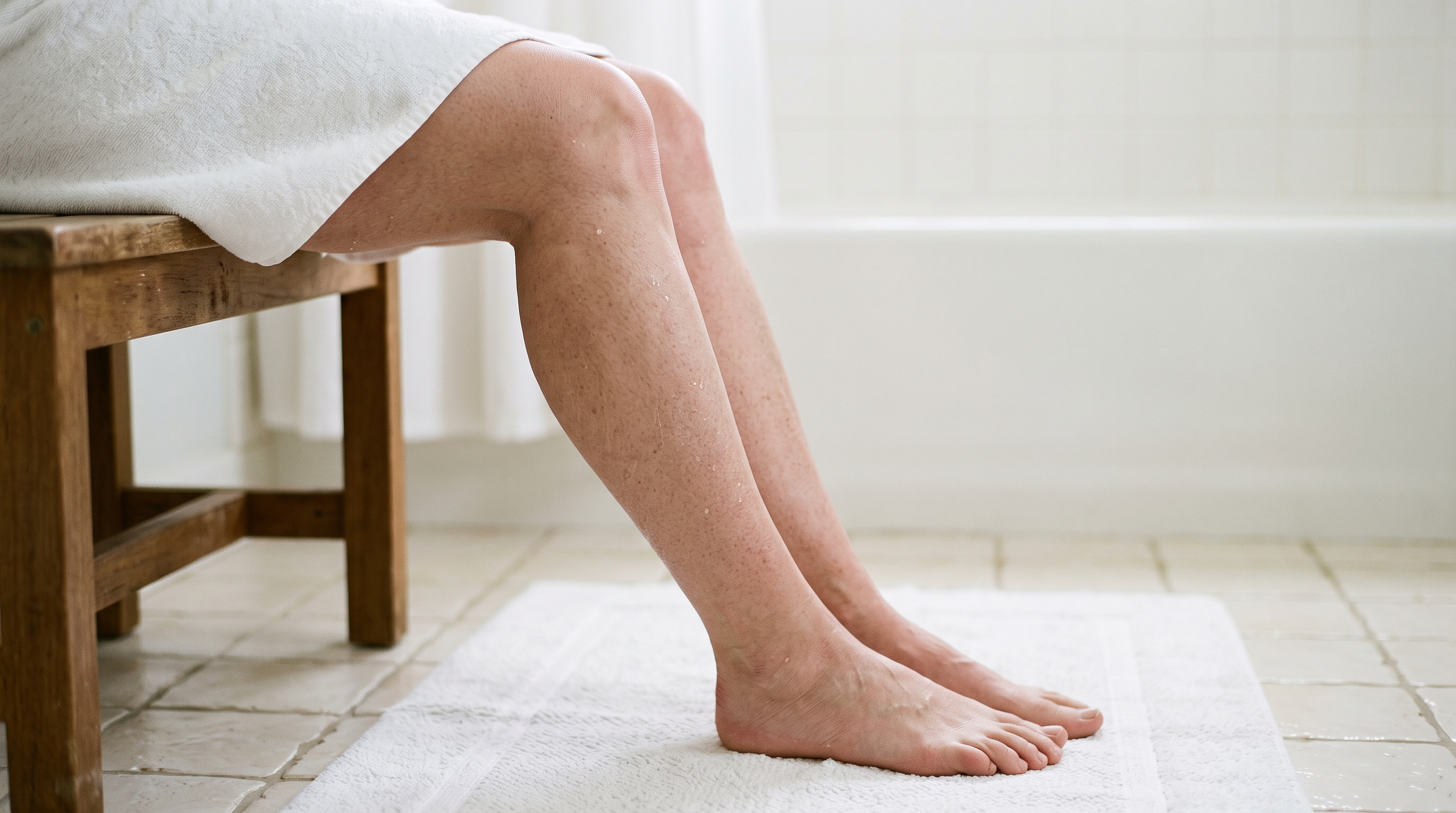
Body skin has fewer oil glands than the face, especially on the shins and forearms, and it is often the first to turn dry, rough and itchy with age. Dry skin in older adults has many causes, including changes in how skin cells mature, lower lipid content, certain medications, and heated or air-conditioned rooms [4].
A humectant on its own can struggle in that environment. If the air is very dry, a lotion that pulls water in without anything to seal it can leave skin feeling tight again within an hour. That is why the best hyaluronic acid body lotions pair it with:
- Glycerin, a smaller, very effective humectant that improves skin hydration, barrier function and mechanical properties, and is especially helpful in dry, cold weather [5].
- Emollients such as squalane, plant oils or shea butter, which soften rough patches.
- Occlusives such as petrolatum or dimethicone, which slow water loss through the skin [6].
- Barrier lipids such as ceramides, for skin that cracks or flakes.
Our guide to hyaluronic acid moisturizers explains the same humectant-plus-seal principle for the face.
Your arms can show real collagen change after 24 weeks of retinol, which is far longer than any lotion’s few hours of plumping.
How to get the most from it
- Apply to damp skin. Pat yourself mostly dry after a shower and apply the lotion within a few minutes, while there is still water on the surface for hyaluronic acid to hold.
- Keep showers short and warm, not hot. Hot water and harsh soaps strip lipids faster than a lotion can replace them [4].
- Use a humidifier in winter. Raising indoor humidity is one of the simplest ways to reduce dryness [4].
- Choose fragrance-free if you itch. Dry body skin is easily irritated, and fragrance adds no hydration.
- Do not skip the shins and forearms. These areas have the least oil and often show dryness and crepiness first.
For persistent flaking on the legs, our guide to crepey skin on the legs covers exfoliation and other steps that help.
What a hyaluronic acid lotion cannot do
Crepey body skin is not only dry skin. With time and sun, the collagen network that gives the dermis its strength becomes fragmented, which weakens the skin’s structure and its ability to bounce back [7]. Hydration can temporarily plump the surface, so crepey arms look better for a few hours, but water does not rebuild that collagen.
That job belongs to retinoids. In a randomized trial of adults with an average age of 87, 0.4% retinol applied to the arm for 24 weeks significantly reduced fine wrinkling compared with a plain lotion and increased procollagen production in the treated skin [8].
Your arms can show real collagen change after 24 weeks of retinol, which is far longer than any lotion’s few hours of plumping.
Hyaluronic acid and retinol work well together on the body. The lotion keeps skin comfortable while the retinoid does the slower structural work. Our comparison of the best body lotions for aging skin and our guide to retinol for the body explain how to build that routine.
Where Nanoretinol fits
The obstacle with body retinol is the same as on the face: conventional formulations often rely on solvents that break down the skin barrier to push retinol in, which leaves already-dry skin red and peeling. Nanoretinol delivers 0.2% stabilized retinol in biomimetic lipid nanoparticles that the skin recognizes as its own, so the retinol passes through without damaging the barrier, and the water-based gel absorbs completely without a greasy finish. In North Biomedical’s study, Nanoretinol was 232% more effective in collagen recovery and 73% more effective in elastin recovery than conventional retinol, and clinical use showed a 56% increase in skin elasticity in 56 days [9].
Use it at night on the areas that are crepiest, such as the forearms, the chest or above the knees, and apply your hyaluronic acid lotion over it or on the nights in between. Use sunscreen on exposed skin the next day.
Hydration now, structure over time
A hyaluronic acid body lotion is a smart buy for dry, tight or dull body skin, especially if it pairs hyaluronic acid with glycerin and a light seal and you apply it to damp skin. Treat it as the comfort layer, not the cure. For crepey skin that you want to firm, combine it with daily sunscreen and a gentle retinol, and give the retinol months to work.
References
- Papakonstantinou E, Roth M, Karakiulakis G. “Hyaluronic acid: A key molecule in skin aging.” Dermato-Endocrinology. 2012;4(3):253-258. doi:10.4161/derm.21923
- Essendoubi M, Gobinet C, Reynaud R, et al. “Human skin penetration of hyaluronic acid of different molecular weights as probed by Raman spectroscopy.” Skin Research and Technology. 2016;22(1):55-62. doi:10.1111/srt.12228
- Pavicic T, Gauglitz GG, Lersch P, et al. “Efficacy of cream-based novel formulations of hyaluronic acid of different molecular weights in anti-wrinkle treatment.” Journal of Drugs in Dermatology. 2011;10(9):990-1000. PubMed 22052267
- White-Chu EF, Reddy M. “Dry skin in the elderly: complexities of a common problem.” Clinics in Dermatology. 2011;29(1):37-42. doi:10.1016/j.clindermatol.2010.07.005
- Fluhr JW, Darlenski R, Surber C. “Glycerol and the skin: holistic approach to its origin and functions.” British Journal of Dermatology. 2008;159(1):23-34. doi:10.1111/j.1365-2133.2008.08643.x
- Lodén M. “Role of topical emollients and moisturizers in the treatment of dry skin barrier disorders.” American Journal of Clinical Dermatology. 2003;4(11):771-788. doi:10.2165/00128071-200304110-00005
- Rittié L, Fisher GJ. “Natural and sun-induced aging of human skin.” Cold Spring Harbor Perspectives in Medicine. 2015;5(1):a015370. doi:10.1101/cshperspect.a015370
- Kafi R, Kwak HS, Schumacher WE, et al. “Improvement of naturally aged skin with vitamin A (retinol).” Archives of Dermatology. 2007;143(5):606-612. doi:10.1001/archderm.143.5.606
- North Biomedical LLC. “Nanoretinol vs. Conventional Retinol: Efficacy in Collagen and Elastin Recovery.” Clinical Study Summary, 2024. Study summary