Hyaluronic Acid Moisturizer: How to Choose One That Actually Keeps Skin Hydrated
Hyaluronic acid pulls water into skin, but only the right formula keeps it there. Here is what the molecular weight, the base and the label order really tell you
Hyaluronic acid has become the ingredient people look for first when their skin feels tight, dull or lined. It shows up in serums, mists, sheet masks and, increasingly, in the everyday moisturizer. That last format is where most people actually meet it, and it is also where the ingredient is easiest to get wrong.
A moisturizer is judged by one thing: how much water your skin is still holding hours after you put it on. Hyaluronic acid is very good at attracting water. It is not, on its own, good at keeping it. Whether a hyaluronic acid moisturizer leaves you plump or oddly tight depends almost entirely on what else is in the jar.
What hyaluronic acid does in your skin
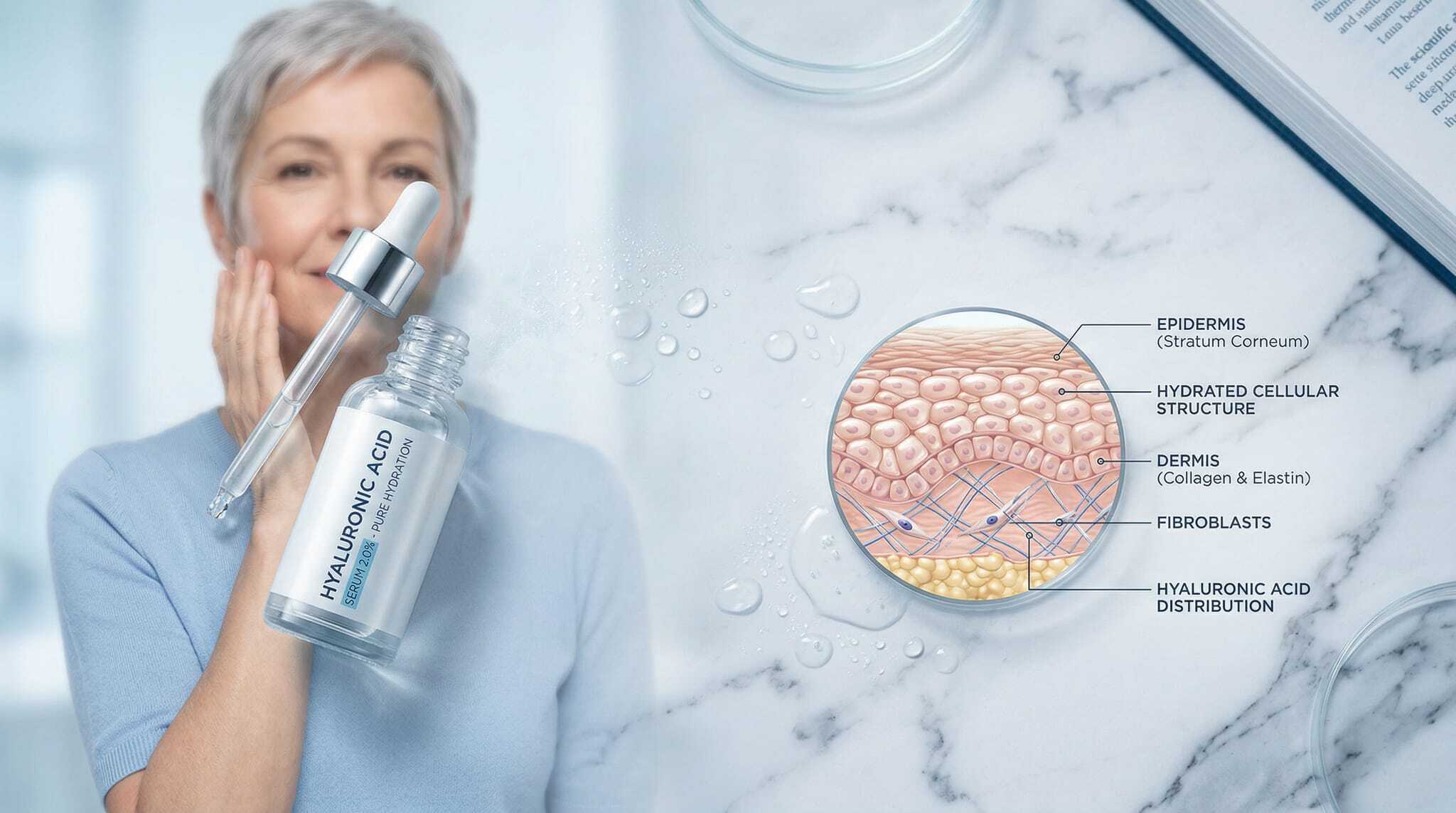
Hyaluronic acid is not a foreign ingredient. It is a sugar-based molecule your body makes, and roughly half of all the hyaluronic acid in the human body sits in the skin, where it binds water and helps keep tissue full and supple [1]. As skin ages, the amount of hyaluronic acid bound in the epidermis falls, and the tissue holds less water. That is part of why older skin looks flatter and fine lines show more.
Applied to the surface, hyaluronic acid acts as a humectant: a water magnet. It draws moisture into the outer layers of the skin, which temporarily swells the cells and softens the look of fine lines. That effect is real and visible within minutes. It is also temporary, which is where formulation comes in.
Why a humectant needs a lid
Dermatology has long classified moisturizers by what their ingredients do. Humectants such as hyaluronic acid and glycerin attract water. Occlusives such as petrolatum, dimethicone and plant butters form a film that slows water from evaporating. Emollients such as squalane and fatty alcohols fill the gaps between skin cells and make the surface feel smooth [2].
A humectant used alone in dry air has a problem. If the air holds little moisture, the water it attracts can come from deeper in your own skin rather than from the room, and that water then evaporates from the surface. Well-designed moisturizers solve this by pairing humectants with occlusive and barrier-supporting ingredients, so the water drawn in stays in [2]. The skin’s own barrier works the same way, relying on natural moisturizing factors inside cells and a lipid layer between them to hold water where it is needed [3].
A moisturizer is judged by one thing: how much water your skin is still holding hours after you put it on.
This is why some people say a hyaluronic acid product makes their skin feel drier. Often the ingredient is not the problem. The formula is missing its lid, or it is being used as a final step in a centrally heated room with nothing sealing it in. If that sounds familiar, it also helps to learn to tell dehydration, a shortage of water, from true dryness, a shortage of oil.
Molecular weight: the number that decides where it works
“Hyaluronic acid” on a label can mean molecules of very different sizes, and size changes what they do.
- High molecular weight hyaluronic acid (roughly 1,000 kDa and above) stays on the surface. It forms a hydrating film and makes skin feel smooth right away.
- Low molecular weight hyaluronic acid (roughly 20 to 300 kDa) is small enough to move into the outer layers of the skin.
A Raman spectroscopy study tracked this directly on human skin. Hyaluronic acid between 20 and 300 kDa passed through the stratum corneum, while the 1,000 to 1,400 kDa form did not [4].
The difference shows up in results. In a randomized, vehicle-controlled study, 76 women aged 30 to 60 applied 0.1% hyaluronic acid creams of five different molecular weights around one eye twice daily for 60 days, with a plain cream on the other side. Every hyaluronic acid cream improved hydration and elasticity compared with the control. Only the 50 kDa and 130 kDa creams significantly reduced wrinkle depth, which the authors attributed to better penetration of the smaller molecules [5].
The practical takeaway: a moisturizer that combines more than one molecular weight, often listed as “multi-weight” or with several forms such as sodium hyaluronate and hydrolyzed hyaluronic acid, covers both the surface film and the deeper hydration.
If you already use a hyaluronic acid serum, you may not need hyaluronic acid in your moisturizer as well, but you do need a moisturizer that seals the serum in.
What a good hyaluronic acid moisturizer looks like
Reviews of hyaluronic acid in cosmetics stress that it performs best in combination, alongside other moisturizing and barrier ingredients rather than as a lone hero [6][7]. When you compare jars, work through these checks:
- Where is it on the list? Hyaluronic acid is effective at low concentrations, so it rarely appears near the top. If it sits below the preservatives and fragrance, the amount is likely token. Look for it, or sodium hyaluronate, in the first half of the list.
- Is there more than one form? Sodium hyaluronate, hydrolyzed hyaluronic acid or sodium acetylated hyaluronate signal a spread of molecular sizes.
- Is there a seal? Look for occlusives or barrier lipids, such as dimethicone, squalane, shea butter or ceramides. For very dry or mature skin, a richer cream will hold water better than a watery gel. Our guide to the best ceramide moisturizer covers barrier lipids in detail.
- Is glycerin there too? Glycerin is a small, well-studied humectant that complements hyaluronic acid. Our comparison of hyaluronic acid vs glycerin explains why the two work well together.
- Is it fragrance-free? Added fragrance does nothing for hydration and is a common trigger for irritation, especially if your barrier is already compromised.
Texture follows skin type. Oily and combination skin usually does well with a gel-cream that still contains a light occlusive such as dimethicone. Dry and mature skin benefits from a cream with butters or ceramides.
Serum or moisturizer?
If you already use a hyaluronic acid serum, you may not need hyaluronic acid in your moisturizer as well, but you do need a moisturizer that seals the serum in. Apply the serum to slightly damp skin, then follow within a minute or two with a moisturizer. If you prefer a single step, a well-built hyaluronic acid moisturizer does both jobs. Our guide to the best hyaluronic acid serum covers the serum side.
What hydration can and cannot do for aging skin
Hydration makes skin look better quickly. Plumped cells reflect light more evenly, fine dehydration lines soften and makeup sits more smoothly. What hydration does not do is rebuild the collagen and elastin network in the dermis, which is what keeps skin firm and resists deeper lines. That structural decline needs an ingredient that changes how skin cells behave.
Retinol is the best-studied option. In a controlled trial in elderly volunteers, 0.4% retinol applied for 24 weeks significantly improved fine wrinkling compared with vehicle and increased procollagen and glycosaminoglycan production, the skin’s own hyaluronic-acid-rich ground substance [8]. In other words, retinol helps skin make more of what a hyaluronic acid moisturizer supplies from the outside. Our article on retinol and hyaluronic acid explains how to layer the two.
Where Nanoretinol fits
Many people avoid retinol because conventional formulas often rely on solvents and petroleum-derived ingredients that push retinol through the skin by disrupting its barrier, which leads to redness, peeling and tightness. That is exactly the opposite of what someone reaching for a hydrating moisturizer wants.
Nanoretinol takes a different route. It encapsulates stabilized 0.2% retinol in biomimetic lipid nanoparticles that skin recognizes as its own, so retinol reaches the cells without damaging the barrier. In North Biomedical’s study summary, it was 232% more effective in collagen recovery and 73% more effective in elastin recovery than conventional retinol, and 56 days of use produced a 61% increase in firmness and a 56% increase in elasticity. Its water-based gel absorbs completely, so it sits comfortably under a hyaluronic acid moisturizer at night.
Choosing with confidence
The best hyaluronic acid moisturizer is not the one with the biggest percentage on the front. It is the one that pairs more than one size of hyaluronic acid with enough occlusive and barrier support to keep water in your skin all day. Match the texture to your skin type, skip the fragrance, and pair it with a well-delivered retinol and daily sunscreen if you want the firmness that hydration alone cannot give.
References
- Papakonstantinou E, Roth M, Karakiulakis G. “Hyaluronic acid: A key molecule in skin aging.” Dermato-Endocrinology. 2012;4(3):253-258. doi:10.4161/derm.21923
- Draelos ZD. “The science behind skin care: Moisturizers.” Journal of Cosmetic Dermatology. 2018;17(2):138-144. doi:10.1111/jocd.12490
- Rawlings AV, Harding CR. “Moisturization and skin barrier function.” Dermatologic Therapy. 2004;17(s1):43-48. doi:10.1111/j.1396-0296.2004.04s1005.x
- Essendoubi M, Gobinet C, Reynaud R, et al. “Human skin penetration of hyaluronic acid of different molecular weights as probed by Raman spectroscopy.” Skin Research and Technology. 2016;22(1):55-62. doi:10.1111/srt.12228
- Pavicic T, Gauglitz GG, Lersch P, et al. “Efficacy of cream-based novel formulations of hyaluronic acid of different molecular weights in anti-wrinkle treatment.” Journal of Drugs in Dermatology. 2011;10(9):990-1000. PMID: 22052267
- Juncan AM, Moisă DG, Santini A, et al. “Advantages of hyaluronic acid and its combination with other bioactive ingredients in cosmeceuticals.” Molecules. 2021;26(15):4429. doi:10.3390/molecules26154429
- Bukhari SNA, Roswandi NL, Waqas M, et al. “Hyaluronic acid, a promising skin rejuvenating biomedicine: A review of recent updates and pre-clinical and clinical investigations on cosmetic and nutricosmetic effects.” International Journal of Biological Macromolecules. 2018;120:1682-1695. doi:10.1016/j.ijbiomac.2018.09.188
- Kafi R, Kwak HSR, Schumacher WE, et al. “Improvement of naturally aged skin with vitamin A (retinol).” Archives of Dermatology. 2007;143(5):606-612. doi:10.1001/archderm.143.5.606