Niacinamide Eye Cream: What It Can Do for Dark Circles and Fine Lines
Niacinamide has solid evidence for fading pigment and repairing the barrier. Here is which kind of dark circle it can help, what to look for on the label, and when to add retinol
Niacinamide, a form of vitamin B3, is one of the few skincare ingredients that is both well studied and widely tolerated. It now shows up in eye creams too, usually aimed at dark circles and fine lines. That raises two fair questions: can niacinamide actually lighten under-eye darkness, and is it enough on its own for crow’s feet?
The answer depends on what is causing your dark circles. This guide explains the main types, what the niacinamide research shows, what to look for on an eye cream label, and where retinol fits.
Not all dark circles are the same
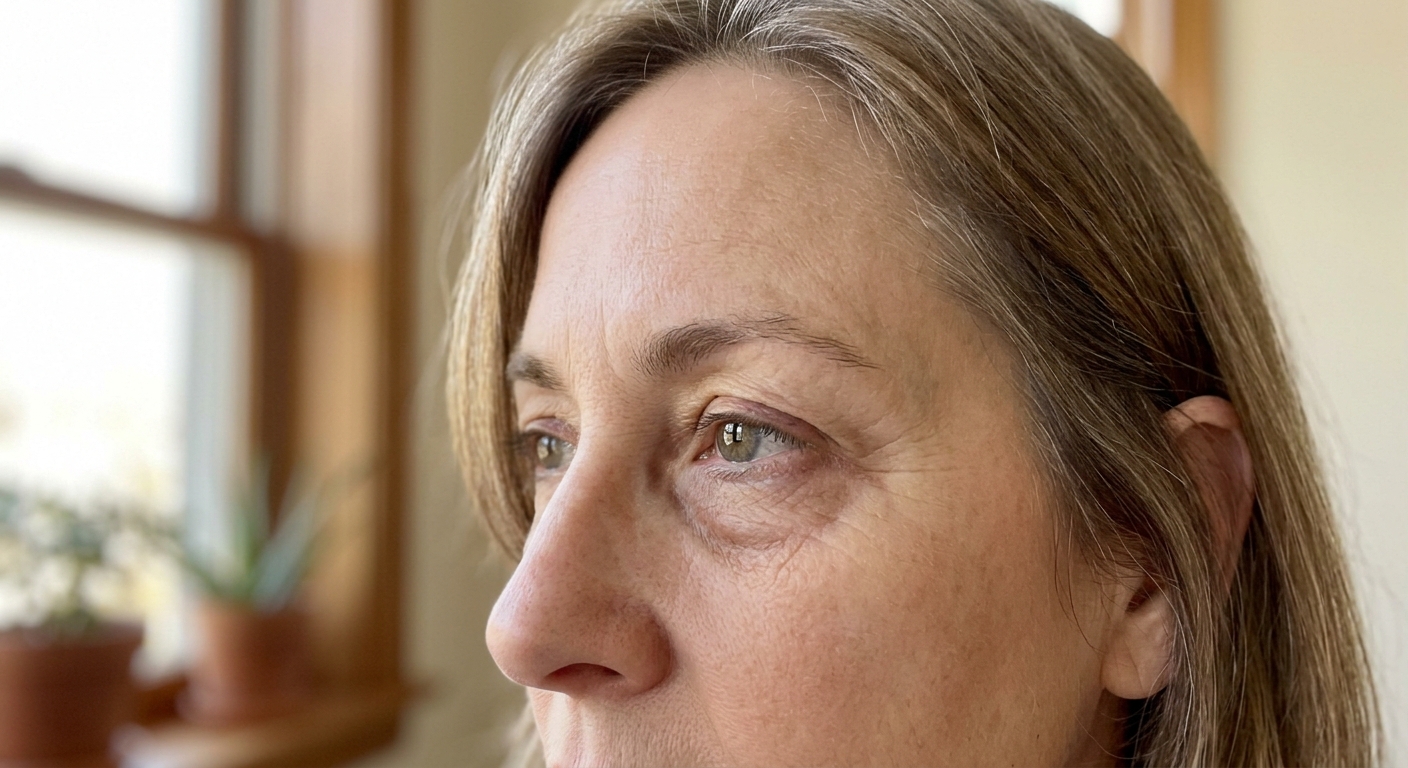
Dark circles have several causes, and they often overlap [1]:
- Pigmented circles: brown or gray-brown darkening from extra melanin, which can be inherited or left behind by allergies and inflamed, rubbed skin.
- Vascular circles: a bluish or purple tone where thin skin lets the blood vessels underneath show through, often with some puffiness.
- Structural shadows: hollows and tear troughs that deepen with age as the skin loosens, casting a shadow that no cream can lighten.
Treatment works best when it targets the main cause [1]. A rough home check helps: gently stretch the skin under your eye. If the brown color stays, pigment is a likely contributor. If the darkness fades or turns bluish, blood vessels or shadow are more likely. Niacinamide’s best evidence is for the first type.
What niacinamide does
Niacinamide handles pigment differently from most brighteners. Rather than blocking the enzyme that makes melanin, it reduces the transfer of finished pigment packages from pigment cells into the surrounding skin cells. In lab models it cut that transfer by 35% to 68% [2].
Your skin showed less hyperpigmentation after 4 weeks of a 5% niacinamide moisturizer than with the same cream without it in a clinical test.
Your skin showed less hyperpigmentation after 4 weeks of a 5% niacinamide moisturizer than with the same cream without it in a clinical test.
Niacinamide also helps aging skin more broadly. In a 12-week split-face study of 50 women, 5% niacinamide applied twice daily reduced fine lines and wrinkles, dark spots, red blotchiness and sallowness, and improved elasticity [3]. A second 12-week study in 50 women aged 40 to 60 confirmed improvements in fine lines, spots, texture and redness [4].
Finally, niacinamide strengthens the barrier. In skin cell studies it raised ceramide production four- to five-fold, and applied to dry skin it increased ceramide levels and reduced water loss [5]. That matters around the eyes, where the skin is the thinnest on the face: in one tissue study, forehead skin was 2.8 times thicker than upper eyelid skin [6].
What the evidence does not show
All of these studies tested niacinamide on the face as a whole, not under the eyes specifically, and no large trial has tested a niacinamide eye cream for dark circles. Its effect on pigment suggests it can help the brown type, but it will not change vascular circles or hollows, and pigment fades slowly.
Products for vascular circles often add caffeine. In a small four-week study in 11 women, an eye pad with 3% caffeine and 1% vitamin K reduced wrinkle depth and dark circles under the treated eye compared with a water pad under the other eye [7]. The study was small and single-blind, so treat it as a hint rather than proof.
Your skin needed 12 weeks of twice-daily 5% niacinamide to show the full fine-line results in facial studies, longer than most people give a new eye cream.
What to look for in a niacinamide eye cream
- A sensible concentration: the facial studies used 2% to 5% [2, 3]. Higher is not automatically better, and the thin eye area is the place to stay conservative.
- Fragrance-free: the eye area reacts easily, and allergic inflammation can itself cause darkening [1].
- Useful partners: caffeine for puffiness [7], peptides for fine lines, and humectants such as glycerin or hyaluronic acid.
- Protective packaging: an airless pump or tube keeps partner ingredients such as vitamin C or retinol stable.
- A texture you will use: a light gel-cream suits mornings under concealer, while a richer cream suits dry eye skin at night.
How niacinamide compares with other under-eye ingredients is covered in our guides to the best eye cream for dark circles, a brightening vitamin C eye cream and a firming peptide eye cream, each of which suits a different cause of tired-looking eyes.
How to use it
Use a rice-grain amount for both eyes. Tap it along the orbital bone with your ring finger, staying clear of the lash line, morning and night. In the morning, follow with sunscreen, because sun exposure darkens pigmented circles.
Give it time. In the facial studies, pigment changes appeared after about four weeks and the broader benefits were measured at 12 weeks [2, 3].
Your skin needed 12 weeks of twice-daily 5% niacinamide to show the full fine-line results in facial studies, longer than most people give a new eye cream.
Adding retinol for crow’s feet and thin skin
Niacinamide improves the look of fine lines, but retinol has stronger evidence for rebuilding the skin itself. On the arms of elderly volunteers, 0.4% retinol lotion used for 24 weeks significantly improved fine wrinkles and increased collagen production compared with the plain lotion [8]. In a 26-week double-blind study in middle-aged women, nightly 0.075% retinol cream on the face improved fine wrinkling in 50% of participants, compared with 24% on the plain cream, with low rates of irritation [9].
Around the eyes, retinol needs a careful start, because thin skin there is quick to dry and flake. Our guide to retinol around the eyes explains how to build up. The two ingredients pair well: niacinamide eye cream in the morning and retinol at night, or niacinamide layered over retinol to support the barrier while the skin adjusts.
An eye-safe retinol option
Many retinol formulas reach the skin by loosening the barrier’s protective lipids, which is why the delicate eye area so often reacts with redness and peeling. Nanoretinol delivers 0.2% stabilized retinol inside biomimetic lipid nanoparticles that the skin recognizes as its own, so it reaches skin cells without breaking down the barrier first, and it is suitable for the eye contour. In North Biomedical’s study summary, Nanoretinol was 232% more effective in collagen recovery and 73% more effective in elastin recovery than conventional retinol, and over 56 days of use skin firmness rose 61% and elasticity rose 56% [10].
A simple routine: niacinamide eye cream and sunscreen in the morning, then a thin layer of Nanoretinol along the orbital bone at night, kept away from the lash line and out of the eyes, followed by your niacinamide eye cream if the area feels dry.
References
- Sarkar R, Ranjan R, Garg S, Garg VK, Sonthalia S, Bansal S. “Periorbital Hyperpigmentation: A Comprehensive Review.” Journal of Clinical and Aesthetic Dermatology. 2016;9(1):49-55. PubMed 26962392
- Hakozaki T, Minwalla L, Zhuang J, Chhoa M, Matsubara A, Miyamoto K, Greatens A, Hillebrand GG, Bissett DL, Boissy RE. “The effect of niacinamide on reducing cutaneous pigmentation and suppression of melanosome transfer.” British Journal of Dermatology. 2002;147(1):20-31. doi:10.1046/j.1365-2133.2002.04834.x
- Bissett DL, Oblong JE, Berge CA. “Niacinamide: A B vitamin that improves aging facial skin appearance.” Dermatologic Surgery. 2005;31(7 Pt 2):860-865. doi:10.1111/j.1524-4725.2005.31732
- Bissett DL, Miyamoto K, Sun P, Li J, Berge CA. “Topical niacinamide reduces yellowing, wrinkling, red blotchiness, and hyperpigmented spots in aging facial skin.” International Journal of Cosmetic Science. 2004;26(5):231-238. doi:10.1111/j.1467-2494.2004.00228.x
- Tanno O, Ota Y, Kitamura N, Katsube T, Inoue S. “Nicotinamide increases biosynthesis of ceramides as well as other stratum corneum lipids to improve the epidermal permeability barrier.” British Journal of Dermatology. 2000;143(3):524-531. doi:10.1111/j.1365-2133.2000.03705.x
- Ha RY, Nojima K, Adams WP Jr, Brown SA. “Analysis of facial skin thickness: defining the relative thickness index.” Plastic and Reconstructive Surgery. 2005;115(6):1769-1773. doi:10.1097/01.prs.0000161682.63535.9b
- Ahmadraji F, Shatalebi MA. “Evaluation of the clinical efficacy and safety of an eye counter pad containing caffeine and vitamin K in emulsified Emu oil base.” Advanced Biomedical Research. 2015;4:10. doi:10.4103/2277-9175.148292
- Kafi R, Kwak HS, Schumacher WE, Cho S, Hanft VN, Hamilton TA, King AL, Neal JD, Varani J, Fisher GJ, Voorhees JJ, Kang S. “Improvement of naturally aged skin with vitamin A (retinol).” Archives of Dermatology. 2007;143(5):606-612. doi:10.1001/archderm.143.5.606
- Kikuchi K, Suetake T, Kumasaka N, Tagami H. “Improvement of photoaged facial skin in middle-aged Japanese females by topical retinol (vitamin A alcohol): a vehicle-controlled, double-blind study.” Journal of Dermatological Treatment. 2009;20(5):276-281. doi:10.1080/09546630902973987
- North Biomedical LLC. “Nanoretinol vs. Conventional Retinol: Efficacy in Collagen and Elastin Recovery.” Clinical Study Summary, 2024. Study summary