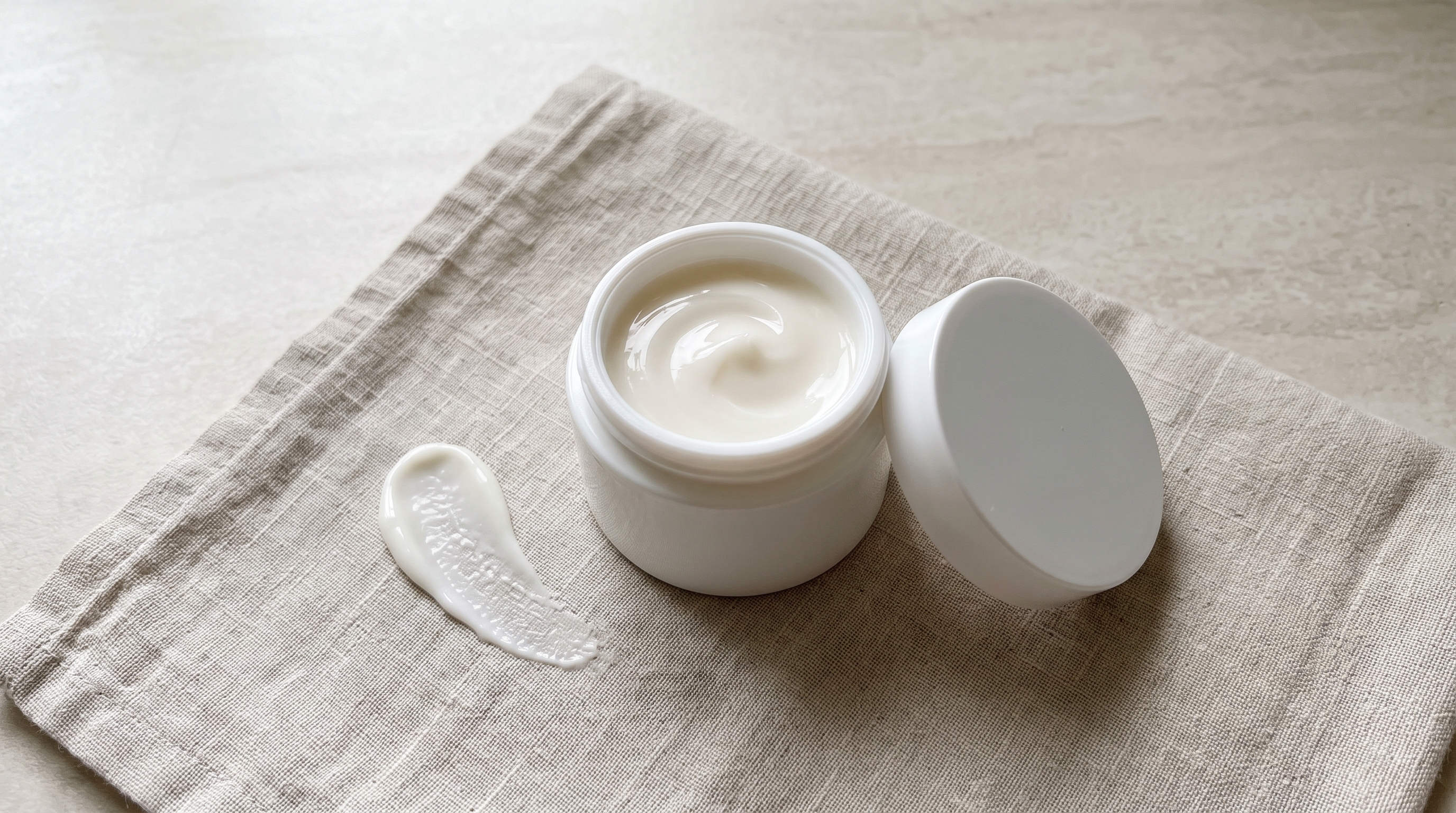
Niacinamide Moisturizer: How to Pick One That Strengthens Your Skin Barrier
The best evidence for niacinamide comes from creams, not serums. Here is what the trials used, which strength makes sense, and how to match the formula to your skin
Niacinamide is usually sold as a serum, often in eye-catching strengths of 10% or more. Yet much of the best clinical evidence for this form of vitamin B3 was gathered in something far less glamorous: an ordinary daily moisturizer.
That matters when you are choosing a product. A niacinamide moisturizer is not a watered-down version of a niacinamide serum. For many people it is the more sensible way to use the ingredient, because it delivers niacinamide in the same kind of formula that was tested, in a step you already do twice a day.
What niacinamide does for your skin barrier
Your skin barrier works like a brick wall. The skin cells are the bricks, and a mortar of lipids, mostly ceramides, fatty acids and cholesterol, fills the spaces between them. When that mortar thins, water escapes, irritants get in, and skin feels tight, rough and reactive.
Niacinamide helps rebuild the mortar. In laboratory work, it increased ceramide production in skin cells between four and five-and-a-half times, along with other barrier lipids, and applying it to dry skin reduced transepidermal water loss, the rate at which water evaporates through the skin [1]. A broader review describes the same pattern across studies: more barrier lipids and protein, better hydration, and calmer, less inflamed skin [2].
What the moisturizer trials showed
The most cited evidence for niacinamide as an anti-aging ingredient comes from split-face studies of a 5% niacinamide moisturizer. In one 12-week trial in 50 women aged 40 to 60, the side treated with niacinamide showed significant improvements in fine lines, hyperpigmented spots, red blotchiness, texture and the yellowish sallowness of aging skin compared with the control side [3]. A second randomized split-face study using 5% niacinamide twice daily for 12 weeks confirmed those improvements and also measured better skin elasticity [4].
Its effect on tone has a clear mechanism. Niacinamide does not block pigment production the way many brighteners do. Instead, it reduces the transfer of pigment packets from melanocytes into surrounding skin cells, cutting that transfer by 35% to 68% in laboratory models, and it lightened hyperpigmentation in clinical testing after four weeks [5].
If the brand states 2% to 5%, you are in the tested range.
For redness-prone skin, a niacinamide-containing moisturizer applied twice daily for four weeks improved barrier function and hydration in 50 people with rosacea, and participants reported their skin felt better by the end [6].
How much niacinamide do you need?
The trials above used 2% to 5%. That range is where the evidence sits, and it is easy to reach in a moisturizer. Higher concentrations are common in serums, but there is little evidence that 10% or 20% works better for barrier or tone, and some people find high strengths make their skin feel warm or tingly.
In practice, that means a moisturizer does not need to shout about its percentage. If the brand states 2% to 5%, you are in the tested range. If it lists niacinamide near the top of the ingredients without a percentage, that usually indicates a meaningful amount. If you want a separate, concentrated niacinamide step, our guide to the best niacinamide serum covers how to choose one.
You may have heard niacinamide causes flushing. That reputation comes from niacin, or nicotinic acid, a closely related form of vitamin B3 that does trigger flushing. Niacinamide is a different molecule and does not usually cause that reaction [2]. Our overview of niacinamide benefits explains the difference in more detail.
Choosing a niacinamide moisturizer for your skin type
Niacinamide suits almost every skin type, but the moisturizer around it should not.
Nanoretinol encapsulates stabilized 0.2% retinol in biomimetic lipid nanoparticles that skin recognizes as its own, so the retinol reaches skin cells without breaking down the barrier your moisturizer is working to protect.
Oily or combination skin. Niacinamide can help here in its own right. In controlled trials, a 2% niacinamide product significantly reduced sebum excretion after two to four weeks in one population and reduced surface oil by six weeks in another [7]. Look for a gel-cream or lotion with light humectants such as glycerin rather than heavy butters. Our guide to the best moisturizer for oily skin lists the textures that work best.
Dry or mature skin. Pair niacinamide with ingredients that seal water in: ceramides, cholesterol, squalane or a small amount of petrolatum or dimethicone. Niacinamide helps your skin make more of its own lipids, and an occlusive keeps the water in while it does.
Sensitive or redness-prone skin. Choose a fragrance-free formula with a short ingredient list. Niacinamide is gentle, but fragrance and essential oils are common triggers in reactive skin.
A quick label checklist:
- Niacinamide in the first half of the ingredient list, or a stated 2% to 5%
- Barrier support such as ceramides, glycerin or squalane
- No added fragrance
- A texture you will use morning and night, since the trials used twice-daily application
Why it pairs so well with retinol
Niacinamide’s most useful talent may be what it does for other ingredients. Retinoids are the best-studied way to rebuild collagen, but they often cause dryness and irritation in the first weeks, and that is when many people give up.
In a double-blind study in women with photodamage, applying a moisturizer containing niacinamide before and during tretinoin treatment reduced retinoid irritation and improved the overall treatment response compared with a basic moisturizer [8]. A stronger barrier makes the retinoid easier to live with, and an easier retinoid gets used consistently. Our article on retinol and niacinamide explains why the two are such a natural combination.
Where Nanoretinol fits
A niacinamide moisturizer strengthens the barrier, calms redness and evens tone. What it cannot do is rebuild the collagen and elastin that keep skin firm. That is where retinol comes in, and it is why the two work best as a team.
The irritation problem can also be solved from the retinol side. Nanoretinol encapsulates stabilized 0.2% retinol in biomimetic lipid nanoparticles that skin recognizes as its own, so the retinol reaches skin cells without breaking down the barrier your moisturizer is working to protect. In North Biomedical’s study summary it was 232% more effective in collagen recovery and 73% more effective in elastin recovery than conventional retinol, and 56 days of use produced a 61% increase in firmness and a 56% increase in elasticity. Its water-based gel absorbs quickly and suits all skin types, including sensitive skin.
A simple evening routine looks like this: cleanse, apply Nanoretinol, then follow with your niacinamide moisturizer. In the morning, use the moisturizer again under sunscreen.
References
- Tanno O, Ota Y, Kitamura N, et al. “Nicotinamide increases biosynthesis of ceramides as well as other stratum corneum lipids to improve the epidermal permeability barrier.” British Journal of Dermatology. 2000;143(3):524-531. doi:10.1111/j.1365-2133.2000.03705.x
- Gehring W. “Nicotinic acid/niacinamide and the skin.” Journal of Cosmetic Dermatology. 2004;3(2):88-93. doi:10.1111/j.1473-2130.2004.00115.x
- Bissett DL, Miyamoto K, Sun P, Li J, Berge CA. “Topical niacinamide reduces yellowing, wrinkling, red blotchiness, and hyperpigmented spots in aging facial skin.” International Journal of Cosmetic Science. 2004;26(5):231-238. doi:10.1111/j.1467-2494.2004.00228.x
- Bissett DL, Oblong JE, Berge CA. “Niacinamide: a B vitamin that improves aging facial skin appearance.” Dermatologic Surgery. 2005;31(7 Pt 2):860-865. doi:10.1111/j.1524-4725.2005.31732
- Hakozaki T, Minwalla L, Zhuang J, et al. “The effect of niacinamide on reducing cutaneous pigmentation and suppression of melanosome transfer.” British Journal of Dermatology. 2002;147(1):20-31. doi:10.1046/j.1365-2133.2002.04834.x
- Draelos ZD, Ertel K, Berge C. “Niacinamide-containing facial moisturizer improves skin barrier and benefits subjects with rosacea.” Cutis. 2005;76(2):135-141. PubMed: 16209160
- Draelos ZD, Matsubara A, Smiles K. “The effect of 2% niacinamide on facial sebum production.” Journal of Cosmetic and Laser Therapy. 2006;8(2):96-101. doi:10.1080/14764170600717704
- Draelos ZD, Ertel KD, Berge CA. “Facilitating facial retinization through barrier improvement.” Cutis. 2006;78(4):275-281. PubMed: 17121065