Non-Comedogenic Moisturizer: What That Label Actually Guarantees
The comedogenic scale brands still cite was built on rabbit ears in the 1970s, and the researchers who built it said so themselves
Roughly 41,000 people a month type “non comedogenic moisturizer” into Google, and almost all of them assume the phrase means something enforceable. It does not. There is no legal definition of non-comedogenic, no required test, and no body that checks the claim before it goes on the carton. A brand can print it because a supplier’s paperwork says an ingredient scored well in an assay run on an animal in 1979.
That is worth knowing before you build a shortlist around the label. It is not that the concept is meaningless. It is that the label is doing far less work than the price of the product implies.
Where the famous comedogenic lists came from
The whole field starts with a real clinical observation. In 1972, Kligman and Mills described a pattern they called acne cosmetica: low-grade, persistent closed comedones on the cheeks and chin of adult women who had no history of teenage acne, appearing in proportion to how much face product they used [1]. They also noticed the trap that makes it self-sustaining, which is that as more blemishes appear, people apply more coverage over them.
To find culprits, researchers needed a screen. The rabbit ear assay became the standard: apply a substance to the inner surface of an albino rabbit’s ear, wait a few weeks, then count comedones. Fulton and colleagues published the best-known version of that work in 1984, testing therapeutic products, finished cosmetics and raw ingredients [2]. That paper is the ancestor of every “pore-clogging ingredients” chart circulating today. Its offender list named isopropyl myristate and its analogs, including isopropyl palmitate, butyl stearate, decyl oleate and isocetyl stearate, plus lanolin derivatives and, surprisingly to the authors, the D&C Red dyes then standard in blushers.
What almost never travels with those charts is the authors’ own assessment of their method. They wrote that the data came from an assay “which is not an ideal animal model but is the best we have.” They were describing a screening tool, not a verdict.
The chart of pore-clogging ingredients pinned to your bathroom mirror is a list of rabbit-ear results whose own authors called the model imperfect.
Grading ingredients tells you very little about products
The deeper problem is structural. A comedogenic score belongs to an ingredient tested more or less neat. You buy a finished formula, where that ingredient sits at some concentration, in some vehicle, alongside twenty other things.
Mills and Kligman had already built a human version of the test, applying substances under patches to the upper back of people who reliably form comedones and then taking cyanoacrylate biopsies to count microcomedones per square inch [3]. Draelos and DiNardo used a modification of that human assay in 2006 to ask the obvious follow-up question: do finished products built from ingredients on the offender lists actually clog pores? Their conclusion was blunt. Finished products using comedogenic ingredients are not necessarily comedogenic [4].
That single finding invalidates most of how the label is used in practice. Screening a moisturizer by scanning its ingredient list against a chart will reject formulas that are fine and approve formulas that are not, because the chart cannot see concentration or vehicle.
The animal model has its own directional bias, too. Later work applying cosmetic ingredients and vehicles in the rabbit found the assay useful as a rough filter but agreed it should not be read as a human result, with ingredient scores above the lower band requiring human confirmation before anyone draws a conclusion [5]. In practice, rabbit ears say yes more often than human backs do.
What to check instead of the claim
None of this means you should ignore clogged pores as a consideration. It means the information you need is not printed on the box.
Comedones take weeks to surface, so any product you have judged in 48 hours you have not actually judged.
Three things are more predictive than the label:
Texture and residue. The single most useful proxy is how the product finishes. A formula that leaves a film you can still feel two hours later is behaving like an occlusive, whatever its ingredient list scores. Water-based gels and thin lotions carry less of this risk than heavy balms, which is why the moisturizer that suits oily skin is usually the one that disappears.
Your own four-week test. Comedones take weeks to become visible, so a two-day trial proves nothing. Apply a new product to one side of the forehead or one cheek only for four weeks and compare. This is a crude version of exactly what the human assay does, and it is the only test run on the formula you actually bought, on the skin you actually have.
The Kligman escalation trap. If you are adding coverage over new blemishes, you are running the 1972 experiment on yourself. Subtracting products is a legitimate diagnostic step, and it is free.
The awkward part for aging skin
Anyone past 40 is being pulled in two directions. Barrier function declines, which argues for richer, more occlusive moisturizers. Follicles stay perfectly capable of forming closed comedones, which argues against them. The standard compromise, a heavier cream accepted as the price of comfort, is why so much adult cosmetic acne shows up along the jaw and cheekbones.
The better resolution is to stop asking one product to do both jobs. Barrier repair is a lipid-signaling problem that responds to specific ingredients rather than to sheer thickness, which is what a well-built ceramide moisturizer is for. Treatment of tone, texture and firmness is a separate job, and it does not require an occlusive vehicle at all.
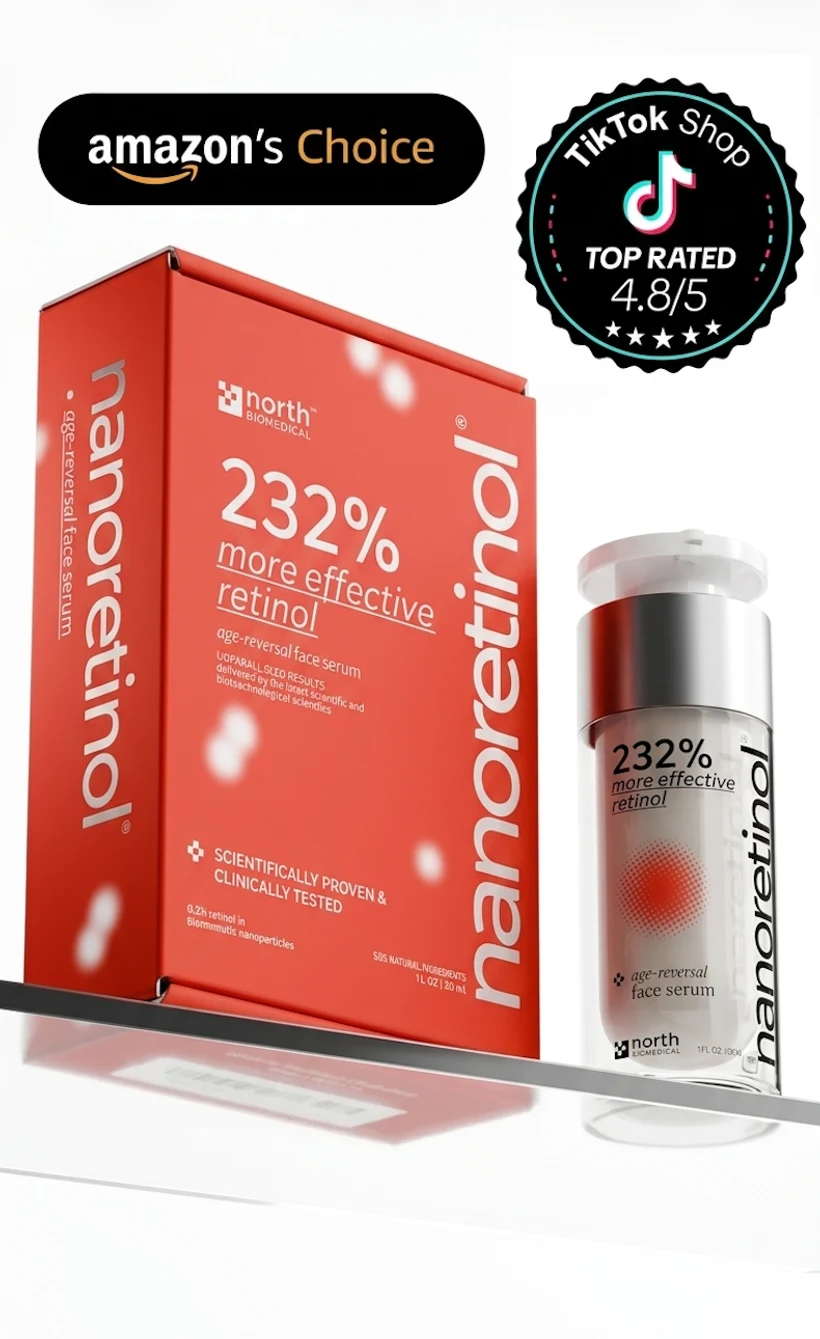
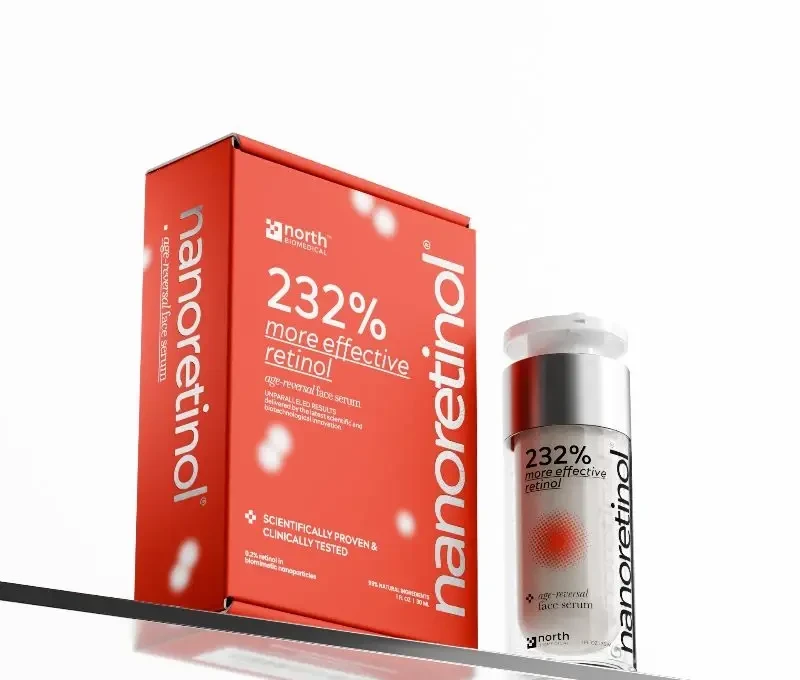
Where Nanoretinol fits
This is the specific reason the delivery system matters more than the ingredient list. Conventional retinol formulations lean on solvents and petroleum-derived penetration enhancers to push the molecule through the stratum corneum, and those vehicles are exactly the heavy, film-forming materials that populate the offender charts in the first place.
Nanoretinol takes a different route. The retinol is encapsulated in biomimetic lipid nanoparticles that the skin recognizes as self and admits through the epithelial barrier intact, so there is no need for a disruptive vehicle to force entry. The formula itself is a water-based gel, 99% natural, with complete absorption and a matte finish rather than a residual film, and North Biomedical’s clinical study summary reports the encapsulated form as 232% more effective in collagen recovery and 73% more effective in elastin recovery than conventional retinol, alongside a 61% increase in firmness and a 56% increase in elasticity over 56 days. It is formulated for all skin types, including oily and combination skin.
The short version
Treat non-comedogenic as marketing shorthand rather than a specification. Judge a moisturizer by what it leaves on your skin, give it four weeks on one side of your face, and keep the job of treating aging skin separate from the job of comforting it.
References
- Kligman AM, Mills OH Jr. “Acne cosmetica.” Archives of Dermatology. 1972;106(6):843-850. PMID: 4264346
- Fulton JE Jr, Pay SR, Fulton JE 3rd. “Comedogenicity of current therapeutic products, cosmetics, and ingredients in the rabbit ear.” Journal of the American Academy of Dermatology. 1984;10(1):96-105. doi:10.1016/S0190-9622(84)80050-X
- Mills OH Jr, Kligman AM. “A human model for assessing comedogenic substances.” Archives of Dermatology. 1982;118(11):903-905. PMID: 7138047
- Draelos ZD, DiNardo JC. “A re-evaluation of the comedogenicity concept.” Journal of the American Academy of Dermatology. 2006;54(3):507-512. doi:10.1016/j.jaad.2005.11.1058
- Nguyen SH, Dang TP, Maibach HI. “Comedogenicity in rabbit: some cosmetic ingredients/vehicles.” Cutaneous and Ocular Toxicology. 2007;26(4):287-292. doi:10.1080/15569520701555383