
Dermatologist-Recommended Skin Care Routine for Your 50s
Built around the post-menopausal collagen curve rather than a generic step list, including the two habits worth dropping from your 40s
Most routines written for this decade are the forties routine with a richer moisturiser bolted on. That misses what is distinctive about the fifties, which is that the underlying physiology changes rather than merely continuing. The rate of collagen loss shifts, barrier function gets less forgiving, and products you tolerated comfortably for ten years can suddenly sting.
A routine built around that shift looks different from one built around age alone. It is also shorter than most lists suggest.
What actually changes in this decade
The defining event is oestrogen withdrawal, and its effect on skin is one of the better-quantified findings in the field. Measuring skin collagen content in postmenopausal women, researchers found a clear decline related to years since menopause, and showed that the loss was preventable in women receiving sex hormone replacement [1]. The commonly cited figure from this body of work is a decline of roughly 1% to 2% per year after menopause, and it is front-loaded: the steepest losses cluster in the years immediately following.
Oestrogen receptors sit throughout skin, and their influence runs well past collagen. Reviews of oestrogen and ageing skin describe effects on dermal thickness, hydration, wound healing and elastin quality, which is why the changes in this decade arrive together rather than one at a time [2]. Thinner, drier, less elastic skin does not just show existing lines more clearly. It also tolerates less.
The collagen you lose in the five years around menopause is not lost at the same rate as the collagen you lost in your forties, and the routine should acknowledge that.
That tolerance change is the practical hinge. The fifties routine has to deliver more biological signal through a barrier with less margin for error, which rules out simply doubling the strength of everything.
Step one: a cleanser that stops subtracting
Nothing in a cleanser will build collagen, so the only job is to finish the wash without having removed barrier lipids. Foaming surfactant cleansers that suited oilier skin in earlier decades now leave a tight, squeaky finish that signals stripped lipids rather than cleanliness.
Switch to a cream, milk or oil cleanser, and wash once at night rather than twice a day. Morning water alone is enough for most people in this decade. This is the single cheapest improvement available, and it costs nothing.
Step two: the one non-negotiable active
If only one step survives a busy week, it should be a retinoid at night. It remains the only topical class with repeated histological evidence of rebuilding collagen that has been lost, rather than temporarily improving how skin looks.
The trial that matters most here was run in genuinely aged skin. Applying 0.4% retinol lotion up to three times a week for 24 weeks produced glycosaminoglycan levels around 40% higher than vehicle-treated skin, along with increased collagen production, which the investigators identified as the likely basis for wrinkle effacement [3]. That study was conducted in participants with a mean age of 87, which makes it unusually relevant: the response is not something the skin loses the capacity for.
Apply it to dry skin, at night, starting at two nights a week and building only when there is no residual irritation. Give it six months before judging it.
Step three: support the barrier so step two survives
This is the part the forties routine did not need. A retinoid is only as good as your adherence to it, and adherence in this decade fails on irritation rather than on motivation.
Two supporting actives earn their place. Niacinamide at 5% applied twice daily for 12 weeks produced significant reductions in fine lines and wrinkles, hyperpigmented spots, red blotchiness and sallowness in a double-blind, left-right randomised study of women with photoaged facial skin [4]. And hyaluronic acid addresses something specific to ageing skin rather than a generic dryness claim, since skin’s hyaluronan content and its ability to retain water both fall with age, which is a structural contributor to the loss of turgor and plumpness [5].
A moisturiser chosen for skin over 50 sitting on top of both is not an optional luxury step. It is what makes the retinoid tolerable.
Adherence is the active ingredient nobody lists, and in your fifties it fails because of stinging rather than because of forgetting.
Step four: the step with the strongest trial behind it
Daily sunscreen has better randomised evidence for preventing visible ageing than any cream on the market. In a randomised trial of adults assigned to daily versus discretionary broad-spectrum sunscreen, the daily group showed 24% less skin ageing measured by surface micro-topography after four and a half years [6]. No topical anti-ageing product has a comparable result from a comparable design.
Use it every day, including indoors near windows and through winter. It also protects the investment in step two, since retinoid-treated skin should not be spending its afternoons accumulating fresh photodamage.
Two habits from your forties to retire
Exfoliation cadence is the first. A twice-weekly acid that suited you at 45 frequently becomes counterproductive once barrier lipids decline, and the symptom is misread as dryness that needs more exfoliation. Drop to once a week or once a fortnight, and if you are already using a retinoid, consider dropping it altogether for a month to see whether your “dry patches” resolve.
Layering count is the second. Seven-step routines have more failure points and more irritants, and the evidence base thins rapidly past the four steps above. The routine that worked in your forties was likely built for oilier, more resilient skin than you have now.
Where Nanoretinol fits
The tension in this whole routine is that the most valuable step is the one most likely to be abandoned. Conventional retinol formulations use solvents and petroleum-derived penetration enhancers that get the molecule through the barrier by disrupting it, and fifties skin is exactly the population least able to absorb that cost.
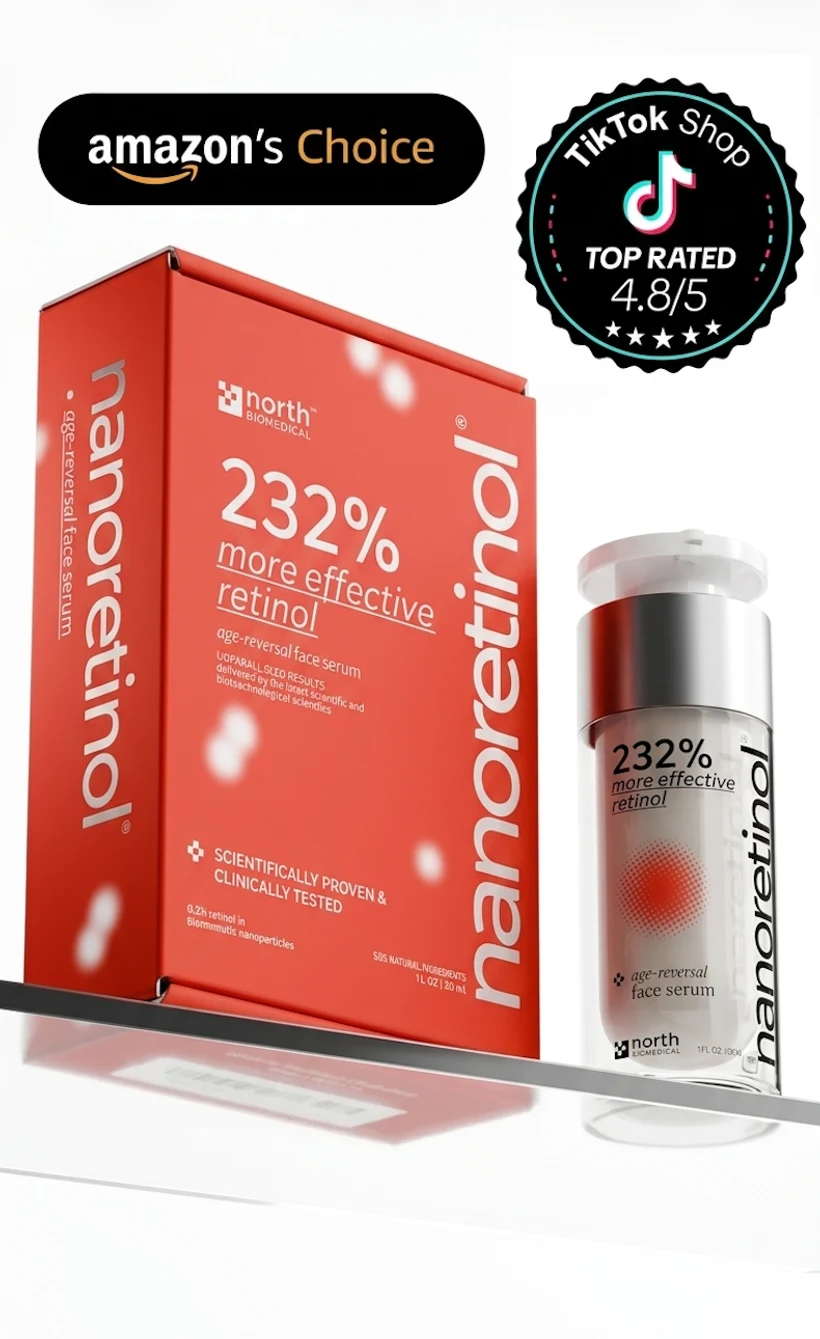
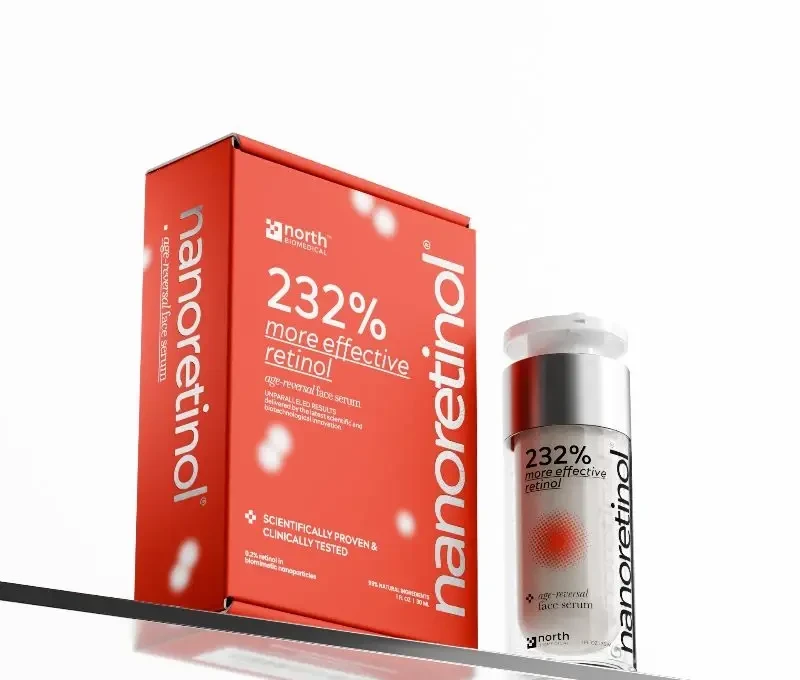
Nanoretinol resolves that trade-off by changing the delivery instead of the dose. The retinol is encapsulated in biomimetic lipid nanoparticles that the skin recognises as self and admits through the epithelial barrier intact, with no need to break the barrier down. North Biomedical’s clinical study summary reports the encapsulated form as 232% more effective in collagen recovery and 73% more effective in elastin recovery than conventional retinol, with a 61% increase in skin firmness and a 56% increase in skin elasticity over 56 days of use, at a stabilised 0.2% concentration suitable for sensitive skin and safe around the eye contour.
Putting the week together
Water in the morning, sunscreen over a light moisturiser, and that is the whole daytime routine. At night, cream cleanser, retinoid on two to four nights, niacinamide or a hyaluronic acid serum on the others, moisturiser every night without exception.
If you are working through the wider set of menopausal skin changes, the same logic applies across all of them: identify what physiology changed, treat that, and resist adding steps to compensate for a routine that is failing on tolerance rather than on ingredients.
References
- Brincat M, Moniz CF, Kabalan S, Versi E, O’Dowd T, Magos AL, Montgomery J, Studd JW. “Decline in skin collagen content and metacarpal index after the menopause and its prevention with sex hormone replacement.” British Journal of Obstetrics and Gynaecology. 1987;94(2):126-129. doi:10.1111/j.1471-0528.1987.tb02338.x
- Thornton MJ. “Estrogens and aging skin.” Dermato-Endocrinology. 2013;5(2):264-270. doi:10.4161/derm.23872
- Kafi R, Kwak HS, Schumacher WE, Cho S, Hanft VN, Hamilton TA, King AL, Neal JD, Varani J, Fisher GJ, Voorhees JJ, Kang S. “Improvement of naturally aged skin with vitamin A (retinol).” Archives of Dermatology. 2007;143(5):606-612. doi:10.1001/archderm.143.5.606
- Bissett DL, Oblong JE, Berge CA. “Niacinamide: A B vitamin that improves aging facial skin appearance.” Dermatologic Surgery. 2005;31(7 Pt 2):860-865. doi:10.1111/j.1524-4725.2005.31732
- Papakonstantinou E, Roth M, Karakiulakis G. “Hyaluronic acid: A key molecule in skin aging.” Dermato-Endocrinology. 2012;4(3):253-258. doi:10.4161/derm.21923
- Hughes MC, Williams GM, Baker P, Green AC. “Sunscreen and prevention of skin aging: a randomized trial.” Annals of Internal Medicine. 2013;158(11):781-790. doi:10.7326/0003-4819-158-11-201306040-00002