
The Best Skin Care Routine for Your 40s, According to the Evidence
The decade prevention stops being enough and correction has to start earning its place
Something changes around forty-three that nobody warns you about. The skin does not suddenly look older. It stops bouncing back. The pillow crease that used to fade over breakfast is still faintly there at lunch. The lines that appeared when you smiled begin appearing when you do not.
That shift is the reason a routine built in your thirties stops delivering in your forties. The thirties are a prevention decade, and a good thirties routine is mostly about not making things worse. The forties are the decade when the losses become visible at rest, and a routine has to start actively putting something back.
The Arithmetic Nobody Runs
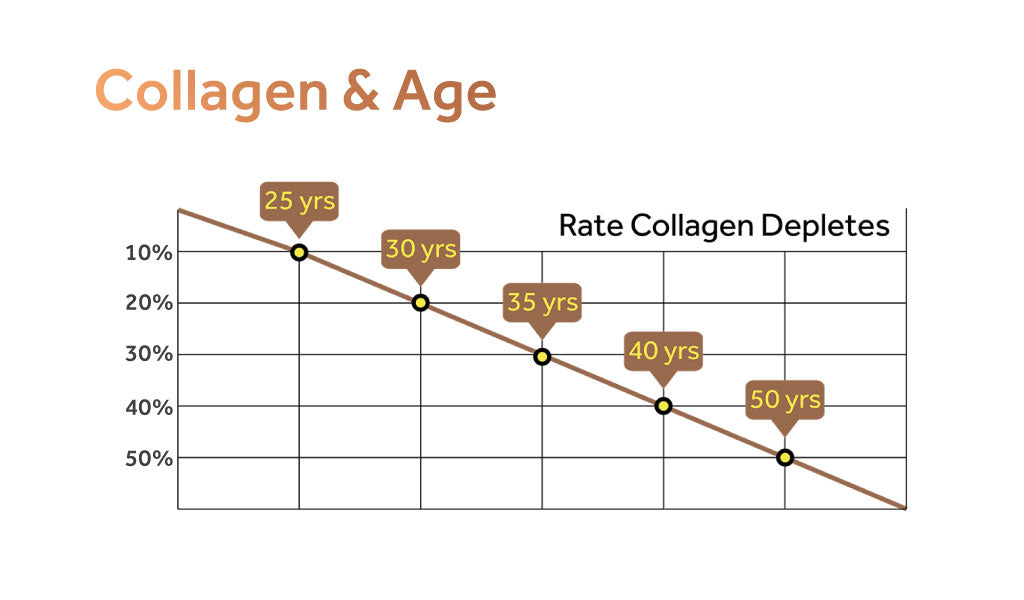
The foundational measurement here is fifty years old and has never been meaningfully overturned. Researchers measured skin collagen content, dermal thickness, and collagen density across 148 people aged 15 to 93, and found that collagen content declines roughly linearly through adult life, at a rate commonly summarised as about 1% per year, with women lower than men at every age measured [1].
Compound that quietly from your mid-twenties and the forties are simply where the running total becomes legible on your face.
The Variable That Separates Forty from Thirty
Chronological loss is only half of it. The other half is hormonal, and its timing is the specific reason this decade behaves differently.
Under the STRAW+10 staging system, the field’s standard framework for reproductive aging, the early menopausal transition typically begins in a woman’s mid-to-late forties, marked by persistent variation in cycle length, with the median final menstrual period arriving around age 51 or 52 [2]. Skin registers that transition. In a study comparing 69 untreated postmenopausal women with 37 women receiving hormone implants, skin collagen content fell significantly with each year since menopause in the untreated group, and hormone replacement prevented that decline [3].
So the forties are not one process. They are chronological collagen loss and the beginning of an estrogen-linked acceleration arriving at the same time. Understanding perimenopausal skin changes is what turns a generic anti-aging routine into one aimed at what is actually happening.
Compound that quietly from your mid-twenties and the forties are simply where the running total becomes legible on your face.
Before Any of That: The 80% Problem
There is a temptation in this decade to buy complexity. It is worth pausing on how much of what you see in the mirror is not aging at all.
When researchers compared 298 women who habitually sought sun with those who avoided it, scoring wrinkles and texture, sagging, vascular change, and pigmentation, ultraviolet exposure accounted for an estimated 80% of visible facial aging signs. Pigment irregularity tracked UV most tightly, while sagging tracked chronological age [4].
That number reorders the shopping list. And the intervention is not theoretical: in a randomised trial of 903 adults over four and a half years, daily broad-spectrum sunscreen produced 24% less skin aging than discretionary use, measured objectively on silicone skin casts. The daily group showed no detectable increase in photoaging across the entire study [5].
The Morning Routine
Keep it short enough that you actually do it every day, because consistency is the active ingredient.
Cleanse gently, or simply rinse if your skin runs dry, which it increasingly will. Apply an antioxidant serum on damp skin if you enjoy the step. Follow with a moisturiser matched to how your skin behaves now rather than how it behaved at thirty. Then finish with broad-spectrum SPF 30 or higher, applied at a genuine full-face quantity, every single day including the overcast ones.
If you add one thing to the morning, add niacinamide. In a twelve-week split-face trial of 50 women aged 40 to 60, a moisturiser containing 5% niacinamide significantly outperformed the same moisturiser without it on fine lines, hyperpigmented spots, texture, red blotchiness, and sallowness [6]. That is an unusually direct match between a study population and the reader of this article.
In photodamaged human skin, type I collagen formation runs 56% lower than in sun-protected skin from the same person.
The Night Routine
Night is where the correction happens, and the order matters more than the number of products. If you are unsure how to sequence what you already own, the general rule for layering skincare is thinnest to thickest, water before oil.
Cleanse properly to remove sunscreen and the day. Apply your retinoid to dry skin. Follow with moisturiser. That is a complete, evidence-supported night routine, and adding steps to it produces diminishing returns quickly.
The One Product That Changes the Trajectory
Everything above manages the decline. One category reverses part of it.
In photodamaged human skin, type I collagen formation runs 56% lower than in sun-protected skin from the same person. Treated with topical tretinoin, collagen I formation increased by 80%, while vehicle-treated skin declined 14% [7]. That effect is not confined to prescription strength. In a randomised, double-blind, vehicle-controlled trial, 24 weeks of 0.4% over-the-counter retinol significantly improved fine wrinkling scores against vehicle and raised procollagen I and glycosaminoglycan expression in biopsied skin [8].
This is the reason a retinoid stops being optional in your forties. It is the only widely available topical that has been shown, on biopsy, to make fibroblasts build again. Starting one now also front-loads the benefit, in the same way that preventing wrinkles is cheaper than treating them.
Where Nanoretinol Fits
The practical failure of retinol has never been efficacy. It is that most people quit. Conventional retinol barely crosses the epithelial barrier, and the formulations that push it through rely on chemicals and petroleum derivatives that break the barrier down through lipid mobility, which delivers the burning, redness, and peeling that end most attempts within a month. In a decade when the barrier is already thinning, that trade is a bad one.
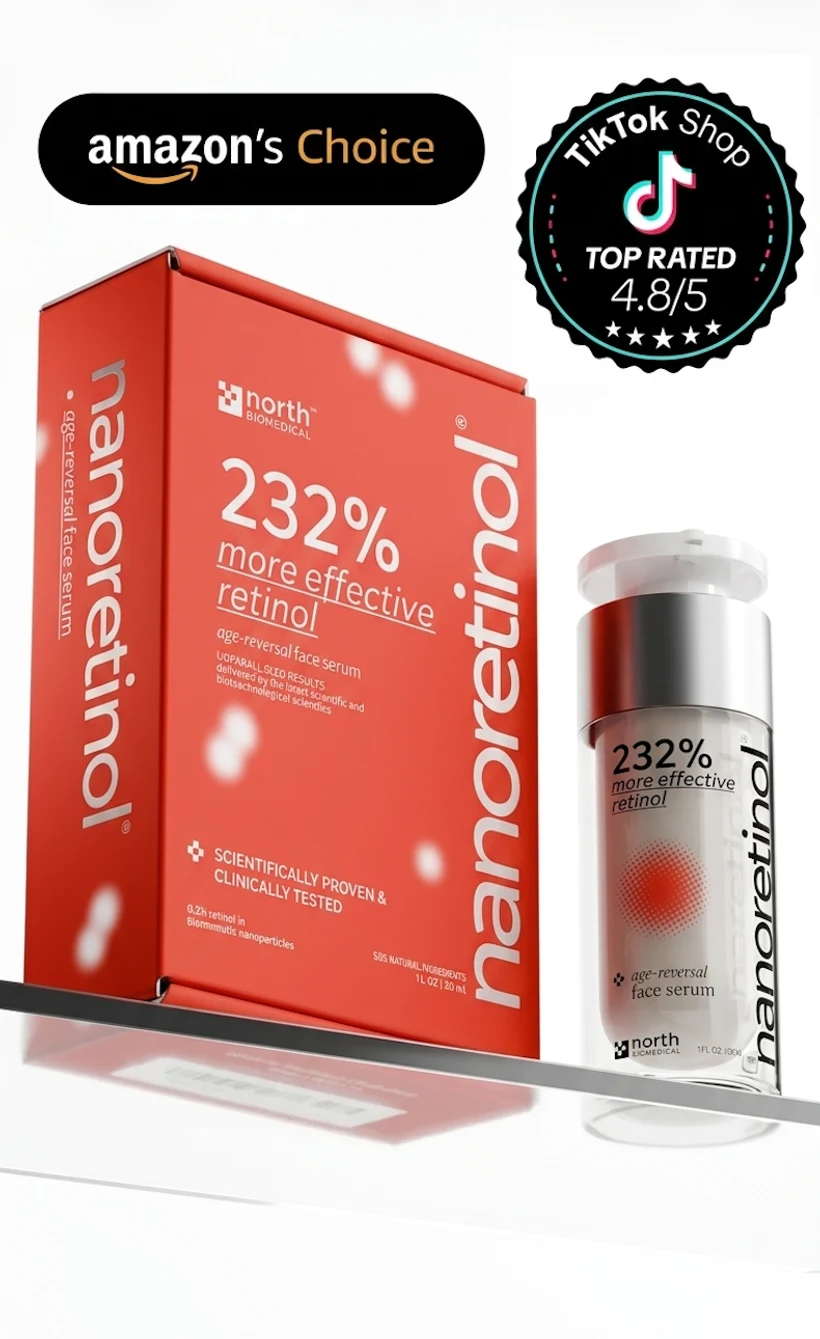
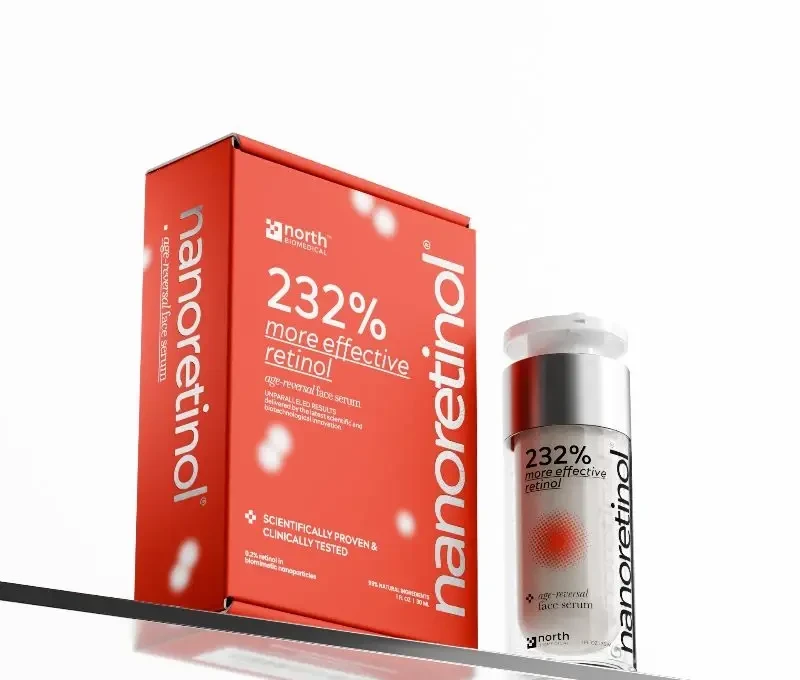
Nanoretinol solves the delivery problem instead of brute-forcing it. Its 0.2% retinol sits inside biomimetic lipid nanoparticles that are externally identical to skin cells, so the body reads them as self and admits them through the barrier without damaging it, the same nanotechnology used in modern drug delivery. Measured against conventional retinol it proved 232% more effective in collagen recovery and 73% more effective in elastin recovery, with drastically reduced cytotoxicity. Over 56 days of use, skin firmness rose 61% and elasticity rose 56% [9]. The formula is water-based, 99% natural, and suitable for sensitive skin and the eye contour, which is what makes nightly use realistic rather than aspirational.
What to Stop Paying For
A forties routine gets better by subtraction as often as by addition. Collagen creams sit at the top of the list, since intact collagen molecules are far too large to reach the dermis from the outside. Ten-step regimens compete with themselves and irritate skin that no longer tolerates irritation well. Anything promising to lift or tighten in a topical is describing a temporary film, not a change in tissue. And a second exfoliant on top of a retinoid usually costs you barrier function without buying additional turnover.
Spend the difference on sunscreen you will genuinely reapply and a retinoid you can genuinely tolerate every night.
The Decade That Rewards Starting
The uncomfortable truth about the forties is that they are still early. Collagen loss compounds, which means the same product started now returns more than it will at fifty-five, and the interventions that work are unglamorous, cheap relative to procedures, and boring to maintain.
Sunscreen every morning. A retinoid most nights. A moisturiser that suits the skin you have today. Done consistently for a decade, that is a different face than the alternative, and no serum bought in a panic at fifty-eight closes the gap.
References
- Shuster S, Black MM, McVitie E. “The influence of age and sex on skin thickness, skin collagen and density.” British Journal of Dermatology. 1975;93(6):639-643. doi:10.1111/j.1365-2133.1975.tb05113.x
- Harlow SD, Gass M, Hall JE, Lobo R, Maki P, Rebar RW, et al. “Executive summary of the Stages of Reproductive Aging Workshop + 10: addressing the unfinished agenda of staging reproductive aging.” Journal of Clinical Endocrinology & Metabolism. 2012;97(4):1159-1168. PMID: 22344196
- Brincat M, Moniz CF, Kabalan S, Versi E, O’Dowd T, Magos AL, et al. “Decline in skin collagen content and metacarpal index after the menopause and its prevention with sex hormone replacement.” British Journal of Obstetrics and Gynaecology. 1987;94(2):126-129. doi:10.1111/j.1471-0528.1987.tb02338.x
- Flament F, Bazin R, Rubert V, Simonpietri E, Piot B, Laquieze S. “Effect of the sun on visible clinical signs of aging in Caucasian skin.” Clinical, Cosmetic and Investigational Dermatology. 2013;6:221-232. doi:10.2147/CCID.S44686
- Hughes MC, Williams GM, Baker P, Green AC. “Sunscreen and prevention of skin aging: a randomized trial.” Annals of Internal Medicine. 2013;158(11):781-790. doi:10.7326/0003-4819-158-11-201306040-00002
- Bissett DL, Miyamoto K, Sun P, Li J, Berge CA. “Topical niacinamide reduces yellowing, wrinkling, red blotchiness, and hyperpigmented spots in aging facial skin.” International Journal of Cosmetic Science. 2004;26(5):231-238. doi:10.1111/j.1467-2494.2004.00228.x
- Griffiths CEM, Russman AN, Majmudar G, Singer RS, Hamilton TA, Voorhees JJ. “Restoration of collagen formation in photodamaged human skin by tretinoin (retinoic acid).” New England Journal of Medicine. 1993;329(8):530-535. doi:10.1056/NEJM199308193290803
- Kafi R, Kwak HS, Schumacher WE, Cho S, Hanft VN, Hamilton TA, et al. “Improvement of naturally aged skin with vitamin A (retinol).” Archives of Dermatology. 2007;143(5):606-612. PMID: 17515510
- North Biomedical LLC. “Nanoretinol vs. Conventional Retinol: Efficacy in Collagen and Elastin Recovery.” Clinical Study Summary, 2024. Study summary