Smoking and Wrinkles: What the Damage Actually Is and What Recovers When You Quit
Twin studies let researchers isolate tobacco from genetics — and the results are more specific, and more hopeful, than the usual warnings
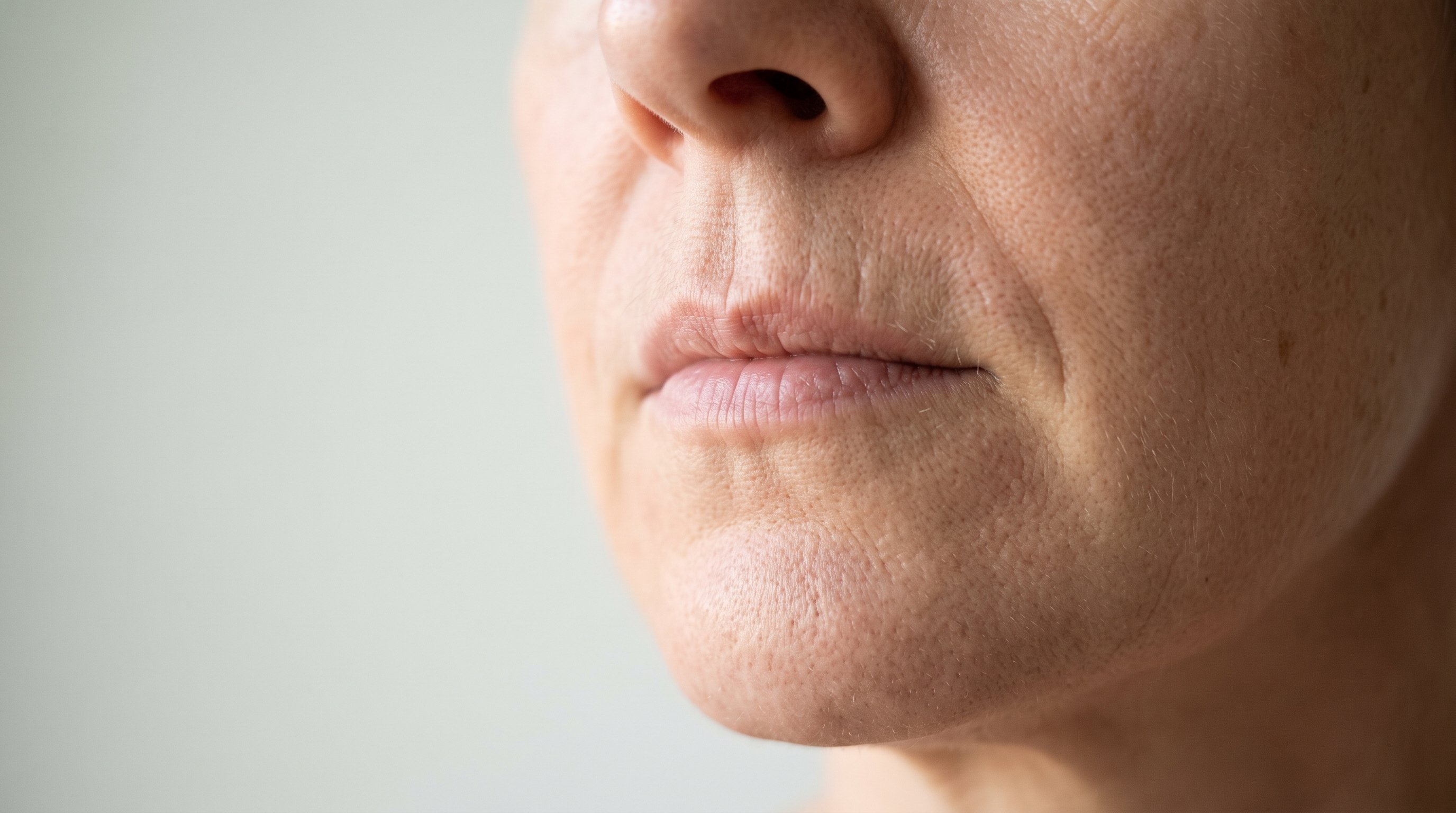
In 1985 a physician named Douglas Model published a short paper in the British Medical Journal asking whether “smoker’s face” was a real clinical sign. He examined 116 patients and found that a distinct cluster of features — deep lines radiating from the lips and eyes, a gaunt bony contour, a grey or slightly orange complexion — identified current or former smokers with striking accuracy, independent of age, sun exposure, and weight change [1].
Forty years later that observation has been taken apart mechanism by mechanism. The useful thing about the modern research is not that it confirms smoking ages skin, which nobody doubted. It is that it tells you precisely which parts of the damage are structural and which are not.
The twin studies that removed the confounders
The persistent problem with smoking research is that smokers differ from non-smokers in dozens of ways. Identical twins solve it, because genetics and usually childhood sun exposure are held constant.
In a study of twin pairs discordant for smoking, the smoking twin was consistently judged to have worse upper and lower eyelid skin, more pronounced nasolabial folds, deeper upper and lower lip lines, and more sagging of the jawline [2]. A separate twin analysis found that skin aging scores rose with pack-years, and that a difference of five years of smoking duration between twins was enough to produce a visible difference in graded facial aging [3].
Two people with identical DNA, raised in the same house, can be separated by five years of cigarettes and look visibly different ages.
Earlier population work had already established the dose relationship. In a study controlling for sun exposure and age, heavy smokers were more than twice as likely as non-smokers to show premature facial wrinkling, and the effect of smoking and sun exposure together was greater than either alone [4].
What tobacco actually does to the dermis
Two mechanisms carry most of the damage, and they work in opposite directions on the same tissue.
The first is accelerated collagen destruction. Skin contains matrix metalloproteinases, enzymes that dismantle collagen as part of normal remodelling. MMP-1 is the one that cleaves intact type I collagen, the structural protein that makes up most of the dermis. Skin biopsies from smokers show significantly increased MMP-1 messenger RNA compared with non-smokers, and the increase appears in skin that has not been heavily sun-exposed [5]. Tobacco does not merely fail to protect collagen; it actively upregulates the machinery that removes it.
The second is elastic fibre disorganisation. Morphometric and immunohistochemical analysis of skin from smokers found abnormal, thickened and fragmented elastic fibres in the dermis, a pattern resembling solar elastosis but occurring on sun-protected sites [6]. The tissue is not just thinner. It is qualitatively wrong, which is why smoker’s skin often reads as leathery rather than simply lined.
On top of both sits chronic vasoconstriction. Nicotine narrows dermal capillaries, and the resulting reduction in cutaneous blood flow limits oxygen and nutrient delivery to the very fibroblasts that would otherwise rebuild the matrix.
Why it compounds with sun damage
Ultraviolet light drives facial aging through a closely related pathway: UV exposure induces the same family of matrix metalloproteinases, degrading collagen faster than it is replaced, with the deficit accumulating over decades [7]. Smoking and sunlight therefore converge on the same enzymatic bottleneck from two directions.
This is the mechanism behind the multiplication seen in the epidemiology. A review of the molecular evidence concluded that tobacco smoke and ultraviolet radiation share oxidative and MMP-mediated pathways, which is why the combination produces more damage than the arithmetic sum of the two [8]. If you smoke and you have historic sun damage on the face, you are not dealing with two separate problems.
The collagen you had at 30 is a bank balance, and smoking increases the withdrawal rate without touching the deposits.
What genuinely recovers after quitting
Here the news is better than the warnings imply, provided you separate the two categories.
Recovers, and relatively quickly. The vascular component is largely reversible. Cutaneous microcirculation improves within weeks to months of the last cigarette, and with it the grey, dull, poorly perfused look that makes complexion the first thing people notice. Oxidative load falls. Wound healing measurably improves. Most of the “my skin looks better” reports in the first six months after quitting are this.
Does not recover on its own. Collagen and elastin that has already been degraded does not spontaneously come back, because adult dermal fibroblasts in aged, damaged skin are already producing less collagen than they once did. Deep perioral lines, jawline laxity, and established elastosis are structural, and stopping the cause simply stops the loss getting worse. The fixed portion is why our guide to smoker’s lines treats them as a rebuilding problem rather than a hydration one.
That split defines the strategy. Quitting protects what remains. Rebuilding what was lost requires something that tells fibroblasts to produce collagen again, which is the same problem addressed in boosting collagen production.
The one topical category with the right mechanism
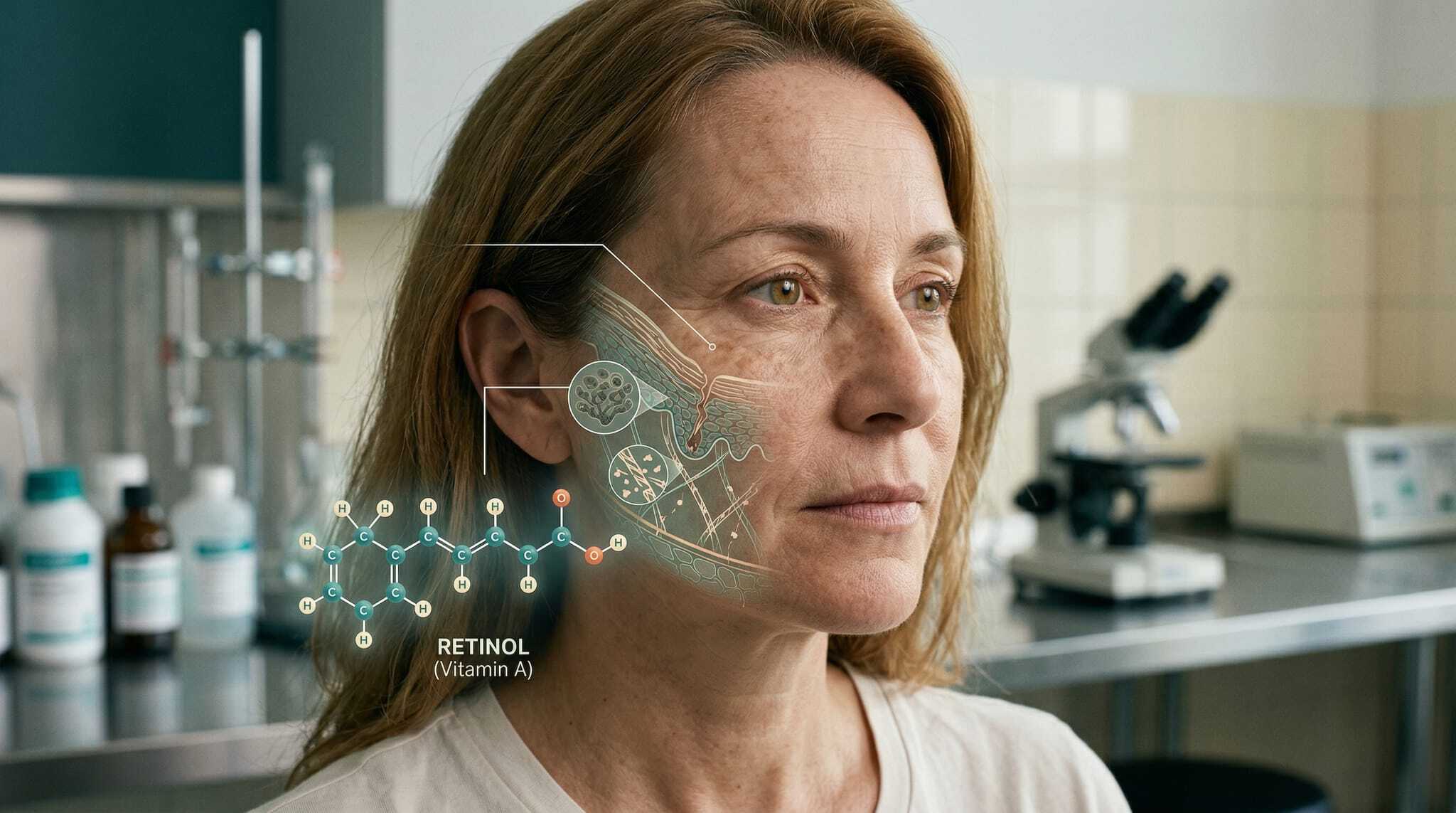
Most skincare aimed at smoking damage targets the surface. The damage is in the dermis, and only a short list of topicals demonstrably reaches it and changes fibroblast behaviour. Retinoids are at the top of that list precisely because they act on the two processes tobacco disrupted: they suppress matrix metalloproteinase expression and they stimulate procollagen synthesis. That is the opposite of what MMP-1 upregulation does.
The obstacle is that conventional retinol is exactly the wrong texture for skin whose barrier is already compromised by years of oxidative stress and reduced perfusion. Standard formulations cross the epithelial barrier by disrupting it, and the redness and peeling that follow are why so many people quit in the first fortnight.
Nanoretinol takes a different route. Its retinol is encapsulated in biomimetic lipid nanoparticles the skin recognises as self and admits without barrier damage, which is what allows a gentle 0.2% formulation to outperform conventional retinol by 232% in collagen recovery and 73% in elastin recovery in North Biomedical’s clinical study, with drastically reduced cytotoxicity. For skin recovering from tobacco, the elastin figure matters as much as the collagen one. Our broader treatment of the ingredient sits in retinol for wrinkles.
The realistic timeline
Stopping halts the enzymatic attack immediately. Circulation and complexion improve over the first few months, and that is the part you will notice without looking for it. Structural change is slower: the retinol trials that show measurable collagen and wrinkle improvement in aged skin run for months, not weeks, and require nightly consistency plus daily sunscreen to stop the sun re-opening the same pathway tobacco just closed.
The forty-year-old observation still holds. Smoker’s face is real, it is specific, and roughly half of it is negotiable.
References
- Model D. “Smoker’s face: an underrated clinical sign?” British Medical Journal (Clinical Research Edition). 1985;291(6511):1760-1762. doi:10.1136/bmj.291.6511.1760
- Okada HC, Alleyne B, Varghai K, Kinder K, Guyuron B. “Facial Changes Caused by Smoking: A Comparison between Smoking and Nonsmoking Identical Twins.” Plastic and Reconstructive Surgery. 2013;132(5):1085-1092. doi:10.1097/PRS.0b013e3182a4c20a
- Doshi DN, Hanneman KK, Cooper KD. “Smoking and Skin Aging in Identical Twins.” Archives of Dermatology. 2007;143(12):1543-1546. doi:10.1001/archderm.143.12.1543
- Kadunce DP, Burr R, Gress R, Kanner R, Lyon JL, Zone JJ. “Cigarette Smoking: Risk Factor for Premature Facial Wrinkling.” Annals of Internal Medicine. 1991;114(10):840-844. doi:10.7326/0003-4819-114-10-840
- Lahmann C, Bergemann J, Harrison G, Young AR. “Matrix metalloproteinase-1 and skin ageing in smokers.” The Lancet. 2001;357(9260):935-936. doi:10.1016/S0140-6736(00)04220-3
- Just M, Ribera M, Monso E, Lorenzo JC, Ferrandiz C. “Effect of smoking on skin elastic fibres: morphometric and immunohistochemical analysis.” British Journal of Dermatology. 2007;156(1):85-91. doi:10.1111/j.1365-2133.2006.07575.x
- Fisher GJ, Wang ZQ, Datta SC, Varani J, Kang S, Voorhees JJ. “Pathophysiology of Premature Skin Aging Induced by Ultraviolet Light.” New England Journal of Medicine. 1997;337(20):1419-1429. doi:10.1056/NEJM199711133372003
- Yin L, Morita A, Tsuji T. “Skin aging induced by ultraviolet exposure and tobacco smoking: evidence from epidemiological and molecular studies.” Photodermatology, Photoimmunology & Photomedicine. 2001;17(4):178-183. doi:10.1034/j.1600-0781.2001.170407.x