
Strength Training for Loose Skin: What Lifting Can and Cannot Tighten
Muscle refills what dieting emptied, but the dermis keeps its own record of being stretched
The advice arrives within about four seconds of mentioning loose skin to anyone at a gym. Build muscle underneath it. Fill it back out. Give the skin something to sit on.
It is not bad advice. It is just answering half of a two-part question, and the half it leaves alone is the half most people are actually upset about.
Two problems wearing one name
When skin hangs, two separate things have usually happened, and they have almost nothing to do with each other.
The first is a volume problem. Fat and muscle underneath the skin acted as scaffolding, that scaffolding shrank, and the covering that fit the old shape now has slack in it. This is a geometry problem, and geometry problems have physical solutions.
The second is a tissue problem. Skin that spent months or years stretched has a dermis whose collagen architecture was physically rearranged and whose elastic fibres were pulled past what they can recover from. That is a materials problem, and it lives inside the skin rather than under it.
Strength training is an excellent answer to the first. It has very little to say about the second.
What lifting genuinely does
The body composition evidence here is strong and worth taking seriously. A systematic review and meta-analysis of 114 randomised controlled trials, covering more than 4,000 people with overweight and obesity, found that resistance training on its own reduced body fat percentage by about 1.6% and fat mass by roughly 1 kg against controls. Combined with caloric restriction, the effect was substantially larger, at around 3.8% body fat and 5.3 kg of fat mass [1].
A systematic review and meta-analysis of 114 randomised controlled trials, covering more than 4,000 people with overweight and obesity, found that resistance training on its own reduced body fat percentage by about 1.6% and fat mass by roughly 1 kg against controls.
Add hypertrophy to that and the practical effect on how a limb looks can be considerable. An arm with more muscle mass in it fills its skin differently. Someone who lost a great deal of weight quickly and then spent a year training seriously often looks dramatically better, and a real part of that is the scaffolding coming back.
None of that is cosmetic sleight of hand. If your loose skin is mostly slack over a deflated area, filling the area is a legitimate fix, and it is the one intervention that also makes you stronger.
The part the dermis remembers
Here is where the gym answer runs out.
Skin that has been mechanically stretched does not simply spring back to its old internal structure. Researchers examining human skin under stretch found that collagen bundles became thicker and aligned themselves far more parallel than in unstretched skin, with a collagen orientation index of 0.57 against 0.40 in controls [2]. The dermis reorganises under load. That reorganisation is a lasting change in architecture, not a temporary deformation waiting to relax.
Follow-up data after major weight loss tells the same story from the clinical side. In a two-year prospective study of patients after bariatric surgery, measured skin elasticity was still reduced at both 6 and 24 months, even while hydration and water loss through the barrier stayed normal [3]. Two years is long enough for almost any recoverable process to recover. Elasticity did not.
Elastin is the hard ceiling
The reason sits in one specific protein.
Elastin is what allows skin to return to shape after being deformed, and the body’s production schedule for it is unforgiving. Elastin synthesis peaks shortly before birth and largely shuts down around puberty, leaving fibres with a half-life measured in decades that are rarely remodelled in adults [4]. You are, functionally, working with the elastic fibre network you finished building as a teenager.
This is why skin retraction after weight loss is so variable and so age-dependent, and why a 25-year-old and a 55-year-old who lose the same amount of weight get very different outcomes. It also explains why no exercise protocol has ever demonstrated skin retraction as an outcome. The tissue that would need to do the retracting is not being replaced.
Training does reach the skin, just not that way
Now the genuinely interesting part, because the story is not entirely one-sided.
Mice lacking that signalling showed reduced dermal collagen and thinner dermis by 18 months, and a 12-week exercise programme in sedentary older adults increased skin collagen content.
A 16-week randomised trial in 61 middle-aged women compared resistance training against aerobic training and found that the resistance group showed increased dermal thickness and upregulated genes for dermal extracellular matrix components [5]. That is a real effect on the dermis itself, measured in humans, from lifting weights.
There appears to be a signalling route for it. Work on exercise and skin ageing identified an AMPK and interleukin-15 axis running from muscle to skin. Mice lacking that signalling showed reduced dermal collagen and thinner dermis by 18 months, and a 12-week exercise programme in sedentary older adults increased skin collagen content [6].
So exercise does improve the raw material. What it does not do is take up existing slack. A slightly thicker, better-supplied dermis is a better dermis, and it still drapes exactly as loosely over an area that has been stretched. Improving skin quality and reversing skin laxity are different outcomes, and only one of them is on the table.
Why the fibroblast is the real target
Underneath all of this sits one cell type. Fibroblasts build collagen, and with age they stop keeping up.
Comparing fibroblasts from donors over 80 against donors aged 18 to 29, the older cells produced markedly less type I procollagen, at 56 against 82 ng/mL. They also showed poorer attachment to the surrounding matrix, covering 58% of the cell surface against 78% in young cells [7]. Aged fibroblasts sit in a degraded matrix, lose mechanical tension, and downshift production as a result. Less collagen produces a flimsier matrix, which provides less tension, which further suppresses production.
Anything that meaningfully improves skin elasticity has to interrupt that loop at the cell. Exercise nudges it from the outside through circulation and signalling. Topical retinoids act on it directly, which is why they remain the most evidence-backed approach to boosting collagen production available without a procedure.
A realistic plan
Train for the volume problem, because it works and the returns extend well past appearance. Expect the most visible gains where muscle sits directly under loose skin, particularly arms, thighs and the abdomen. Go slowly through the fat loss phase if you still have weight to lose, since gradual loss gives the dermis more time to adapt than rapid loss does, a point covered in more depth in our guide to loose skin after weight loss.
Then treat the skin as its own project, because that is what it is.
Where topical work earns its place
The gap between what training fixes and what it leaves behind is a collagen gap, and collagen responds to retinoids better than to anything else you can apply. The obstacle has always been delivery. Conventional retinol struggles to cross the epithelial barrier in useful quantities, and most formulations solve that by chemically degrading the barrier, which is where the burning and peeling come from.
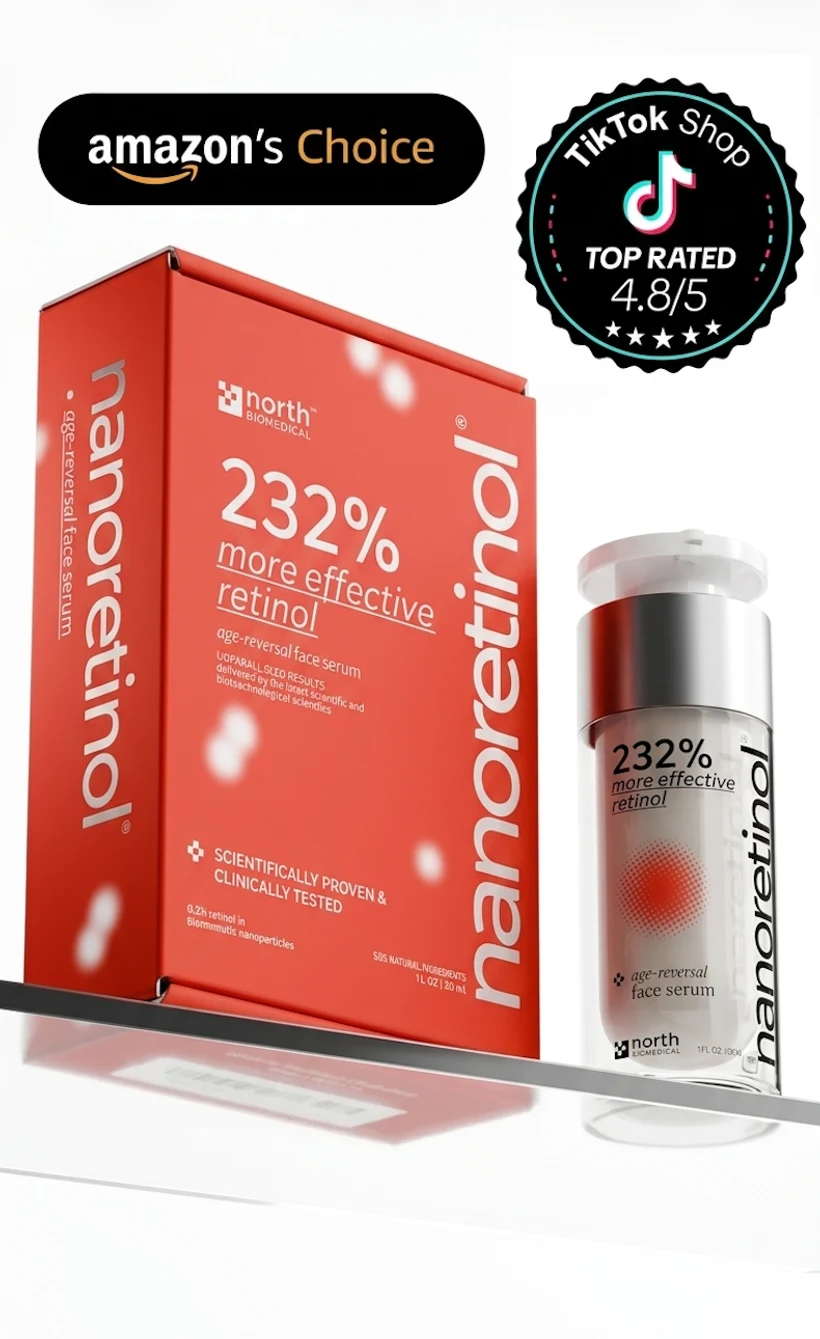
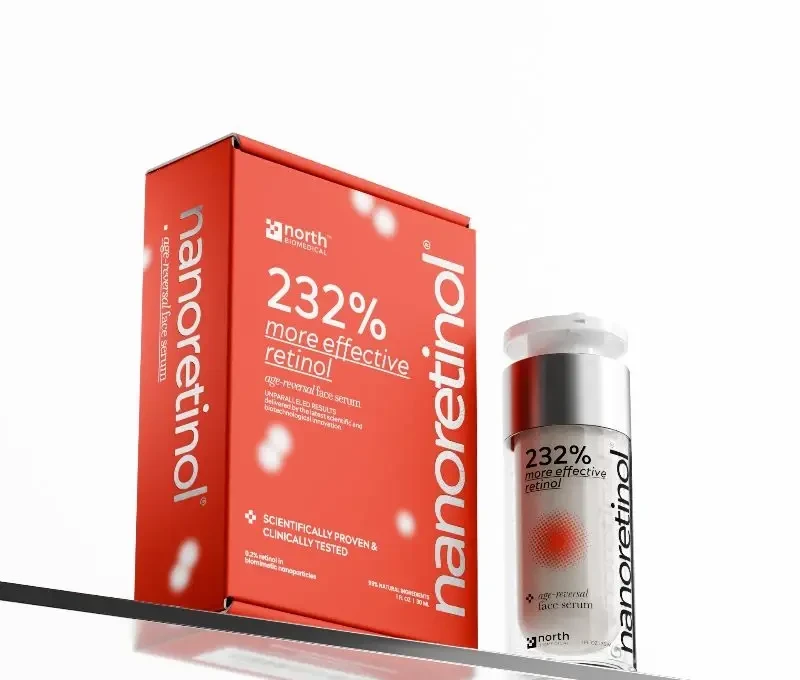
Nanoretinol carries 0.2% retinol inside biomimetic lipid nanoparticles that skin recognises as its own and admits intact, so nothing has to be broken to let it through. Measured against conventional retinol it produced 232% greater collagen recovery and 73% greater elastin recovery, with drastically reduced cytotoxicity. Across 56 days of use it delivered 61% greater skin firmness and 56% greater skin elasticity.
Lift for the scaffolding, treat the fabric
The honest summary is that strength training is worth doing and will not do the job alone. It refills what dieting emptied, it modestly improves dermal thickness, and it stops well short of tightening skin that has already been stretched past its elastic recovery. Build the muscle for the shape underneath. Work on the dermis directly for everything the muscle cannot reach.
References
- Lopez P, Taaffe DR, Galvão DA, Newton RU, Nonemacher ER, Wendt VM, Bassanesi RN, Turella DJP, Rech A. “Resistance training effectiveness on body composition and body weight outcomes in individuals with overweight and obesity across the lifespan: A systematic review and meta-analysis.” Obesity Reviews. 2022;23(5):e13428. doi:10.1111/obr.13428
- Verhaegen PDHM, Schouten HJ, Tigchelaar-Gutter W, van Marle J, van Noorden CJF, Middelkoop E, van Zuijlen PPM. “Adaptation of the dermal collagen structure of human skin and scar tissue in response to stretch: an experimental study.” Wound Repair and Regeneration. 2012;20(5):658-666. doi:10.1111/j.1524-475X.2012.00827.x
- Triwatcharikorn J, Itthipanichpong Y, Washrawirul C, et al. “Skin manifestations and biophysical changes following weight reduction induced by bariatric surgery: A 2-year prospective study.” Journal of Dermatology. 2023;50(12):1635-1639. doi:10.1111/1346-8138.16951
- Halsey G, Sinha D, Dhital S, Wang X, Vyavahare N. “Role of elastic fiber degradation in disease pathogenesis.” Biochimica et Biophysica Acta - Molecular Basis of Disease. 2023;1869(5):166706. doi:10.1016/j.bbadis.2023.166706
- Nishikori S, Yasuda J, Murata K, Takegaki J, Harada Y, Shirai Y, Fujita S. “Resistance training rejuvenates aging skin by reducing circulating inflammatory factors and enhancing dermal extracellular matrices.” Scientific Reports. 2023;13(1):10214. doi:10.1038/s41598-023-37207-9
- Crane JD, MacNeil LG, Lally JS, Ford RJ, Bujak AL, Brar IK, Kemp BE, Raha S, Steinberg GR, Tarnopolsky MA. “Exercise-stimulated interleukin-15 is controlled by AMPK and regulates skin metabolism and aging.” Aging Cell. 2015;14(4):625-634. doi:10.1111/acel.12341
- Varani J, Dame MK, Rittie L, Fligiel SEG, Kang S, Fisher GJ, Voorhees JJ. “Decreased collagen production in chronologically aged skin: roles of age-dependent alteration in fibroblast function and defective mechanical stimulation.” American Journal of Pathology. 2006;168(6):1861-1868. doi:10.2353/ajpath.2006.051302