Best Mineral Sunscreen: Why Particle Size Decides More Than SPF
Zinc oxide and titanium dioxide protect through a film, and the number on the tube tells you almost nothing about how good that film is
Standing in front of a shelf of mineral sunscreens, the only numbers you are given are SPF and, occasionally, a percentage of zinc oxide. Both feel like they should settle the decision. Neither does much of the work.
A mineral filter is a solid suspended in a base. Its protection depends on how completely and evenly that solid ends up spread across your skin, and on how the particles themselves are made. Those two variables move real-world protection far more than the printed SPF, and neither of them appears anywhere on the packaging. Here is how to read a mineral sunscreen for what actually matters.
A Filter That Works by Sitting Still
Organic (chemical) filters absorb ultraviolet energy and dissipate it, and in doing so some of them degrade. Inorganic filters — zinc oxide and titanium dioxide — mostly scatter, reflect, and absorb without changing themselves. That stability is their defining advantage.
It was documented directly: microfine zinc oxide was shown to attenuate across the UVB and UVA range while remaining photostable, and it did not degrade when combined with organic filters under irradiation [1]. A sunscreen that holds its protection through four hours on a beach is doing something an unstabilised organic filter cannot promise. If you want the fuller comparison, the chemical versus mineral question has more nuance in it than the marketing on either side suggests.
The catch is that scattering only happens where the particles are. An organic filter dissolved in a base distributes itself molecularly. A mineral filter is a powder that has to be physically dispersed, and any patch of skin where the film thins out is a patch with proportionally less protection.
Zinc Oxide, Titanium Dioxide, and the UVA Gap
The two minerals are not interchangeable. When their attenuation was compared head to head at equivalent microfine particle sizes, zinc oxide provided broader and more uniform coverage across the UVA range, particularly in UVA I from 340 to 380 nm, where titanium dioxide falls away [2].
This matters more than it sounds. UVB burns, and UVA does the slow structural damage. Ultraviolet exposure upregulates the signalling that induces matrix metalloproteinases — collagenase, gelatinase, stromelysin — which degrade dermal collagen while simultaneously suppressing new procollagen synthesis [3]. A filter with a gap in its UVA coverage is leaving the wavelengths responsible for photoaging comparatively unattended while still earning a high SPF, because SPF is a UVB measurement.
If you want the fuller comparison, the chemical versus mineral question has more nuance in it than the marketing on either side suggests.
In practice, a mineral sunscreen leaning on zinc oxide is the safer default, and one relying mainly on titanium dioxide should be carrying broad-spectrum certification you have actually looked for.
The Nano Question Runs in Both Directions
“Non-nano” is printed on mineral sunscreens as though it were straightforwardly reassuring. It is a trade-off with two sides.
Larger particles scatter visible light more, which is what produces the white cast. They also shift the attenuation profile: the particle-size work above found protection quality tied to how finely the mineral was milled, with microfine grades giving better and more even UVA coverage than coarser ones [2]. Buying non-nano buys you a cosmetic outcome at some cost to the protection curve.
The safety concern that drove the non-nano trend has not held up especially well. A review of the literature on nanosized titanium dioxide and zinc oxide in sunscreens found no evidence of significant penetration beyond the stratum corneum into viable epidermis [4]. The particles sit on top of dead cells, which is exactly where a physical filter is supposed to be.
That is the honest reason many people choose mineral in the first place. When four organic filters were tested under maximal-use conditions, all four reached plasma concentrations above the FDA threshold that triggers nonclinical toxicology review [5]. That finding says nothing about harm — systemic absorption is not the same as a demonstrated risk — but it is a real difference in behaviour, and preferring a filter that stays on the surface is a defensible preference rather than a superstitious one.
The Number on the Tube Assumes a Film You Will Not Apply
Every SPF figure on the market is certified using a standardised film of 2 mg of product per square centimetre of skin. Almost nobody applies that much.
When the quantity was varied experimentally in vivo, the relationship between the amount applied and the protection achieved proved exponential rather than proportional, and real-world sunbathers were found to apply roughly a quarter of the certifying thickness [6]. Halving the layer does not halve the protection; it costs considerably more than that.
The best mineral sunscreen is the one whose texture and finish let you apply a genuinely generous layer, on your actual face, every day, without negotiating with yourself about it.
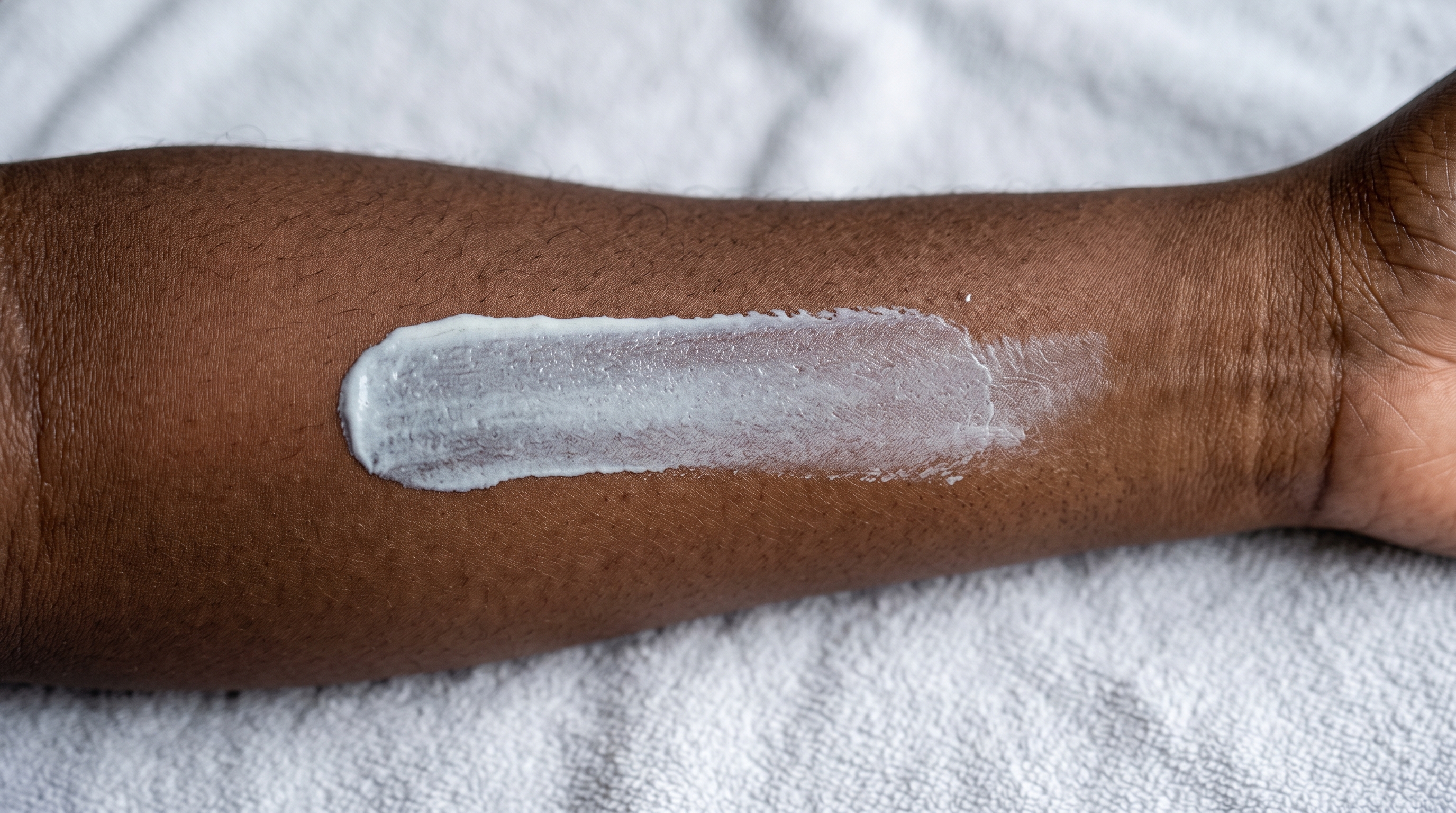
For a mineral sunscreen this compounds. The filter is a suspension that has to be spread rather than a solution that spreads itself, and the visible white cast is the single most common reason people under-apply. Fighting the white cast by rubbing a thin layer in until it disappears is, mechanically, choosing to wear less sunscreen than the label describes.
Which reframes the buying decision. The best mineral sunscreen is the one whose texture and finish let you apply a genuinely generous layer, on your actual face, every day, without negotiating with yourself about it. Elegance in the vehicle is not vanity here. It is the variable that determines the dose.
What Even Perfect Sunscreen Does Not Do
Daily sunscreen use works, and the evidence is unusually clean. In a randomised trial in Queensland, the group assigned daily sunscreen showed no detectable increase in skin aging over four and a half years, while the discretionary-use group aged measurably more [7].
Read that carefully: no detectable increase. Sunscreen held the line. It did not walk anything back. Everything already accumulated in the dermis from previous decades stays exactly where it is, and sunscreen’s role in aging skin is preventive by design.
Repair is a separate mechanism with a separate ingredient. Topical tretinoin was shown to restore type I procollagen formation in photodamaged skin relative to vehicle, which is the finding that separates retinoids from every filter ever formulated [8]. Protection stops the bleeding; a retinoid does the rebuilding.
How to Actually Choose One
Look for zinc oxide leading the active ingredients, ideally with broad-spectrum certification you have verified rather than assumed. Treat “non-nano” as a cosmetic preference with a small protection cost rather than a safety upgrade. Ignore percentage claims on the front of the tube — a high zinc percentage in a thick, draggy base you apply sparingly protects worse than a moderate one in a base you apply properly.
Then test the vehicle honestly. Apply the amount you are supposed to apply, roughly a third of a teaspoon for the face, and see whether you can live with the result. If the answer is no, that product will be under-applied for as long as you own it, and a lower SPF you will wear properly beats a higher one you will not.
Where Nanoretinol Fits the Other Half
Sunscreen and a retinoid are complements, not alternatives, and they run on opposite schedules: filter by day, repair by night.
The obstacle has always been tolerance. Conventional retinol formulations use chemicals and petroleum derivatives that break down the epithelial barrier through lipid mobility in order to push the molecule through — an odd thing to do to skin you spend every morning protecting. Nanoretinol encapsulates 0.2% retinol in biomimetic lipid nanoparticles the skin recognises as self and admits without that damage, which is why it achieves 232% more effective collagen recovery and 73% more effective elastin recovery than conventional retinol while being significantly gentler on skin cells.
Use it at night, and use sunscreen within twenty-four hours afterwards. That pairing is the entire strategy: stop the new damage in the morning, rebuild the old damage overnight.
Reading the Tube Properly
Mineral sunscreen is a good choice for reasons that survive scrutiny — photostable filters, no meaningful systemic absorption, a mechanism that sits on the surface where you can see it. What it is not is a category where the biggest number wins.
Choose zinc-led, verify broad spectrum, treat non-nano as a cosmetic call, and then spend most of your attention on whether you will genuinely apply enough of it. The best mineral sunscreen is boringly simple to identify: it is the one on your face, in the correct quantity, today.
References
- Mitchnick MA, Fairhurst D, Pinnell SR. “Microfine Zinc Oxide (Z-Cote) as a Photostable UVA/UVB Sunblock Agent.” Journal of the American Academy of Dermatology. 1999;40(1):85-90. doi:10.1016/S0190-9622(99)70532-3
- Pinnell SR, Fairhurst D, Gillies R, Mitchnick MA, Kollias N. “Microfine Zinc Oxide Is a Superior Sunscreen Ingredient to Microfine Titanium Dioxide.” Dermatologic Surgery. 2000;26(4):309-314. doi:10.1046/j.1524-4725.2000.99237.x
- Fisher GJ, Kang S, Varani J, Bata-Csorgo Z, Wan Y, Datta S, Voorhees JJ. “Mechanisms of Photoaging and Chronological Skin Aging.” Archives of Dermatology. 2002;138(11):1462-1470. doi:10.1001/archderm.138.11.1462
- Newman MD, Stotland M, Ellis JI. “The Safety of Nanosized Particles in Titanium Dioxide- and Zinc Oxide-Based Sunscreens.” Journal of the American Academy of Dermatology. 2009;61(4):685-692. doi:10.1016/j.jaad.2009.02.051
- Matta MK, Zusterzeel R, Pilli NR, et al. “Effect of Sunscreen Application Under Maximal Use Conditions on Plasma Concentration of Sunscreen Active Ingredients: A Randomized Clinical Trial.” JAMA. 2019;321(21):2082-2091. doi:10.1001/jama.2019.5586
- Faurschou A, Wulf HC. “The Relation Between Sun Protection Factor and Amount of Sunscreen Applied In Vivo.” British Journal of Dermatology. 2007;156(4):716-719. doi:10.1111/j.1365-2133.2006.07684.x
- Hughes MC, Williams GM, Baker P, Green AC. “Sunscreen and Prevention of Skin Aging: A Randomized Trial.” Annals of Internal Medicine. 2013;158(11):781-790. doi:10.7326/0003-4819-158-11-201306040-00002
- Griffiths CEM, Russman AN, Majmudar G, Singer RS, Hamilton TA, Voorhees JJ. “Restoration of Collagen Formation in Photodamaged Human Skin by Tretinoin (Retinoic Acid).” New England Journal of Medicine. 1993;329(8):530-535. doi:10.1056/NEJM199308193290803