Mineral Sunscreen With No White Cast: The Physics Behind the Ghost
Why zinc and titanium turn skin grey, and which formulation choices actually fix it
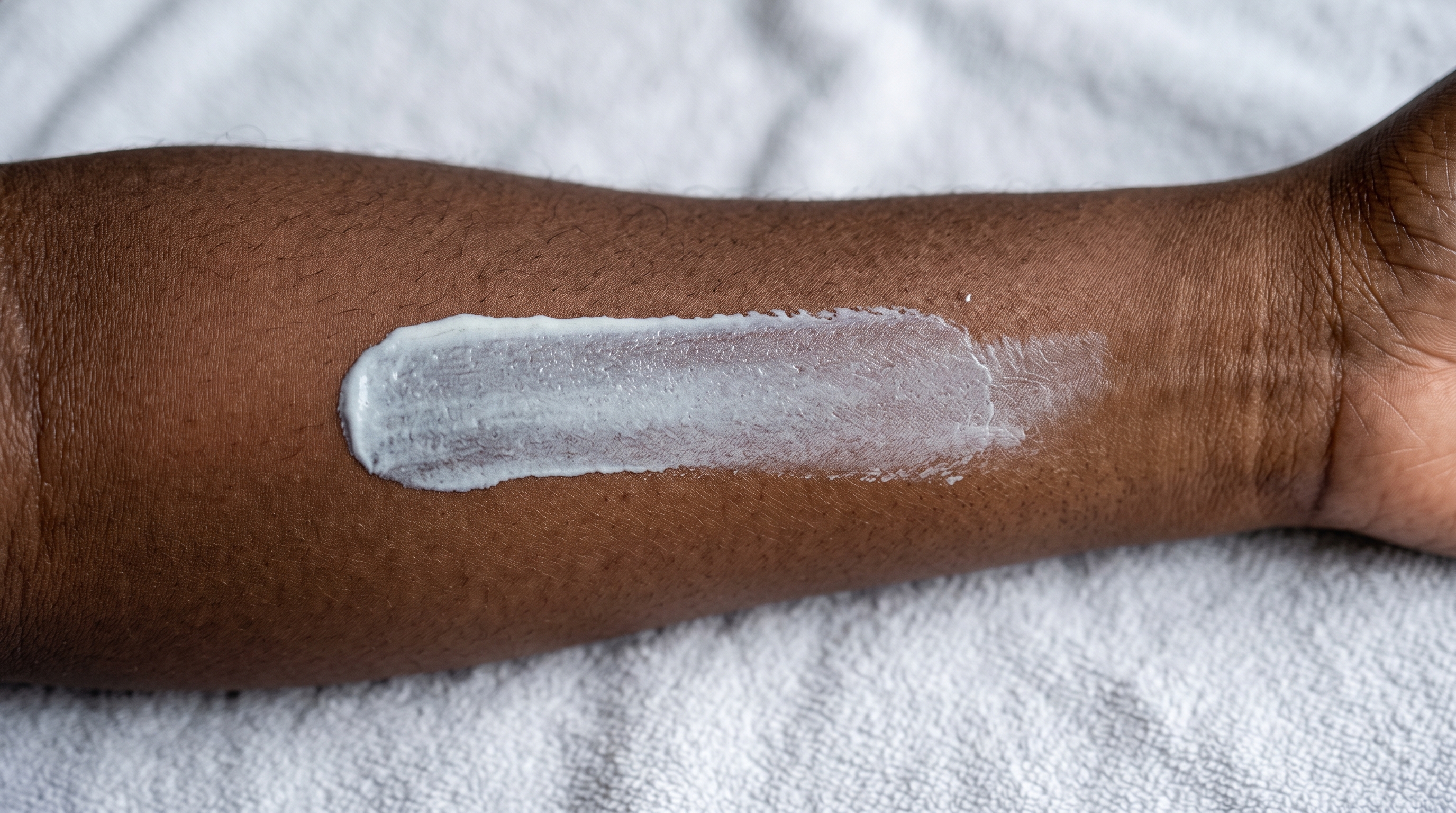
There is a specific moment that ends a lot of sunscreen habits. You apply a mineral formula, look in the mirror, and see a stranger with a faint lavender-grey film sitting on top of their face. You wipe it off. Tomorrow you skip it.
That moment is a formulation failure, not a personal one, and it is worth understanding precisely because the fix is not “try harder.” Some mineral sunscreens genuinely disappear on skin. The difference between those and the ones that haunt you comes down to optics.
White cast is a light-scattering problem
Zinc oxide and titanium dioxide are the two inorganic UV filters approved in the United States [1]. They work partly by absorbing ultraviolet light and partly by scattering it, and scattering is where the trouble starts, because a particle that scatters ultraviolet efficiently will often scatter visible light too.
How much visible light a particle scatters depends on two things: how big it is relative to the wavelength of that light, and how different its refractive index is from the material around it. Skin sits near 1.4 to 1.5. Zinc oxide sits around 2.0. Titanium dioxide sits around 2.7.
That last number is the reason titanium dioxide has a reputation for being the chalkier of the two. A larger refractive index mismatch means more of the visible spectrum bounces back at the observer instead of passing through to your actual skin tone. The particle is doing exactly what a white pigment does, because chemically that is what it also is.
Particle size is the lever formulators pull first
Visible light runs roughly 400 to 700 nanometers. Scattering is strongest when particle size is on the same order as the wavelength being scattered, so conventional pigment-grade particles measured in the high hundreds of nanometers are almost purpose-built to look white.
Shrink those particles well below the visible wavelength and the physics changes. Micronized and nano-scale grades scatter far less visible light while still absorbing ultraviolet effectively, which is why they became the standard for cosmetically acceptable mineral sunscreens [2].
If the dispersion is poor, those particles reaggregate in the tube or on your face into clusters that are, optically, large particles again.
This is where a persistent worry comes up, so it is worth addressing directly. The safety question about nano-scale mineral filters has been studied extensively, and the reviewed evidence indicates these particles remain on the outer layers of intact skin rather than passing into living tissue [2]. The cosmetic elegance you gain does not come at the cost of the barrier.
There is a catch, though, and it is the reason two sunscreens with identical ingredient lists can behave completely differently. Fine particles want to clump. If the dispersion is poor, those particles reaggregate in the tube or on your face into clusters that are, optically, large particles again. The white cast comes back. Good dispersion chemistry is invisible on a label and decisive in the mirror.
The tint solution, and why it is more than cosmetic
The most reliable route to a mineral sunscreen that vanishes is to stop fighting the whiteness and cancel it instead. Adding iron oxides, the same pigments used in foundation, shifts the film’s color toward skin tones and neutralizes the grey.
Iron oxides do something else worth knowing about. They absorb visible light, including the high-energy visible range that contributes to pigmentation problems in deeper skin tones. Tinted sunscreens therefore offer protection that untinted mineral formulas do not, particularly for people prone to melasma and post-inflammatory hyperpigmentation [3].
The trade-off is obvious: a tinted formula has to roughly match you. The range has widened enormously, but this remains the reason many people end up preferring a well-formulated chemical or hybrid filter system. If you are weighing that decision, we laid out the full comparison in mineral vs chemical sunscreen.
What to look for, and what to ignore
A few practical rules follow from the physics.
Favor zinc-dominant formulas over titanium-dominant ones if white cast is your main complaint. The lower refractive index gives the formulator more room to work with, and zinc is also the filter most often recommended for reactive skin, as we discuss in the best sunscreen for sensitive skin.
If you have ever wondered why a Korean or French sunscreen felt better on your skin, that is a large part of the answer.
Treat “non-nano” as a preference, not a safety upgrade. Non-nano grades are more likely to sit visibly on the skin, and the safety case for avoiding nano-scale mineral filters on intact skin is not well supported by the reviewed literature [2].
Judge the vehicle, not just the actives. A modern emulsion with good wetting and film formation will lay down a thin, even layer. A poorly dispersed one deposits patchily, and patchy films look chalky and protect unevenly.
Test on your jawline in daylight, not on the back of your hand under a store’s lighting. Most white cast complaints are really daylight complaints.
One thing not to compromise on is the amount you apply. The SPF on the bottle is measured at an application density considerably higher than what people use in practice, and real-world application is frequently around a quarter to a half of the tested amount [4]. Applying a thin, cast-free layer of a strong sunscreen can leave you with less protection than the number suggests. The honest goal is a formula you will apply generously, every day, without negotiating with yourself about it, and topping up midday with a powder sunscreen is a reasonable way to keep that habit intact over makeup.
Global filter availability is part of the story too. Several UVA filters that are routine in Europe and Asia are not approved for use in the United States, which is a real constraint on what American formulators can build [5]. If you have ever wondered why a Korean or French sunscreen felt better on your skin, that is a large part of the answer.
Why any of this matters for aging skin
Daily photoprotection is the single highest-return anti-aging habit available, and ultraviolet exposure remains the dominant environmental driver of collagen breakdown and the visible signs that follow [6]. A sunscreen you abandon in week two protects nobody. Cosmetic elegance is not vanity here. It is compliance, and compliance is the entire mechanism.
Prevention is only half the job, though. Sunscreen stops tomorrow’s damage. It does not restore the collagen that decades of exposure already degraded, and no amount of SPF will.
That repair job belongs to retinol, which downregulates the collagen-degrading enzymes ultraviolet light activates and stimulates new collagen synthesis. The obstacle has always been delivery: getting retinol through an intact barrier without stripping that barrier with harsh solvents.
Nanoretinol addresses that directly by encapsulating retinol in biomimetic lipid nanoparticles the skin recognizes as self, so the molecule passes through the epithelial barrier rather than breaking it down. North Biomedical’s clinical study measured 232% greater collagen recovery and 73% greater elastin recovery against conventional retinol, with drastically reduced cytotoxicity, and users showed a 61% increase in firmness and a 56% increase in elasticity over 56 days. It is water-based and gentle enough for sensitive skin, which matters when you are also applying sunscreen daily. For more on building that pairing, see our guide to how sunscreen changes the way skin ages.
Finding the one you will actually wear
The mineral sunscreen that disappears on you exists. It is probably zinc-dominant, well dispersed, possibly tinted, and formulated by someone who took the optics seriously.
Finding it takes a few tries, and those tries are worth making, because the best sunscreen has never been the one with the highest number. It is the one still in your routine next August.
References
- Schneider SL, Lim HW. “A review of inorganic UV filters zinc oxide and titanium dioxide.” Photodermatology, Photoimmunology & Photomedicine. 2019;35(6):442-446. doi:10.1111/phpp.12439
- Smijs TG, Pavel S. “Titanium dioxide and zinc oxide nanoparticles in sunscreens: focus on their safety and effectiveness.” Nanotechnology, Science and Applications. 2011;4:95-112. doi:10.2147/NSA.S19419
- Lyons AB, Trullas C, Kohli I, Hamzavi IH, Lim HW. “Photoprotection beyond ultraviolet radiation: A review of tinted sunscreens.” Journal of the American Academy of Dermatology. 2021;84(5):1393-1397. doi:10.1016/j.jaad.2020.04.079
- Petersen B, Wulf HC. “Application of sunscreen: theory and reality.” Photodermatology, Photoimmunology & Photomedicine. 2014;30(2-3):96-101. doi:10.1111/phpp.12099
- Osterwalder U, Sohn M, Herzog B. “Global state of sunscreens.” Photodermatology, Photoimmunology & Photomedicine. 2014;30(2-3):62-80. doi:10.1111/phpp.12112
- Dupont E, Gomez J, Bilodeau D. “Beyond UV radiation: A skin under challenge.” International Journal of Cosmetic Science. 2013;35(3):224-232. doi:10.1111/ics.12036