Best Highlighter for Mature Skin: Why Particle Size Beats Shade
The optics of glow, why glitter exaggerates texture on older skin, and how to pick a finish that reads as radiance instead of sparkle
Most advice about highlighter on older skin stops at a single instruction: avoid glitter, use cream. That instruction is correct, but it is given as a style rule when it is actually a physics rule, and understanding why it is true tells you far more than the rule itself does.
Highlighter is the only makeup category whose entire function is optical. Foundation covers, blush adds colour, but a highlighter changes nothing except the way light leaves your face. On a surface that has become less uniform, that is a much harder job than it is at thirty.
What “Glow” Actually Is
Skin returns light in two distinct ways. Some light bounces straight off the surface at a mirror angle, which is specular reflection, and that is what we perceive as shine or gloss. The rest penetrates, scatters through the tissue, and comes back diffusely, which is what we perceive as the skin’s colour and depth.
Optical work measuring skin gloss with high sensitivity separated these two components directly and showed that the specular signal can be quantified independently of the diffuse one [1]. Healthy-looking radiance is a specific balance of the two: enough specular reflection to read as luminous, spread evenly enough that no single point dominates.
This is not a vanity metric. A study on facial radiance found that manipulating the perceived luminosity of a face measurably changed how attractive and how positively that face was rated [2]. Glow is doing real perceptual work, which is why the category exists at all.
Why Older Skin Punishes the Wrong Finish
Specular reflection is exquisitely sensitive to surface geometry. A smooth surface reflects the mirror-angle light coherently, as one broad soft highlight. A rough surface breaks that same light into many small highlights pointing in different directions.
Foundation covers, blush adds colour, but a highlighter changes nothing except the way light leaves your face.
Research relating skin micro-topography and roughness to age found exactly the change you would expect: measured surface roughness increases significantly with age, and the microrelief becomes coarser and less regular [3]. So the surface you are applying highlighter to at sixty is optically a different material from the one at thirty. Apply a product with large reflective particles to it, and each particle sits somewhere on that uneven terrain, catching light at its own angle. The result is not a broad glow, it is a scatter of individual bright points that trace every ridge and fold.
This is also why evenness matters more than brightness. Studies of facial skin colour homogeneity found that more uniform skin is consistently rated as younger, healthier, and more attractive, in work replicated across both female [4] and male [5] faces. Anything that increases visible unevenness works directly against the effect you are buying the product for. If pronounced texture is your starting point, crepey skin on the face is worth reading first, because no highlighter will out-optic a surface problem.
The Pigment Science Behind the Rule
The reflective ingredients in highlighters are effect pigments, usually mica or synthetic fluorphlogopite coated in a thin layer of titanium dioxide or iron oxide. Their optical behaviour depends on submicron structure: a comprehensive review of angle-dependent optical effects showed that colour and reflectivity in these systems arise from thin-film interference at the coating layer, and that the visual result is governed by both the thickness of that coating and the size of the platelet carrying it [6].
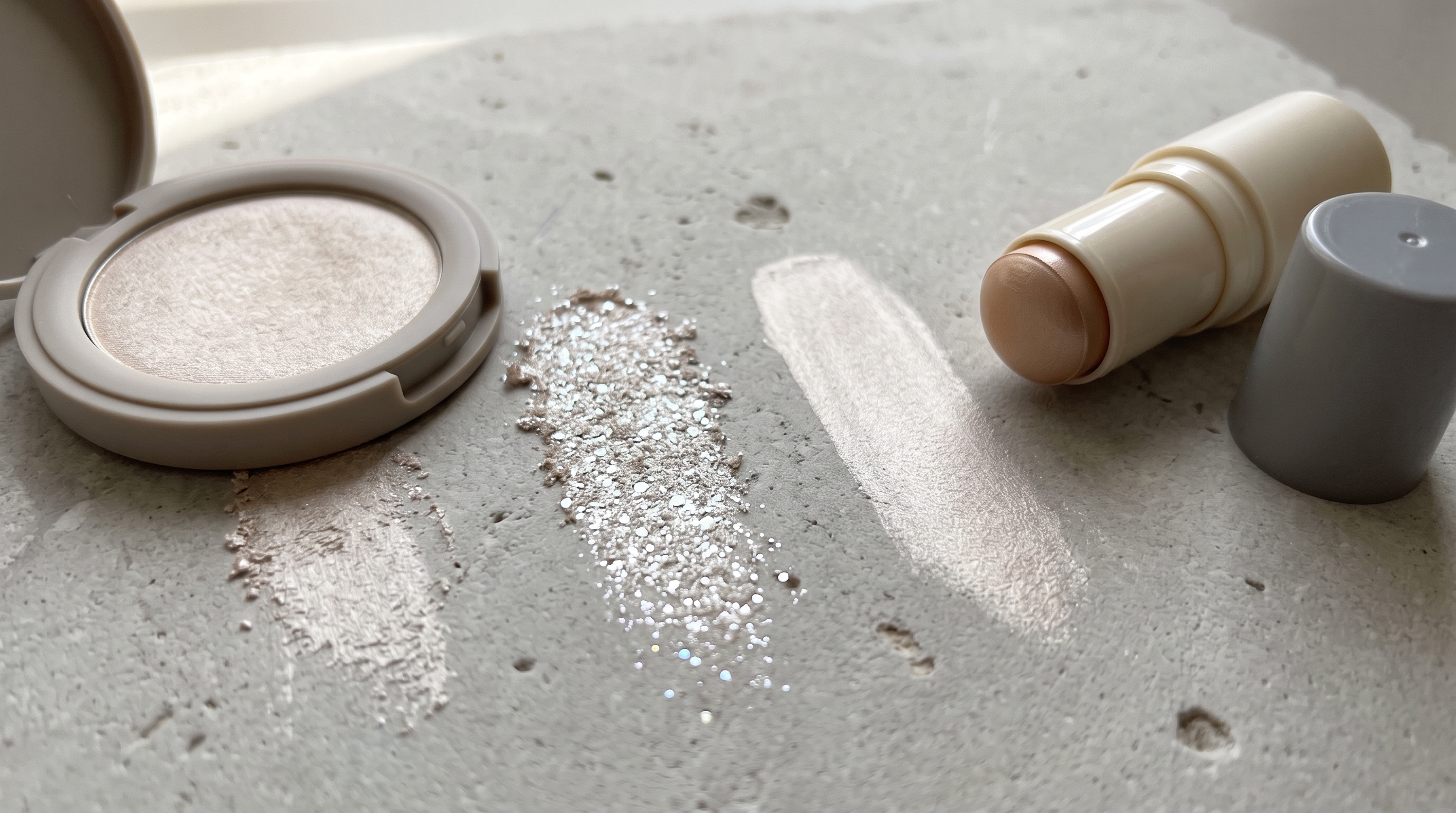
The practical translation is short. Large platelets produce discrete, high-contrast sparkle you can resolve with the naked eye. Small platelets produce a continuous sheen, because the individual reflections are too fine to distinguish and blend into one soft highlight. Same chemistry, opposite result, and the only variable that changed was particle size.
How to Choose One
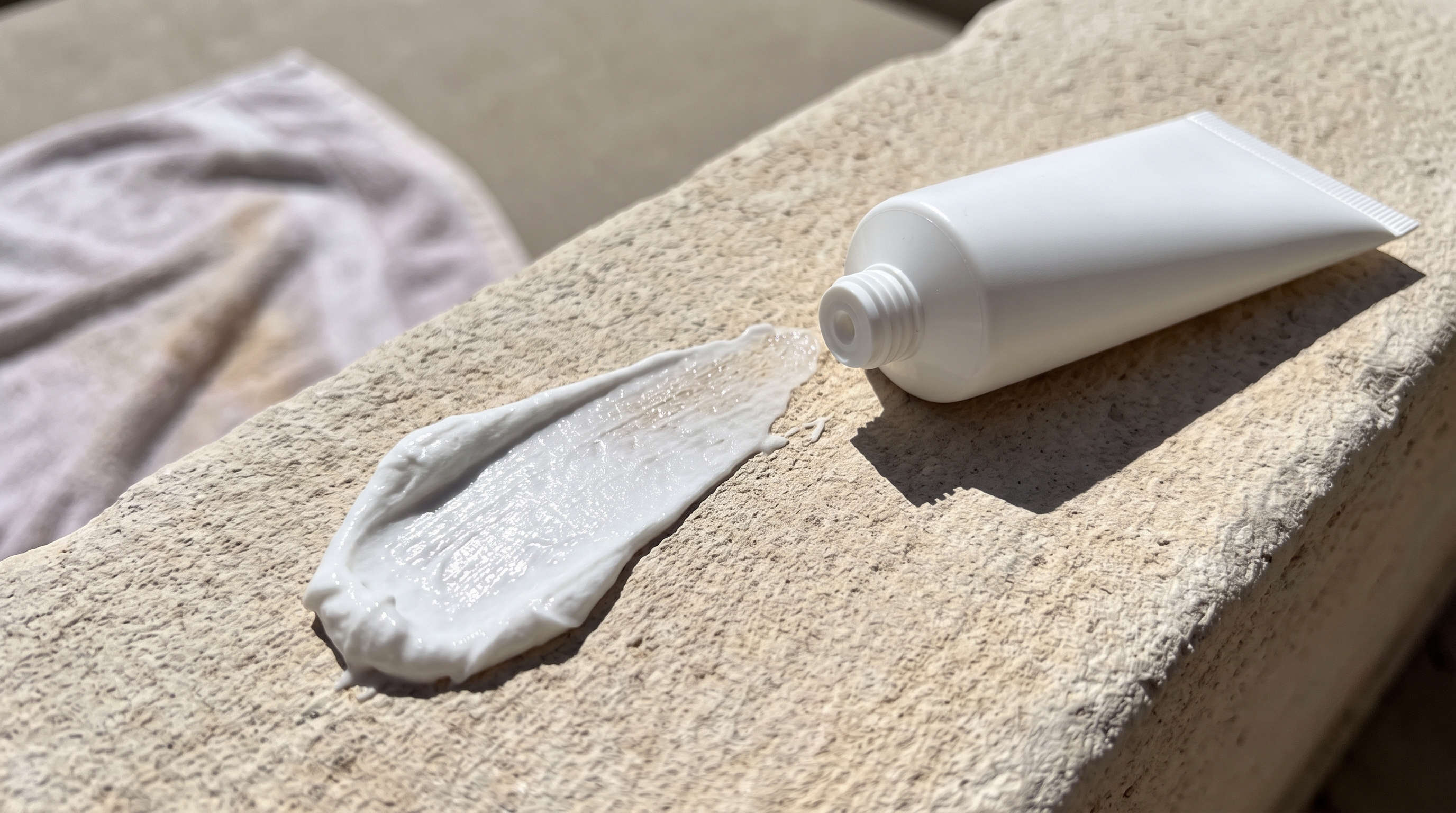
Rub a swatch on the back of your hand and look at it in daylight. If you can pick out individual sparkles, it will emphasize texture. If it looks like a continuous wet sheen, it will not. This single test is more reliable than any product description.
Its 0.2% retinol is encapsulated in biomimetic lipid nanoparticles that the skin recognizes as self and allows through the barrier, instead of the conventional approach of disrupting the barrier to force penetration.
Prefer cream and liquid over pressed powder. Not because powder is inherently wrong, but because cream bases include emollients that fill shallow furrows and let the pigment sit on a more level plane. Powder settles into the furrows instead.
Avoid anything described as “frost,” “metallic,” or “duochrome.” These require large platelets by definition.
Check the finish in motion. Turn your head under a light. A fine sheen shifts smoothly. A coarse one flickers.
Place it lower and smaller than you think. The high cheekbone sweep is designed for taut skin. On mature skin the safer placement is a short band on the upper cheek and a touch at the inner corner of the eye, where the skin stays smoother. Setting the surrounding area first with a fine setting powder keeps the highlight from migrating into nearby lines.
Consider skipping it in favour of a dewy cream blush, which produces a similar lift with less risk, if your texture is pronounced.
Changing the Surface Rather Than the Light
Everything above is a workaround. You are choosing pigments that flatter an uneven surface, which is a sensible thing to do, but the surface is the actual variable in the equation.
The roughness measured in that micro-topography study is not fixed. A double-blind, vehicle-controlled trial of topical tretinoin on photoaged skin found significant improvement in surface roughness and fine wrinkling against a placebo control [7]. Smoother skin returns specular light more coherently, which means broader, softer highlights and less punishment for particle size. Improve the surface and the range of highlighters that look good on you widens.
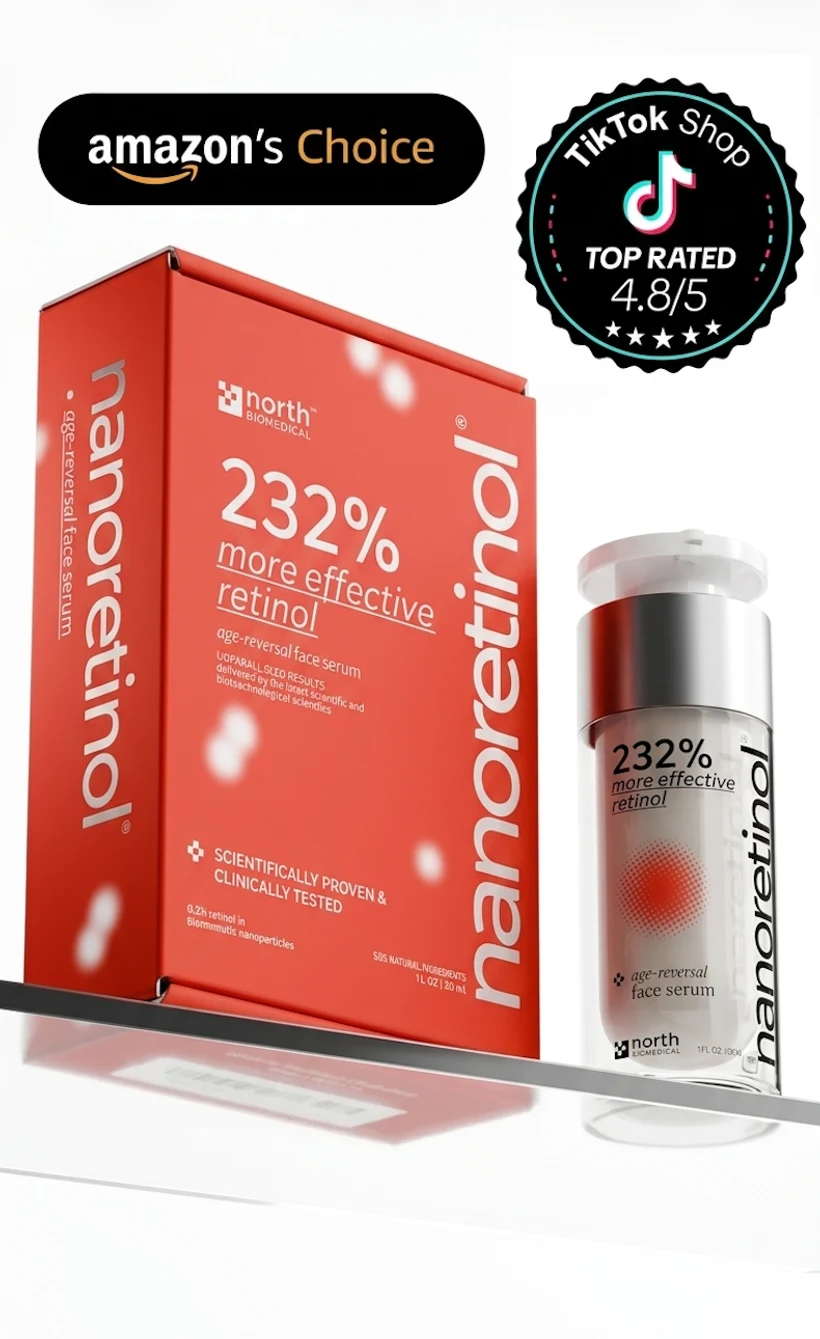
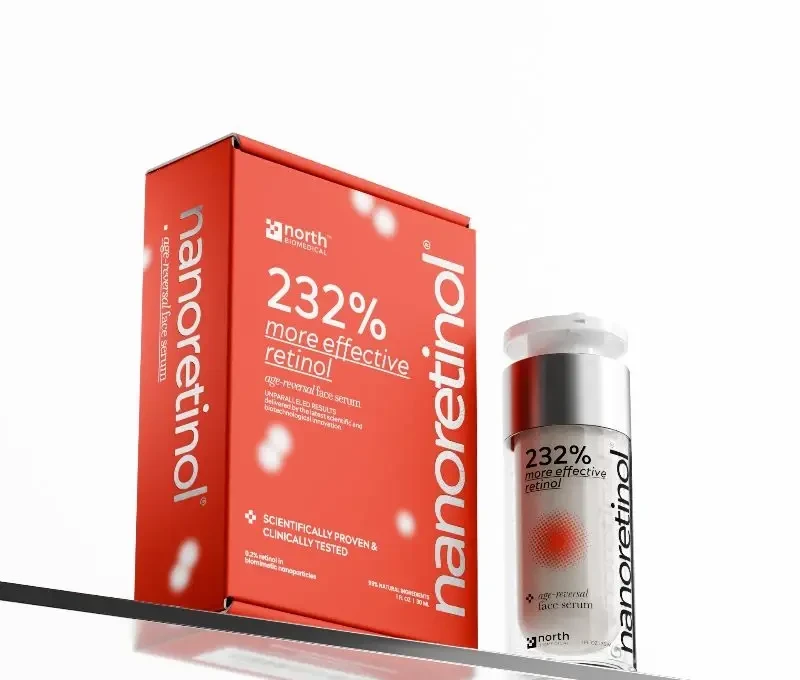
Nanoretinol approaches that through delivery rather than dose. Its 0.2% retinol is encapsulated in biomimetic lipid nanoparticles that the skin recognizes as self and allows through the barrier, instead of the conventional approach of disrupting the barrier to force penetration. That is how it reaches 232% greater collagen recovery and 73% greater elastin recovery than conventional retinol, with clinical measurements showing a 61% increase in skin firmness over 56 days. Firmer, smoother skin is the real highlighter, and it is the one that still works on the days you wear nothing.
Putting It Together
Buy the finish, not the shade. Test for resolvable sparkle in daylight before you commit, favour cream textures over pressed powder, and place the product where your skin is smoothest rather than where a tutorial says. Then work on the surface underneath, because every improvement there quietly upgrades every product you already own.
References
- Ezerskaia A, Ras A, Bloemen P, Pereira SF, Urbach HP, Varghese B. “High Sensitivity Optical Measurement of Skin Gloss.” Biomedical Optics Express. 2017;8(9):3981-3992. doi:10.1364/BOE.8.003981
- Ikeda H, Saheki Y, Sakano Y, Wada A, Ando H, Tagai K. “Facial Radiance Influences Facial Attractiveness and Affective Impressions of Faces.” International Journal of Cosmetic Science. 2021;43(2):144-157. doi:10.1111/ics.12673
- Trojahn C, Dobos G, Schario M, Ludriksone L, Blume-Peytavi U, Kottner J. “Relation Between Skin Micro-topography, Roughness, and Skin Age.” Skin Research and Technology. 2015;21(1):69-75. doi:10.1111/srt.12158
- Matts PJ, Fink B, Grammer K, Burquest M. “Color Homogeneity and Visual Perception of Age, Health, and Attractiveness of Female Facial Skin.” Journal of the American Academy of Dermatology. 2007;57(6):977-984. doi:10.1016/j.jaad.2007.07.040
- Fink B, Matts PJ, D’Emiliano D, Bunse L, Weege B, Röder S. “Colour Homogeneity and Visual Perception of Age, Health and Attractiveness of Male Facial Skin.” Journal of the European Academy of Dermatology and Venereology. 2012;26(12):1486-1492. doi:10.1111/j.1468-3083.2011.04316.x
- Pfaff G, Reynders P. “Angle-Dependent Optical Effects Deriving from Submicron Structures of Films and Pigments.” Chemical Reviews. 1999;99(7):1963-1982. doi:10.1021/cr970075u
- Weiss JS, Ellis CN, Headington JT, Tincoff T, Hamilton TA, Voorhees JJ. “Topical Tretinoin Improves Photoaged Skin. A Double-Blind Vehicle-Controlled Study.” JAMA. 1988;259(4):527-532. doi:10.1001/jama.1988.03720040019020