Best Red Light Therapy Device: What Separates a Real One From an Expensive Lamp
Irradiance, dose, and wavelength decide whether a device does anything at all, and almost no brand prints them on the box
Red light therapy moved from dermatology clinics into bathrooms fast enough that the shopping experience is now genuinely confusing. A handheld wand costs $80. A full-body panel costs $2,000. Both promise collagen. Neither box tells you the one number that determines whether the device in front of you can reproduce what the research found.
That number is dose.
The Spec Sheet Is Measuring the Wrong Thing
Marketing for these devices leads with LED count, total wattage, or the number of wavelengths crammed into the array. None of those describe what your skin receives. Skin does not respond to how many diodes point at it. It responds to how much light energy lands on each square centimetre of tissue, which comes down to two things: irradiance, meaning how intense the light is at your actual treatment distance, measured in milliwatts per square centimetre, and how long you sit there.
Dose, written in joules per square centimetre, is irradiance multiplied by time. A device delivering 10 mW/cm² for ten minutes hands your skin 6 J/cm². The same device at half that intensity needs twenty minutes to do the same job. This arithmetic lets you compare a $90 mask against a $900 panel on equal terms, and it is precisely the arithmetic most brands leave off the packaging.
What the Light Is Doing Down There
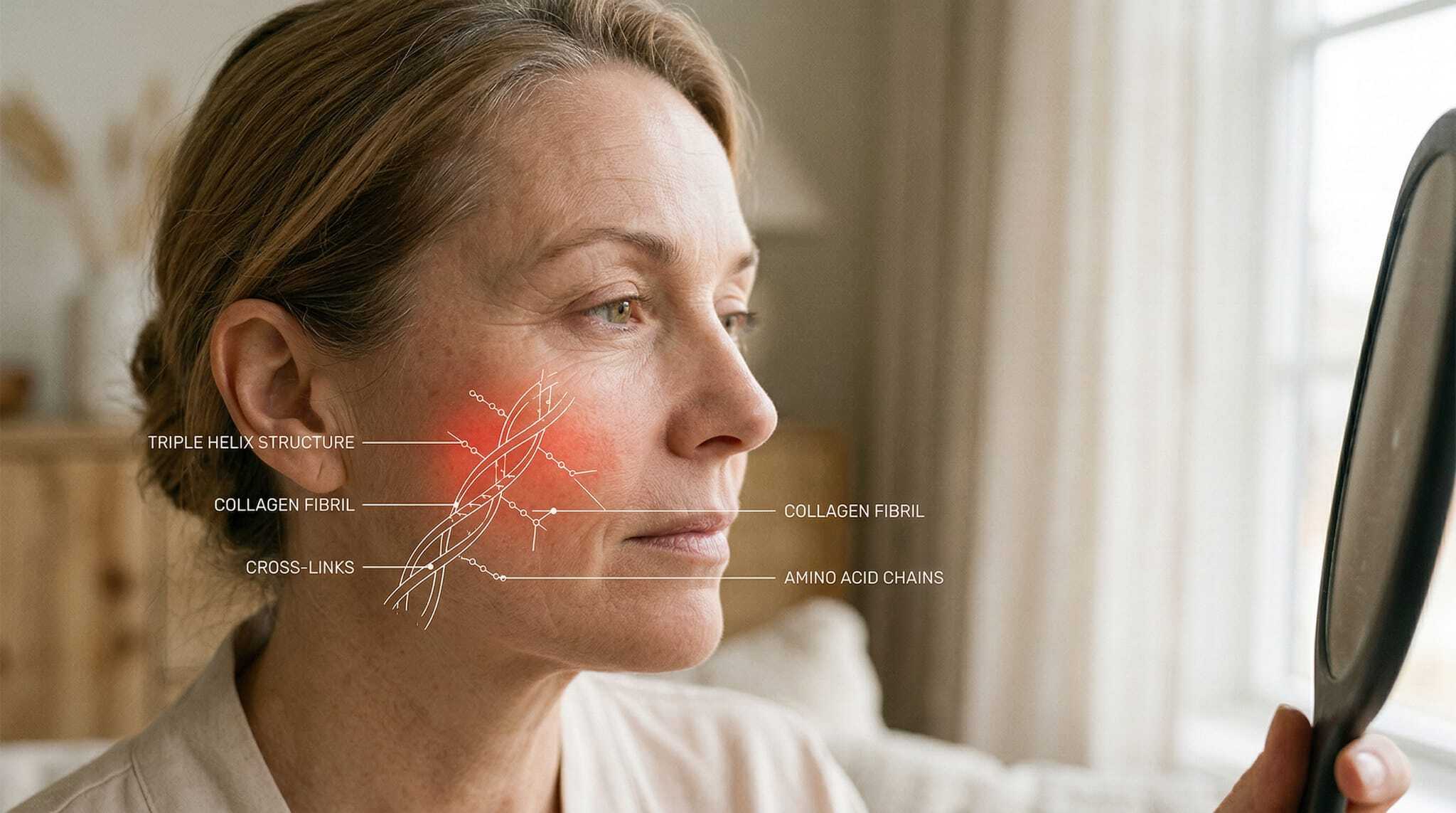
Red and near-infrared light are absorbed by cytochrome c oxidase, an enzyme complex in the mitochondrial electron transport chain [6]. When photons in roughly the 600 to 850 nanometre range reach that chromophore, the downstream effects include increased ATP production, a brief burst of reactive oxygen species, a rise in nitric oxide, and shifts in intracellular calcium [6]. Those signals cascade into transcription factor activation and new protein synthesis [2].
The most direct skin evidence comes from a tissue-engineered model treated with pulsed 660 nm light across eleven sessions. Treated skin produced 31 percent more type I procollagen and 18 percent less MMP-1, the enzyme that dismantles existing collagen [3]. Building more while degrading less is the entire mechanism in one sentence, and it is why the technology belongs in any serious discussion of how to boost collagen production.
Red and Near-Infrared Do Different Jobs
The cleanest wavelength comparison is a 76-patient split-face trial running four arms: 830 nm alone, 633 nm alone, the two combined, and sham, twice weekly for four weeks [4]. All three active arms produced measurable improvement, with a maximum wrinkle reduction of 36 percent and a maximum elasticity increase of 19 percent, alongside histologic increases in collagen and elastic fibres [4].
A device delivering 10 mW/cm² for ten minutes hands your skin 6 J/cm².
For shoppers that finding is liberating. You do not need an exotic wavelength cocktail. Roughly 633 nm red works. Roughly 830 nm near-infrared works and reaches deeper. A device offering both is reasonable. A device advertising nine wavelengths is selling a spec sheet rather than an outcome.
More Light Is Not More Result
Here consumer intuition fails badly. Photobiomodulation follows a biphasic dose response, sometimes called the Arndt-Schulz curve: low doses stimulate, while higher doses of the identical wavelength stop helping or turn inhibitory [5]. This is not a footnote. It is among the most reliably reproduced features of the whole field [5][6].
So “medical grade” and “highest irradiance available” are not automatically virtues. A very powerful panel run for a long session can overshoot the window the trials operated in. The largest controlled trial in this space enrolled 136 volunteers, ran irradiances between 5.9 and 13.3 mW/cm², and delivered around 9 J/cm² per session, twice weekly, across 30 sessions [1]. Those are modest numbers.
Run that trial’s arithmetic and a sensible session length falls out. Reaching 9 J/cm² at 13.3 mW/cm² takes about eleven minutes. At 5.9 mW/cm² it takes roughly twenty-five. Both arms worked. If a manufacturer claims three minutes at arm’s length is enough, ask what irradiance they measured, and whether they measured it at the panel face or where your face will actually be. Irradiance drops sharply with distance, and that gap is the most common way a real device quietly underdelivers.
What the Results Honestly Look Like
In that 136-person trial, expert graders judged wrinkles improved in 69 percent of the red-only group and 75 percent of the polychromatic group, against 4 percent of controls [1]. Ultrasound showed intradermal collagen density rising in both active groups, and skin roughness fell significantly [1].
Nanoretinol takes a different route, encapsulating 0.2% retinol in biomimetic lipid nanoparticles the skin recognises as self and allows through intact.
Those effects are real. They are also gradual, and they required thirty sessions across roughly fifteen weeks. Anyone hoping a home device substitutes for non-surgical skin tightening procedures will be disappointed. What red light does well is improve texture, fine lines, and dermal density slowly and painlessly, with an unusually clean safety record and no downtime.
Choosing a Form Factor
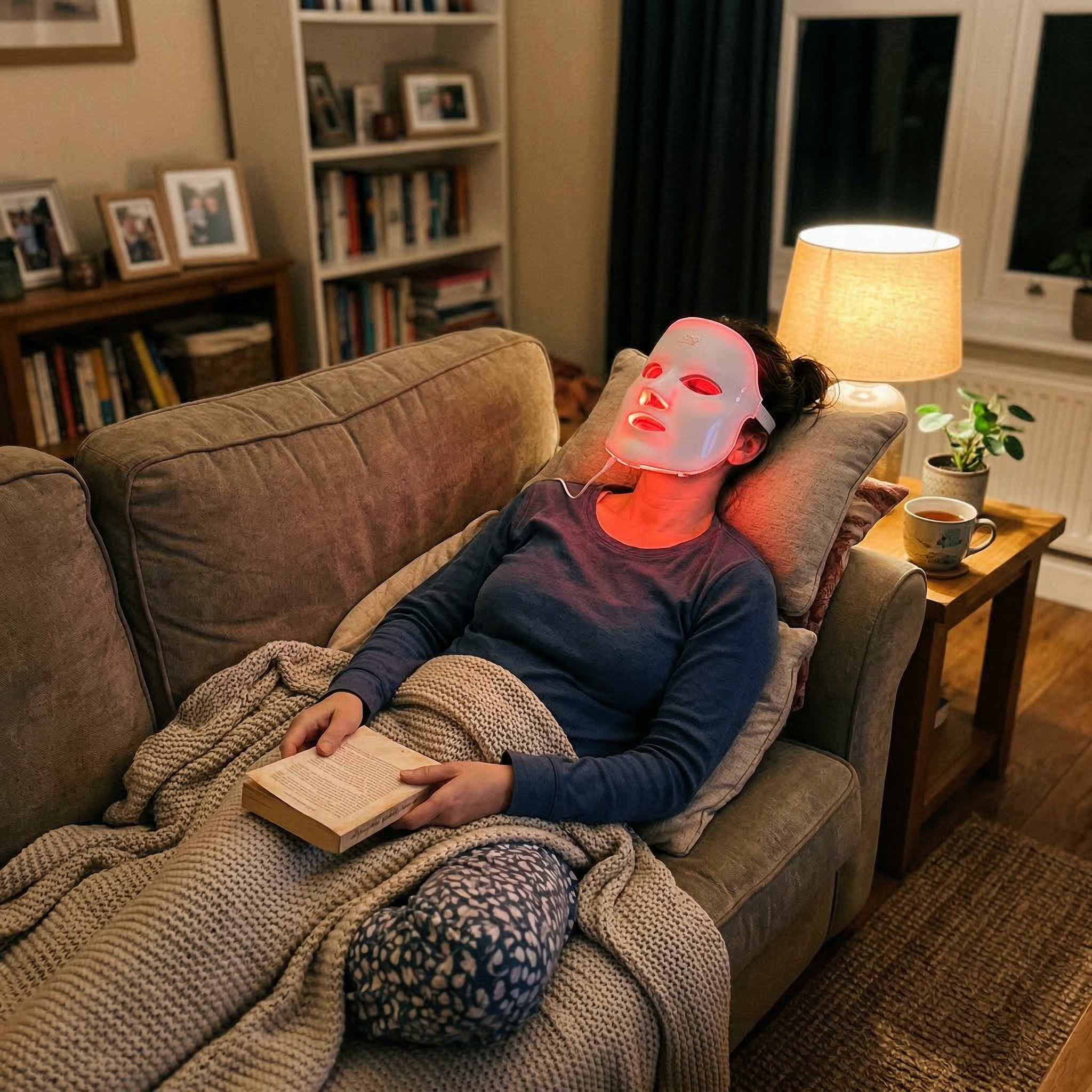
Masks win on consistency, and consistency matters more than peak specification given that every positive trial depended on repeated sessions over months. The tradeoff is that flexible silicone masks generally run at lower irradiance, so sessions need to run longer to reach the same dose. Our guide to LED face masks for anti-aging covers that category in depth.
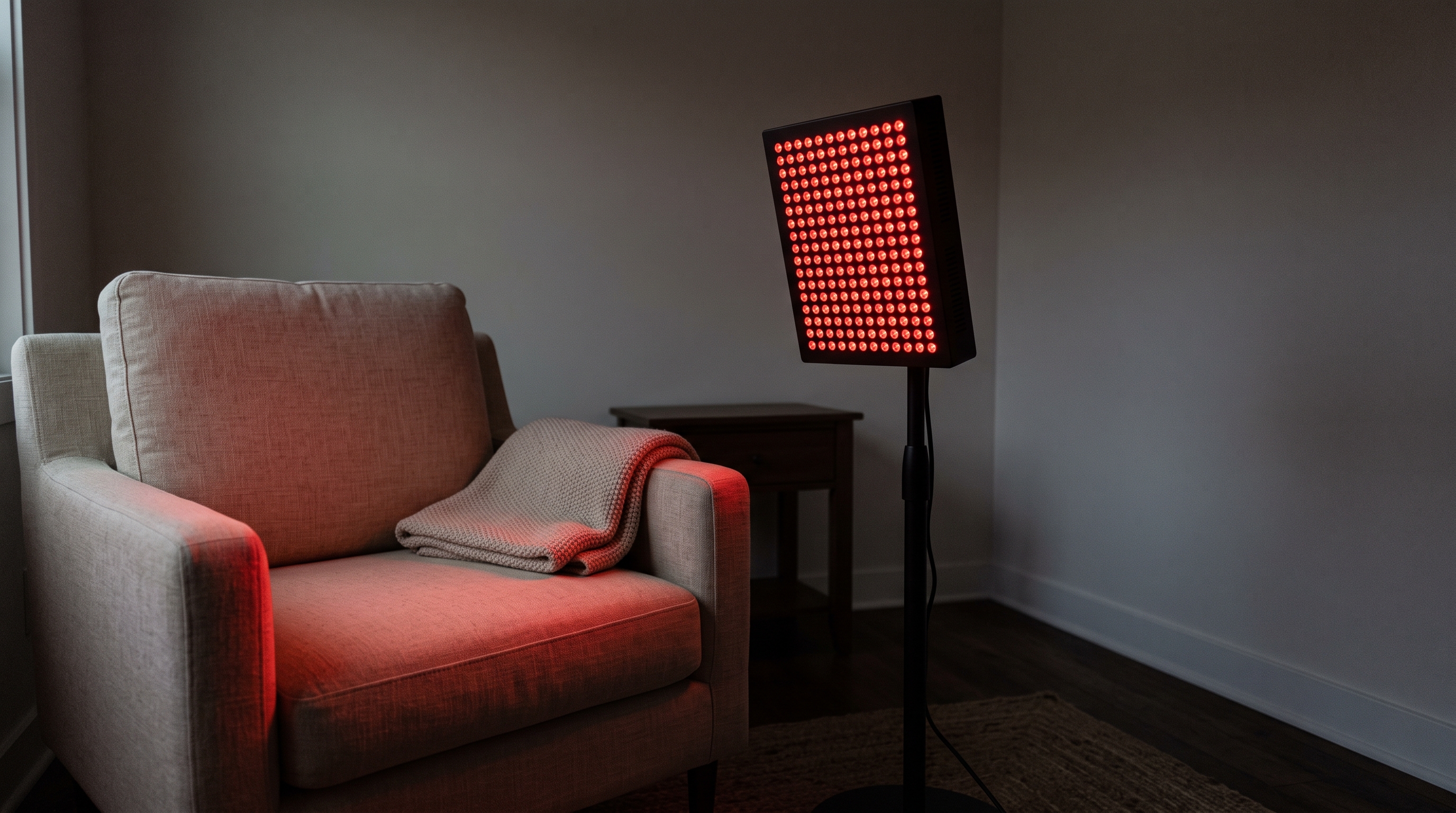
Panels deliver higher irradiance and cover the neck, chest, and hands in the same session, which is a genuine advantage because those areas age visibly and get neglected. The cost is that you have to sit still in front of one.
Wands and handhelds are the weakest option for facial aging. Treating a face a few square centimetres at a time, for the session lengths these doses demand, is a compliance problem dressed up as a product.
Where a Device Sits Next to What You Apply
Light asks the fibroblast to build more collagen. It does not change how the rest of the skin behaves, and it does little for pigmentation, cell turnover, or surface quality. That is why a device sensibly supplements a topical routine instead of replacing one, a point our closer look at red light therapy for wrinkles makes with the same trial data.
The best-evidenced topical for these endpoints remains a retinoid, where the limiting factor has always been delivery. Conventional retinol formulations struggle to cross the epithelial barrier, and many of them get through only by disrupting it, which is exactly where the redness and peeling originate. Nanoretinol takes a different route, encapsulating 0.2% retinol in biomimetic lipid nanoparticles the skin recognises as self and allows through intact. In North Biomedical’s clinical study, it proved 232% more effective than conventional retinol in collagen recovery and 73% more effective in elastin recovery, with a 61% increase in skin firmness over 56 days of use.
Pairing a light device with a well-delivered retinoid is a sound strategy. Buying the device instead of one is not.
Reading the Box Like a Skeptic
Ask four questions before spending anything. What wavelengths, and do they sit near 633 nm and 830 nm? What is the irradiance, and at what distance was it measured? What session length reaches roughly 6 to 10 J/cm² at that irradiance? And can you realistically do this three to five times a week for four months?
A device that answers all four clearly deserves consideration at almost any price. A device that answers none of them, but opens with how many LEDs it contains, has already told you what it is.
References
- Wunsch A, Matuschka K. “A Controlled Trial to Determine the Efficacy of Red and Near-Infrared Light Treatment in Patient Satisfaction, Reduction of Fine Lines, Wrinkles, Skin Roughness, and Intradermal Collagen Density Increase.” Photomedicine and Laser Surgery. 2014;32(2):93-100. doi:10.1089/pho.2013.3616
- Avci P, Gupta A, Sadasivam M, Vecchio D, Pam Z, Pam N, Hamblin MR. “Low-level laser (light) therapy (LLLT) in skin: stimulating, healing, restoring.” Seminars in Cutaneous Medicine and Surgery. 2013;32(1):41-52. PMID 24049929
- Barolet D, Roberge CJ, Auger FA, Boucher A, Germain L. “Regulation of Skin Collagen Metabolism In Vitro Using a Pulsed 660 nm LED Light Source: Clinical Correlation with a Single-Blinded Study.” Journal of Investigative Dermatology. 2009;129(12):2751-2759. doi:10.1038/jid.2009.186
- Lee SY, Park KH, Choi JW, Kwon JK, Lee DR, Shin MS, Lee JS, You CE, Park MY. “A Prospective, Randomized, Placebo-Controlled, Double-Blinded, and Split-Face Clinical Study on LED Phototherapy for Skin Rejuvenation.” Journal of Photochemistry and Photobiology B: Biology. 2007;88(1):51-67. doi:10.1016/j.jphotobiol.2007.04.008
- Huang YY, Chen AC, Carroll JD, Hamblin MR. “Biphasic Dose Response in Low Level Light Therapy.” Dose-Response. 2009;7(4):358-383. doi:10.2203/dose-response.09-027.Hamblin
- Hamblin MR. “Mechanisms and Applications of the Anti-Inflammatory Effects of Photobiomodulation.” AIMS Biophysics. 2017;4(3):337-361. doi:10.3934/biophy.2017.3.337