Essence vs Serum: What Actually Separates the Two
The formulation differences that are real, and the ones that exist only on the label
Two bottles sit on the same shelf at the same price. One says essence, one says serum. The ingredient lists overlap by about 80%, the textures are both somewhere between water and syrup, and the sales assistant explains that the essence “preps” the skin so the serum can “work better.” Nobody explains what preps means.
There is a real answer buried under the marketing, and it has nothing to do with which word is printed on the carton. What separates these two products, when anything separates them at all, comes down to three measurable things: how thick the formula is, how much active is dissolved in it, and how large those active molecules are.
Where the Essence Format Came From
The essence is a Korean and Japanese format that arrived in Western routines already carrying a job description nobody in the West had asked for. In its original context it sat between cleansing and treatment as a lightweight, watery layer applied in several passes, sometimes as many as seven, to build hydration gradually rather than in one heavy application.
That practice is the honest core of the category. The Western retail version kept the bottle and lost the method.
The Three Differences That Are Physically Real
Viscosity. An essence is usually thinner. That is not a cosmetic detail. A lower-viscosity vehicle spreads further, absorbs faster, and layers without pilling, which is what makes the multiple-pass method possible in the first place.
Active load. Serums are typically formulated at higher concentrations of a smaller number of actives. Essences tend toward lower concentrations of humectants and conditioning agents. Typically is doing real work in that sentence, because plenty of essences out-perform plenty of serums.
Molecular weight. This is the one almost nobody checks, and it decides more than the other two combined.
A 2025 review of solute, vehicle and skin interactions makes the point with a clinical example: a 0.05% clobetasol cream produced greater skin permeation than a 0.1% clobetasol propionate solution.
Molecular Size Decides What Gets In
The stratum corneum is not a sieve with one hole size, but it behaves close enough to one that dermatology has a rule of thumb for it. Reviewing the compounds that successfully cross intact skin, Bos and Meinardi found that essentially every topical drug in transdermal use, and every known contact sensitizer, has a molecular weight below 500 daltons [1]. Above that threshold, passive diffusion through the barrier becomes negligible.
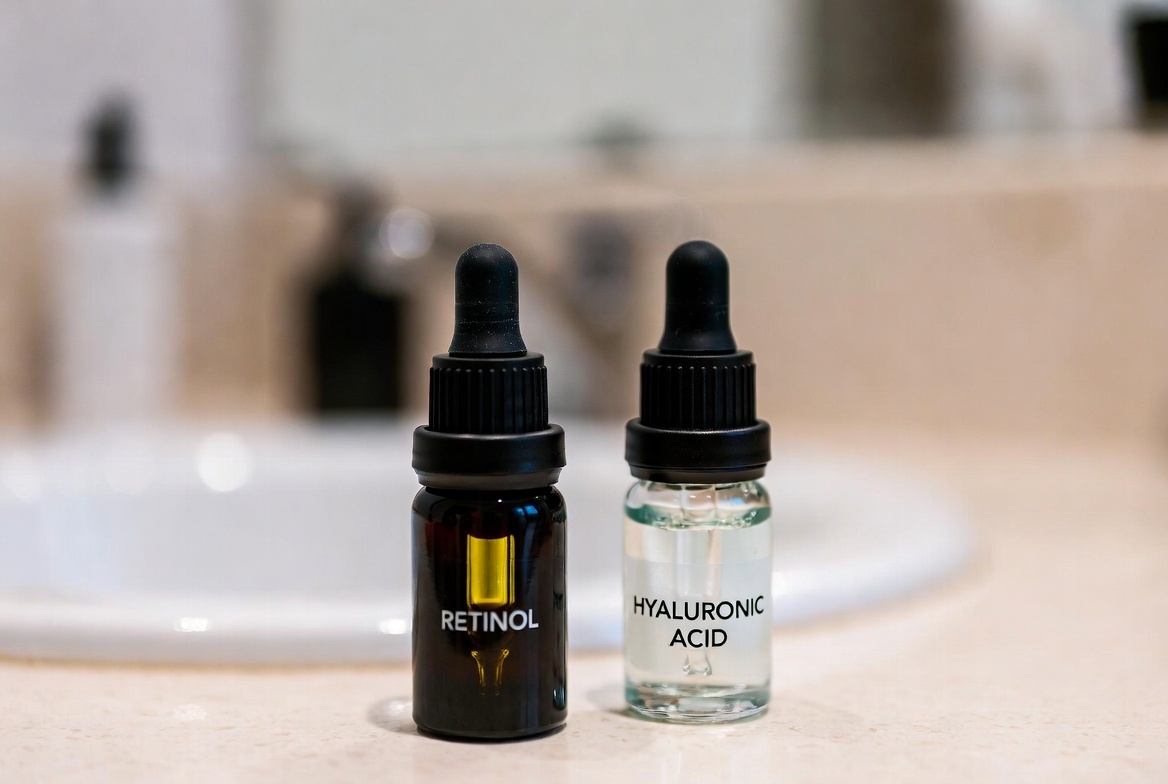
Hyaluronic acid is the ingredient where this stops being theoretical, because it ships in wildly different sizes under one name. Using Raman micro-imaging on human skin, researchers tracked hyaluronic acid of varying molecular weights and found that low-molecular-weight fractions between 20 and 300 kDa passed through the stratum corneum, while high-molecular-weight fractions of 1,000 to 1,400 kDa did not penetrate at all and remained on the surface [2].
Both versions are useful and they are not doing the same thing. The large fraction forms a hydrating film on top. The small fraction gets in. A bottle that says only “hyaluronic acid” has told you nothing about which one you bought, whether the label above it reads essence or serum. Our guide to hyaluronic acid goes deeper on the size question.
The Vehicle Beats the Percentage
Here is where the essence-versus-serum framing collapses entirely. The number on the front of a bottle describes what went into the formula, not what reaches your skin.
A 2025 review of solute, vehicle and skin interactions makes the point with a clinical example: a 0.05% clobetasol cream produced greater skin permeation than a 0.1% clobetasol propionate solution [3]. Half the concentration in a well-matched vehicle out-delivered double the concentration in a poorly matched one. The solvent system, the pH, the emulsifiers and the particle chemistry all sit between the active and the target, and any of them can waste the whole dose.
This is the single most useful idea to carry out of the category debate, and it applies just as much when you are choosing between a serum and a moisturizer.
It is also in-vitro data on cultured keratinocytes, which is a long way from a measured change in your face over 12 weeks.
What “Hydration” Means in a Watery Layer
Most essences are, functionally, humectant delivery. Glycerin usually leads the list, and the human evidence for it is better than its unglamorous reputation suggests. Comparing stratum corneum hydration across subjects, researchers found that hydration tracked more closely with the skin’s glycerol content than with sebum output, with glycerol arriving in the outer layers through both circulation and sebaceous turnover [4].
Underneath that sits natural moisturizing factor, the set of hygroscopic amino-acid derivatives packed inside corneocytes that holds water in place. Studies of soaking and washing show that depleting NMF measurably degrades how the stratum corneum handles water [5]. That is the mechanism a good essence is borrowing: it is topping up a hydration system your skin already runs, which is also the principle behind the skin flooding method.
Worth being precise about what that buys you. Hydration changes how skin looks and feels within hours. It does not change the dermis.
Is Fermented Filtrate Doing Anything?
Fermented ingredients are the essence category’s signature flourish, and Galactomyces ferment filtrate is the most common. It is more than folklore. In human keratinocytes, treatment with Galactomyces ferment filtrate consistently altered 99 genes across three separate production lots, upregulating the epidermal barrier and differentiation genes SPRR1A and SPRR1B along with the wound-healing gene SERPINB2 [6].
That is real, reproducible cell-level activity. It is also in-vitro data on cultured keratinocytes, which is a long way from a measured change in your face over 12 weeks. Interesting, not decisive.
A Test for Whether Your Essence Earns Its Step
Ask three questions. What is the highest-value ingredient above the preservative on the list, and does the serum you already own contain it? Does the texture actually let you layer, or does it pill under the next product? And when you skip it for two weeks, does anything change?
If the answer to all three is no, you own two versions of the same product and the order you apply them in is the only thing you have been optimizing.
The Part Neither Category Is Built For
Both essences and serums, at their best, are hydration and surface-support products. They plump the stratum corneum, smooth light-scattering, and make skin look better by the afternoon. What almost none of them do is rebuild the collagen and elastin scaffolding underneath, because that requires a molecule that reliably reaches living tissue in the dermis, and the 500-dalton problem is unforgiving about which molecules manage it.
Retinol manages it, and has the strongest evidence of any over-the-counter anti-aging active. Its historical limitation was the vehicle: conventional formulations use solvents that force passage by breaking down the skin barrier, which is what produces the burning and peeling.
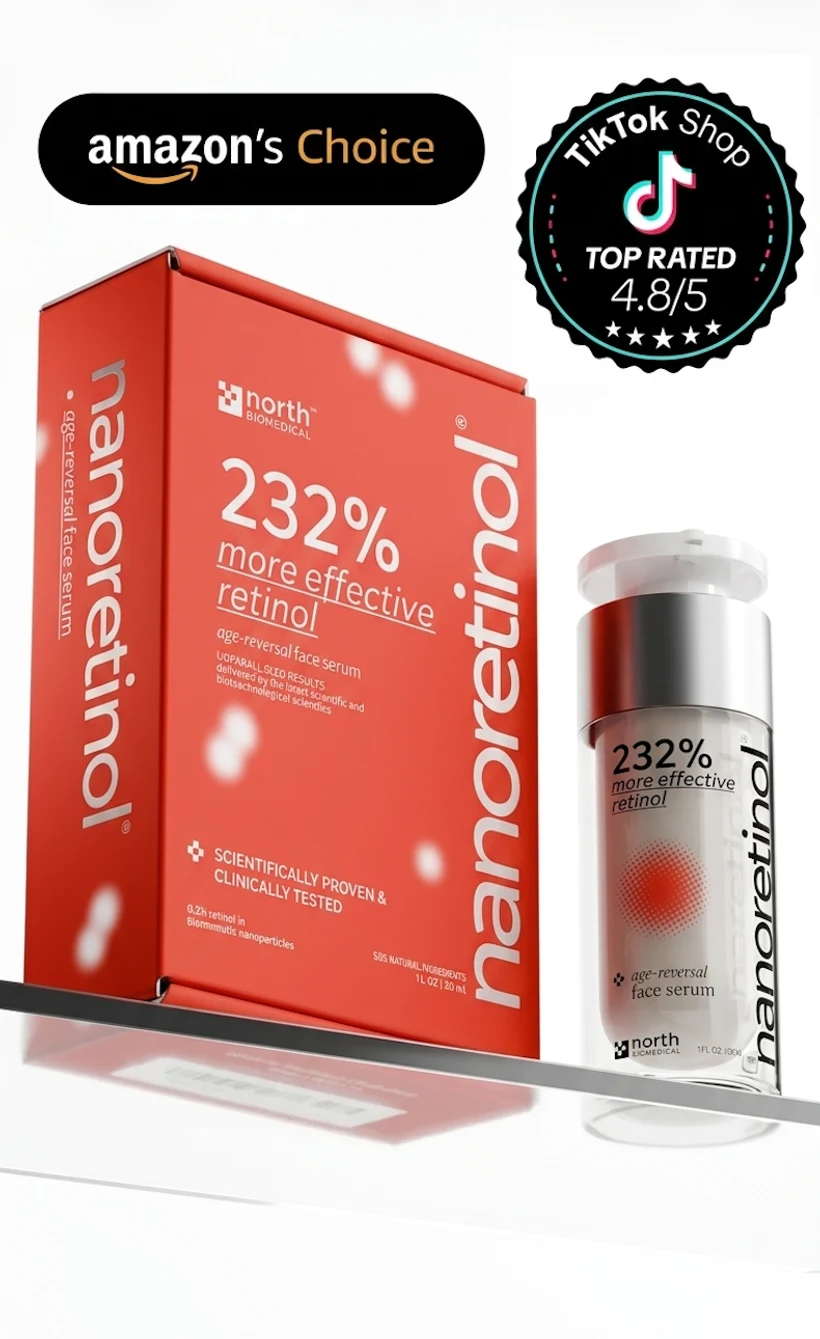
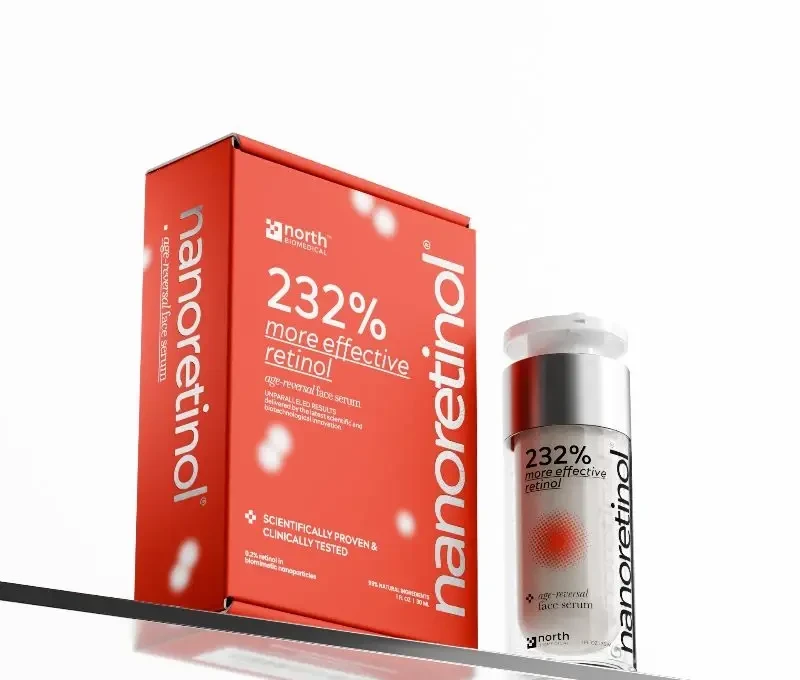
Nanoretinol was built around that exact delivery problem. Its retinol is encapsulated in biomimetic lipid nanoparticles that the skin recognizes as “self” and permits through the epithelial barrier intact, with no need to damage it first. In North Biomedical’s clinical study, that delivery route made the encapsulated form 232% more effective than conventional retinol in collagen recovery and 73% more effective in elastin recovery, with drastically reduced cytotoxicity. It is the vehicle argument from earlier in this article, taken to its conclusion: at 0.2%, delivered properly, it outperforms far higher concentrations that never arrive.
Choosing Between Them, Practically
Stop shopping the category and start reading the formula. If your skin runs dry or tight, a humectant-led watery layer under your moisturizer is a genuine upgrade and the word on the bottle is irrelevant. If it runs comfortable already, an essence is a pleasant ritual with a small ceiling. Either way, the product that changes your skin’s structure is the one you apply at night.
References
- Bos JD, Meinardi MM. “The 500 Dalton Rule for the Skin Penetration of Chemical Compounds and Drugs.” Experimental Dermatology. 2000;9(3):165-169. doi:10.1034/j.1600-0625.2000.009003165.x
- Essendoubi M, Gobinet C, Reynaud R, Angiboust JF, Manfait M, Piot O. “Human Skin Penetration of Hyaluronic Acid of Different Molecular Weights as Probed by Raman Spectroscopy.” Skin Research and Technology. 2016;22(1):55-62. doi:10.1111/srt.12228
- Tapfumaneyi P, Phan K, Huang Y, Sodsri K, Namjoshi S, Maibach H, Mohammed Y. “Solute-Vehicle-Skin Interactions and Their Contribution to Pharmacokinetics of Skin Delivery.” Pharmaceutics. 2025;17(6):764. doi:10.3390/pharmaceutics17060764
- Choi EH, Man MQ, Wang F, Zhang X, Brown BE, Feingold KR, Elias PM. “Is Endogenous Glycerol a Determinant of Stratum Corneum Hydration in Humans?” Journal of Investigative Dermatology. 2005;125(2):288-293. doi:10.1111/j.0022-202X.2005.23799.x
- Visscher MO, Tolia GT, Wickett RR, Hoath SB. “Effect of Soaking and Natural Moisturizing Factor on Stratum Corneum Water-Handling Properties.” Journal of Cosmetic Science. 2003;54(3):289-300. PMID: 12858228
- Nakajima A, Sakae N, Yan X, Hakozaki T, Zhao W, Laughlin T, Furue M. “Transcriptomic Analysis of Human Keratinocytes Treated with Galactomyces Ferment Filtrate, a Beneficial Cosmetic Ingredient.” Journal of Clinical Medicine. 2022;11(16):4645. doi:10.3390/jcm11164645