Best Serum for Microneedling: What to Apply When the Barrier Is Open
Needling turns an ordinary leave-on serum into something closer to an injection — which changes what belongs on your skin and when
There is a category error built into how microneedling serums are sold. They are marketed as accessories — a nice finishing step, a way to get more from your device. In reality the serum is not an accessory to the treatment. For several hours after a session, it is part of it, because the treatment has removed the barrier that normally decides how much of any product gets into you.
Once you see it that way, the question stops being “which serum is best” and becomes “what am I comfortable having delivered past my stratum corneum”, which is a much more useful question and has a much shorter list of acceptable answers.
The Treatment Is a Controlled Injury
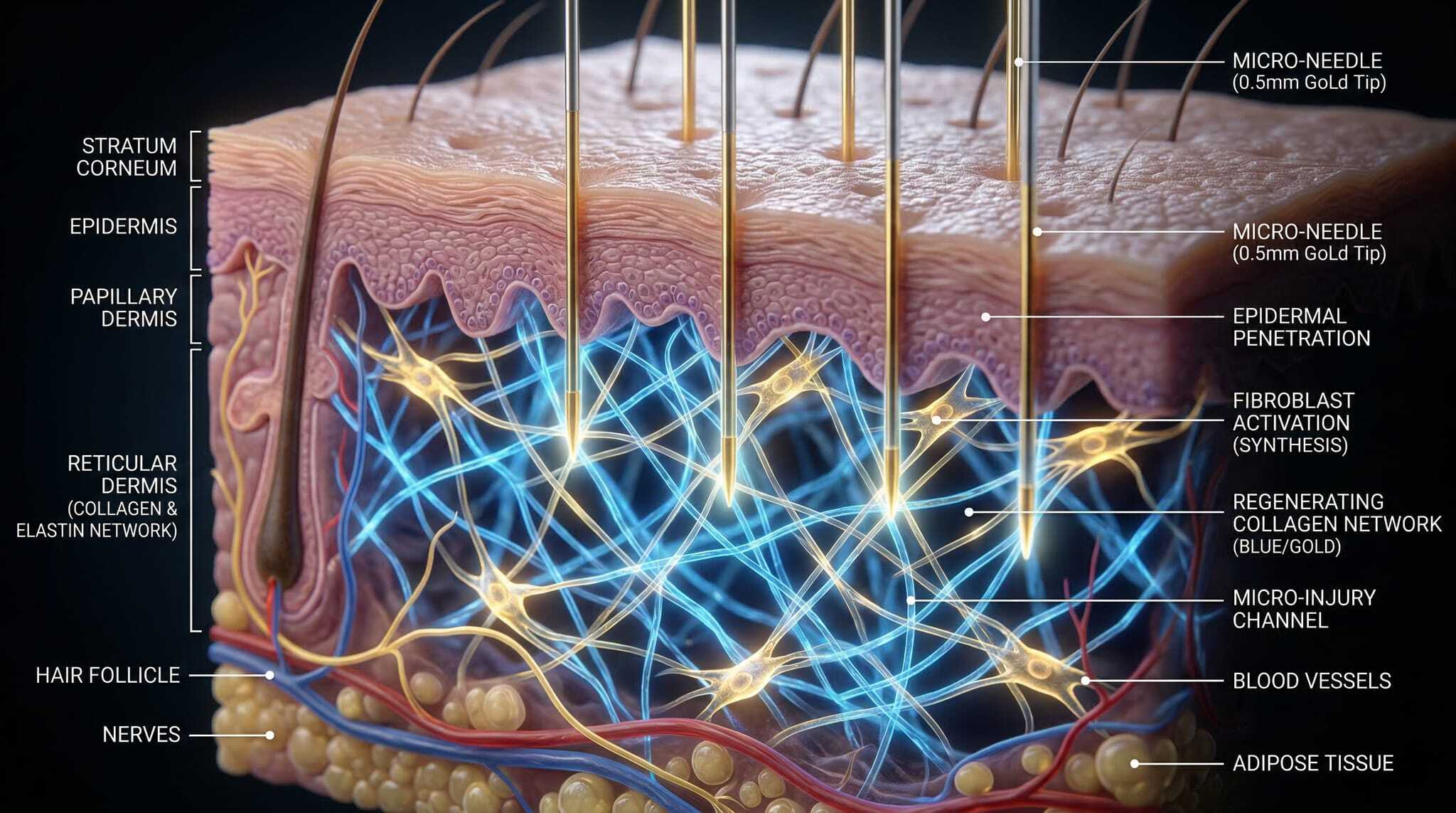
Microneedling — percutaneous collagen induction, in the literature — works by making thousands of tiny punctures that provoke a wound-healing response. The evidence that this remodels tissue is solid. In a retrospective series of 480 patients, histology at six months showed a considerable increase in collagen and elastin deposition, and at one year the epidermis showed 40% thickening of the stratum spinosum, with patients rating their overall improvement at 60% to 80% better [1].
That is the whole mechanism: you are not delivering collagen, you are asking the skin to build it. Our guide to microneedling benefits covers what the response can and cannot achieve, and radiofrequency microneedling covers the energy-assisted version.
The Channels Turn a Cosmetic Into a Dose
The second thing needling does is far less discussed in marketing copy. Microneedle arrays between 550 and 900 micrometres enhanced transdermal transport of compounds up to at least 72 kilodaltons across human skin — molecules vastly larger than anything intact skin admits [2]. In the same work, 300-micrometre needles failed to pierce the skin at all, which is a useful reality check on the shortest at-home rollers.
Seventy-two kilodaltons is not a cosmetic threshold. It is a pharmaceutical one. Your serum’s preservatives, emulsifiers, fragrance components and pH adjusters go along for the ride with the active you actually wanted.
Your serum’s preservatives, emulsifiers, fragrance and pH adjusters all go through the channels alongside the active you actually wanted.
How Long the Door Stays Open
The window is longer than most people assume, and it depends on what you do next. Without occlusion, microchannels resealed and barrier function recovered within about two hours. With occlusion — which is exactly what happens when you layer a cream or a mask over freshly needled skin — channels stayed open for anywhere from 3 to 40 hours depending on needle length and density [3].
So the decision is not only about the serum you apply during the session. It extends to whatever you put on top of it for the rest of the day, and to your normal evening routine that same night.
The Case Series That Should Change Your Shopping List
The clearest warning in this literature is a JAMA Dermatology report of three women who developed biopsy-confirmed foreign-body facial granulomas after a cosmetic product was applied during microneedling. Tissue cultures were sterile — this was not an infection — and two of the three patch-tested positive to the specific product used [4].
Read that carefully, because the implication is counterintuitive. These were not dangerous products. They were ordinary cosmetics behaving normally on intact skin and behaving like injected foreign material once the barrier was bypassed. A formula being safe in its intended use tells you nothing about its safety in this one.
These were ordinary cosmetics behaving normally on intact skin and behaving like injected foreign material once the barrier was bypassed.
Which rules out more of the shelf than people expect: anything fragranced, anything with a long excipient list, anything with botanical extracts of uncertain composition, anything whose pH sits well away from neutral, and anything not sold sterile or single-use if you can help it.
What the Evidence Supports Applying
The list of formulas with actual trial data behind them during a session is short, and that is a feature.
Hyaluronic acid, plain and simple. Not because it is glamorous, but because it is a single well-characterised molecule with no preservative burden worth worrying about, and it is the default in clinical practice for exactly that reason.
Platelet-rich plasma, where available. In a 27-patient split-face trial, microneedling with PRP produced an excellent response in 18.5% of patients against 7% for microneedling with vitamin C, and a lower poor-response rate of 22.2% against 37% [5]. A separate 24-patient trial across six sessions and twelve weeks found dermaroller combined with PRP significantly outperformed dermaroller alone, with the best dermal structural improvement on histology [6]. PRP is autologous — it is your own plasma — which neatly sidesteps the foreign-material problem.
Growth factor serums, with weaker evidence. A 30-patient case series using a microneedling device with a growth-factor serum reported physician-rated rejuvenation at 95% overall confidence within six weeks [7]. Suggestive rather than decisive.
Note what that first trial implies about vitamin C. It was the comparator, and it lost. Low-pH ascorbic acid during a session is a popular recommendation with no supporting evidence and an obvious mechanistic reason to expect stinging and inflammation instead.
A Timeline That Works
The week before. Pause retinoids, acids and scrubs for three to five days. You want an intact, calm barrier going in, not one already mid-turnover.
During the session. Plain hyaluronic acid or sterile saline as glide, or PRP if a clinician is providing it. Nothing else, and nothing fragranced.
The first 24 hours. Bland occlusive moisturiser only. Remember that occlusion is what extends the open window to as long as 40 hours [3], so this is not the moment for anything active. No makeup, no sunscreen on raw skin — stay out of the sun instead.
Days two to five. Resume gentle moisturising and sunscreen. Skip actives.
Day five onward. Reintroduce your actives, and this is where the real work happens. Microneedling is used clinically precisely because it boosts topical delivery [9], but the delivery you want long-term is the kind that happens through a healed barrier, not an open one. Topical retinoids remain the best-evidenced intervention for photoaged skin [8], and their contribution between sessions compounds with what the needling started. If you are needling at home rather than in a clinic, our at-home microneedling guide covers depth and frequency, and how to boost collagen production covers the broader picture the treatment plugs into.
Where a Gentler Retinol Changes the Routine
The between-sessions window is the part of a needling routine most people waste, and usually for a specific reason: conventional retinol is irritating enough that reintroducing it on skin still recovering from a session feels like a bad idea, so it gets postponed until the next session is already close. The irritation is not inherent to retinol. It comes from the delivery strategy — conventional formulations use solvents and petroleum derivatives that force the active across the barrier by destabilising its lipid structure, on skin whose barrier is the thing you are trying to rebuild.
Nanoretinol was engineered to avoid that trade-off. Its retinol sits inside biomimetic lipid nanoparticles the skin recognises as self and admits intact, so nothing has to be disrupted to get the active where it works. The measured results are 232% greater effectiveness in collagen recovery and 73% in elastin recovery than conventional retinol, with drastically reduced cytotoxicity in cellular assays, in a water-based 0.2% gel suitable for sensitive skin. For someone running a needling schedule, that combination is the difference between four productive weeks between sessions and four cautious ones — with the obvious caveat that it belongs on healed skin, not in the session itself.
The Short Version
Treat the serum as part of the procedure rather than a garnish on it. During a session, apply the least interesting thing you own: a single-molecule humectant, or your own plasma. Keep the fragranced, botanically complex, low-pH products for skin that has closed back up. Then put your effort into the fortnight afterwards, because the collagen the needling triggered is built over weeks, and what you apply on day ten matters more to the result than what you applied on day zero.
References
- Aust MC, Fernandes D, Kolokythas P, et al. “Percutaneous Collagen Induction Therapy: An Alternative Treatment for Scars, Wrinkles, and Skin Laxity.” Plastic and Reconstructive Surgery. 2008;121(4):1421-1429. doi:10.1097/01.prs.0000304612.72899.02
- Verbaan FJ, Bal SM, van den Berg DJ, et al. “Assembled Microneedle Arrays Enhance the Transport of Compounds Varying Over a Large Range of Molecular Weight Across Human Dermatomed Skin.” Journal of Controlled Release. 2007;117(2):238-245. doi:10.1016/j.jconrel.2006.11.009
- Gupta J, Gill HS, Andrews SN, et al. “Kinetics of Skin Resealing After Insertion of Microneedles in Human Subjects.” Journal of Controlled Release. 2011;154(2):148-155. doi:10.1016/j.jconrel.2011.05.021
- Soltani-Arabshahi R, Wong JW, Duffy KL, et al. “Facial Allergic Granulomatous Reaction and Systemic Hypersensitivity Associated With Microneedle Therapy for Skin Rejuvenation.” JAMA Dermatology. 2014;150(1):68-72. doi:10.1001/jamadermatol.2013.6955
- Chawla S. “Split Face Comparative Study of Microneedling With PRP Versus Microneedling With Vitamin C in Treating Atrophic Post Acne Scars.” Journal of Cutaneous and Aesthetic Surgery. 2014;7(4):209-212. doi:10.4103/0974-2077.150742
- El-Domyati M, Abdel-Wahab H, Hossam A. “Combining Microneedling With Other Minimally Invasive Procedures for Facial Rejuvenation: A Split-Face Comparative Study.” International Journal of Dermatology. 2018;57(11):1324-1334. doi:10.1111/ijd.14172
- Samizadeh S, Belhaouari L. “Effectiveness of Growth Factor-Induced Therapy for Skin Rejuvenation: A Case Series.” Journal of Cosmetic Dermatology. 2021;20(6):1867-1874. doi:10.1111/jocd.13750
- Mukherjee S, Date A, Patravale V, et al. “Retinoids in the Treatment of Skin Aging: An Overview of Clinical Efficacy and Safety.” Clinical Interventions in Aging. 2006;1(4):327-348. doi:10.2147/ciia.2006.1.4.327
- Iriarte C, Awosika O, Rengifo-Pardo M, et al. “Review of Applications of Microneedling in Dermatology.” Clinical, Cosmetic and Investigational Dermatology. 2017;10:289-298. doi:10.2147/CCID.S142450