How to Apply Eye Cream: Where It Goes, How Much, and Why It Matters
The orbital rim, the 2 mm rule, and what the migration data says about getting product too close
Most eye cream advice stops at “dab gently with your ring finger,” which tells you nothing about the two decisions that actually change the outcome: how close to the lash line the product lands, and how much of it you use. Both have been measured, and the numbers are more useful than the ritual.
The skin you are treating is the thinnest and most permeable on the face, it sits directly against a mucous membrane, and it moves roughly 15,000 times a day. That combination is why technique here matters more than anywhere else in a routine.
The Skin You Are Working On
Facial skin is structurally different from the rest of the body, and periorbital skin is the extreme case. The stratum corneum of the face is thinner and built from fewer corneocyte layers than skin elsewhere, with correspondingly higher transepidermal water loss and weaker barrier function measured instrumentally [1]. Skin thickness, hydration and sebum all vary systematically by body region, so a formula that behaves well on a cheek does not necessarily behave well 3 cm higher [2].
Permeability follows the same pattern. The classic regional absorption work using labeled cortisol found penetration varied by more than an order of magnitude between sites on the same person, with thin, sparsely keratinized areas at the top of the range [3]. Applied to the eye area, that cuts both ways: actives get in more readily, and so does anything irritating.
The eye area absorbs more of whatever you put on it, which makes it the one place where dose and placement matter more than the product.
The Orbital Rim Is Your Boundary
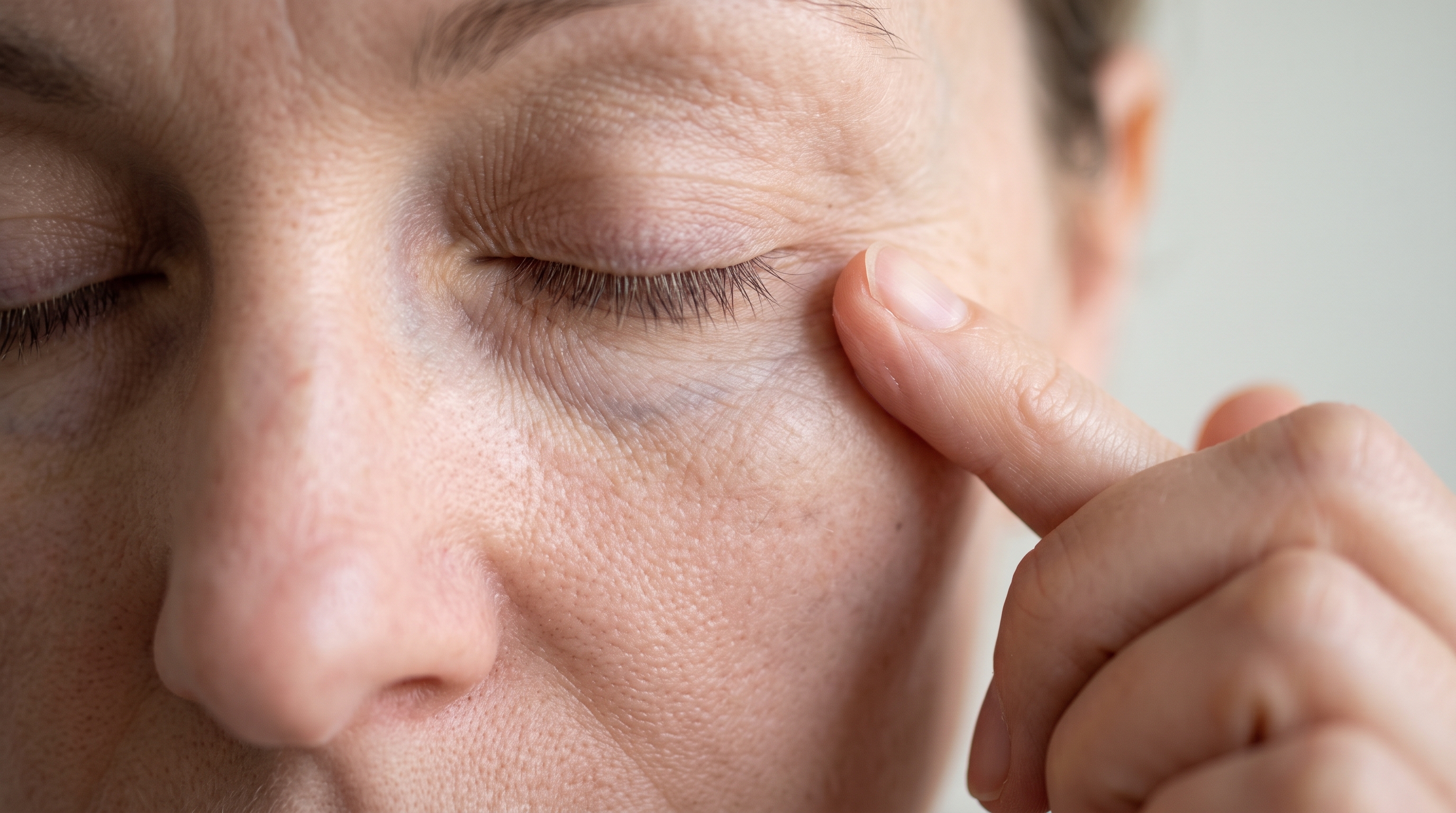
Run a fingertip below your lower lashes until you feel the bony ridge of the eye socket. That ridge, the orbital rim, is the landmark worth using. Product placed on or just outside it sits on skin that is anchored to bone, and it has somewhere to go besides the eye.
Placement on the orbital rim rather than the soft tissue immediately under the lashes is the single change that prevents most stinging, watering and morning puffiness complaints. The cream migrates inward as it settles and as you blink, which means the rim is a starting position rather than a limit.
How Close Is Too Close
This has been quantified precisely. In a study of 75 volunteers, a fluorescein-tagged cosmetic gel was applied in one of three positions and the ocular surface was then examined with a slit lamp. Applied along the inner lash line and eyelid margin, the product reached the ocular surface in 96% of eyes within 5 minutes. Applied close to but not touching the lash line, 20%. Applied about 2 mm outside the lash line, 12% [4].
At 30 minutes, the at-the-lash-line group had climbed to 60%, and instilling an eye drop afterward significantly increased contamination in both of the outer groups. A review of eye cosmetics and the tear film reached the same conclusion across multiple prospective studies: application at the inner lash line produces more tear film contamination and more ocular discomfort than application on the outer periocular skin [5].
Moving your eye cream 2 mm further from the lash line drops the chance of it reaching your eye from 96% to 12%.
Two millimeters is roughly the width of the pencil line you would draw with a sharp eyeliner. That is the whole margin between a product working on your skin and a product sitting on your cornea.
How Much: The Dose Nobody Measures
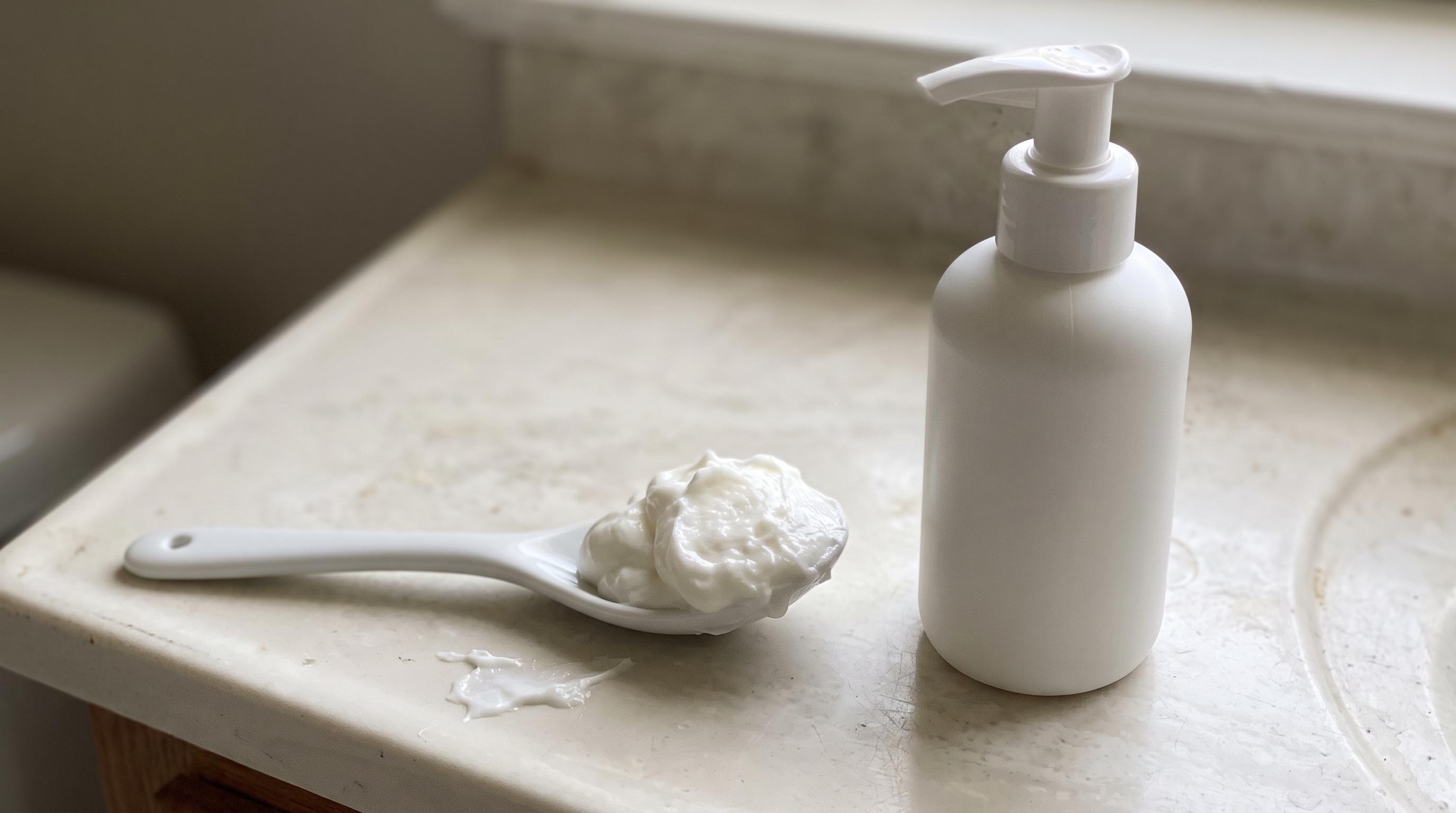
Excess product has nowhere to go except into the eye or into the fine creases where it pills under concealer. A volume about the size of a grain of rice per eye is enough for a cream to cover the orbital rim, outer corner and upper lid without a visible film, and an actual retinoid in the same area needs less than that. If your under-eye area looks shiny 10 minutes later, you used more than the skin could take.
Under-dosing is rarer but real: a thin smear confined to the outer corner leaves the inner tear trough, where most crepiness shows, untreated. Cover the whole arc from the outer corner along the rim to below the inner corner.
Tap, Don’t Drag
The mechanical argument for tapping is straightforward. Dragging a fingertip across skin this thin displaces tissue that has very little dermal collagen to resist it, and it pushes product toward the lash line, which is exactly where the migration data says you do not want it. Short, light taps deposit product without lateral force and let it warm and spread on its own.
Use whichever finger applies the least pressure. The ring finger is conventional because it is the weakest, not because there is anything special about it.
Which Direction to Work
Standard advice says to sweep from the inner corner outward to follow lymphatic drainage. Lymphoscintigraphy of the human eyelid supports the outward direction for a different reason than usually given: in 72% of cases the first-order sentinel node was the preauricular node, near the front of the ear, regardless of which part of the eyelid was injected [6].
So drainage from the whole eyelid runs laterally toward the temple in most people. Working outward is consistent with that, and it also moves product away from the eye rather than toward it. Both arguments point the same way, which is a convenient result.
Where It Sits in the Routine
Eye cream goes on after water-based serums and before or alongside face moisturizer, on skin that is still slightly damp. Occlusive moisturizer applied first forms a barrier film that slows what follows it, which is the basic mechanism behind layering thin to thick [8]. If you use a separate eye serum, that goes under the cream, a distinction we cover in eye serum versus eye cream.
At night, apply eye products at least 20 minutes before lying down. Horizontal is when migration and morning puffiness happen.
Does Technique Change Results?
It changes tolerability, which changes adherence, which is what changes results. The largest controlled periorbital wrinkle study to date ran 196 women for 8 weeks comparing a cosmetic niacinamide, peptide and retinyl propionate regimen against prescription 0.02% tretinoin, and product tolerance was an explicit endpoint alongside wrinkle grading [7]. Studies in this area treat irritation as part of the efficacy question, because the person who stings every night stops applying.
When the Active Matters More Than the Method
Technique gets an active to the right place. What it cannot do is make a poorly delivered retinoid tolerable on eyelid skin, which is the reason so many people own an eye cream they use twice a week. Retinoids remain the best-evidenced topical for periorbital lines, and the constraint has always been getting them in without inflaming skin this thin.
Nanoretinol addresses the delivery step instead of the dose, carrying 0.2% retinol inside biomimetic lipid nanoparticles that the skin reads as its own material and admits without the epithelial barrier being broken down. It is water-based, absorbs to a matte finish, and is formulated to be safe for the eye contour. In North Biomedical’s clinical study summary, Nanoretinol vs. Conventional Retinol: Efficacy in Collagen and Elastin Recovery (2024), it produced 232% greater collagen recovery and 73% greater elastin recovery than conventional retinol, with drastically reduced cytotoxicity in cellular assays. For the fine lines under the eyes that technique alone never fixes, and for anyone who has given up on retinol around the eyes, that is the variable worth changing.
Getting It Right Tonight
Find the orbital rim with a fingertip. Place a rice-grain of product along it, 2 mm clear of the lashes. Tap outward toward the temple, never drag. Wait before lying down. Then judge the product on 12 weeks of consistent use rather than on how it felt the first night, and if it stings at the correct distance from your lash line, the formula is the problem and not your technique. Our guide to eye creams for wrinkles covers what to look for on the label.
References
- Tagami H. “Location-related differences in structure and function of the stratum corneum with special emphasis on those of the facial skin.” International Journal of Cosmetic Science. 2008;30(6):413-434. doi:10.1111/j.1468-2494.2008.00459.x
- Firooz A, Sadr B, Babakoohi S, Sarraf-Yazdy M, Fanian F, Kazerouni-Timsar A, Nassiri-Kashani M, Naghizadeh MM, Dowlati Y. “Variation of biophysical parameters of the skin with age, gender, and body region.” The Scientific World Journal. 2012;2012:386936. doi:10.1100/2012/386936
- Feldmann RJ, Maibach HI. “Regional variation in percutaneous penetration of 14C cortisol in man.” Journal of Investigative Dermatology. 1967;48(2):181-183. doi:10.1038/jid.1967.29
- Goto T, Zheng X, Gibbon L, Ohashi Y. “Cosmetic product migration onto the ocular surface: exacerbation of migration after eyedrop instillation.” Cornea. 2010;29(4):400-403. doi:10.1097/ICO.0b013e3181bd4756
- Wang MTM, Craig JP. “Investigating the effect of eye cosmetics on the tear film: current insights.” Clinical Optometry. 2018;10:33-40. doi:10.2147/OPTO.S150926
- Nijhawan N, Marriott C, Harvey JT. “Lymphatic drainage patterns of the human eyelid: assessed by lymphoscintigraphy.” Ophthalmic Plastic and Reconstructive Surgery. 2010;26(4):281-285. doi:10.1097/IOP.0b013e3181c32e57
- Fu JJ, Hillebrand GG, Raleigh P, Li J, Marmor MJ, Bertucci V, Grimes PE, Mandy SH, Perez MI, Weinkle SH, Kaczvinsky JR. “A randomized, controlled comparative study of the wrinkle reduction benefits of a cosmetic niacinamide/peptide/retinyl propionate product regimen vs. a prescription 0.02% tretinoin product regimen.” British Journal of Dermatology. 2010;162(3):647-654. doi:10.1111/j.1365-2133.2009.09436.x
- Draelos ZD. “The science behind skin care: moisturizers.” Journal of Cosmetic Dermatology. 2018;17(2):138-144. doi:10.1111/jocd.12490