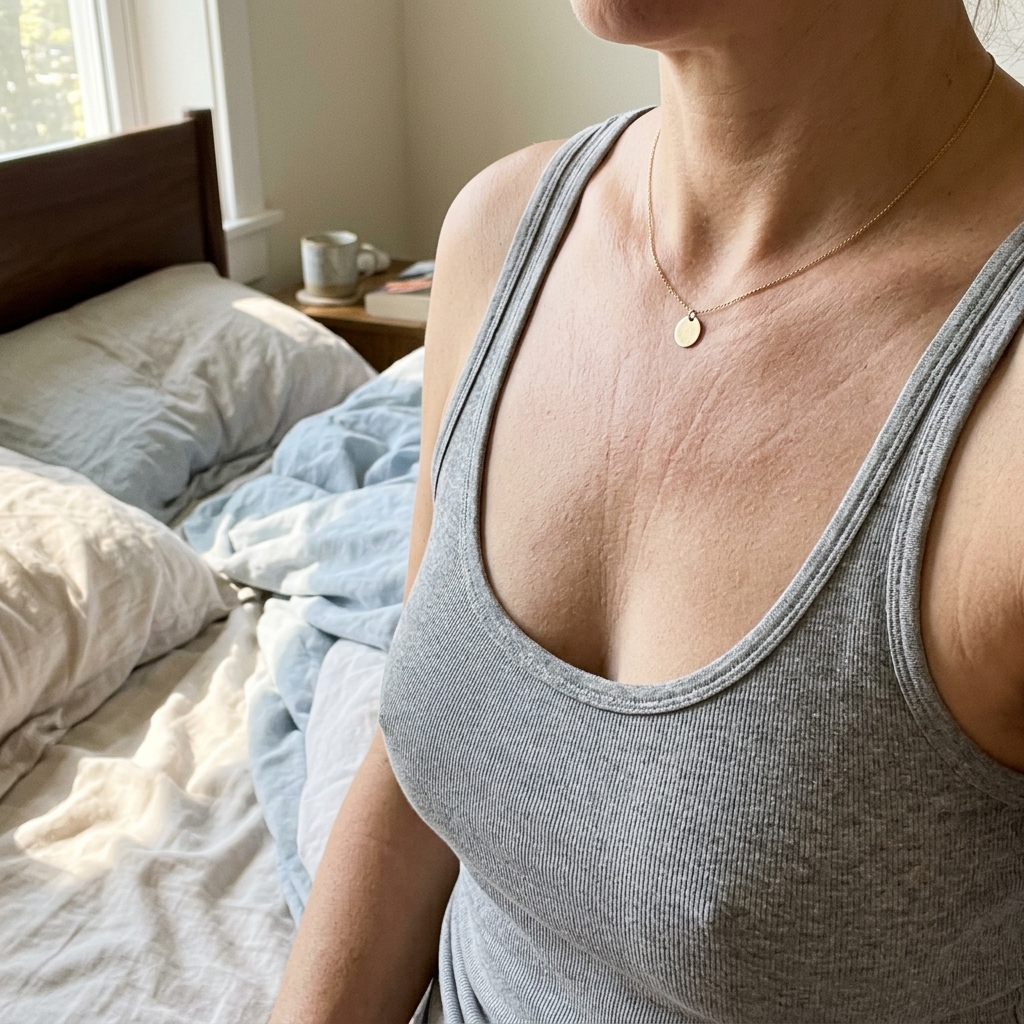
Chest Wrinkles: Why Your Décolletage Ages Faster and What Actually Helps
The skin on your chest gets more UV exposure than almost any other part of your body — and most people don't start treating it until the damage is already visible
The Body Part Skincare Routines Almost Always Skip
Ask someone to describe their anti-aging skincare routine and you’ll hear about serums, eye creams, SPF — almost always stopping at the jawline. The chest is an afterthought at best. This habit has a predictable cost: the décolletage often shows aging several years ahead of the face, developing lines, crepey texture, and deep horizontal wrinkles that are harder to address once they appear than the fine lines most people focus on.
Understanding why the chest ages differently — and what actually addresses it — starts with the biology of the skin below the collarbone.
Why Décolletage Skin Ages Differently
Fewer sebaceous glands. The chest has significantly fewer oil-producing glands than the face. This means the skin naturally lacks the lipid layer that helps facial skin stay hydrated and protected. Drier skin has a lower threshold for showing lines and loses elasticity faster.
Chronic, cumulative UV exposure. Open necklines, swimwear, and clothing choices expose the chest to decades of UV accumulation. Unlike the arms or legs — often covered for much of the year — the décolletage receives relatively consistent sun exposure across seasons for most people. This chronic damage adds up in ways that become visible from the forties onward.
Sleep position. Side sleeping compresses the chest skin for six to eight hours each night, creating lateral pressure folds that, over years, become permanent creases. This mechanism is entirely distinct from expression lines or sun damage — it’s mechanical compression folding the skin repeatedly over thousands of hours. The same mechanism runs on the face, where the fabric question gets asked most often, and the evidence on silk pillowcases for wrinkles is more mixed than the category implies.
Thinner skin with fewer regenerative resources. The dermis of the chest shares structural similarities with facial skin but without the same density of fibroblasts and sebaceous activity that support the face’s ability to regenerate.
What Is Actually Happening in the Skin
The core mechanism of chest skin aging — like all photoaging — is collagen degradation combined with impaired collagen production.
Solar UV radiation reduces type I procollagen synthesis (the primary structural protein in the dermis) by blocking the transforming growth factor-beta type II receptor/Smad signaling pathway [1]. At the same time, UV activates matrix metalloproteinases (MMPs) — enzymes that actively break down existing collagen and elastin fibers. The result is a skin structure that is producing less collagen while degrading more of what it has, a process that accelerates with each decade of unprotected sun exposure.
In sun-exposed skin, measurable collagen loss begins in the third decade of life, with clinically visible differences between protected and unprotected skin sites becoming apparent by the forties and deepening through each subsequent decade [2]. The chest reflects this trajectory with particular clarity because it receives the chronic exposure but rarely the skincare attention.
Ask someone to describe their anti-aging skincare routine and you’ll hear about serums, eye creams, SPF — almost always stopping at the jawline.
What Doesn’t Work
It helps to clear the air on approaches that have little evidence behind them:
Silicone chest patches. Anti-wrinkle décolletage patches (silicone or textile) create hydration occlusion overnight and may temporarily reduce the appearance of lines by preventing moisture loss during sleep. They don’t stimulate collagen, improve skin structure, or reverse photoaging. They’re a topical hydration tool — useful for comfort, not structural improvement.
Firming creams without validated actives. Moisturizers marketed for the décolletage with vague “firming” or “lifting” language typically contain emollients and peptides that provide hydration and mild surface benefits. Without retinoids or other clinically validated ingredients, they don’t address the collagen and elastin loss driving structural wrinkles.
Occasional use. Whatever you apply, single or infrequent use produces no lasting structural change. Collagen-stimulating actives require consistent use over weeks before their histological effects appear.
What the Clinical Evidence Supports
Sunscreen — First and Non-Negotiable
If there is a single intervention with the most evidence for preventing photoaging, it is broad-spectrum SPF applied consistently. For the chest specifically, consistent sun protection is especially high-leverage because cumulative UV damage is the dominant cause of décolletage aging. Every application prevents further collagen degradation. Our article on sunscreen for aging skin covers the full mechanism if you want the science on why SPF outperforms every other anti-aging investment.
Retinoids — The Evidence-Backed Active
The clinical evidence for retinoids in reversing photoaging — including on the chest and neck — is robust. Retinoids work by binding to nuclear retinoic acid receptors that regulate collagen synthesis, inhibit MMP activity, and accelerate keratinocyte turnover [3]. In clinical terms: they stimulate new collagen, slow the enzymatic destruction of existing collagen, and improve surface texture simultaneously.
A one-year double-blind, vehicle-controlled trial using topical stabilized retinol found continued improvement in photodamage markers over 12 months, with measurable reductions in wrinkling, improved skin texture, and increased collagen density in treated skin [4]. Benefits accumulated over time — short-term results were modest, but the annual picture was clinically meaningful.
Studies specifically applying retinoids to the neck and chest have documented improvements over 8–12 weeks of regular use. The same collagen-stimulating and cell-renewal mechanisms that reduce facial wrinkles operate identically on décolletage skin.
Studies specifically applying retinoids to the neck and chest have documented improvements over 8–12 weeks of regular use.
Building a Décolletage Skincare Routine
A practical approach follows directly from the evidence:
Morning: Broad-spectrum SPF 30 or higher applied generously to the chest and neck. Most people apply this to the face and stop at the chin. Extending SPF downward costs thirty seconds and prevents the damage that drives the problem in the first place.
Evening: After cleansing, apply retinol to the chest using the same routine as the face. This is the single most common omission in skincare routines — people who use retinol stop at the jawline, leaving the décolletage untreated.
Hydration: A ceramide-based moisturizer supports the skin barrier and reduces the dryness that makes lines appear more prominent on chest skin.
If you’re beginning retinoid use on the chest, start at lower frequency — two to three nights per week — and increase gradually. Chest skin is often unaccustomed to active ingredient application and may need time to build tolerance.
For the similar aging mechanisms affecting the neck, our breakdown of turkey neck treatment covers the overlapping causes and approach for that adjacent area.
The Formulation Consideration
Conventional retinol formulations were designed primarily with facial skin in mind. They work by using vehicles that disrupt the skin barrier to force the ingredient through — a process that produces the stinging, peeling, and redness that cause many people to discontinue use before collagen benefits appear.
Nanoretinol uses lipid nanoparticle encapsulation to bypass this problem. The nanoparticles are biomimetic — structurally recognized as “self” by skin cells — allowing passive transport through the epithelial barrier without disrupting it. Retinol is released at depth, near the fibroblasts and keratinocytes where its mechanisms actually operate, rather than sitting largely at the surface as conventional formulations do.
In clinical testing, Nanoretinol produced 232% greater collagen recovery than conventional retinol and a 61% improvement in skin firmness within 56 days — while generating significantly fewer side effects. For skin that has been undertreated for years, the collagen-recovery response tends to be pronounced.
The Timeline
Chest wrinkles don’t reverse quickly. The structural damage from years of UV exposure requires consistent active ingredient use over months to meaningfully address. But the skin’s capacity to produce new collagen — stimulated by retinoids — remains active well into older adulthood, and clinical improvement in photoaged skin from consistent retinol use typically appears within 12 weeks and continues to build over a full year [4].
The most common mistake is starting late and expecting fast results, or applying the right products only to the face while leaving the chest untreated. Starting now — with daily SPF and consistent evening retinoid application extended to the chest — produces results. Waiting adds to the damage load that makes those results harder to achieve.
References
-
Quan T, He T, Kang S, Voorhees JJ, Fisher GJ. “Solar ultraviolet irradiation reduces collagen in photoaged human skin by blocking transforming growth factor-beta type II receptor/Smad signaling.” American Journal of Pathology. 2004;165(3):741-51. doi:10.1016/S0002-9440(10)63337-8
-
Uitto J. “The role of elastin and collagen in cutaneous aging: intrinsic aging versus photoexposure.” Journal of Drugs in Dermatology. 2008;7(2 Suppl):s12-6. PMID:18404866
-
Mukherjee S, Date A, Patravale V, Korting HC, Roeder A, Weindl G. “Retinoids in the treatment of skin aging: an overview of clinical efficacy and safety.” Clinical Interventions in Aging. 2006;1(4):327-348. doi:10.2147/ciia.2006.1.4.327
-
Randhawa M, Rossetti D, Leyden JJ, Fantasia J, Zeichner J, Cula GO, Southall M, Tucker-Samaras S. “One-year topical stabilized retinol treatment improves photodamaged skin in a double-blind, vehicle-controlled trial.” Journal of Drugs in Dermatology. 2015;14(3):271-280. PMID:25738849